Feng Shui amulets and Taoist talismans: Chinese symbols to wear
Discover a collection of Feng Shui amulets, Taoist talismans, and pendants inspired by ancient Chinese traditions. Protective dragons, Pixiu associated with prosperity, Bagua, Luo Pan, ritual bells, guardian lions, and figures from Taoist mythology make up a universe where symbolism, craftsmanship, and natural stones meet.
Designed to be worn close to the body or kept as personal items, these pieces incorporate shapes, characters, and emblems passed down through religious art, popular Chinese culture, and traditional Feng Shui practices. Each has its own language: some evoke protection, others balance, vigilance, courage, prosperity, or the harmonious circulation of Qi.
The Obsidian Dragons collection brings together Feng Shui jewelry and Chinese amulets selected for the quality of their craftsmanship, the richness of their iconography, and the authenticity of their materials. Jade, obsidian, rock crystal, turquoise, Nan Hong agate, labradorite, and 925 silver give these talismans a material presence that matches their symbolic depth.
What is a Feng Shui amulet?
Feng Shui is a traditional Chinese art dedicated to the observation and organization of relationships between human beings, their environment, and the movements of Qi. It particularly studies orientations, forms, the five elements, Yin and Yang, as well as how a place can promote a sense of balance and coherence.
A Feng Shui amulet translates some of these principles into a personal object. It may combine Bagua trigrams, auspicious animals, astrological signs, auspicious characters, or materials to which Chinese culture attributes special value. Worn as a pendant, kept in a pocket, or placed in a chosen space, it becomes a tangible reminder of the intention its owner wishes to cultivate.
Feng Shui and Taoism are not strictly interchangeable. The former primarily concerns the harmonization of space and environmental influences, while Taoism constitutes a much broader philosophical, religious, and ritual tradition. However, they share part of the Chinese cosmological vocabulary: Qi, Yin and Yang, the five phases, the trigrams, and the idea of a harmony to be sought between human beings and the transformations of the world. It is in this meeting point that many traditional Chinese talismans are found.
What is a Taoist talisman?
In Taoist traditions, talismans can take many different forms: inscribed papers, seals, medallions, coins, pendants, bells, or ritual objects. Some bear sigil characters, cosmological diagrams, or representations of protective deities. Their historical function depends on the context, the school, and the ritual to which they belong.
The jewelry in this collection is inspired by this visual and symbolic heritage. They do not replace religious consecration or the guidance of a qualified master. However, they allow one to wear a chosen symbol, maintain a connection with Chinese thought, or integrate a meaningful handcrafted object into daily life.
This distinction is important: the authenticity of an amulet does not rest on a promise of supernatural results. It is recognized in the accuracy of its iconography, the quality of its materials, the precision of its craftsmanship, and the transparency with which its origin and symbolism are presented.
The main symbols of our Feng Shui amulets
🐉 The Chinese dragon: authority, movement, and power of Qi
The dragon occupies a central place in Chinese cosmology, art, and imagination. Unlike the Western dragon often associated with chaos, the Asian dragon is linked to water, clouds, rain, renewal, and celestial authority. In Feng Shui, it evokes an ascending, creative, and protective energy.
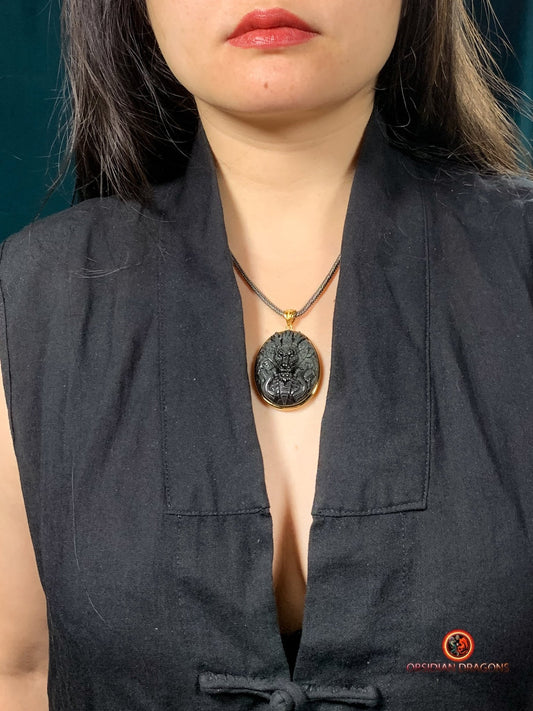
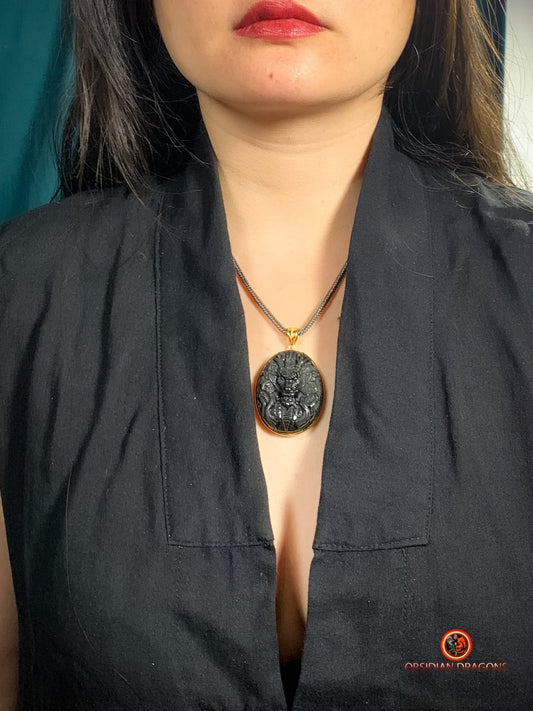
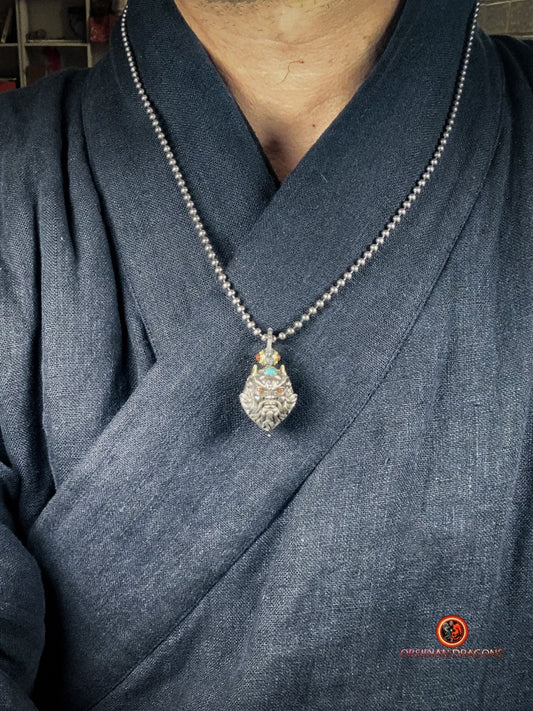
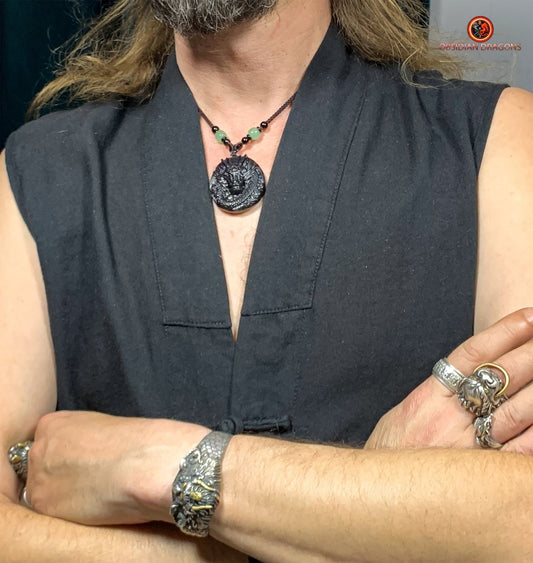
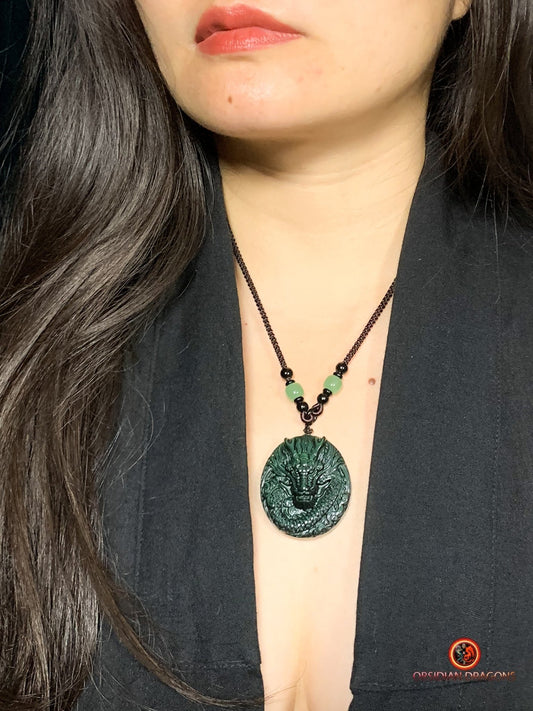
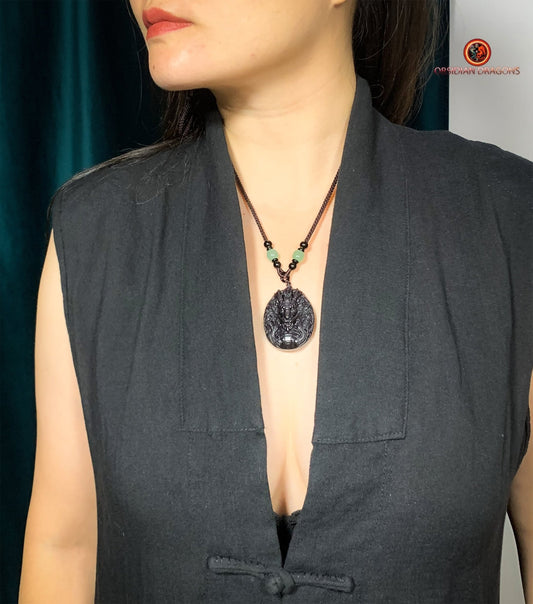
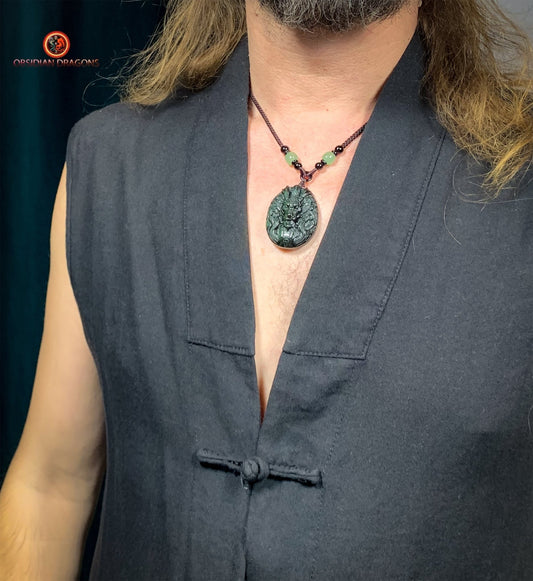
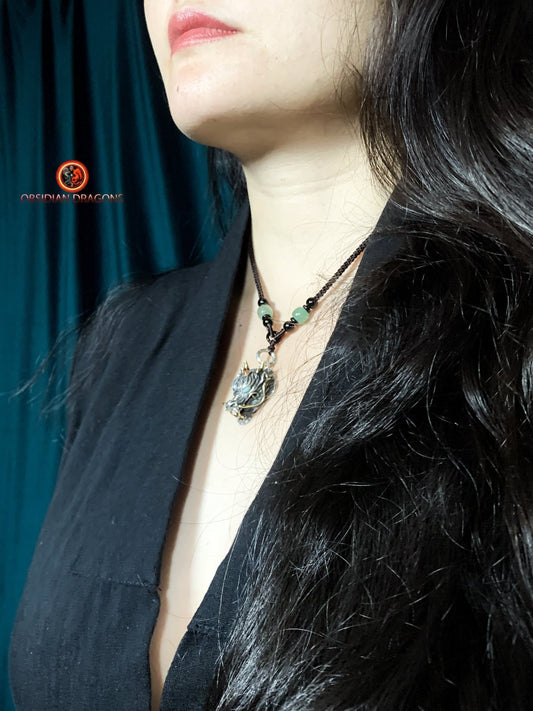
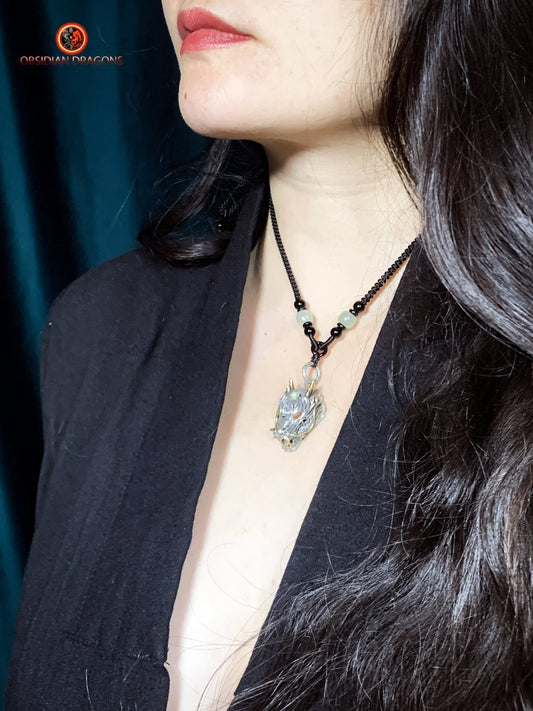
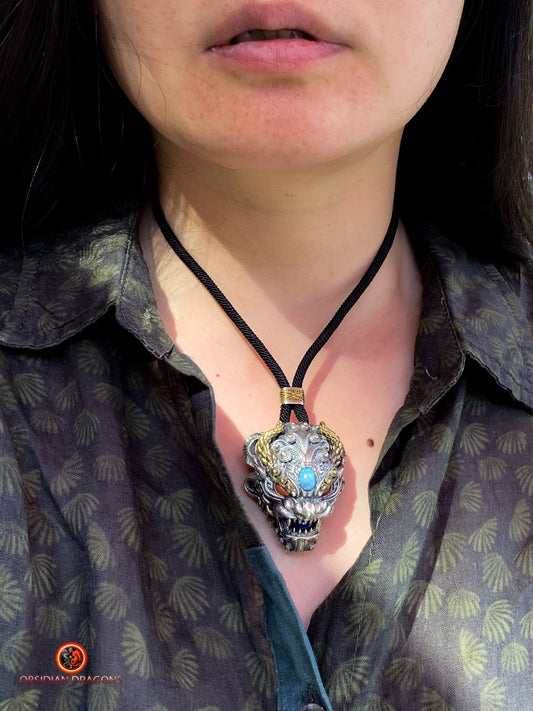
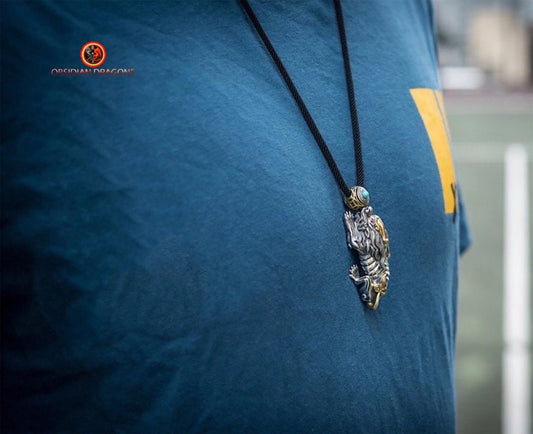
The Feng Shui dragon pendants in the collection take the form of miniature sculptures in silver, jade, obsidian, or rock crystal. Some surround a pearl, a bell, or a natural stone; others reveal details inspired by imperial dragons and guardian creatures of Chinese architecture. Wearing a dragon can symbolize determination, the ability to transform, and the will to move forward with strength without losing discernment.
👉 To delve deeper into this major figure,
discover our article on the dragon in Feng Shui practice by clicking on the following link: 📎 The dragon in Feng Shui - Strength and energy
or this other article detailing the nine sons of the dragon available via this other link: 📎 The 9 sons of the dragon - Origin, history, and symbolism
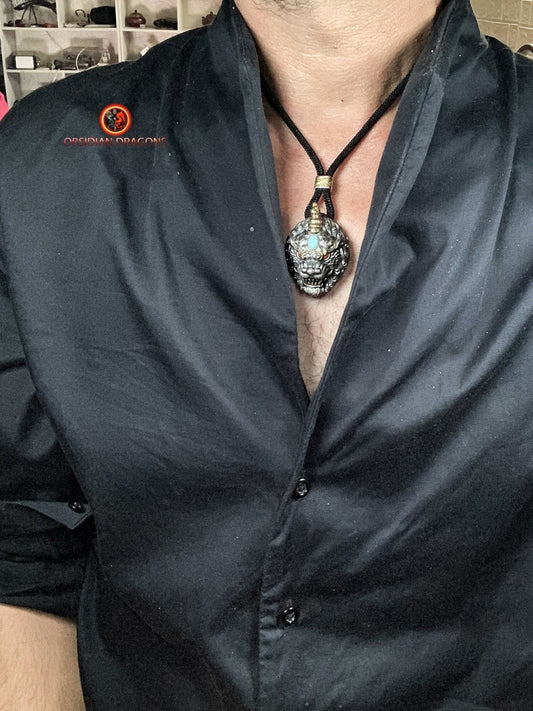
🦁 The Pixiu: guardian of prosperity
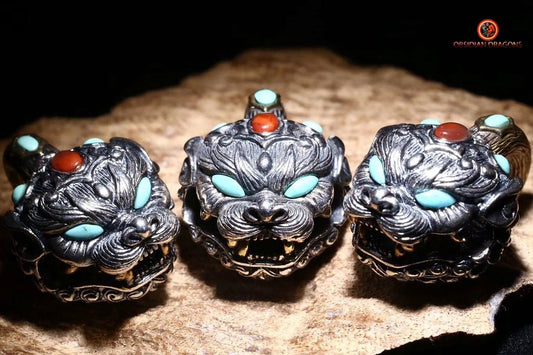
The Pixiu, sometimes spelled Pi Xiu, is an auspicious creature from Chinese mythology. Its appearance generally combines traits of dragons, lions, and other powerful animals. Popular tradition associates it with guarding treasures, prosperity, and protecting already acquired wealth.
A Pixiu amulet can be carved from jade, obsidian, or another natural stone, then mounted as a pendant or set in silver. The quality of the carving is essential: posture, horns, mouth, wings, and expression all contribute to the creature's character. Beyond its association with fortune, the Pixiu also evokes vigilance and the ability to protect what has been built with patience.
Our Pixiu talismans are distinguished by their natural materials and a careful selection of volumes, color, and fineness of workmanship. They appeal to both Feng Shui enthusiasts and collectors of miniature Chinese sculptures.
👉 For more information on the Pixiu
Consult our dedicated article by clicking on the following link: 📎 Who is Pixiu? Symbolism and use in Feng Shui
☯️ The Bagua and the Luo Pan: a representation of cosmic order
The Bagua gathers the eight trigrams formed by Yin and Yang lines. Each is associated with a natural dynamic: Heaven, Earth, Thunder, Wind, Water, Fire, Mountain, and Lake. Together, they offer a symbolic grid for understanding transformations, orientations, and relationships between phenomena.
The Luo Pan is the traditional compass used in the study of Feng Shui. Its rings can combine directions, trigrams, earthly branches, Chinese zodiac signs, and other systems of correspondences. When a Bagua Luo Pan is miniaturized on an amulet, it becomes a condensed image of the cosmos and its cycles.
Our Bagua and Luo Pan pendants are engraved on several levels to preserve the legibility of this symbolic architecture. Some models combine these Chinese elements with a Dorje or a Buddhist figure, testifying to the historical and artistic exchanges between Chinese and Tibetan traditions. These pieces are particularly suitable for people attracted by cosmogony, the I Ching, the eight trigrams, and the principles of Feng Shui balance.
🔔 Taoist bells: sound as a symbol of purification
In many Asian traditions, sound marks passage, attracts attention, and defines ritual space. Bells and gongs also appear in certain Taoist practices, where their vibration accompanies ceremonies and the symbolic ordering of the place.
Some of our Taoist protection amulets include a small mobile bell. The tinkling produced by movement brings the sculpture to life and recalls the traditional use of sound to signal a presence or evoke the dissipation of undesirable influences. Dragon, Taotie, Chinese inscriptions, and natural stones can surround this discreet mechanism.
These sonorous pendants are both characterful jewelry and objects inspired by ritual. They are captivating due to their complex construction, their hidden compartments, and the richness of details visible on each side.
👻 Hei Bai Wuchang: impermanence, justice, and passage
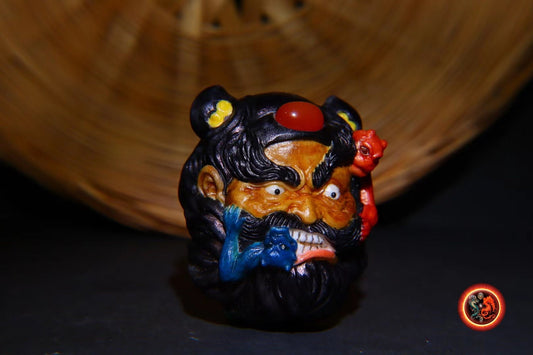
Hei Wuchang and Bai Wuchang are two figures in Chinese popular religion, often depicted as messengers of the underworld. One dressed in black, the other in white, they accompany souls and embody justice, destiny, and impermanence. Their iconography, both unsettling and protective, occupies a unique place in temples, narratives, and popular Taoist art.
A Bai Wu Chang amulet therefore does not simply stem from a macabre aesthetic. It refers to a moral conception of passage, in which actions are observed and their consequences acknowledged. Depending on the representations, Bai Wuchang is also associated with fortune and the protection of travelers.
👉 Our blog article
Presents their history, attributes, and the legends surrounding them, available by clicking on the following link: 📎 Hei Bai Wuchang - The Passers to the Afterlife
🐯 The tiger and guardian lions: courage, vigilance, and stability
The tiger is one of the great protective symbols in Chinese culture. In some interpretations of Feng Shui, the White Tiger is associated with the West and corresponds to the Azure Dragon placed in the East. It represents a more earthly, vigilant, and defensive force, which must remain in balance with the expansive momentum of the dragon.
👉 Discover our blog article on the tiger in Feng Shui
Available by clicking directly on the following link: 📎 The tiger in Feng Shui - Symbol of strength and courage
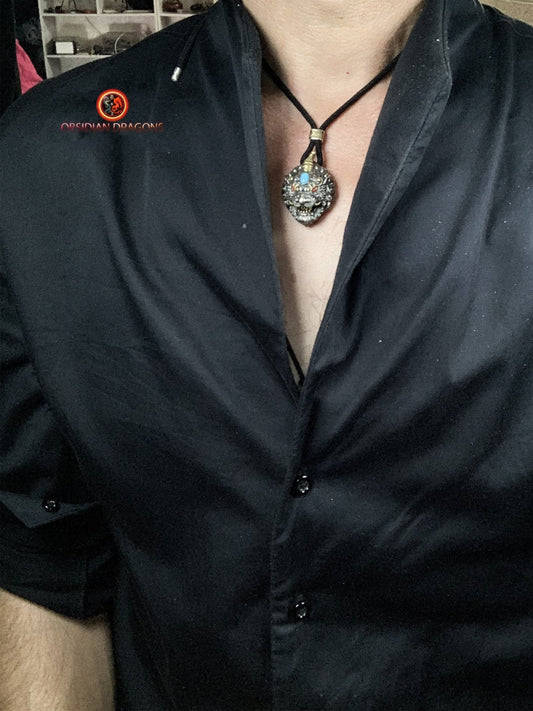
Guardian lions, sometimes called Buddha lions or Foo dogs in the West, traditionally watch over the entrances of palaces, temples, and important residences. Miniaturized as pendants, they retain this sentinel posture and become personal symbols of courage and stability.
👉 For more information on Chinese guardian lions
Explore our dedicated article by clicking on the following link: 📎 Chinese guardian lions - History and symbolism
Natural stones and materials of our Chinese talismans
💚 Jade: a major material in Chinese civilization
Jade has been worked in China for several millennia. Its resistance, its smooth feel after polishing, and the diversity of its shades have nourished a symbolism associated with nobility, rectitude, longevity, and protection. However, several materials are marketed under the name of jade, mainly jadeite and nephrite, to which many imitations are added.
Gemmological expertise makes it possible to identify the nature of the stone and to search for any treatments. This vigilance is particularly important for Feng Shui jade amulets, whose value depends as much on the material as on the carving, color, and quality of the polish.
🖤 Obsidian: depth, brilliance, and visual strength
Obsidian is a natural volcanic glass resulting from the rapid cooling of silica-rich lava. Its black color, sometimes streaked with golden, silvery, or concentric reflections, gives it an intense presence. It lends itself particularly well to dragons, Pixiu, Taotie, and other protective figures whose volumes it highlights.
In contemporary symbolic uses, obsidian is often associated with grounding, introspection, and protection. We present these correspondences as traditions and cultural interpretations, without attributing any medical effect to them. Each natural obsidian talisman is above all a mineral sculpture whose nuances and inclusions are unique.
👉 Discover the vast world of obsidians
Thanks to our dedicated blog article, available via the following link: 📎 Obsidians, formation, history, deposits, uses, counterfeits, and use in lithotherapy
💎 Rock crystal, labradorite, turquoise, and Nan Hong agate
Rock crystal brings transparency and light to engraved or sculpted dragons. Labradorite reveals blue, green, or golden iridescence that changes depending on the orientation of the jewel. Turquoise, very present in the arts of Central Asia, Western China, and the Tibetan world, creates a powerful contrast with silver. Nan Hong agate, prized for its deep reds, is traditionally worked in southwestern China.
These stones are chosen as much for their gemmological qualities as for their place in the aesthetics of Asian jewelry. Color variations, inclusions, and natural irregularities are not flaws: they constitute the identity of each piece.
⚒️ 925 silver and artisanal craftsmanship
925 silver offers both strength, fineness of engraving, and contrast with natural stones. It allows for the creation of mobile mechanisms, sculpted bails, miniature inscriptions, and complex mountings. Some pieces receive golden touches intended to highlight a symbol, a glance, or a central motif.
Silver can tarnish over time due to contact with air, humidity, and skin. This evolution is natural and reversible with proper cleaning. It does not compromise the quality of the metal.
How to choose a Feng Shui amulet or a Taoist talisman?
🧭 Choose according to the symbol that speaks to you
The most appropriate choice often begins with iconography. The dragon corresponds to a search for movement, authority, or transformation. The Pixiu evokes prosperity and the preservation of resources. The Bagua refers to balance and the understanding of cycles. The tiger and guardian lions embody vigilance and courage more. Hei Bai Wuchang invites contemplation of destiny, justice, and impermanence.
It is not necessary to accumulate several symbols. An amulet clearly understood and chosen for a personal reason often has more meaning than an assembly based solely on promises of luck.
👁️ Observe the material, the carving, and the details
The beauty of a talisman lies in the harmony between its material and its design. A jade Pixiu will highlight the softness of its polish and the density of the stone. An obsidian dragon will gain depth and contrast. A silver Bagua will allow for more precise engraving. A rock crystal pendant will play with light and transparency.
Also consider the dimensions, weight, type of bail, and recommended cord or chain length. An imposing piece can become a true collector's item, while a smaller amulet will be easy to wear daily.
🤲 Wearing your talisman or integrating it into a personal space
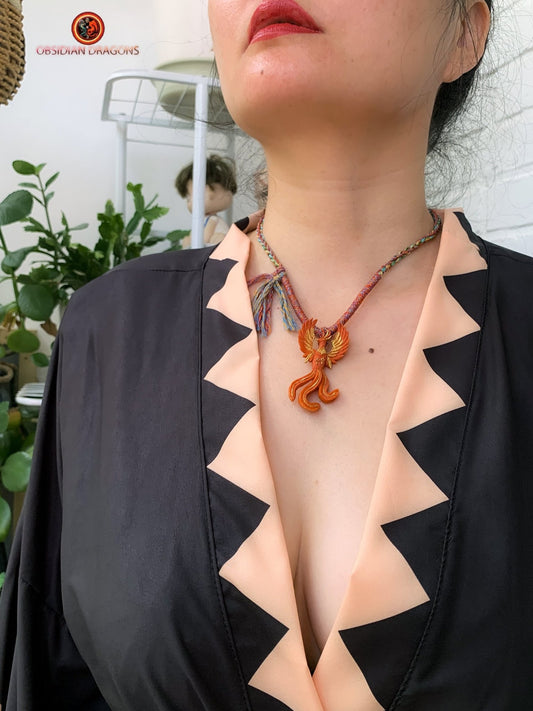
A Feng Shui pendant can be worn around the neck, kept in a pouch, or placed in a space dedicated to meditation and study. Its use depends on its shape, durability, and your personal relationship to the symbol.
However, objects intended to harmonize a home should not be placed randomly based solely on a general formula. Traditional Feng Shui takes into account orientation, architectural context, time, and the people occupying the space. For an in-depth analysis, the guidance of a qualified practitioner is preferable.
Authenticity, gemological selection, and singular pieces
Jeremy Guelle, founder of Obsidian Dragons and a gemologist graduated from the National Gemology Institute of Paris, selects the stones and verifies the consistency of mineralogical descriptions. This expertise allows distinguishing natural material from numerous imitations, recognizing certain treatments, and documenting the important characteristics of each piece of jewelry.
The selection is not limited to the stone. It also considers the quality of the carving, the legibility of the symbols, the construction of the pendant, the solidity of the mounting, and the overall balance of the piece. A complex amulet must be able to be viewed from all angles: front, back, bail, engravings, and any mobile elements contribute to its identity.
Many models are produced in small series or offered as unique pieces. Variations in shade and design are then normal and sought after. They remind us that natural stone and manual work never produce two perfectly identical objects.
Between Chinese tradition and contemporary creation
Taoist jewelry and contemporary Feng Shui amulets are not objects frozen in the past. Artisans continue to interpret ancient symbols, combine them with new materials, and imagine mountings adapted to daily wear. A dragon can thus encircle a labradorite, a Bagua can be engraved in 925 silver, or a ritual bell can be incorporated into a sculptural pendant.
This evolution does not erase tradition when the symbol remains identifiable and correctly explained. On the contrary, it allows the object to maintain a living presence. At Obsidian Dragons, we seek this balance between cultural heritage, gemological quality, and aesthetic strength.
Some pieces combine Taoist, Buddhist, and popular Chinese elements. These encounters reflect the complex history of religious exchanges in Asia. However, they must be described accurately so as not to present all Asian amulets as belonging to a single tradition. If your search specifically concerns Ghau, DZI, Phurba, or Tibetan reliquaries, please consult our collection of authentic Buddhist amulets.
Caring for a natural stone or silver amulet
Keep your amulet away from shocks, chemicals, perfumes, and prolonged humidity. Remove it before bathing, swimming, or any activity likely to damage the stone or mounting. Clean silver with a soft, appropriate cloth, without abrasive products on gilded parts or fragile gems.
Not all stones accept the same cleaning methods. Turquoise, certain dyed agates, organic materials, and stones with natural fissures require special attention. In case of doubt, prefer a dry cloth and contact us before using water, salt, heat, or a so-called energy purification process.
Symbolic maintenance is a personal matter. Meditation, intention, prayer, or a simple moment of attention can accompany the object, but no universal method is imposed.
Frequently asked questions about Feng Shui amulets
Does a Feng Shui amulet automatically bring good luck?
An amulet is primarily a symbolic support. In popular tradition, certain motifs are associated with luck, protection, or prosperity, but no object can guarantee a material result. Its value lies in the quality of its craftsmanship, its cultural heritage, and the meaning given to it by the person who chooses it.
What is the difference between a Feng Shui amulet and a Feng Shui object?
An amulet is generally personal and can be worn or carried. A Feng Shui object is rather intended for a specific location in a space. Both can use similar symbols, but their use and scale differ. Discover also our Feng Shui objects dedicated to space harmony.
Can several Taoist talismans be worn together?
Yes, provided their weight, mounting, and symbolism remain consistent for you. However, there is no automatic advantage to multiplying amulets. It is better to understand each symbol and avoid associations that could damage the stones by friction.
How to tell if a stone is natural?
Identification absolutely requires gemological observations and appropriate instruments. Color, inclusions, refractive index, density, and optical reactions allow distinguishing many materials. Appearance alone is not always enough, especially for jade, turquoise, quartz, and their imitations.
Does a Taoist amulet need to be consecrated?
That depends on the intended use. A ritual object belonging to a specific religious practice may require consecration performed within that tradition. A symbolic piece of jewelry or a miniature sculpture can be worn without claiming to possess this religious status. Our descriptions indicate the nature of each piece as clearly as possible.
Are these amulets suitable as gifts?
Yes, especially when the symbol is chosen according to the recipient's personality or interest. A dragon can accompany a stage of transformation, a Pixiu can celebrate a project, a tiger can recall courage, and a Bagua can evoke the search for balance. Presenting the meaning of the object makes the gift more personal.
Discover your Feng Shui amulet
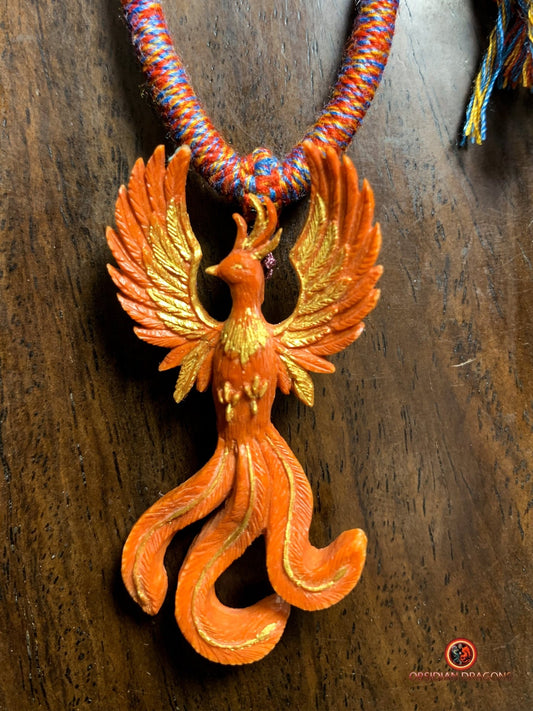
Choosing a talisman means encountering a form, a material, and a story. Whether it's a jade Pixiu pendant, an obsidian dragon, a Bagua Luo Pan amulet, a Taoist bell, or a representation of Bai Wu Chang, each piece offers a different way to enter the symbolic Chinese universe.
Explore our collection of Feng Shui amulets and Taoist talismans, observe the details of each creation, and let yourself be guided by the symbol whose presence resonates most accurately with your journey.