-
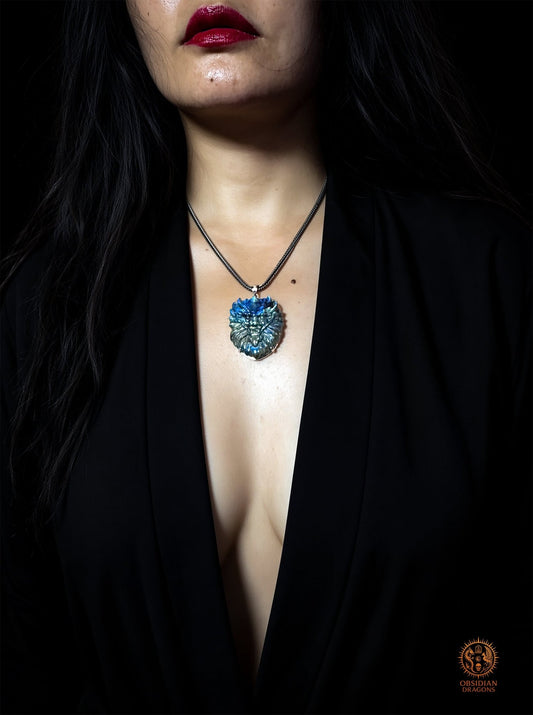
Dragon labradorite pendant set in 925 silver
Regular price €148,00 EURRegular price -
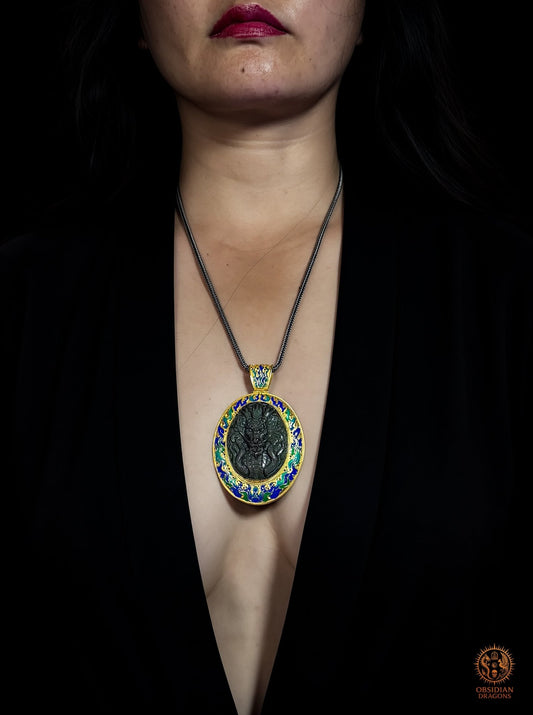
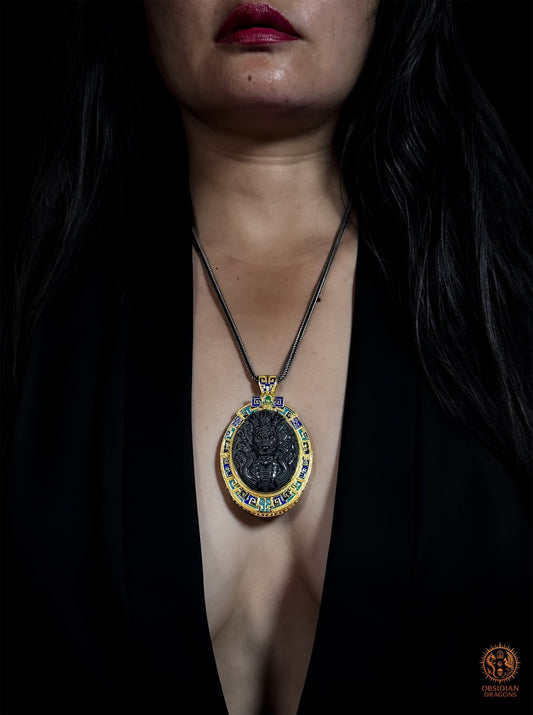
Flame dragon pendant – Obsidian, vermeil, cloisonné
Regular price €688,00 EURRegular price -
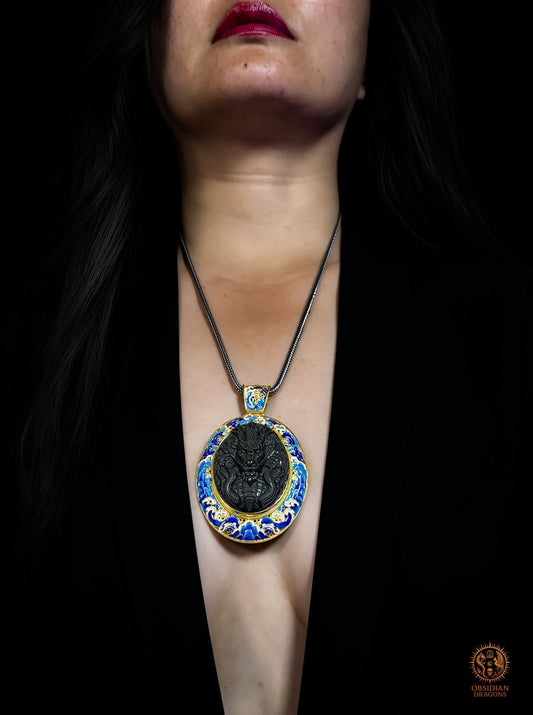
Wave Dragon Pendant – Obsidian, cloisonné vermeil
Regular price €688,00 EURRegular price -
Thunder Dragon Pendant – Obsidian, cloisonné vermeil
Regular price €688,00 EURRegular price -
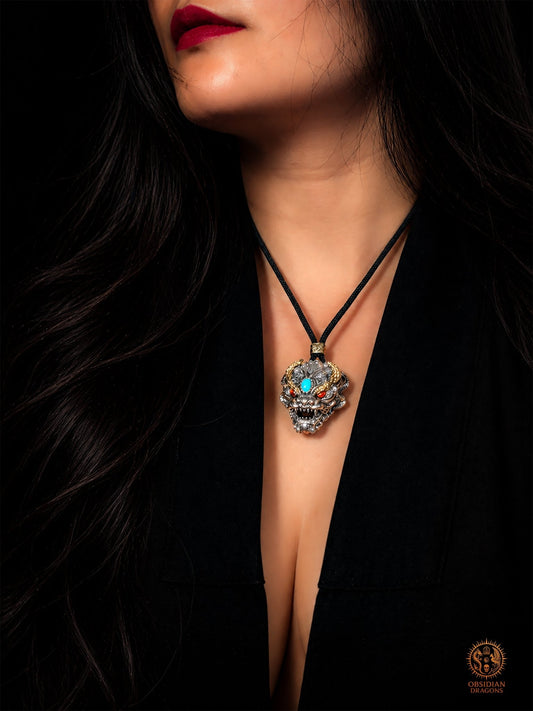
Sterling Silver Dragon Skull Pendant - Talisman of Power
Regular price €288,00 EURRegular price -
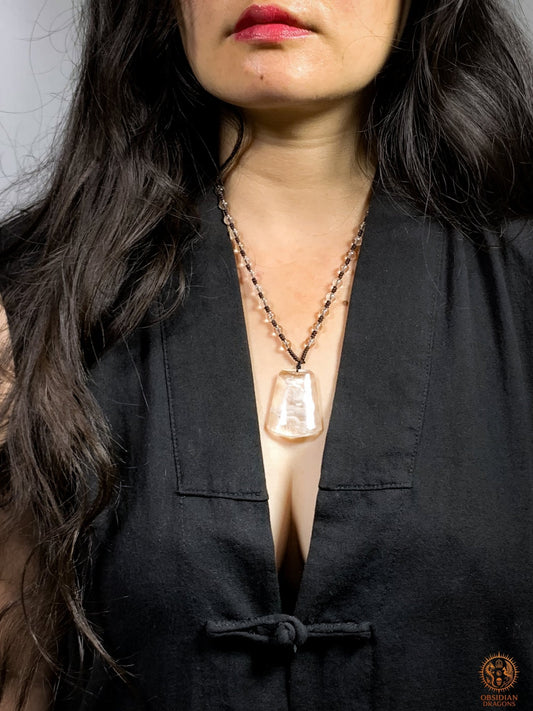
Rock Crystal Dragon Pendant – Intaglio - Glyptic
Regular price €98,00 EURRegular price -
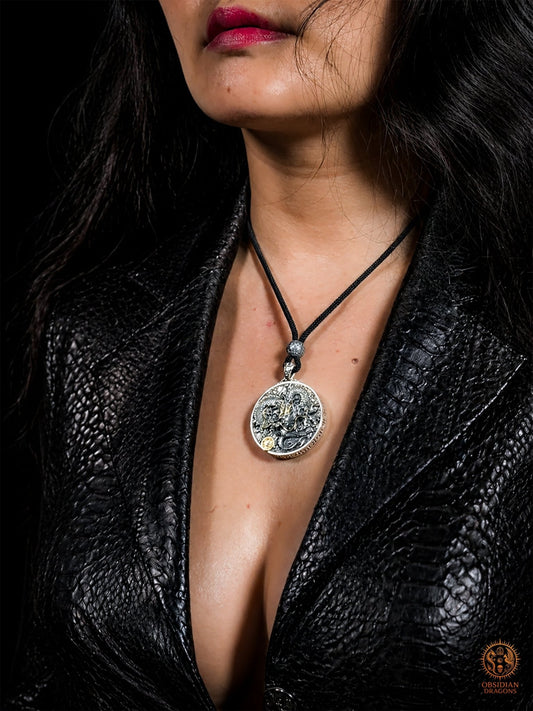
925 Silver Dragon Pendant – Turquoise & Agate nan hong
Regular price €350,00 EURRegular price -
Feng Shui Dragon Pendant - Taoist Ghost Chaser Bell
Regular price €483,00 EURRegular price -
Dragon Pendant - Turquoise - Taoist Protective Bell
Regular price €623,00 EURRegular price -
Natural Obsidian Dragon Amulet - Esoteric Jewelry
Regular price €115,00 EURRegular price -
Obsidian Dragon Talisman - Protection and Energy
Regular price €115,00 EURRegular price -
Celestial Eye Obsidian Dragon Pendant - Gold and Silver
Regular price €115,00 EURRegular price -
Obsidian Dragon Talisman - 24K Gold Plated Silver
Regular price €115,00 EURRegular price -
Celestial Eye Obsidian Dragon Pendant - Spiritual Protector
Regular price €50,00 EURRegular price -
Celestial Eye Obsidian Dragon Pendant - Sacred Guardian
Regular price €50,00 EURRegular price -
Celestial Eye Obsidian Dragon Pendant - Sacred Emblem
Regular price €50,00 EURRegular price










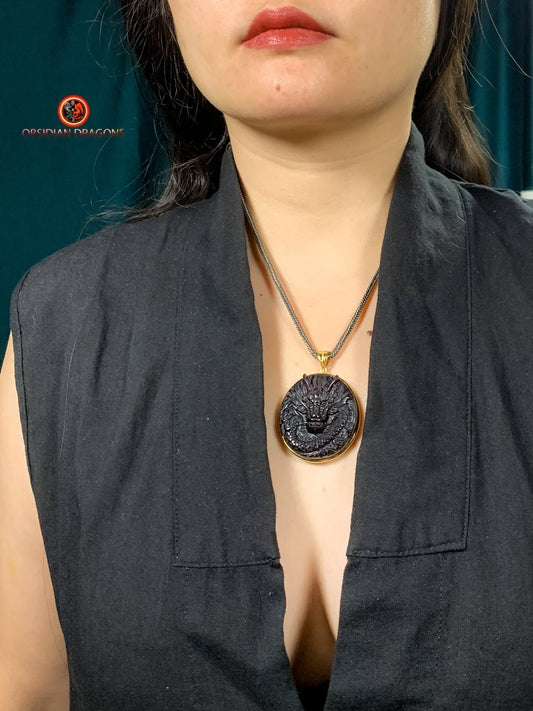

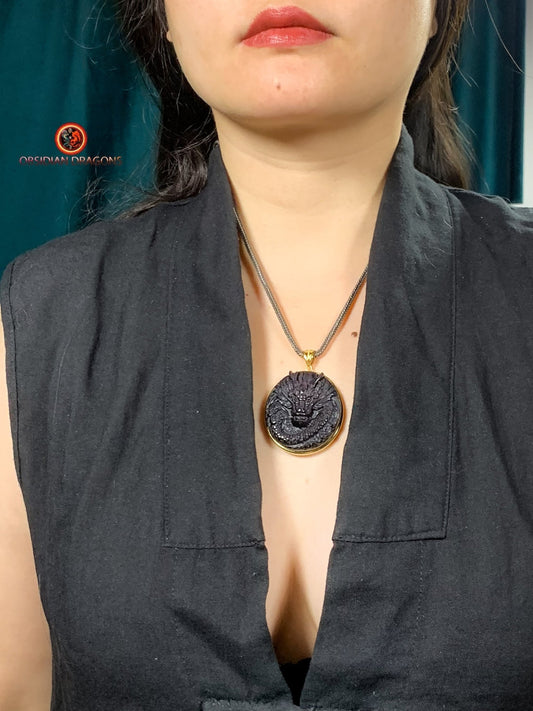

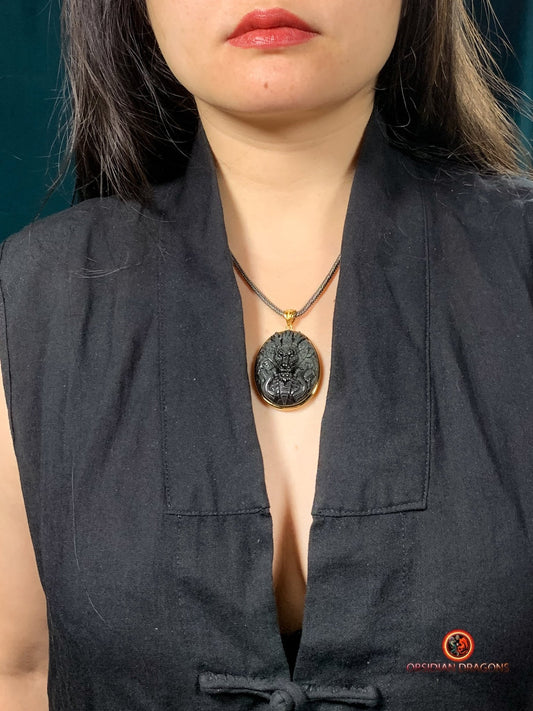

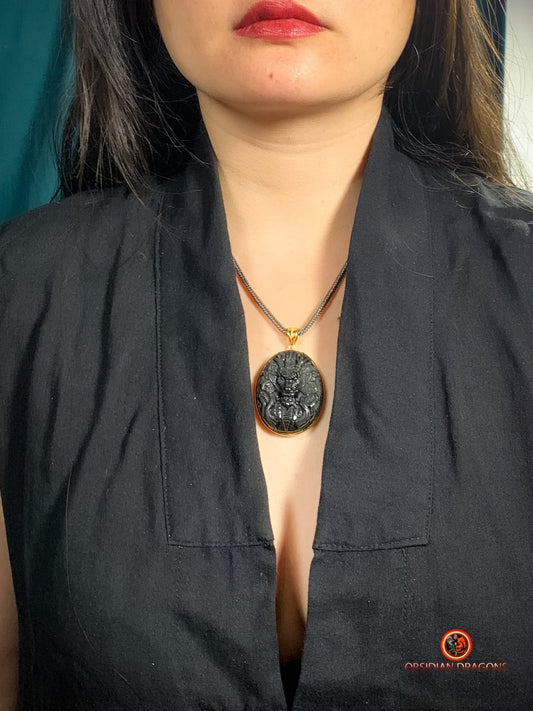

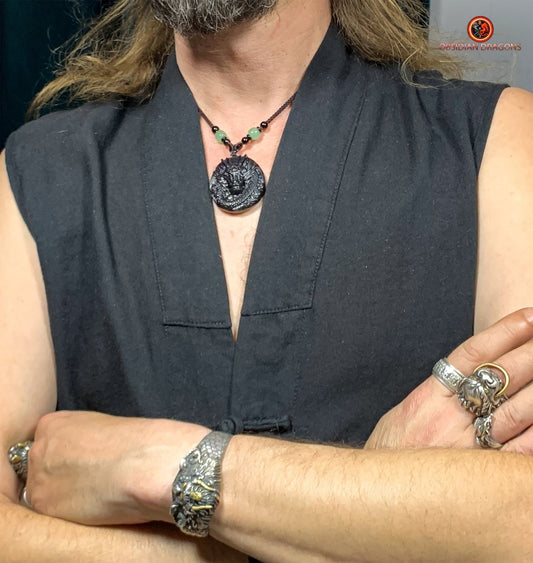

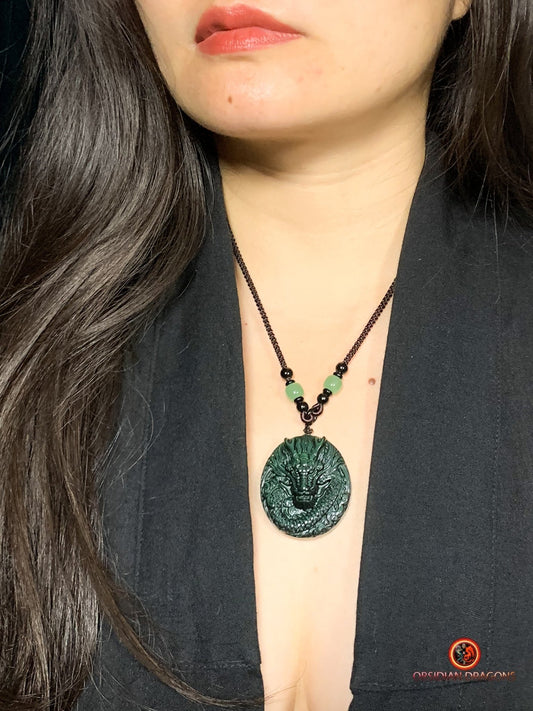

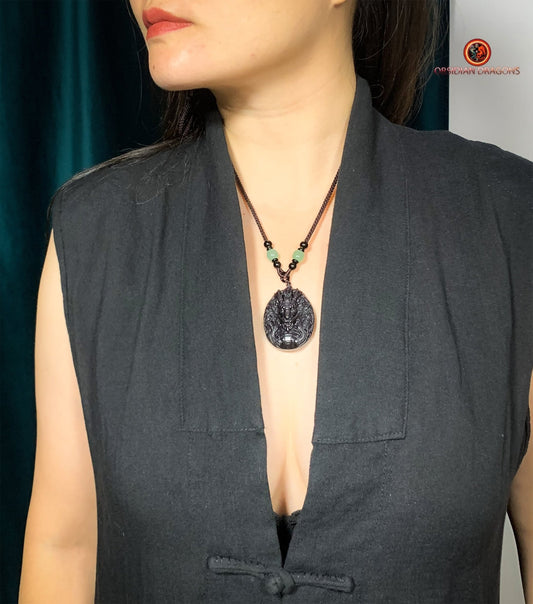
Collection: Handmade dragon pendants in silver and natural stones
Feng Shui Dragon Pendants in Silver, Vermeil, and Natural Stones: Chinese Talismans, Glyptics, and Exclusive Obsidian Dragons Creations
The dragon pendant brings an ancient creature into the intimate space of jewelry. Worn at the center of the body, it follows movement, catches the light, and gives material presence to a chosen symbol. Sterling silver, fine silver, vermeil, cloisonné enamel, Celestial Eye obsidian, rock crystal, turquoise, Nan Hong agate, and lapis lazuli allow the dragon to take profoundly different forms.
The Obsidian Dragons collection brings together handcrafted silver and natural stone dragon pendants, carved amulets, Taoist bells, glyptics, vermeil jewelry, and creations made in collaboration with specialized artisans. Some pieces highlight the power of a solid silver dragon head; others reveal a dragon engraved in transparent quartz or carved into the deep black of natural obsidian.
The most elaborate creations combine an exclusive Celestial Eye obsidian cabochon, a vermeil setting, and meticulous cloisonné enamel work. Produced in extremely limited editions, they demonstrate Obsidian Dragons' commitment to making artisanal dragon jewelry a true wearable art object.
Each model has its own character, weight, proportions, and symbolic language. The collection thus allows for choosing a dragon pendant for men, a dragon pendant for women, or a unisex dragon pendant, without confining the creature to a single aesthetic.

🐉 The Asian Dragon: Celestial Power, Movement, and Transformation
The Chinese dragon, called lóng 龙 in simplified script and 龍 in traditional script, holds a fundamental place in the history and imagination of East Asia. Its serpentine body combines the characteristics of several animals: scales, claws, horns, whiskers, mane, and an intensely expressive gaze.
This composite appearance reflects a nature capable of crossing boundaries. The dragon can dwell in aquatic depths, traverse rivers, hide in clouds, and ascend into the sky. It belongs to multiple domains without remaining confined to any.
Unlike the Western dragon, frequently depicted as a winged creature guarding treasure or battling a hero, the Asian dragon is historically linked to water, rain, clouds, seasonal cycles, and sovereign authority. This general distinction should not erase the diversity of European and Asian narratives, but it helps to better understand the serpentine silhouette of the Chinese dragon pendant.
The dragon's strength also evokes the ability to adapt, understand circumstances, and intervene at the opportune moment. This intelligence of movement brings the dragon closer to certain Taoist principles: not to become rigid, not to exhaust oneself in blind resistance, and to know how to transform one's trajectory without losing one's intention.
An Asian dragon pendant can then become a reminder of a power conscious of its own limitations. It is no longer just about displaying strength, but about seeking harmony between determination and flexibility, presence and withdrawal, action and contemplation.
The term "oriental dragon pendant" is sometimes used to distinguish these serpentine forms from European dragons. However, the term remains very general: China, Japan, Korea, Tibet, and Southeast Asia have developed distinct iconographies. Each piece must therefore be interpreted according to its own motifs rather than indiscriminately attributed to a single tradition.
🔬 Gemmological Expertise and Material Transparency
Jeremy Guelle, founder of Obsidian Dragons and a certified gemologist from the National Institute of Gemology in Paris, selects stones and ensures the consistency of gemmological descriptions.
This expertise allows for examining material characteristics, researching certain treatments, and distinguishing many natural stones from their imitations. It is particularly important for obsidian, turquoise, quartz, Nan Hong agate, and lapis lazuli.
Gemmological observation does not mean that every piece of jewelry automatically comes with an individual laboratory report. When a specific certificate is provided, this information is included on the product sheet. In other cases, the description specifies the relevant observations and characteristics of the stone.
The selection also concerns carving, the quality of settings, the construction of the bail, the solidity of the mounting, the reverse side of the pendant, and the balance between its weight and its suspension system.
Some pieces are assembled or created directly by Obsidian Dragons. Others are produced in collaboration with specialized workshops, notably Huang Yi Studio in Beijing. Still others are selected from artisans whose craftsmanship matches the collection's identity.
This distinction prevents confusing original creation, collaboration, limited series, and artisanal selection. When a dragon pendant offered as a unique piece or a limited edition is presented, its status is clearly indicated.
🧭 How to Choose Your Dragon Pendant?
The choice begins with the dragon's form. A frontally carved head creates a direct presence. A serpentine dragon introduces more movement. An intaglio favors contemplation and light. A bell adds sound to the visual language. A dragon skull explores impermanence and fantasy.
The material is the second criterion. Sterling silver reveals details and is more resistant to the stresses of daily wear. Fine silver has a higher purity but greater malleability. Vermeil combines the structure of silver with the warmth of gold. Obsidian brings depth and contrast, while rock crystal plays with transparency.
Size and weight are essential. Some pendants remain discreet; others are true wearable sculptures, potentially exceeding several tens of grams. A heavy piece requires an appropriate chain, cord, and bail.
Always observe the actual dimensions rather than relying solely on photographs. Check the height with the bail, width, thickness, and weight. A spectacular piece in a photograph can turn out to be very imposing when worn.
Also examine the suspension method. Some models come with an adjustable cord or chain; others require a separately chosen support. To accompany the most massive pieces, discover our collection of 925 and 950 sterling silver chains.
The bail must be wide enough to accommodate the intended chain. The diameter of the clasp, which must be able to pass through the bail, should also be considered.
Finally, choose a piece of jewelry whose composition is clearly described. A natural stone dragon pendant must specify the nature of the stone, the metals used, any treatments, the weight, and the dimensions.
❤️ Wearing the Dragon Close to the Heart
The pendant occupies a different place than a ring or a bracelet. Suspended from a chain or cord, it moves with respiration and usually rests at the center of the chest. This proximity to the heart gives it an intimate dimension, but it does not correspond to a universal energetic rule.
It would be historically imprudent to assert that all civilizations wore the dragon against the heart according to an identical ritual. Body ornaments, amulets, and representations of protective creatures are ancient, but the pendants gathered in this collection are contemporary creations inspired by different heritages.
Nevertheless, a dragon necklace can become a deeply personal object. Its presence accompanies the wearer, marks a stage of life, and materializes an intention. Depending on one's sensitivity, the dragon can evoke transformation, courage, inner sovereignty, or the will to preserve what has true value.
The pendant does not automatically produce these qualities. It acts more as a visible sign, a witness, and sometimes a support for meditation. Its symbolic power arises from the encounter between iconography, material, and the consciousness of the person who chooses it.
☯️ The Dragon Pendant in Feng Shui
Feng Shui is a traditional Chinese art dedicated to observing the relationships between humans, the environment, orientations, forms, and movements of Qi. It primarily concerns the organization of space and should not be reduced to an accumulation of objects supposedly attracting good luck automatically.
In some schools, landscape forms are compared to the body of a dragon. Mountains, valleys, and waterways draw lines through which Qi seems to concentrate, circulate, or disperse. The dragon then becomes a dynamic image of the territory.
The Azure Dragon is also one of the great directional figures of Chinese cosmology. Associated with the East, spring, and renewal, it corresponds to the White Tiger of the West, and the Vermilion Phoenix of the South and the Black Tortoise of the North.
The Feng Shui dragon pendant transposes part of this heritage into personal jewelry. It does not replace the analysis of a place or the intervention of a qualified practitioner. However, it allows for wearing a representation of movement, renewal, and balance between forces.
In a contemporary spiritual interpretation, the dragon can recall the intention one wishes to cultivate: perseverance, discernment, capacity for evolution, or trust in the movement of life. These meanings belong to the symbolic realm and do not constitute guaranteed material effects.
To delve deeper into this major figure of Chinese cosmology,
discover our article on the dragon in Feng Shui, its strength and energy.
🧿 Dragon Talisman, Amulet, and Spiritual Jewelry
The terms "pendant," "talisman," and "amulet" are not strictly interchangeable. A pendant primarily refers to an object suspended from a chain or cord. An amulet is traditionally worn or kept with a protective intention. A talisman often combines a material, an image, an inscription, or a ritualistic preparation with a specific function.
A dragon talisman can therefore be a consecrated ritual object, but it can also refer to contemporary jewelry whose symbolism accompanies a personal journey. The exact nature of each piece must be presented with transparency.
A Taoist dragon pendant does not automatically acquire religious status because it depicts a dragon, a Taotie, or Chinese characters. Consecration belongs to a ritual context, a transmission, and a defined tradition. In the absence of these elements, it is more accurate to speak of jewelry inspired by Taoist iconography.
The expression "protection dragon pendant" must also be understood symbolically. In Chinese beliefs and contemporary uses, the dragon can represent vigilance, authority, and the preservation of an inner space.
A spiritual dragon pendant can accompany meditation, prayer, or a moment of mindfulness. It can also be worn without religious practice, simply for the beauty of its material and the power of its design.
Similarly, a dragon amulet can be chosen as a personal object without its owner adhering to a particular belief. The essential lies in understanding the symbol and the freely constructed relationship with it.
🐲 Dragons, Nine Sons, and Creatures of the Chinese Bestiary
Chinese mythology does not present the dragon in a single form. Several traditions evoke its nine sons, each possessing a particular temperament and function. The lists vary according to texts and periods, which prevents a perfectly fixed genealogy.
Bixi carries steles; Pulao is associated with the power of sound and appears on bells; Suanni takes on a leonine appearance and is found on incense burners; Bi'an evokes vigilance and justice; Chiwen guards the ends of ridgepoles; Qiuniu loves music; Chaofeng occupies heights; Fuxi accompanies inscriptions; Yazi has a more martial character and is found on weapons.
These figures show that the dragon's power can become endurance, eloquence, contemplation, courage, creativity, or vigilance.
To explore these different traditions,
consult our study on the nine sons of the dragon, their origin, history, and symbolism.
Some pieces in the collection also feature the Taotie, an enigmatic animal mask present on many ritual Chinese bronzes. Its iconography has seen multiple interpretations: gluttony, power, vigilance, or a presence separating the ordinary world from the ritual space.
⚒️ The Dragon Pendant in 925 and 990 Sterling Silver
Silver is particularly suitable for representing the dragon. Its luminosity highlights the scales, horns, whiskers, and facial features. An oxidized finish can darken the recesses of the carving and enhance its readability.
A 925 sterling silver dragon pendant is made from an alloy that is 925 thousandths pure, or 92.5% silver. The remaining 7.5% consists of other metals, most often copper, intended to improve the mechanical resistance of the alloy.
925 sterling silver is suitable for detailed carvings, bails, hinges, bells, and frequently handled elements. However, it remains susceptible to scratches and can gradually tarnish upon contact with sulfur compounds present in the air or on the skin.
A 990 sterling silver dragon pendant is made from an alloy that is 990 thousandths pure, or 99% silver. Its higher purity gives it a different character but also makes it more malleable. It should not be presented as absolutely pure silver, a designation that would correspond more to a purity close to 999 thousandths.
The expression "solid silver dragon pendant" means that the part concerned is made of a silver alloy throughout its thickness, and not a simple layer of silver deposited on a common metal. However, the pendant may include other materials: copper, natural stones, enamel, cord, or gilding.
A silver dragon pendant can have a polished, oxidized, or partially gilded finish. The exact composition of each model is indicated on its product sheet to clearly distinguish solid silver, vermeil, gold-plated, gilded copper, and other surface treatments.
🌞 Vermeil, Gold-Plated, and Gilded Metal
A vermeil dragon pendant combines a silver base with a layer of gold. This denomination should not be confused with simple gilded metal or with solid gold jewelry.
The term "vermeil" meets precise criteria: the base must be silver and receive a layer of gold of at least 750 thousandths and a minimum thickness of five microns. Vermeil thus retains the structure of silver jewelry while offering the warm luster of gold.
A gold-plated dragon pendant can also be made on a silver base or another metal, depending on what is expressly indicated. The nature of the base and the thickness of the gilding are essential for understanding the actual composition of the jewelry.
The contrast between gold and obsidian also has a particular visual strength. Black absorbs the gaze and evokes depth, while gold emphasizes the edges, flames, waves, or patterns surrounding the dragon.
🎨 Cloisonné Enamel: Drawing with Metal and Color
Cloisonné is an enameling technique in which thin metal partitions delineate the different areas of the design. The spaces thus created are filled with enamel, then worked to obtain a colorful, precise, and durable surface.
China deeply developed this art during the Ming and Qing dynasties. Chinese artisans adapted it to their own repertoire: dragons, clouds, lotuses, waves, auspicious symbols, and motifs inspired by archaic bronzes.
In a cloisonné enamel dragon pendant, the partitions structure the color and give the motif its legibility. The metal simultaneously becomes support, separation, and drawing.
Its creation requires great precision. The partitions must follow the curve of the setting, the different colors must remain distinct, and the final polishing must reveal the design without erasing the reliefs. On a small piece of jewelry, the difficulty is accentuated by the fineness of the motifs.
Obsidian Dragons' cloisonné creations bring historical craftsmanship to life in a contemporary composition adapted to daily wear and the brand's identity.
🌩️🌊🔥 The Triptych of Thunder, Waves, and Flames
The Thunder, Waves, and Flames series marks a major evolution in Obsidian Dragons' creation. Each model combines an exclusive cabochon of natural Celestial Eye obsidian, a sculpted dragon, a vermeil setting, and a cloisonné enamel decoration.
These pendants are crafted in collaboration with Huang Yi Studio in Beijing. Their visual language is inspired by Chinese arts, ritual bronzes, cloisonné, and the cosmology of the elements.
⚡ The Thunder Dragon Pendant and Leiwen Motifs
The Thunder Dragon Pendant in obsidian, vermeil, and cloisonné is organized around a geometric decoration inspired by the Leiwen 雷纹, literally "thunder pattern."
Leiwen generally take the form of angular spirals or square meanders. They notably appear in the decorative vocabulary of ancient Chinese bronzes. Their presence around the dragon creates a tension between geometric order and organic movement.
Thunder announces the breaking of silence. It can symbolize awakening, decision, and sudden transformation. The dragon associated with it is not an immobile creature: it becomes the impulse capable of traversing an old state to open a passage.
This original dragon pendant is for those who recognize in thunder the moment when long-contained energy becomes manifest.
🌊 The Waves Dragon Pendant
The Waves Dragon Pendant in obsidian, vermeil, and cloisonné combines the black of the stone, the gold of the setting, and different shades of blue, turquoise, and white.
The waves recall its historical connection with water, rain, and atmospheric changes. Their movement breaks into foam, recedes, and starts again, giving the pendant a continuous rhythm.
In a philosophical reading, water represents the ability to adapt. It has no shape of its own but molds to every relief without losing its nature. It appears flexible yet can transform landscapes.
The Waves Dragon thus evokes a fluid force, capable of bypassing obstacles, waiting, and returning. The depth of the obsidian cabochon responds to the light of the enamels as the darkness of the ocean responds to the reflections of the sky.
🔥 The Flames Dragon Pendant
The Flames Dragon Pendant in obsidian, vermeil, and cloisonné explores a different energy. Red, orange, and luminous enamels surround the sculpture without erasing the deep black of the obsidian.
Fire transforms what it encounters. It can illuminate, purify, warm, or destroy when its power is no longer controlled. Its symbolic value therefore depends on the consciousness with which it is maintained.
The Flames Dragon can be understood as an image of inner transmutation: consuming what hinders, preserving what remains alive, and converting ordeal into knowledge.
The triptych thus forms three complementary movements. Thunder awakens, Waves adapt, and Flames transform. No model is superior to the others; each expresses a different way of relating to change.
🌌 The Obsidian Dragon Pendant
Obsidian is a natural volcanic glass resulting from the rapid cooling of lava, usually rich in silica. It does not possess the ordered crystalline structure of a mineral in the strict sense. Its vitreous luster and conchoidal fracture testify to its amorphous nature.
An obsidian dragon pendant combines a material born of volcanism with a creature linked to waters and the sky. This encounter between geological fire and aquatic dragon creates a particularly rich tension.
Black obsidian highlights the reliefs of the sculpture. Its polished surfaces capture light sources while its hollows remain dark. This alternation makes certain details appear or disappear depending on the viewing angle.
In contemporary lithotherapy practices, obsidian is often associated with introspection, grounding, and protection. These correspondences belong to the realm of spiritual traditions and do not constitute demonstrated medical effects.
To discover this material with a historical and gemological approach, consult our file dedicated to obsidian, its formation, deposits, uses, imitations, and its place in lithotherapy.
👁️ The Celestial Eye Obsidian Dragon Pendant
The term "Celestial Eye obsidian" is a commercial designation used for certain obsidians revealing concentric zones or colored reflections. When the stone is correctly oriented and polished, these structures can evoke an eye, a nebula, or a succession of rings.
The optical effects observed in reflective obsidians can come from different microstructures, inclusions, and oriented internal layers. Their intensity depends on the provenance, cut, polish, and direction of light.
In a Celestial Eye obsidian dragon pendant, the artisan must understand the stone before sculpting it. The dragon motif and the colored areas must complement each other. Inadequate orientation could make the eye almost invisible once the jewel is worn.
Each cabochon presents a particular organization of colors and reflections. This singularity explains why two pendants from the same model are never rigorously identical.
The most accessible models in the collection emphasize the sculpture of the obsidian itself. The vermeil and cloisonné creations add a metallic and colored architecture around the cabochon, transforming the stone into a miniature scene.
🔮 Rock Crystal, Intaglio, and Glyptics
Rock crystal is the colorless and transparent variety of quartz. Its chemical composition is silicon dioxide, and its crystalline structure clearly distinguishes it from obsidian, which is an amorphous volcanic glass.
The rock crystal dragon pendant allows exploring transparency rather than deep black. Light passes through the stone, encounters the sculpted surfaces, and reveals the dragon depending on the viewing angle.
Glyptics refers to the art of engraving or sculpting stones. Intaglio consists of creating the motif in hollow, unlike cameo where the decoration appears in relief compared to the background.
In an intaglio dragon pendant, the sculpture can be made on the reverse side of the crystal. Seen through the polished face, it appears to float inside the stone and produces an impression of three-dimensional depth.
A glyptic dragon pendant requires particular skill: the artisan must anticipate how the motif will be observed through the quartz, control the inverted volumes, and preserve the legibility of the dragon despite reflections.
This technique allows for the design of a high-end dragon pendant whose value is based not only on the material but also on the quality of the sculpture and the optical intelligence of its realization.
🔵 Turquoise, Nan Hong Agate, and Lapis Lazuli
Turquoise is a hydrated phosphate of copper and aluminum whose color varies from blue to green. Some stones have a brown or dark matrix; others are more homogeneous. Stabilization, impregnation, or coloring treatments exist on the market and must be reported when identified.
A turquoise dragon pendant can use a stone from the Chinese province of Hubei. Its blues create a powerful contrast with oxidized silver, copper, or golden touches.
Nan Hong agate is a red chalcedony prized in China for its colors ranging from orange-red to deep red. Its tones are mainly linked to fine inclusions of iron oxides, especially hematite, and not to cinnabar inclusions as some commercial descriptions claim.
A Nan Hong agate dragon pendant thus combines a siliceous material with warm colors with the cool luminosity of silver. The stone can mark the dragon's gaze, adorn its forehead, or appear on the reverse of the pendant.
Lapis lazuli is a rock composed of several mineral constituents, including lazurite responsible for its blue color. Grains of pyrite and clear calcite patches may be visible. A lapis lazuli dragon pendant should be evaluated according to the intensity and homogeneity of its blue, as well as its possible treatment.
When turquoise, Nan Hong, and lapis lazuli are combined in the same creation, their value does not lie in an accumulation of supposed virtues. It appears in the harmony of colors, the quality of the settings, and the coherence of the whole.
🔔 Taoist Bells and Rattles
Sound plays an important role in many Asian ritual traditions. A bell can mark the beginning of a sequence, call attention, punctuate a practice, or symbolically signal the transition from one state to another.
Some pendants in the collection incorporate a movable bell, a rattle, a dragon, and motifs inspired by popular Taoism. Their construction requires particular attention: the sound element must remain mobile, the sculpture legible, and the mounting strong enough to accompany movement.
Expressions such as "ghost chaser" or "protective bell" refer to popular traditions and cultural interpretations. Their interest lies in the presence of sound, the complexity of the sculpture, and how the jewel comes alive when worn.
💀 The Dragon Skull Pendant: Power and Impermanence
The dragon skull pendant belongs to a different register than that of the Chinese celestial dragon. It blends the mythical creature with the iconography of the skull, universally linked to mortality, time, and transformation.
In a memento mori reading, the skull does not necessarily celebrate death. It recalls the fragility of existence and the importance of giving conscious direction to available time.
Associated with the dragon, it can represent the disappearance of forms, the memory of an ancient power, or the transformation of an energy that no longer manifests itself in its initial appearance.
A living dragon head pendant expresses gaze, breath, and vigilance. A dragon skull, on the contrary, shows what remains when visible strength has withdrawn. These two representations can coexist in a collection without having exactly the same cultural origin.
👤 Men's Dragon Pendant, Women's, or Unisex Jewelry
The dragon does not have a mandatory aesthetic gender. Searches for "men's dragon pendant" and "men's dragon necklace" often lead to massive, dark, and heavily sculpted pieces. This does not mean that these jewels are reserved for men.
A women's dragon pendant can favor a lighter size, a transparent intaglio, or a more delicate setting. However, a woman can choose an imposing bell or a large cloisonné creation.
The unisex dragon pendant is one whose proportions, weight, and visual language match the person wearing it. A women's or men's dragon necklace should be selected according to comfort and personal affinity rather than an arbitrary convention.
The length of the chain greatly changes the appearance. Worn short, the dragon is placed close to the throat or upper sternum. A longer chain allows for more movement and is often suitable for more imposing pendants.
🐉 A Complete Family of Dragon Jewelry
The pendant places the dragon at the center of the chest, but it can interact with other forms of jewelry.
The dragon rings in 925 silver and natural stones concentrate the creature around the hand and gesture. They particularly highlight sculpted heads, claws, and set stones.
The handmade dragon bracelets in silver and natural stones accompany the movement of the wrist. Confronted heads, natural beads, and cuffs give them a different presence than a pendant.
🧼 Caring for a Dragon Pendant in Silver, Vermeil, and Natural Stones
Remove your pendant before showering, bathing, swimming, sports, or any activity likely to cause impacts. Chlorine, perfumes, cosmetics, detergents, and abrasive products can alter metals, stones, and enamels.
Clean silver with a soft, suitable cloth. A slight patina can be retained when it highlights the dragon's reliefs. Avoid aggressively polishing intentionally oxidized parts.
Vermeil should be treated with greater delicacy. Abrasive polishing eventually thins the gold layer. Use a clean, dry cloth, without applying excessive pressure.
Cloisonné enamel is durable, but it remains sensitive to impacts. A fall can cause a crack or chip. Do not use an ultrasonic bath or steam cleaner on a pendant combining enamel, obsidian, and a gilded setting.
Obsidian has sufficient hardness to be worn as jewelry, but its vitreous nature makes it brittle. Protect it from impacts against tiles, metal, and harder stones.
Turquoise is relatively porous and can react to perfumes, oils, and chemicals. Rock crystal is more scratch-resistant, but an intaglio sculpture must nevertheless be protected from impacts.
Store the pendant separately in its case or in a soft pouch. A heavy piece should not rest on a fragile stone or hit other jewels during transport.
So-called energetic purification methods belong to personal beliefs. However, not all materials can withstand salt, water, heat, or prolonged sun exposure. The physical preservation of the jewel must always take precedence over an unsuitable symbolic method.
❓ Frequently Asked Questions about Dragon Pendants
Does a dragon pendant really bring good luck?
The dragon is associated, in different Chinese traditions, with authority, renewal, and favorable influences. A pendant can materialize this symbolism, but it guarantees neither fortune, success, nor supernatural protection.
What is the difference between a dragon pendant and a dragon amulet?
A pendant refers to the shape of the suspended jewelry. An amulet refers more to the protective function attributed to it. A pendant can be worn purely for its aesthetic appeal, while an amulet is chosen for a symbolic or spiritual purpose.
Does a Feng Shui dragon pendant need to be consecrated?
No. Feng Shui-inspired jewelry can be worn without consecration. A ritual consecration belongs to a specific religious tradition and should not be assumed in the absence of precise information.
What is the difference between 925 silver and 990 silver?
925 silver contains 92.5% silver and generally has better mechanical resistance. 990 silver contains 99% silver and is more malleable. The best choice depends on the construction and intended use of the pendant.
What is the difference between vermeil and gold plated?
Vermeil must have a silver base covered with gold according to precise regulatory criteria. Gold-plated jewelry can use another metal as a base. The product sheet should always specify the actual composition.
How to recognize a natural stone?
Appearance alone is not always enough. Identification may require a magnifying glass, a refractometer, a polariscope, density measurement, or other gemological observations. Some treatments and synthetic materials require more in-depth analysis.
Is the chain included with the pendant?
It depends on the model. Some pendants come with an adjustable cord or a chain; others are offered alone. This information is found in the characteristics of each product sheet.
How to choose a chain for a heavy pendant?
The chain must be proportionate to the weight of the pendant, and its clasp must be able to pass through the bail. For a particularly massive piece, opt for a sturdy link and a length that allows the jewelry to rest comfortably.
Can a dragon pendant be worn every day?
Yes, if its dimensions, weight, and materials match your activity. Massive pieces, cloisonné enamels, and prominent sculptures require more precautions than a small silver pendant.
Can a dragon pendant be given as a gift?
Yes. The dragon can accompany a transformation, a new project, or an important milestone. Choosing the material and shape based on the recipient's personality makes the gift more fitting than a general promise of luck.
🐉 Discover your dragon pendant
Choosing a dragon pendant is about bringing an ancient creature into dialogue with modern craftsmanship. Sterling silver, vermeil, cloisonné, glyptic, celestial eye obsidian, rock crystal, turquoise, and Nan Hong agate give each piece a unique identity.
Whether it's a 925 silver dragon pendant, a carved obsidian amulet, a dragon head pendant, a Taoist bell, a dragon skull, or an exclusive cloisonné vermeil creation, each piece of jewelry offers a different way to approach power, movement, and transformation.
Explore the collection of silver and natural stone dragon pendants, examine the dimensions, weight, materials, and mounting of each creation, then let yourself be guided by the encounter between the dragon, the material, and your own journey.