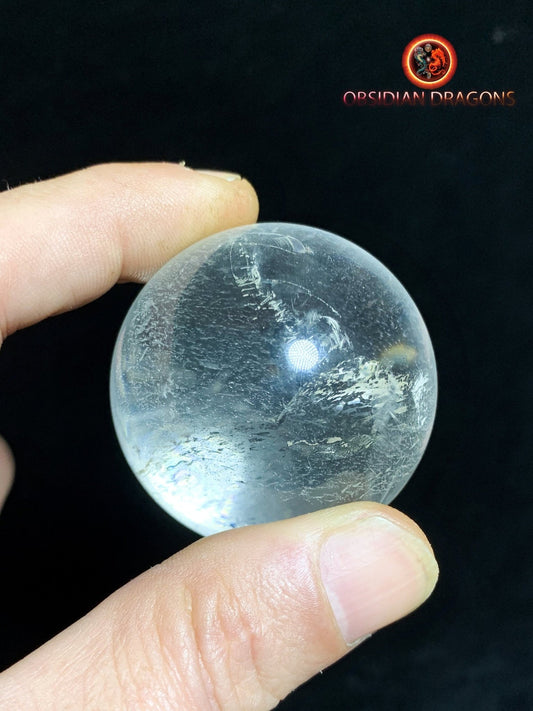
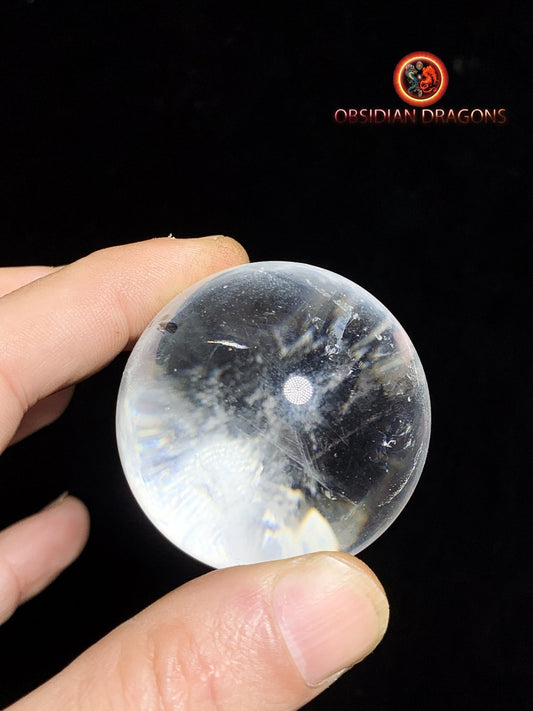
🔮 Natural Crystal Balls: Where Matter Meets the Gaze
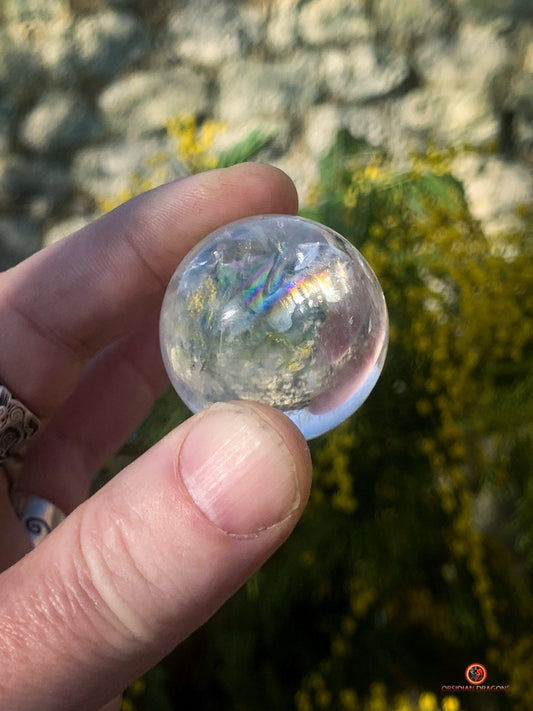
A crystal ball attracts the eye even before one knows the exact nature of the stone. Its surface offers no fixed point, no preferred direction. Light glides around it, sometimes passing through its material and revealing an inner landscape composed of veils, frosts, ancient fractures, and mineral inclusions.
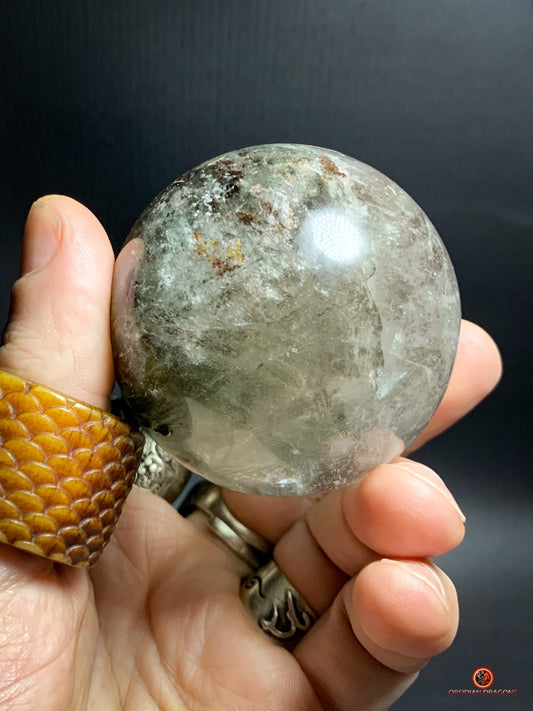
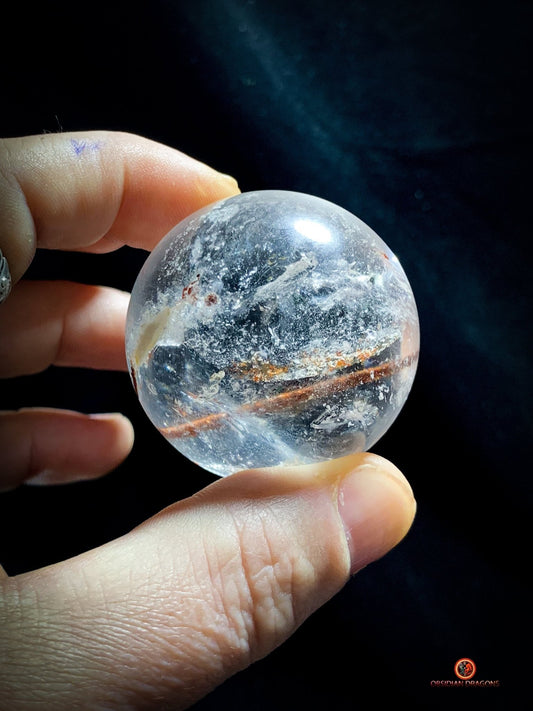
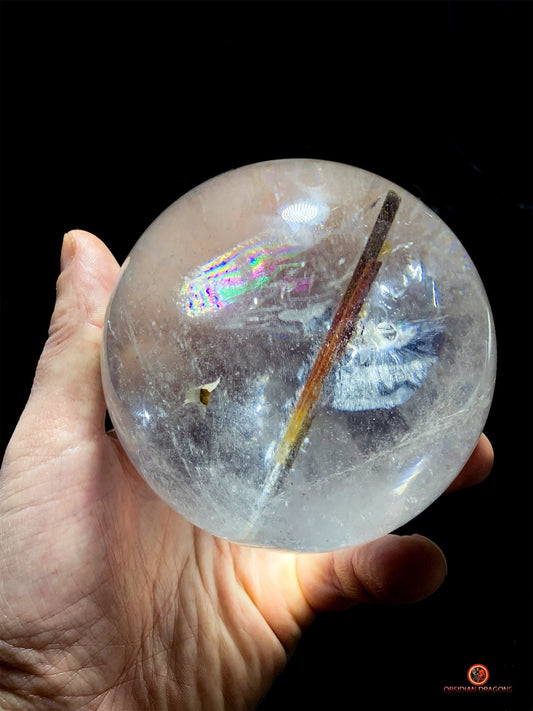
Our collection of natural crystal balls brings together quartz spheres chosen for their gemmological interest, their polishing quality, and their visual presence. Transparent rock crystal, smoky quartz with rutile, chlorite quartz, rock crystal with tourmaline, or asteriated rose quartz each possess a unique identity.
These pieces can be sought after as mineralogical collectibles, aids for contemplation, meditation spheres, spiritual decorative elements, or divinatory crystal balls. Their nature does not change according to the use attributed to them: they remain above all natural stones shaped and polished by human hands.
As a gemmologist graduated from the National Gemmology Institute of Paris, Jeremy Guelle selects these spheres by observing their material, inclusions, transparency, potential optical phenomena, and cutting quality. This approach allows for distinguishing gemmological observation from the symbolic, esoteric, or lithotherapeutic interpretations that may then accompany each stone.
💎 What is a True Natural Crystal Ball?
The term "crystal ball" is often used to refer to very different objects. Some spheres are made of transparent glass, K9 optical glass, or other industrial materials. Others are carved from rock crystal, rose quartz, smoky quartz, obsidian, or various natural stones.
In this collection, a natural crystal ball refers to a sphere shaped from natural mineral material, primarily quartz. The stone obviously did not grow in a perfectly round form. The sphere results from lapidary work in which a fragment of raw material is progressively rough-hewn, calibrated, abraded, and then polished.
It is therefore important to distinguish between the naturalness of the material and the geometry of the object. The stone is natural, while its spherical shape is the result of human intervention.
A true rock crystal ball may exhibit inclusions, veils, internal frosts, translucent areas, or small natural discontinuities. These characteristics are not necessarily defects. They can testify to the conditions under which the quartz formed and make each mineral sphere unique.
A perfectly transparent crystal ball completely devoid of internal structure is not automatically superior. In some cases, this apparent perfection may even prompt one to check whether it is truly natural quartz or a glass imitation.
🔬 Rock Crystal, Clear Quartz, and Hyaline Quartz
Rock crystal is the colorless and transparent variety of quartz. Its chemical formula is SiO₂, i.e., silicon dioxide. Its ordered crystalline structure distinguishes it from glass, whose structure is amorphous.
Quartz belongs to the trigonal crystal system and has a hardness of 7 on the Mohs scale. This hardness allows it to retain a beautiful polish, but it does not make it unbreakable. A rock crystal sphere can withstand many everyday frictions while remaining vulnerable to falls, violent shocks, and pre-existing fractures in the stone.
The expressions clear quartz, transparent quartz, hyaline quartz, and natural rock crystal describe similar realities. The term "rock crystal" belongs to a long historical and commercial tradition, while "hyaline quartz" directly emphasizes the transparency of the material.
However, it would be scientifically incorrect to oppose rock crystal to quartz as if they were two distinct minerals. Rock crystal is indeed quartz. Rose quartz, smoky quartz, and included quartz are other expressions of this same large mineral family.
This precision is essential, as the word "crystal" has several meanings in common language. It can refer to a solid whose constituents are organized in an ordered structure, but also to certain categories of glass used in decorative arts. A "K9 crystal" ball, for example, is an industrial optical glass object and not a natural rock crystal sphere.
🌍 The Formation of Quartz: A Geological Memory Transformed into a Sphere
Quartz forms in varied geological environments. It can crystallize in hydrothermal veins, pegmatites, rock cavities, or various metamorphic and magmatic contexts. Silica-rich fluids circulate in the rock, then atoms gradually organize into a crystalline structure when temperature, pressure, and composition conditions allow.
This growth is not always regular. Conditions can evolve, interrupt, and then resume. Already present minerals can be trapped by the quartz. Fissures can open, heal, or receive new deposits. Fluids, gases, or tiny crystals can remain captive within the material.
An included crystal ball then becomes much more than a transparent object. It retains traces of its formation. Rutile needles, tourmaline crystals, chlorite aggregates, veils, and internal frosts belong to the geological history of the specimen.
Polishing does not create this interior landscape. It makes it visible.
The spherical shape has a particular advantage here. Unlike a flat surface, it allows the stone to be observed from a multitude of angles without a true beginning or end. An inclusion may appear close to the surface, then sink into the depth as the sphere rotates. A reflection disappears while another forms. The stone thus appears to change, whereas only the viewpoint has shifted.
⚪ The Sphere: Totality, Balance, and Immobile Movement
The sphere is a paradoxical form. It seems perfectly immobile when resting on its base, but it contains the possibility of movement in all directions.
In many philosophies, the round shape has been associated with totality, unity, cycle, and continuity.
A natural quartz sphere concentrates this reflection in a material born from very ancient geological processes. The perfect geometry belongs to human work, while the inclusions remain irregular. The order of form meets the apparent disorder of nature.
It is perhaps this tension that makes a mineral ball so contemplative. It encloses a fragment of landscape without ever completely immobilizing it. Each rotation modifies the light, the depth, and the relationship between the eye and the stone.
🌈 Frosts, Veils, and Rainbow Reflections in Rock Crystal
The frosts in rock crystal are internal structures that can evoke ice, feathers, clouds, or fractured landscapes. They often correspond to natural fissures, healed areas, or discontinuities that appeared during or after the growth of the quartz.
When light encounters some of these internal surfaces, it can reflect, refract, or produce interference colors. Rainbow reflections then appear at a particular angle, then disappear as soon as the sphere or the light source moves.
Its optical effect results from the interaction between light and the stone's internal structures. The intensity of the colors depends on the orientation of the fracture, its thickness, the quality of the polishing, and the lighting conditions.
The Natural Rock Crystal Ball with rainbow reflections illustrates this encounter between clarity and fracture. The crystal is not interesting despite its internal landscape, but precisely because this landscape gives it a depth impossible to exactly reproduce.
In a philosophical interpretation, the rainbow reflection reminds us that light only becomes visible when it encounters a boundary. What first appears as a rupture in the material can then become the place where color manifests itself.
✨ Rutilated Quartz: Mineral Needles Suspended in Light
Rutile is a mineral primarily composed of titanium dioxide. When it develops into acicular crystals and is then included in quartz, it can form fine golden, coppery, reddish, or darker needles.
The names rutilated quartz, rutile quartz, and "Venus hair" are commonly used in trade. However, the most precise gemmological term remains "quartz with rutile inclusions."
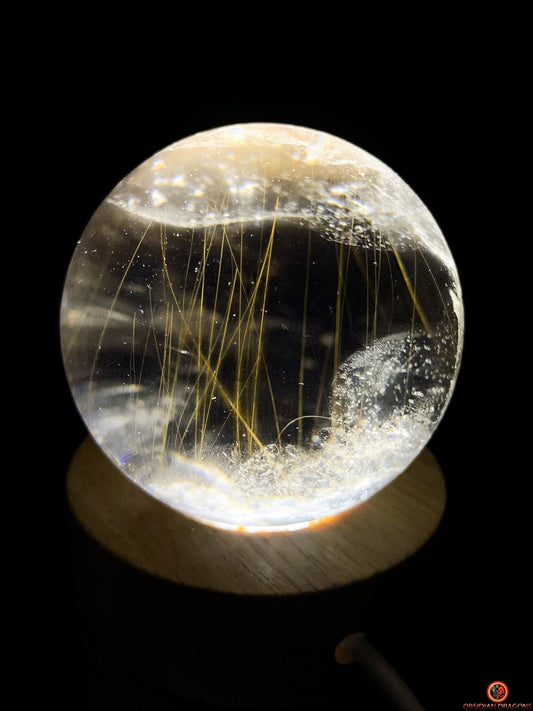
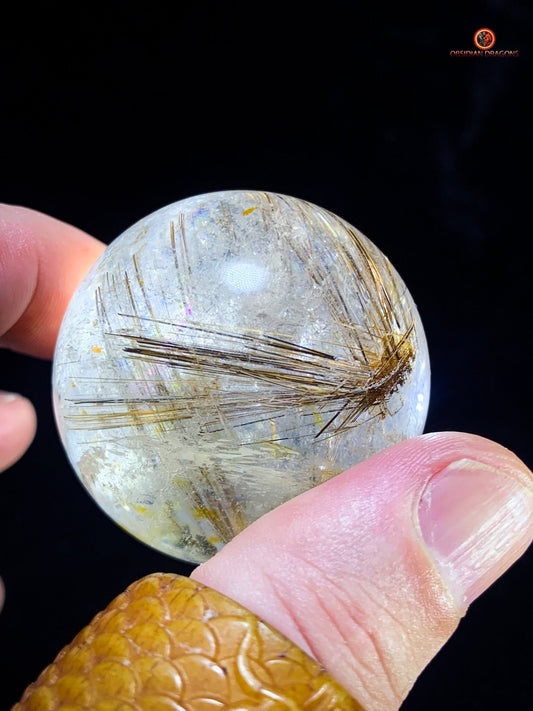
In a rutilated quartz ball, the spherical shape transforms these needles into a three-dimensional architecture. Some appear to traverse the entire stone. Others group into bundles, cross each other, or seem to float in the transparent material.
Rutile represents a distinct mineral phase, trapped during the growth of quartz. The value of the sphere then depends on the arrangement of the needles, their visibility, the transparency of the host quartz, the overall contrast, and the quality of the polishing.
In contemporary lithotherapy traditions, rutilated quartz is often associated with vitality, direction, and movement. Its needles evoke lines of force, flashes, or paths traversing a quieter material.
🌫️ Smoky Rutilated Quartz: Shadow Traversed by Gold
Smoky quartz is a variety of quartz whose shades can range from light gray to almost black brown. Its natural color is linked to the action of geological irradiation on certain defects in the crystal structure, particularly in the presence of aluminum traces. Artificial treatments also exist on the market, which makes the examination of the stone and the transparency of its description particularly important.
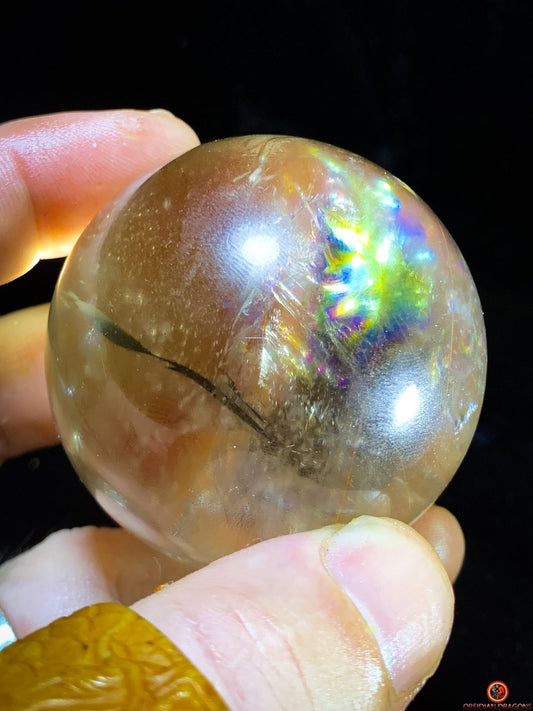
In a smoky rutilated quartz ball from Brazil, the luminous needles seem to emerge from a deep brown or gray. The contrast produces an almost alchemical image: metal seems to be born within the shadow.
Smoky quartz is traditionally associated with grounding, stability, and a return to concrete reality. Rutile, on the other hand, introduces a sense of direction and momentum. Their union can be interpreted as the image of a force capable of moving forward without losing its center.
A smoky rutilated quartz ball can be chosen as a meditation sphere, a spiritual decorative object, or a gemmological collector's piece. Its beauty does not rely on absolute transparency, but on how light penetrates a darkened material before encountering the inclusions.
🌿 Chlorite Quartz: An Inner Mineral Landscape
The word "chlorite" does not refer to a single mineral, but to a group of phyllosilicates whose shades are often green, grey-green, or brownish. When chlorites are included in quartz, they can form clouds, mosses, layers, silhouettes, or internal landscapes.
The expressions chlorite quartz, chloritic quartz, landscape quartz, and sometimes garden quartz or shaman quartz are used to describe these specimens. However, not all of them have a perfectly stable gemmological definition. The term "lodolite", in particular, should not be automatically applied to every rock crystal with chlorite.
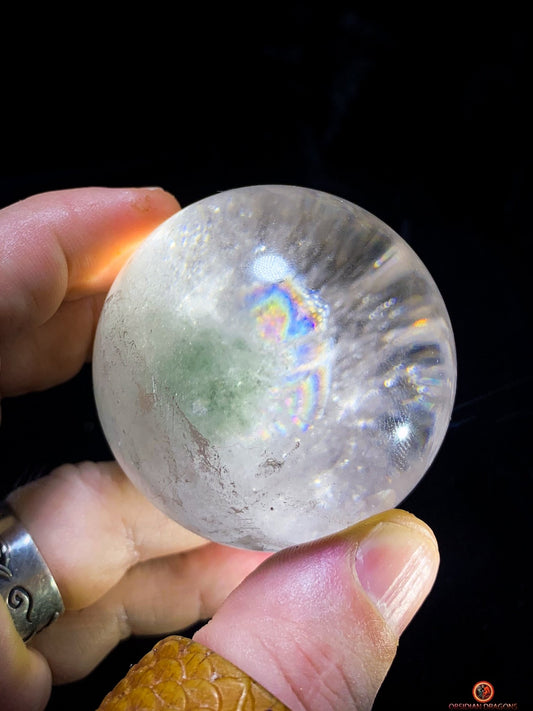
A crystal ball with chlorite inclusions and rainbow reflections combines two visual languages. The green inclusions give the impression of a vegetal or underwater landscape, while the internal fractures occasionally reveal spectral colors.
The natural chlorite quartz sphere can also be contemplated as a geological miniature. It does not imitate an external landscape: it is our imagination that recognizes forests, mists, or reliefs in a mineral organization that was not created for us.
In contemporary spiritual uses, chlorite is associated with purification, renewal, and connection to the plant world.
⚫ Rock Crystal with Tourmaline
Tourmaline refers to a complex family of borosilicates that can exhibit many colors. Some tourmalines included in quartz take the form of black, green, or dark crystals, sometimes elongated and clearly visible in the transparent material.
A rock crystal ball with tourmaline inclusions thus unites two mineral species within the same natural architecture. Quartz constitutes the host material, while tourmaline reveals a different stage of geological growth.
A black tourmaline is often called schorl in trade, while a green tourmaline can belong to different compositions. A rigorous determination may require more than simple visual observation.
The contrast between a dark inclusion and a transparent rock crystal has great graphic strength. The tourmaline seems to trace an axis, a fault, or a presence within the sphere.
In contemporary lithotherapy, black tourmaline is commonly associated with protection and grounding. Rock crystal is rather associated with clarity and symbolic amplification. Their association is then interpreted as a meeting between openness and limit, transparency and structure, expansion and protection.
🌸 Asteriated Rose Quartz and the Phenomenon of Asterism
Rose quartz is a variety of quartz whose colors range from very pale pink to more saturated tones. Its translucency and sometimes cloudy appearance are linked to very fine inclusions and the internal structure of the material.
Some properly oriented and polished rose quartz specimens reveal an optical phenomenon called asterism. Under a punctual light source, several luminous bands intersect and form a star, often with six rays. The star moves when the light, the observer, or the stone changes position.
The expressions asteriated rose quartz and star rose quartz describe this phenomenon. Asterism results from the organization of tiny rutile inclusions oriented within the stone and their interaction with light.
In contemporary traditions, rose quartz is associated with love, gentleness, relational appeasement, and the heart chakra. The star can symbolically represent a luminous center appearing within a cloudy material.
🏺 From Prestige Object to Divination Crystal Ball
Rock crystal has fascinated human societies since antiquity. Its transparency has long nourished the idea of a material located between water, ice, and stone. The Greek word krystallos referred to ice, and several ancient authors believed that rock crystal was frozen water that had become impossible to melt.
Artisans of different cultures used transparent quartz to craft vessels, seals, ornaments, religious objects, and lapidary works. Its hardness makes it difficult to work, while its transparency rewards precise polishing.
The ancient existence of spherical rock crystal objects does not, however, mean that all these pieces were used for divination. A sphere could be a prestige object, a natural curiosity, a lapidary work, or a decorative element.
In China, rock crystal balls mounted on stands are notably attested under the Qing dynasty. They testify to the interest in the transparency of quartz, the perfection of the spherical form, and the working of hard stones.
In Europe, the divinatory contemplation of a reflective or transparent surface took various forms. Water, mirrors, polished stones, dark discs, and crystals served as supports for what the English language calls scrying or crystal gazing.
One of the best-known examples belongs to the English Renaissance. John Dee, mathematician, astrologer, and advisor to Queen Elizabeth I, used various objects of contemplation with his mediums as part of spiritual and angelic research. Several pieces attributed to him are now preserved in museum collections.
In the 19th and 20th centuries, the image of the fortune-teller observing a luminous ball widely spread in posters, literature, theater, and cinema. The crystal ball then became one of the most immediately recognizable symbols of divinatory arts.
👁️ Crystallomancy, Scrying, and Crystal Contemplation
Crystallomancy refers to a practice of divination or visionary research based on the contemplation of a crystal. Scrying has a broader meaning: it can use a crystal ball, a dark mirror, a water surface, or any other support that favors the appearance of mental forms and images.
In this practice, the crystal is not necessarily considered a screen literally showing the future. It can function as a support for concentration, a visual threshold, or an object allowing one to momentarily divert attention from the external world.
Reflections, inclusions, blurred areas, and variations in light offer an open canvas for the imagination. The human brain spontaneously seeks shapes in ambiguous structures. Faces, landscapes, or movements can be perceived in the depths of the stone without objectively existing there.
This observation does not diminish the value of the experience. It simply allows us to understand that an inner vision can arise from the encounter between the crystal, light, memory, and the observer's state of attention.
🧘 Meditating with a crystal ball
A meditation sphere can be used without adhering to any particular belief. Its regular shape and internal depths offer a stable point of concentration. The gaze settles, breathing slows, and attention gradually returns to the present moment.
To meditate with a crystal ball, it is best to choose soft, indirect light. The sphere can be placed on a stable support, slightly below eye level. It is not necessary to stare intently at the stone or to seek a vision. Relaxed observation is sufficient.
Rock crystal is suitable for meditation focused on clarity and observation. Smoky quartz can symbolically support grounding work. Rutilated quartz introduces a sense of movement and direction. Chlorite quartz invites contemplation of organic forms. Asterated rose quartz places a moving star at the center of attention.
🌙 Lithotherapy, energy, and symbolic language
In lithotherapy, rock crystal is described as a symbolic amplifier, a stone of clarity, or a support for energy harmonization. Rose quartz is associated with love and inner peace, smoky quartz with grounding, rutilated quartz with vitality, and tourmaline with protection.
These interpretations constitute a symbolic language. They can help a person formulate an intention, structure a ritual, or give material presence to an inner process.
☯️ Crystal ball and Feng Shui
In Feng Shui practices, the sphere is associated with a regular circulation of Qi. Its continuous surface has no angles where movement would seem to stop. A Feng Shui crystal ball can be placed in a meditation space, office, or living room to introduce a stable, luminous, and balanced form.
This use should be distinguished from faceted crystals suspended in front of a window, which belong to another type of object and produce bright flashes of light in the room.
A sphere in Feng Shui practice can be chosen based on the relationship between its color and the desired atmosphere. Rock crystal visually brings transparency and light. Smoky quartz introduces more depth. Rose quartz creates a softer presence, while an inclusion quartz draws attention to the material's inner complexity.
Feng Shui is concerned with the relationship between a place, its uses, its orientations, its circulations, and the people who inhabit it.
🔍 Glass, K9 crystal, natural quartz, and synthetic quartz
Recognizing a genuine natural crystal ball may require more than visual inspection. Transparent glass can imitate rock crystal, while synthetic quartz can exhibit chemical and physical properties very similar to those of natural quartz.
Perfectly round bubbles can indicate glass, but their absence does not prove that the material is natural. Conversely, certain natural cavities or fluid inclusions can be mistaken for bubbles by an inexperienced observer.
Frosts, consistent mineral inclusions, and certain growth structures provide important information. However, identification may require a gemological loupe, a polariscope, a refractometer, a density measurement, or other appropriate methods.
It is not advisable to perform destructive tests by scratching or striking the sphere. A natural stone should not be damaged in an attempt to prove its authenticity.
K9 glass is an industrially manufactured optical glass. It can offer remarkable transparency and be a beautiful decorative object, but it should not be sold as natural rock crystal. Similarly, a synthetic quartz sphere must be described as such.
🔬 An Obsidian Dragons gemological selection
At Obsidian Dragons, selection is not based solely on transparency. A sphere may be chosen for an exceptional rutile network, a well-positioned tourmaline, a chlorite landscape, a mobile asterism, or frosts producing rainbow reflections.
Each stone is examined individually. The regularity of the sphere, the quality of the polish, the condition of the surface, fractures, inclusions, and the consistency of the appellation are all taken into account.
Gemological expertise is not automatically an individual laboratory report. When a specific certificate accompanies a piece, this information is on its product sheet. In other cases, the description presents the observations made and the relevant elements for understanding the material.
This distinction prevents confusing a stone expertly examined by a gemologist with a stone certified by an independent laboratory. The precision of words is part of the transparency we owe to collectors.
When a crystal ball is offered as a unique piece, the photographs present the actual specimen available. Natural inclusions make exact reproduction impossible. A sphere from the same deposit or of the same type of quartz will always possess its own inner landscape.
🧭 Buying a natural crystal ball: how to choose?
Choosing a crystal ball begins by defining the relationship you wish to have with it. A collector will observe the rarity of inclusions, their arrangement, origin, and gemological interest. Someone seeking a meditation sphere may prefer a stone whose color or inner landscape naturally favors their attention. For decorative use, dimensions, the stand, and how light passes through the material will become essential.
Transparency should not be the sole criterion. A very clear rock crystal can offer great optical depth, while a quartz rich in inclusions tells a more visible geological story. A tourmaline, rutilated, or chlorite quartz ball may be more sought after than a completely clear sphere when its inclusions form a remarkable composition.
Size profoundly alters the experience. A small crystal ball fits easily in the hand and can accompany close meditation. A medium sphere naturally finds its place on a desk, shelf, or altar. A large crystal ball becomes a true mineral presence and requires a stand proportionate to its weight.
The diameter must always be read with the weight. The mass of a sphere increases rapidly as its diameter grows. A few extra centimeters can therefore transform an easy-to-handle object into a much heavier mineralogical piece.
A crystal ball with a stand must rest on a sufficiently stable base. The diameter of the housing must match the sphere, and the material of the base should not risk scratching its surface. Some models come with a stand, sometimes illuminated, while others are sold alone. This information is indicated on each product sheet.
💰 Why does the price of a crystal ball vary?
The price of a crystal ball depends primarily on the quantity and quality of raw material required. The manufacture of a sphere involves a significant loss of material, as an irregular volume must be progressively reduced to a perfectly round shape.
Diameter strongly influences the price. As size increases, volume and weight progress much faster than the simple diameter. Large blocks of quartz healthy enough to be transformed into spheres also become more difficult to find.
Transparency, color, origin, potential treatments, the rarity of inclusions, the intensity of an asterism, and the quality of the polish also play a role. A well-centered asterated rose quartz ball, a rock crystal crossed by a remarkable tourmaline, or a smoky quartz rich in rutile needles cannot be valued like a uniform industrial sphere.
Value is therefore not determined by a supposed energetic power. It is based on the material, rarity, lapidary work, gemological interest, and visual singularity of the piece.
🏠 Where to place a quartz sphere?
A natural crystal sphere can be placed on a desk, in a library, on a personal altar, or in a meditation space. Its location should allow for observation without exposing it to shocks, vibrations, or the risk of falling.
A dark background highlights clear inclusions and rutile needles. Side lighting often reveals internal reliefs. Spot lighting allows observation of the asterism of rose quartz, while a soft light better showcases the veils of rock crystal.
However, direct and prolonged exposure to the sun should be avoided. A transparent sphere can act as a lens, concentrating light rays on a point and intensely heating nearby material. It should never be left in front of a window, on a sun-exposed sill, or near paper, textile, dry wood, or other flammable materials.
This precaution applies to both quartz balls and glass spheres. The beauty of a luminous object should never make one forget the physical laws governing light.
🧼 Cleaning and preserving a crystal ball
A quartz ball can generally be cleaned with a soft, slightly damp cloth, then dried immediately. Abrasive products, powders, hard brushes, and chemical cleaners are unnecessary and can alter the polish or leave residues.
A sphere with numerous internal fractures should be handled with care. Ultrasonic baths, steam cleaners, and sudden temperature variations should be avoided, as they can weaken certain fissures.
Salt should not be applied directly to the surface or introduced into fractures. Energy purification methods fall under personal beliefs and should never compromise the physical preservation of the stone.
The sphere should remain on a stable support or be stored in a padded box. Its round shape makes it particularly prone to rolling. A fall onto tiles or concrete can cause a chip, fracture, or complete breakage, despite the hardness of quartz.
❓ Frequently asked questions about natural crystal balls
What is a natural crystal ball?
A natural crystal ball is a sphere shaped from natural mineral material, most often quartz. The stone is natural, but its round shape results from cutting and polishing work.
What is the difference between a crystal ball and a quartz sphere?
A quartz sphere precisely describes the material and shape. The term "crystal ball" is broader and can also refer to a glass sphere used for decoration or divination. The product sheet should therefore always specify the actual composition of the object.
Is rock crystal actually quartz?
Yes. Rock crystal is the colorless and transparent variety of quartz. It has the same fundamental chemical composition, SiO₂, as rose quartz and smoky quartz.
What is the difference between rock crystal and glass?
Quartz has an ordered crystalline structure, while glass is amorphous. Their appearance can be similar, but their optical properties, density, behavior under polarized light, and inclusions generally allow them to be distinguished.
How to recognize a true natural crystal ball?
Appearance alone is not always enough. Natural inclusions, growth structures, and optical properties provide clues, but rigorous identification may require a loupe, polariscope, refractometer, or density measurement.
Why does my crystal ball have inclusions?
Inclusions are minerals, fluids, cavities, or structures trapped during quartz growth. They can document several stages of its geological history and make the sphere unique.
What is rutilated quartz?
Rutilated quartz is a quartz containing rutile crystals, often visible as needles. "Quartz with rutile inclusions" is the most precise gemological term.
What is chlorite quartz?
This is a quartz containing minerals from the chlorite group. These often greenish inclusions can form clouds, layers, or internal landscapes.
What is tourmalinated rock crystal?
It is natural quartz that has trapped one or more tourmaline crystals during its growth. Tourmaline can appear black, green, or other colors depending on its composition.
What is asterated rose quartz?
Asterated rose quartz reveals a luminous star when tiny oriented rutile inclusions interact with a pinpoint light source. The effect moves with the stone, light, or observer.
How to choose a crystal ball?
One must observe the material, diameter, weight, polish, inclusions, stand, and intended use. The best sphere is not necessarily the most transparent, but the one whose presence, dimensions, and inner landscape correspond to your search.
What size crystal ball should I choose?
A small sphere is suitable for handling and close meditation. An intermediate size easily fits on a desk or altar. A large sphere becomes an impressive collector's item and requires a sturdy base.
What is crystallomancy?
Crystallomancy is a practice of divinatory contemplation using a crystal as a medium. It belongs to the broader family of scrying, which can also employ mirrors or water surfaces.
Can a crystal ball really predict the future?
No evidence shows that a crystal ball can objectively see the future. It can serve as a support for intuition, imagination, meditation, or spiritual practice, without guaranteeing the truth of the visions or interpretations obtained.
How to use a crystal ball for meditation?
Place it on a stable support under soft light, then observe its surface or inclusions without straining your eyes. The objective can simply be to stabilize attention and accompany breathing.
Why is every natural crystal ball unique?
Inclusions, fractures, veils, color, and transparency result from a particular geological history. Two spheres from the same type of quartz will never present exactly the same inner landscape.
Can a crystal ball be placed in the sun?
A transparent sphere should never be left in direct sunlight. It can concentrate light like a lens, produce intense heat, and ignite nearby material.
How to clean a quartz sphere?
Use a soft, slightly damp cloth, then dry the stone. Avoid abrasives, chemicals, ultrasonics, steam, and thermal shocks, especially when the quartz has internal fractures.
🔮 Discover your natural crystal ball
Choosing a natural crystal ball means choosing a material whose depth is never revealed in a single observation. Rock crystal plays with transparency, smoky quartz retains light, rutile traces its needles, chlorite composes landscapes, tourmaline introduces a mineral presence, and asteriated rose quartz reveals a moving star.
Each sphere can be viewed as a gemological object, a lapidary work, a meditation aid, a divinatory crystal ball, or a silent presence in a personal space.
Explore our collection of natural crystal balls, observe the dimensions, weight, inclusions, origin, and stand of each model, then let the light show you what a photograph cannot fully reveal.