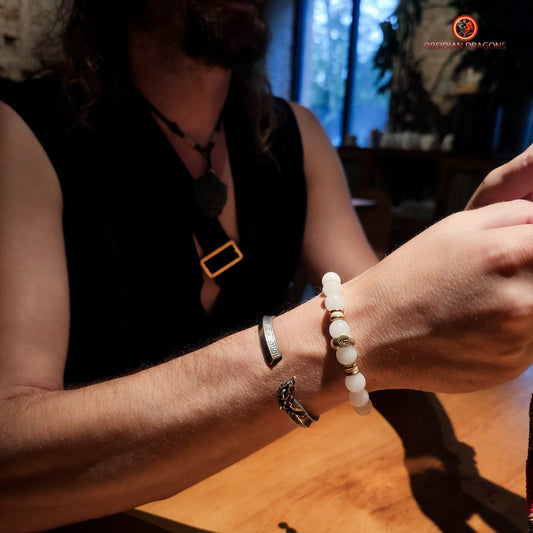
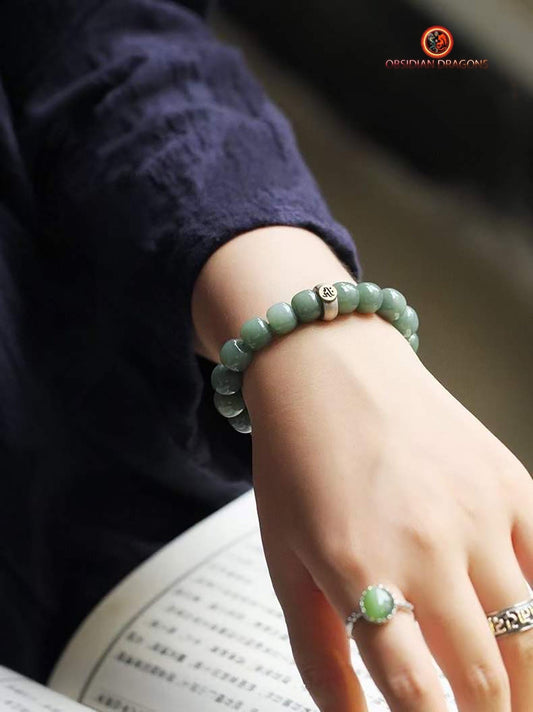
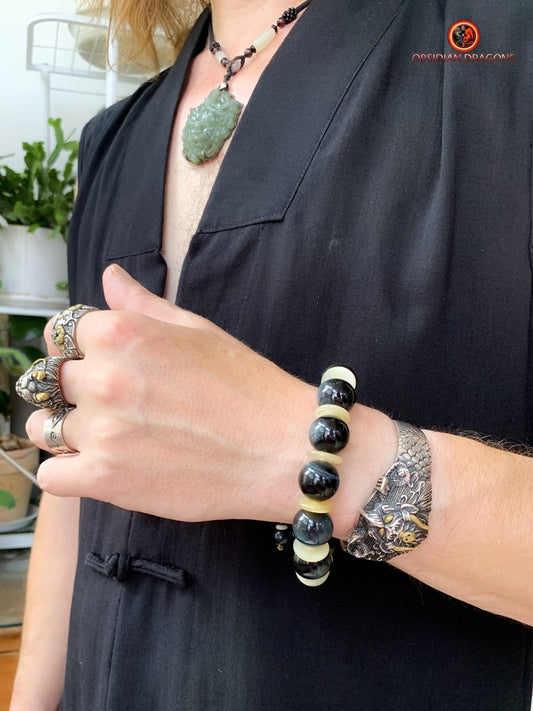
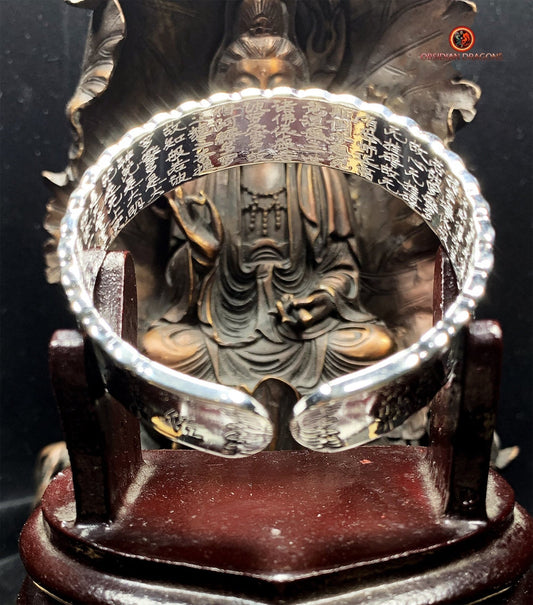
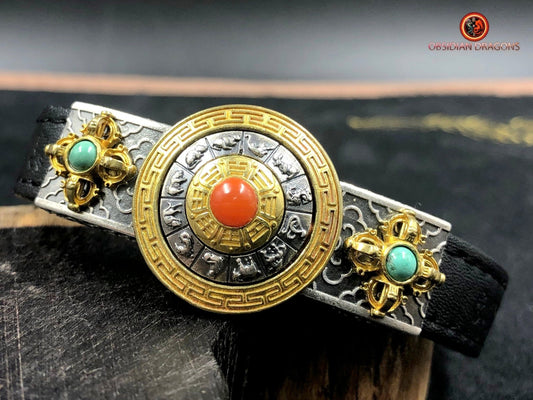
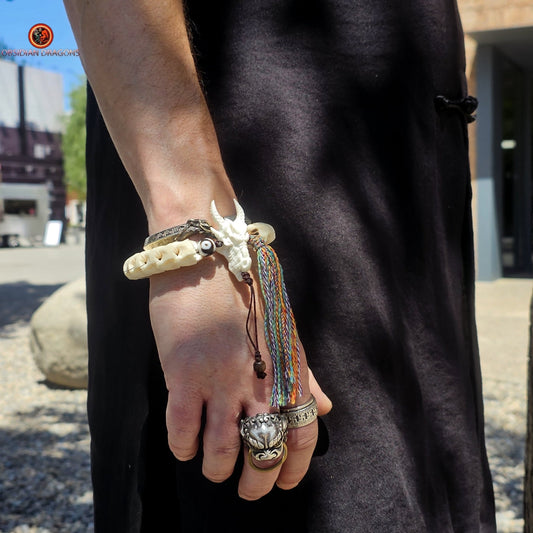
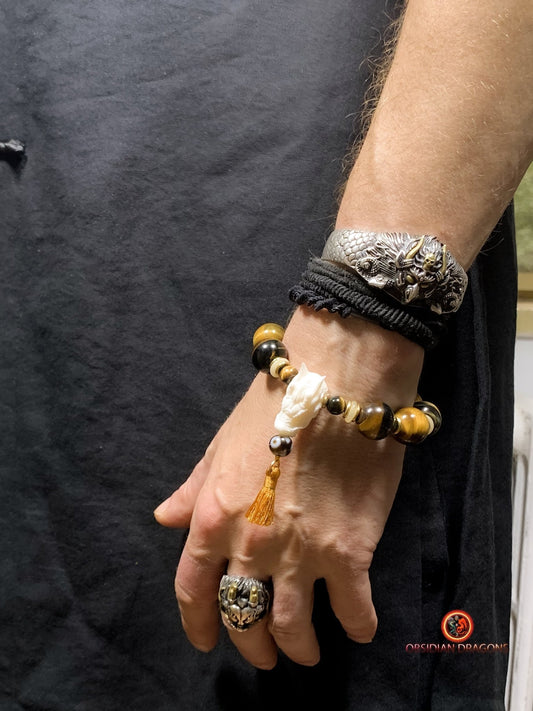
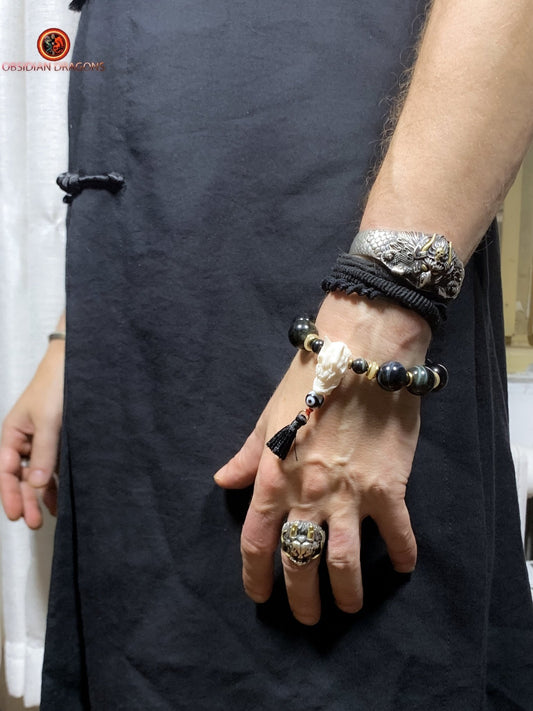
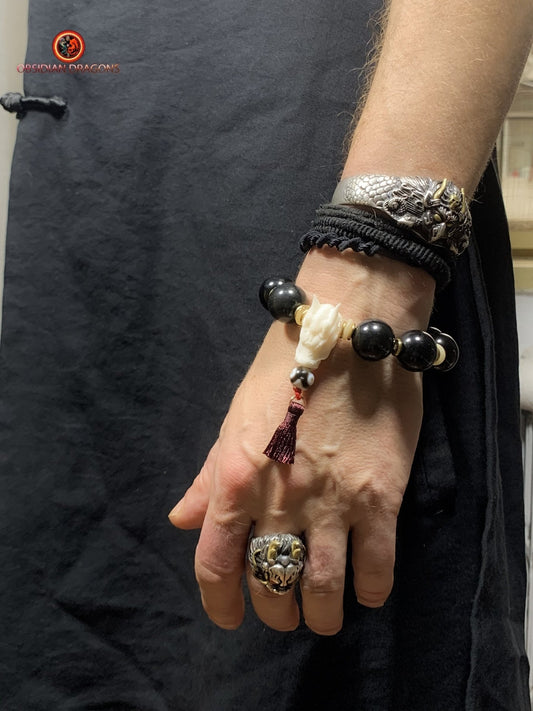
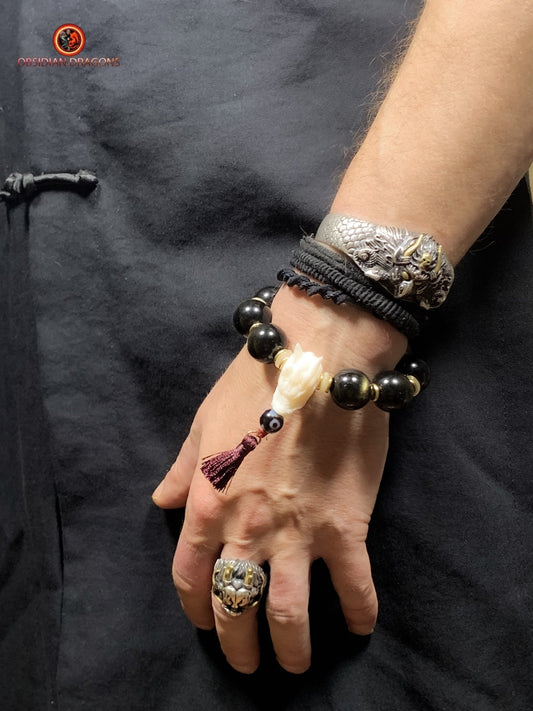
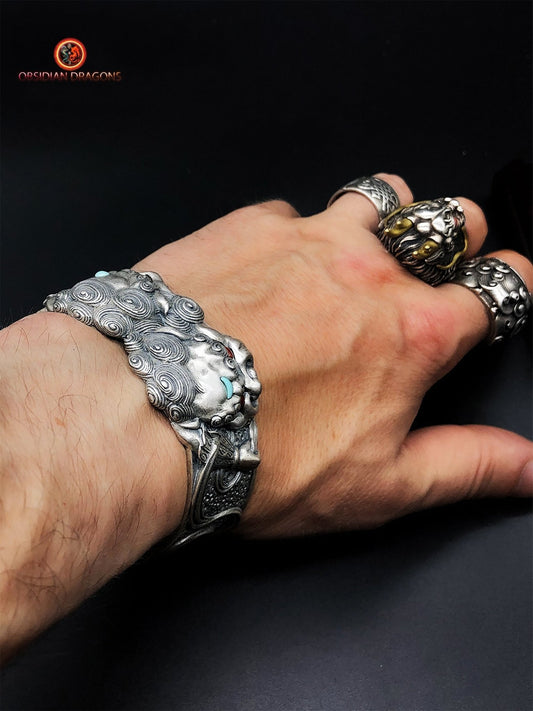
💎 Handcrafted bracelets in natural stones, 925 silver and fine materials: expert-certified gemstones, Buddhist malas, Feng Shui talismans and spiritual jewelry
A bracelet accompanies the hand. It moves with the hand, catches the light, touches the skin.
When it brings together a natural stone, crafted metal, an organic or plant-based material and a carefully chosen symbol, it becomes a personal creation at the intersection of material, craftsmanship and intention.
The Obsidian Dragons natural stone bracelet collection brings together very different pieces of jewelry: natural bead bracelets, mineral bangles, silver cuffs, wrist malas, Buddhist bracelets, Feng Shui bracelets, dragon creations, pieces adorned with skulls, jewelry made of wood, seeds, bone, horn, mother-of-pearl, amber or mammoth ivory. Some designs are understated and entirely focused on the beauty of a single gemstone. Others take the form of true wearable sculptures, imbued with references to Buddhism, Taoism, Chinese arts or memento mori.
Some pieces are created and assembled directly by Obsidian Dragons. Others are born from collaborations with specialized workshops. Others still are selected from artisans whose expertise, materials and aesthetic align with our approach. Each product page specifies, as far as possible, the composition, dimensions, weight, assembly method and nature of the creation.
As the creator of Obsidian Dragons and a gemmologist graduated from the National Institute of Gemmology in Paris, I examine and select the stones, taking into account their gemmological consistency, quality, appearance and observable treatments.
⚒️ The bracelet, from ancient adornment to contemporary creation
The bracelet belongs to the oldest forms of adornment. Long before modern jewelry, human societies wore shells, bones, teeth, seeds, polished stones and metal elements around their wrists. Depending on the place and period, these objects may have signaled belonging, rank, alliance, ritual protection or simply a taste for adornment.
Our bracelets result from the meeting of several heritages: modern assembly techniques, Asia-inspired sculptures, beads from international trade, meditative practices and personal aesthetic research.
At Obsidian Dragons, this tension between the ancient and the contemporary is part of the creative process. A silver dragon head can be paired with Mexican obsidian; a Buddhist motif carved in deer antler can meet Hetian nephrite jade; a Burmese amber bead can become the center of a Qing dynasty-inspired Shibazi bracelet. The coherence comes from the precision with which materials, symbols and techniques are brought together.
🛠️ Obsidian Dragons creations, collaborations and unique pieces
Some bracelets are designed and assembled directly by us. The stones, beads, sculptures and metal elements are then brought together to create a new composition. Other pieces of jewelry are developed in collaboration with specialized workshops capable of working with silver, cloisonné, jade, deer antler or other materials requiring a particular technique.
Finally, some pieces are selected for the quality of their stone or craftsmanship.
A handcrafted artisanal bracelet will necessarily have small variations. A sculpture may have a slightly different expression, a natural bead has its own inclusions, and a hand-woven design will never look exactly like an industrial production.
The terms "unique piece," "small series," "exclusive creation" and "custom-made" are used according to the reality of each model. A personalized bracelet can be adapted to the wrist circumference, available materials and the client's aesthetic intention. A truly unique piece cannot be reproduced identically when its stones or sculptures exist in only one copy.
🔬 Natural stones, semi-precious stones and gemstones: choosing the right words
The expression natural stone bracelet is commonly used to refer to a piece of jewelry composed of beads, cabochons or carved elements made from a material formed in nature. In gemmology, the term "gemstone" allows us to group together mineral, organic or rock materials used for their beauty, relative rarity, durability or workability.
The expressions "semi-precious stones" and "ornamental stones" belong to traditional jewelry vocabulary. The term "semi-precious stones," still highly searched on the internet, is based on an old commercial hierarchy that pits a few so-called precious stones against all others. This classification does not reflect the true diversity of gemstones. A remarkable piece of obsidian, high-quality nephrite jade, natural turquoise or exceptional agate do not become secondary just because they do not belong to a restricted historical category.
A natural stone may nevertheless have been heated, dyed, impregnated, stabilized, irradiated, filled or reconstituted. The word "natural" describes its origin, but does not preclude checking for treatments. Stabilized turquoise remains of natural origin, while having undergone an intervention intended to improve its strength. Colored agate must be presented as such when the treatment is known. A synthetic material has a laboratory origin, even if it shares a composition close to that of a natural gemstone. An imitation merely reproduces the appearance of another material.
This distinction is essential for choosing an authentic natural stone bracelet. A loupe, microscope, density measurement, refractometer, polariscope, observation of spectra or inclusions may be necessary. Some identifications and treatments also require more advanced laboratory analysis.
🧭 How to choose a natural stone bracelet?
The choice begins with the material. A person attracted by deep blacks and shifting reflections may turn to an obsidian bracelet. Jade will suit those looking for a soft polish and a strong connection to Chinese culture. Rock crystal favors transparency, amethyst purple depth, turquoise the contrast of blue, and agate the richness of patterns.
The construction comes next. A bead bracelet follows the movement of the wrist. A bangle maintains a rigid shape. A cuff asserts its presence even more. A bracelet mounted on a cord can offer precise adjustment, while an elastic band makes it easier to put on but must remain proportional to the weight of the beads.
To measure your wrist circumference, use a flexible tape without pulling it too tight. You must then add the desired ease, taking into account the internal volume occupied by large beads. Two bracelets of the same apparent length can offer very different comfort if one is made of 8 mm beads and the other of 16 mm beads.
A natural stone bracelet for a wide wrist must be designed with sufficient length and an assembly capable of supporting its weight. The dimensions indicated on each product page are therefore more useful than photographs alone.
Finally, observe the coherence of the whole. The value of a high-end bracelet rests on the harmony of colors, the quality of the sculptures, the choice of proportions, the strength of the cord, the finish of the perforations, and the symbolic accuracy of the composition.
🌌 Natural obsidian bracelets
Obsidian is a natural volcanic glass, generally originating from silica-rich magma whose viscosity and cooling conditions limited the formation of an ordered crystalline structure. It is therefore not a crystal in the mineralogical sense, even though it is frequently sold in the trade under the general term "crystal."
A natural obsidian bracelet can be composed of round beads, polished slabs, carved elements, or a bangle carved from the mass. Black obsidian visually absorbs light and creates a powerful contrast with silver, copper, or deer antler. Silver obsidian and golden obsidian reveal reflections produced by internal microstructures that become visible when the stone and light source are correctly oriented.
The commercial term "Celestial Eye obsidian" refers to certain reflective obsidians featuring colored or concentric zones. On a Celestial Eye obsidian bracelet, each bead reacts differently as the wrist turns. An area that appears almost black from one angle may reveal a green, purple, golden, or silver ring from another. Quality depends on the material, but also on the orientation of the cut and polishing.
The Mexican Celestial Eye obsidian bracelet holds a special place in the Obsidian Dragons universe. It can take the form of a bead bracelet, an obsidian bangle, or a creation combining the stone with a silver dragon head. In contemporary lithotherapy practices, obsidian is linked to introspection, grounding, and protection. These correspondences belong to spiritual traditions and do not constitute proven medical effects.
To learn more about its formation, deposits, history, imitations, and uses,
consult our study on obsidian, its formation, its history, its counterfeits, and its place in lithotherapy.
🟢 Nephrite jade bracelets and Chinese culture of yu
The word "jade" mainly covers two large gemmological families: jadeite, belonging to the pyroxene group, and nephrite, belonging to the amphibole group. Their composition differs, but their particularly tough texture has allowed for the manufacture of adornments, ritual objects, symbolic weapons, and sculptures for millennia.
In China, the character yu 玉 possesses a broader cultural field than the jade defined solely by modern gemmology. It evokes a material worthy of being polished, contemplated, passed down, and associated with human qualities. In Confucian texts, jade was likened to rectitude, moderation, benevolence, and continuity. Its value is therefore not solely linked to its color: texture, touch, translucency, craftsmanship, and cultural history also contribute to its appreciation.
A natural jade bracelet can be made of white, green, yellow, brown, or variegated nephrite jade. Hetian jade, or Hetian Yu, historically refers to a cultural and geographical area linked to Xinjiang and the Kunlun Mountains. Today, this term may be used more broadly on the Chinese market; it should therefore not replace the gemmological identification of the material.
The Hetian nephrite jade bracelet is distinguished by a soft polish and a less brilliant presence than that of a transparent gemstone. Its beauty rests on the depth of the texture, the color transitions, and the tactile sensation of the material. A jade and silver bracelet, a jade mala bracelet, or a Shibazi bracelet can combine this mineral continuity with Buddhist or Chinese motifs.
Jade can receive different treatments. Jadeite is traditionally classified in certain markets according to the impregnations, colorations, or whitenings it has undergone. Nephrite can also be dyed or imitated by other rocks. The examination of the structure and the transparency of the description are therefore more important than a simple commercial promise.
🔮 Quartz, rock crystal, amethyst, and other varieties
Quartz is crystallized silicon dioxide. Its family includes colorless rock crystal, purple amethyst, rose quartz, smoky quartz, and numerous materials with inclusions. A natural quartz bracelet allows us to observe a great variety of transparencies, zonations, and internal phenomena.
Rock crystal can be perfectly clear, veiled by fractures, enriched with growth ghosts, or traversed by inclusions. Amethyst owes its color to colored centers linked notably to the presence of iron in the crystal lattice and to natural irradiation. Natural citrine is less common than heated amethysts marketed under this name; the exact nature of each stone must therefore be appreciated with caution.
Solid rose quartz owes its color mainly to very fine fibrous inclusions of a silicate related to dumortierite. In some specimens, acicular rutile inclusions oriented along several crystallographic directions can produce visible asterism on a properly oriented and polished curved surface.
A rock crystal bracelet, a rose quartz bracelet, a smoky quartz bracelet, or an amethyst bracelet does not express light in the same way. Rock crystal plays with transparency, rose quartz diffuses a soft clarity, smoky quartz filters reflections, and amethyst introduces a purple depth. Their choice can be aesthetic, symbolic, or meditative, but also based on their virtues for lithotherapy practitioners.
🔵 Agate, DZI, turquoise, malachite, and character stones
Agate is a banded chalcedony whose patterns result from successive siliceous deposits. Its colors can be natural or modified by different processes. Nan Hong agate, appreciated in China for its red and orange tones, belongs to the chalcedony family. Its colors are mainly associated with fine iron oxide inclusions, and not with the presence of cinnabar as some commercial descriptions sometimes claim.
DZI are agate beads adorned with motifs interpreted in Tibetan and Himalayan cultures. Their market brings together ancient beads, contemporary productions, treatments, and very different qualities. A DZI bracelet or a Tibetan agate bracelet must be described precisely: age, origin, and ritual character, eyes, bands, tiger's teeth, and other designs possess a strong symbolic dimension.
Turquoise is a hydrated copper and aluminum phosphate. Its color varies from blue to green and can be traversed by a brown or dark matrix. Stabilization, impregnation, dyeing, and imitations are common. A natural turquoise bracelet, especially when it uses Hubei turquoise, must therefore be evaluated according to its actual material and any treatments.
Malachite is a copper carbonate recognizable by its green bands. It is relatively soft and sensitive to acids. Lapis lazuli is a rock composed of several minerals, including lazurite, responsible for its blue, often accompanied by calcite and pyrite. Charoite is a purple material with fibrous movements, while amazonite generally belongs to the microcline feldspar group. Diopside, carnelian, onyx, garnet, labradorite, moonstone, tourmaline, hematite, and pyrite each bring a particular structure, color, and resistance.
Tiger's eye and hawk's eye reveal a shifting chatoyancy linked to their fibrous organization. Pietersite presents fragments and fibers creating movements that can evoke a storm sky. In a bracelet, these stones naturally come alive to the rhythm of the wrist.
⚙️ 925 silver bracelets, cuffs, and crafted metals
A 925 silver bracelet is made of an alloy containing 92.5% silver. The other metals, generally dominated by copper, improve its mechanical strength. This alloy is suitable for dragon heads, clasps, carved elements, bangles, and cuffs regularly handled.
The expression "solid silver bracelet" indicates that the element concerned is made of a silver alloy throughout its thickness, as opposed to a layer deposited on a common metal. It does not mean that the jewelry contains 100% silver or that it does not contain any other material. A silver and natural stone bracelet can bring together 925 silver, copper, cord, jade, obsidian, turquoise, or amethyst in the same composition.
Silver tarnishes upon contact with sulfur compounds present in the air, on the skin, or in certain products. This transformation is normal. Controlled oxidation can even be used by the artisan to darken the recesses and make the scales, mantras, or motifs of a cuff more legible.
Copper, bronze, and brass have warmer colors and also develop a patina. Golden elements must be distinguished from solid gold. Gilding, plating, gold-colored metal, gold-plated silver, and vermeil do not designate the same composition. Cloisonné enamels add an architecture of metal and color, particularly suited to creations inspired by the Chinese ornaments of the Qing dynasty.
The silver cuff bracelet offers a different presence from a beaded bracelet. Its width, weight, and rigidity must suit the wrist. A cuff should not be opened and closed abruptly with each use, as this risks weakening the metal. A bangle, a rigid bracelet, and a cuff are therefore not chosen solely by their apparent diameter, but by their opening, their inner shape, and their actual adjustability.
🦴 Bone, horn, antler, and mammoth ivory
Organic materials of animal origin have very different structures. Bone is a mineralized tissue combining mainly a phosphate phase with an organic matrix. Horn is composed mostly of keratin. Antler, despite its name, is not a plant material: it is a bony tissue developed and then renewed by the animal.
A carved bone bracelet, a buffalo bone bracelet, or an antler bracelet allows for particularly expressive relief work. Skulls, dragons, Mahakala, Ganesh, animals, and symbols can be carved on small volumes. The surface can be left light, tea-patinated, polychrome, or darkened to make the hollows stand out.
Mammoth ivory is dentine from the fossilized tusks of extinct mammoths. It should never be confused with contemporary elephant ivory. Mammoth molars have a different structure, alternating zones of dentine, enamel, and cementum whose patterns become visible after cutting and polishing. A mammoth molar bracelet can thus reveal naturally complex patterns.
These materials require transparency about their nature and stated origin.
Mother-of-pearl lines the inside of certain shells and is composed notably of aragonite platelets organized in an organic matrix. Its orientation produces changing reflections. Amber is a fossilized plant resin, not a mineral sap. A natural amber bracelet may show yellow, orange, brown, red, or lighter shades depending on its origin and geological history.
🌿 Wood, seeds, and plant materials
Wood brings a warmth and lightness to the bracelet that differs from that of stone. Red sandalwood, dark sandalwood, ebony, and other woods can be turned, polished, carved, or patinated. Their grain, density, and eventual fragrance vary considerably.
A natural wood bracelet evolves in contact with the skin. It can darken, become satin-finished, and acquire a patina. This transformation is not necessarily an alteration: it can become the trace of wear. However, water, perfumes, oils, and sudden humidity changes must be avoided.
Bodhi seeds, rudraksha seeds, and other plant seeds are used in different Asian religious contexts. Not all seeds commercially called "lotus" necessarily come from the botanical lotus. Their identification sometimes requires more caution than traditional trade names suggest.
A wooden mala bracelet or a sandalwood wrist mala can be used to accompany a recitation, count mantras, or simply remind one of a practice. The spiritual value lies in the use, attention, and continuity of the relationship with the object.
📿 Mala bracelet, wrist mala, and 18-bead Shibazi
The mala is a recitation instrument used in several traditions of India and Asia. Its complete form often includes 108 beads, to which a Guru bead, counter beads, counters, or symbolic elements may be added. A wrist mala generally has fewer beads and should not be automatically confused with a full 108-bead mala wrapped around the arm.
A mala bracelet can be strung on a traditional sliding knot cord or an elastic cord. Its strength depends on the thread, the diameter of the holes, the weight of the elements, and the quality of the assembly.
To understand the origin of the Buddhist rosary, the number 108, and the different uses of recitation,
consult our dossier dedicated to the mala, its origin, its meaning, and its use.
The Shibazi, literally linked to the number eighteen, belongs to the history of Chinese court bracelets and rosaries. Under the Qing dynasty, eighteen-bead compositions could combine gemstones, jade, amber, coral, pearls, seeds, metal, and suspended elements. Obsidian Dragons' creations are directly inspired by this aesthetic.
An 18-bead Shibazi bracelet can bring together white and green Hetian nephrite jade, Burmese amber, gold-plated silver, cloisonné enamel, and the shòu symbol of longevity. Other models create a dialogue between this structure and Yamantaka, Acala, or antler carvings. They thus become self-aware intercultural creations, nourished by Chinese history, Buddhist iconography, and the contemporary eye of the creator.
☸️ Buddhist bracelets, mantras, and protective figures
A Buddhist bracelet can carry a mantra, a vajra or dorje, a Dharma wheel, a seed syllable, a Buddha, a bodhisattva, or a protective deity.
Mahakala, Acala, Yamantaka, and Guru Rinpoche belong to distinct and complex religious contexts. They are not mere protective mascots. Mahakala can appear as a protector of the Dharma in several traditions. Acala, the Immovable expresses a stability capable of overcoming obstacles. Yamantaka manifests, in tantric Buddhism, the victory of wisdom over death and ignorance. Guru Rinpoche, Padmasambhava, occupies a central place in the history of Tibetan Buddhism.
A Mahakala bracelet, an Acala bracelet, or a Yamantaka bracelet can accompany a practice or remind one of an inner quality. It can also be chosen for the power of its carving.
The Buddhist prayer bracelet remains above all a support. The beads can help maintain attention, pace a recitation, and embed a practice in the body. Wearing a Buddhist bracelet without being a practitioner is not necessarily disrespectful, provided one understands the figures represented and does not reduce their tradition to a commercial promise of luck.
☯️ Feng Shui, Taoist bracelets, and Chinese symbols
Feng Shui is first and foremost a set of traditions dedicated to the observation of landscapes, orientations, shapes, and the circulation of Qi in an environment. A Feng Shui bracelet does not organize a place as a traditional study would. It transposes certain symbols into a personal and wearable object.
The Bagua, composed of eight trigrams, refers to the transformations described by the Yijing. The Pixiu belongs to the auspicious Chinese bestiary and was gradually associated with guarding wealth. The character shòu 寿 evokes longevity. Auspicious clouds, bats, the lotus, ancient coins, and endless knots form a visual vocabulary whose meanings have evolved over time.
The Chinese dragon is linked to water, rain, clouds, authority, and transformation. A Feng Shui dragon bracelet can symbolize movement, vigilance, or adaptability.
To explore this figure further,
discover our article dedicated to the dragon in Feng Shui, its strength and energy,
as well as our collection of handcrafted dragon bracelets in silver and natural stones.
A Taoist bracelet can be inspired by trigrams, talismans, popular deities, cosmic patterns, or figures such as Hei Bai Wuchang.
💀 Skulls, snakes, and memento mori
The skull reminds us that every form is subject to time. In the Western tradition of memento mori, it invites us to remember death in order to become more aware of life. In tantric Buddhist iconography, bones evoke impermanence, transformation, and the overcoming of attachment to appearance.
A skull bracelet in silver, bone, antler, or crystal therefore does not have a single meaning. It can relate to fantasy, gothic aesthetics, meditation on impermanence, or a strictly personal interpretation. The dragon adds a dimension of power and metamorphosis; the snake can evoke molting, the cycle, or transmutation.
✨ Lithotherapy, energy, and symbolic protection
Many people seek a bracelet for lithotherapy, an energy bracelet, a grounding bracelet, or a spiritual protection bracelet. These contemporary uses deserve to be approached without disdain, but also without confusing personal conviction with scientific knowledge.
Stones have measurable physical properties: chemical composition, structure, hardness, density, cleavage, color, refractive index, conductivity, or magnetism. The emotional and energetic virtues attributed to gemstones, on the other hand, stem from traditions, symbolic systems, and subjective experiences. They do not constitute proven medical treatments.
A spiritual bracelet can nevertheless play a real role in a personal journey. It can become a tactile reminder, a point of concentration, a meditation aid, or the sign of an inner commitment. This role does not come from an automatic promise inscribed in the material. It is born from the attention paid to the object and the practice it accompanies.
A talisman bracelet, an amulet bracelet, or a lucky bracelet must therefore be understood symbolically. No jewelry can guarantee healing, financial success, luck, protection against an accident, or the disappearance of psychological suffering. The stone can accompany an intention; it replaces neither a doctor, nor a treatment, nor a concrete decision.
👤 Men's bracelet, women's bracelet, or unisex creation
A stone, a dragon, a mantra, or a cuff has no natural gender. Searches for "men's natural stone bracelet" generally lead to large beads, dark colors, oxidized metals, and powerful volumes. Searches for "women's natural stone bracelet" often favor thinner diameters, bright colors, and lightweight constructions. These commercial trends are not rules.
A men's obsidian bracelet can perfectly be worn by a woman; a white jade bracelet presented as feminine can suit a man. The unisex natural stone bracelet is the one whose dimensions, weight, shape, and aesthetics match the person who chooses it.
The diameter of the beads strongly changes the presence of the jewelry. 6 or 8 mm beads generally remain more discreet than 14 or 16 mm beads. A carved head, a Guru bead, or a wide cuff can also make the bracelet more imposing. Comfort must always take precedence over an arbitrary classification.
🧼 Caring for a stone, silver, wood, or organic material bracelet
Remove your bracelet before showering, bathing, swimming, exercising, gardening, or doing manual work. Chlorine, salt, detergents, perfumes, cosmetics, and perspiration can weaken the threads, tarnish the metals, or alter certain porous materials.
Stones do not all have the same resistance. Quartz withstands scratches better than turquoise, malachite, amber, or mother-of-pearl. Obsidian has decent hardness, but its glassy nature makes it brittle in case of impact. A stone bangle can break if it falls on tile.
Clean the silver with a suitable soft cloth, without aggressively polishing the intentionally oxidized parts. Avoid chemical baths on a piece of jewelry combining several materials. Wood, bone, horn, antler, amber, and mammoth ivory should not be left in water or exposed to excessive heat.
Energy purification methods belong to personal practices. Salt, water, the sun, and fumigation are not suitable for all materials. Salt can attack metals and penetrate pores; the sun can alter certain colors; water can damage a cord or an organic material. The physical preservation of the bracelet must always take precedence over a ritual incompatible with its composition.
Store each piece of jewelry separately in a pouch or case. A hard stone can scratch a softer material, and a heavy cuff can break a beaded bracelet if the two are carried together.
❓ Frequently asked questions about natural stone bracelets
How to recognize a genuine natural stone bracelet?
The visual appearance provides clues, but does not always allow for certain identification. Inclusions, structure, density, optical properties, and reactions to gemmological instruments must sometimes be examined. A high price, a cold touch, or an irregular color do not in themselves constitute proof of authenticity.
What difference is there between natural stone, synthetic stone, and imitation?
A natural stone formed without human manufacturing, even if it may have received a treatment. A synthetic stone is produced in a laboratory with a composition and structure corresponding to a natural equivalent. An imitation merely reproduces the appearance of a gemstone with another material, such as glass or resin.
What difference is there between fine stone and semi-precious stone?
"Semi-precious stone" belongs to an old commercial classification still very present in searches. Current gemmological vocabulary prefers to speak of gemstones, fine stones, ornamental stones, or, even better, use the precise name of the material.
Do all bracelets have a certificate?
No. The selection and gemmological examination do not mean that an individual report automatically accompanies each piece of jewelry. When a certificate is provided, this information appears on the product sheet.
How to choose the size of your bracelet?
Measure the wrist with a flexible tape, then take into account the desired ease and the diameter of the beads. A large bead reduces the inner diameter more than a small one. Always consult the dimensions specific to the relevant sheet.
Are bracelets adjustable?
Some bracelets use a sliding knot, an extension chain, or an adjustable structure. Others are mounted on elastic or have a fixed size. A cuff should only be bent within the limits allowed by its construction.
Is a natural stone bracelet reserved for men or women?
No. Color, width, weight, and bead diameter are more relevant criteria than commercial gender. Most creations can be considered unisex as long as the size is suitable.
What is a wrist mala?
It is a bracelet inspired by the mala used for recitation and meditation. Its number of beads varies according to traditions and uses. It can be used to count repetitions, support focus, or simply be worn as a reminder of a practice.
What is a Shibazi bracelet?
The Chinese term refers to a composition of eighteen beads. Shibazi were notably present in the world of court jewelry and accessories during the Qing dynasty. Contemporary creations draw inspiration from them by combining jade, amber, metal, enamel, and symbolic elements.
On which wrist should a spiritual bracelet be worn?
There is no universal rule applicable to all traditions. The choice may depend on comfort, practice, the dominant hand, or an instruction specific to a lineage. In the absence of a precise rule, wear it on the wrist where it naturally accompanies your movements.
Can you wear a Buddhist bracelet without being Buddhist?
Yes, provided you do so with respect and seek to understand the figures or mantras represented. The jewelry does not automatically confer a religious quality and does not replace practice.
Is antler really wood?
No. Antler is a material of animal origin composed of bony tissue. Its French name can be misleading, but it is not a plant-based material.
Is mammoth ivory the same as elephant ivory?
No. It comes from the fossilized tusks of extinct mammoths. It must be explicitly described as mammoth ivory and may remain subject to import or trade regulations that vary by country.
Can you get a natural stone bracelet wet?
It is best to avoid it. Even when a stone is water-resistant, the thread, cord, elastic, metals, or organic materials associated with it can be damaged. Some porous or fragile gemstones also do not tolerate prolonged immersion well.
Why does 925 silver tarnish?
Silver reacts notably with sulfur compounds present in its environment and forms a dark patina. This natural oxidation does not mean that the jewelry is fake. It can be removed with proper care or preserved when it deliberately highlights the contours.
Can you order a custom bracelet?
Yes. Some creations can be adapted or made to order depending on the availability of the stones, carvings, and components. A custom project must take into account the wrist circumference, weight, assembly strength, and the coherence of the chosen materials.
How to choose a bracelet as a gift?
First, observe the person's style and wrist circumference. Then, choose a material or symbol that has real meaning for them. A well-proportioned bracelet that is clearly described constitutes a more thoughtful gift than a general promise of luck or healing.
🐉 Choose a genuine material and a freely embraced symbol
A bracelet can be discreet or monumental, mineral or organic, luminous or dark. It can combine jade with amber, obsidian with silver, turquoise with antler, quartz with copper, or sandalwood with a Buddhist sculpture. What gives a creation its coherence is not the accumulation of materials, but the quality of their combination.
The Obsidian Dragons natural stone bracelet collection is aimed at gemstone enthusiasts, collectors, meditation practitioners, and those seeking a handcrafted piece of jewelry with a strong identity. 925 silver bracelet, mala bracelet, Shibazi bracelet, dragon bracelet, Feng Shui bracelet, Buddhist bracelet, skull bracelet, or simple strand of natural beads: each form offers a different way to inhabit movement.
Take the time to examine the stone, dimensions, weight, assembly, and meaning of each model. Choose a piece of jewelry whose material is described transparently and whose symbol accompanies your own path without ever confining it.