-
dragon skull - handmade - amazonite - unique
Regular price $108.00 USDRegular price -
dragon skull - handmade - amazonite - unique
Regular price $127.00 USDRegular price -
Dragon Skull - Handcrafted - Quartz Geode - Unique
Regular price $77.00 USDRegular price

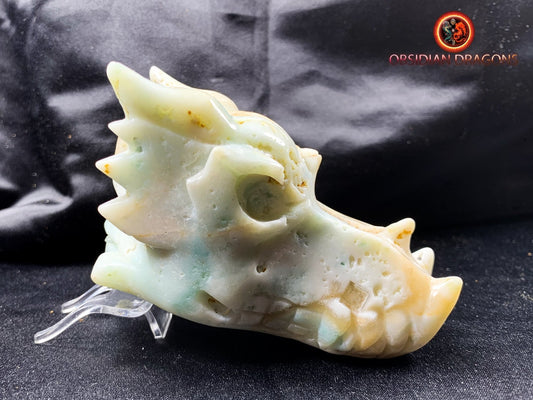

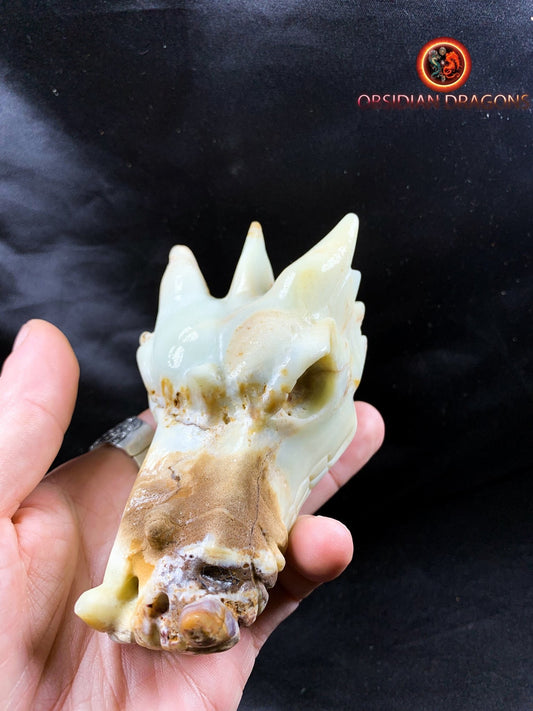

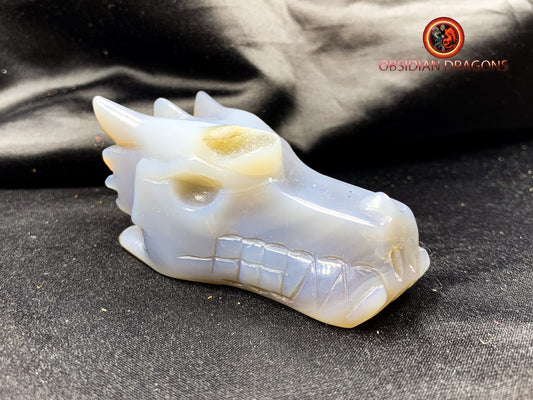
Collection: Natural Stone Dragon Skulls – Unique Handcrafted Sculptures
Dragon Skulls in Minerals, Quartz, Geodes, Agate, and Obsidian: Handcrafted Natural Stone Sculptures, Draconic Meditation, and the Symbolism of Transformation
The Obsidian Dragons skull collection brings together handcrafted sculptures carved from natural stones chosen for their character, structure, and ability to dialogue with the mythical form of the dragon. Translucent quartz, rock crystal, crystal-lined geodes, banded agates, chalcedonies, black, golden, or silver obsidian, rose quartz, chevron amethyst, moss agate, amazonite, and Chinese ornamental stones give rise to unique creations
Each natural stone dragon skull is born from an encounter between geological material and artistic vision. The sculptor must work with a crystalline cavity, an inclusion, a color variation, banding, a translucent area, or an ancient fracture. Some stones accept precise modeling; others impose their limits. A successful sculpture incorporates this mineral history.
This collection also features stone dragon heads, statues, and complete sculptures. The skull reveals the creature's architecture; the living head expresses its gaze, breath, and vigilance; the full sculpture develops its movement. These different forms share, however, the same search: to give presence to the dragon without concealing the material from which it originated.
As the creator of Obsidian Dragons and a gemmology graduate of the Institut National de Gemmologie in Paris, I examine and select raw stones according to their appearance, gemmological consistency, and any observable treatments.
This expertise allows for an accurate description of what is offered: a lapidary work in natural stone, photographed individually and selected for the quality of its material as well as its sculpture.

🐉 What is a dragon skull?
The dragon belongs to the great mythological repertoires of humanity. Its forms vary deeply across cultures: celestial serpent, guardian of the waters, master of thunder, winged creature, heroic adversary, imperial power, or primordial force.
The sculptor must invent what legends rarely show. How would the horns be implanted? What bone structure would support the eye sockets, fangs, and jaw? How to translate the dragon's power into stone? Each sculpture offers its own answer.
Some models feature an elongated snout, deep eye sockets, and horns turned backward, close to Western iconography.
Others favor sinuous lines, branched antlers, whiskers, or characteristics borrowed from the Eastern dragon.
The English expression dragon skull refers to this same form in the international art of mineral sculpture. At Obsidian Dragons, it does not refer to an industrial mold, but to a sculpture in quartz, agate, obsidian, or another natural material whose every nuance belongs to the stone itself.
🔎 Gemmological expertise and transparency
Each sculpture in this collection is presented with its photographs, dimensions, weight, and the nature of its material according to available information and observations made. When treatments are identified, they must be disclosed.
Photography is essential. For a natural stone, a generic image cannot replace the piece actually purchased. Banding, a druse, or an obsidian reflection never repeats identically. Unless otherwise clearly stated, photographs of unique pieces show the sculpture offered.
Gemmological expertise focuses on the characteristics of the material, the consistency of the designation, any observable treatments, and the overall quality of the sculpture.
This transparency allows one to distinguish a natural stone sculpture from a resin mold, a composite, manufactured glass, or a colored material sold under a misleading name.
⚒️ From raw stone to dragon sculpture
The creation of a handcrafted dragon skull begins with the observation of the block. The artisan looks for the direction of the bands, the placement of inclusions, fragile areas, cavities, and the way light passes through the material.
The first shaping reveals the general volume. The snout, eye sockets, jaw, and horns gradually appear. Rotary tools and abrasives then allow for deepening the eye sockets, separating the fangs, carving the reliefs, and refining the scales.
Final polishing reveals the material. Some parts can be brought to a high shine while others remain matte, raw, or crystallized. In a sculpted geode, the druse must not be polished like the outer surface: its points must remain intact.
A true one-of-a-kind dragon piece sculpted by hand depends on the intelligence with which the lapidary understood the block and distributed its volumes.
🧭 How to choose your dragon skull?
The choice begins with the material. A dragon skull in rock crystal favors transparency and plays of light. A geode showcases a cavity and natural crystallization. Agate reveals bands, landscapes, and color changes. Obsidian offers a black depth and shifting reflections. Rose quartz, amethyst, or amazonite introduce more colorful tones.
The sculpture constitutes the second criterion. Observe the overall symmetry without demanding mechanical regularity. Examine the horns, eye sockets, jaw, teeth, and the way the reliefs join the main volume. A slight asymmetry can add personality; an area that is too thin can weaken the object.
Size and weight greatly alter the presence of a work. A small skull can be held during meditation or placed in a small space. A large dragon skull becomes a central sculpture and requires a stable piece of furniture. A very heavy piece should never be placed on a fragile shelf or high above a passageway.
The photography must finally be examined from several angles. Studio lighting reveals details, but the reflections of obsidian or the transparency of quartz can vary depending on the actual lighting. Numerical dimensions remain essential to understand the true scale.
A person looking for where to buy a natural stone dragon skull must check the material, weight, dimensions, stated origin, known treatments, the contractual nature of the photographs, and the quality of the description. Price alone does not allow for the evaluation of a sculpture.
🐲 Buying a dragon skull, a dragon head, or a dragon statue: which form to choose?
The dragon skull has an introspective dimension. It shows the structure, memory, and impermanence. It is particularly suitable for collectors, cabinets of curiosities, and practitioners of meditation with a dragon skull.
The natural stone dragon head retains a living expression. The gaze, nostrils, whiskers, scales, and the position of the horns create a more direct relationship with the observer. It can evoke vigilance, authority, or symbolic protection.
The stone dragon statue develops movement further. The body allows for the expression of coiling, elevation, rest, or momentum. In a sculpture inspired by the Chinese dragon, the curves can follow the veining of the stone and recall the movement of clouds or waterways.
No form is superior to the others. The choice depends on what one wishes to look at: the hidden structure, the presence of the face, or the complete movement of the creature.
💎 Why does the price of a dragon skull vary?
The price depends first on the quantity and quality of the material. A large mass of transparent rock crystal, obsidian with well-oriented reflections, or a spectacular geode does not have the same cost as a smaller, more common block.
The complexity of the sculpture comes next. Openwork horns, an open jaw, separate teeth, and deep reliefs require more time and increase the risk of breakage. A large simple volume is not necessarily more difficult to create than a small, extremely detailed sculpture.
The quality of the polishing, overall balance, orientation of natural structures, and the uniqueness of the stone also influence the value. A dragon sculpture for collectors is not worth only its weight: it is worth the harmony between the material and the form.
The terms "rare" or "exceptional quality" must always be justified by observable characteristics. Rarity can come from size, optical quality, color, structure, the orientation of a geode, or the level of sculpture. It must not become an automatic formula.
🌍 Eastern dragon and Western dragon: two imaginaries that meet
The European dragon is represented with wings, claws, a powerful mouth, and a massive body. It can guard a treasure, inhabit a cave, or embody the ordeal the hero must overcome. European traditions do not, however, attribute a uniform meaning to it. Depending on the texts and periods, it becomes an adversary, guardian, image of chaos, hidden knowledge, or telluric power.
The Asian dragon or Chinese dragon, long 龙, has a serpentine body associated with clouds, waters, rains, and atmospheric transformations. In Chinese art, it can evoke imperial authority, fertility, protection, happiness, and the direction of the East. It appears on bronzes, ceramics, paintings, court textiles, temples, and architecture.
The Chinese dragon belongs to a different symbolic system, closely linked to natural rhythms and sovereign power. Different representations show a dragon chasing a flaming pearl, an image whose interpretations evoke wisdom, light, or a precious power difficult to grasp.
In Asian Buddhism, dragons also meet the Indian nāgas and Sino-Tibetan traditions. The Tibetan term druk is associated with the dragon and thunder, as in the traditional name of Bhutan, Druk Yul. These associations show how much their image has circulated, evolved, and absorbed new meanings.
To deepen the place of the dragon in Chinese culture and traditional geomancy,
discover our study dedicated to the dragon in Feng Shui, its force and symbolic energy.
A stone dragon sculpture can therefore evoke fire and combat, water and rain, the mountain and telluric currents, the sky, thunder, or sovereignty. The work becomes a space where these energies meet.
🦴 The meaning of the dragon skull
The skull shows what remains when flesh, movement, and breath have disappeared. It exposes the hidden structure of the being. In European art, the human skull has often accompanied meditation on finitude, the vanity of possessions, and the necessity of living consciously. The memento mori reminds us that every form is temporary.
Associated with the dragon, the skull produces a paradox. The dragon represents unlimited power, while the skull reminds us that no visible manifestation escapes transformation. Strength is no longer shown in its triumph, but in its trace. The symbol of the dragon skull is that of a power traversed, internalized, or rendered silent.
It evokes the end of a cycle, the memory of an ordeal, the transformation of fear, or the passage from an instinctive force to a more mastered consciousness. The living dragon acts; its skull remains. Between the two lies a reflection on what time destroys and what it reveals.
In a philosophical reading, the dragon skull reminds us that true power consists in recognizing and integrating one's own fragility.
The horns, fangs, and imposing eye sockets retain the appearance of strength, while the cavities and fractures open an inner space.
This tension explains why such a sculpture can find its place in a cabinet of curiosities, a mineralogical collection, a Gothic decor, a dark fantasy universe, or a meditation space. It speaks simultaneously to the dragon enthusiast, the natural stone collector, and the one seeking an object of contemplation.
⚗️ Dragon skull, alchemy, and transmutation
An alchemical emblem, the dragon occupies a real place in several concepts of transformation, chaos, and raw material.
the skull represents the ancient form that must be surpassed, while the dragon embodies the energy capable of accomplishing this mutation. The sculpture is seen here as an image of inner transmutation: recognizing the raw elements, uniting them, and giving them a more conscious form.
This reading particularly joins geodes. Their outer surface can appear dense, irregular, or silent, while their cavity reveals a luminous crystalline architecture. The passage from the rind to the druse reminds us that the most compact material can contain a space of openness.
A dragon skull in quartz geode makes this symbolism visible; the stone shows, through its formation, that a cavity can become the place of crystallization.
🔬 Natural stone at the heart of every sculpture
The expression natural stone groups different gemmological realities. Quartz is a crystallized mineral. Agate is a variety of chalcedony composed of microcrystalline silica. Obsidian is an amorphous volcanic glass. The lapidary can also work with rocks composed of several minerals or materials commercially called "jade" in a particular cultural context.
All these materials must not be confused under the vague designation of "crystal". In the esoteric trade, this word is often used to refer to almost any polished stone. In mineralogy, it has a more precise meaning related to the internal organization of the material.
A natural stone dragon skull sculpture can retain inclusions, healed fissures, differences in transparency, zonations, or color changes. These characteristics bear witness to the growth and geological history of the material. They must nevertheless be taken into account when the sculpture features fine horns or reliefs exposed to impacts.
Gemmological selection consists in distinguishing what naturally belongs to the stone from what results from a treatment, coloration, or alteration. It also allows for verifying the consistency between the commercial name used and the observable characteristics.
✨ The dragon skull in rock crystal
Rock crystal is the colorless and transparent variety of quartz. Its chemical composition is silicon dioxide, SiO₂. Its hardness of 7 on the Mohs scale allows it to receive a luminous polish.
A dragon skull in rock crystal plays with light in a particular way. The polished surfaces reveal internal volumes, veils, healed fractures, or natural inclusions. The gaze partially passes through the sculpture before being stopped by an edge, an eye socket, or a denser area.
This transparency alters the perception of imaginary anatomy. The sculpture sometimes appears solid, sometimes almost immaterial. A muzzle stands out clearly from one angle, then disappears into a reflection when the stone is turned.
In crystal healing, rock crystal is associated with clarity, concentration, and the amplification of an intention.
🪨 Dragon skull in quartz geode
A geode is a rock cavity whose inner walls are lined with crystals. In many geodes used for sculpture, the outer shell is made of chalcedony or agate, while the interior contains a quartz druse.
Agate is a type of chalcedony that generally features banded structures. It is composed of microcrystalline silica, while the crystals visible inside the cavity belong to macrocrystalline quartz. A single sculpture can therefore combine an agate rind, areas of chalcedony, and a rock crystal druse.
Working with a dragon skull carved from a geode requires a particular understanding of volume. Before revealing the horns, eye sockets, and jaw, the artisan must anticipate the location of the cavity. An incorrectly oriented cut could destroy the crystallization or place it in an area unrelated to the face.
When positioned successfully, the geode forms a ridge across the top of the skull, an open cavity between the horns, or appears in the jaw. The stone gives the dragon its symbolic depth.
Geodes differ in the size of their crystals, the depth of their cavity, the color of their agate, and the arrangement of their bands. This is why two dragon skulls in quartz geode from the same workshop can never be identical.
🌫️ Agate, chalcedony, and moss agate
Chalcedony has a very fine texture composed of microcrystalline silica. It can be translucent, milky, gray, bluish, brown, or colored by various inclusions. When its structures form successive bands, the term agate becomes appropriate.
A dragon skull in banded agate reveals lines that cross the sculpture independently of its anatomy. The sculptor can choose to follow them, make them appear on the forehead, or let them cut across the muzzle like the strata of an ancient landscape.
The green, brown, or black structures of moss agate come from mineral inclusions (chlorites) that evoke moss, branches, or forest landscapes. A dragon skull in moss agate suggests a creature connected to the earth, roots, and plant time.
In the Obsidian Dragons collection, agates, chalcedonies, and geodes are chosen as much for their structure as for their color. A spectacular druse is not enough if the sculpture lacks balance; a precise sculpture also loses its power if the orientation of the material does not serve the form.
🌑 The obsidian dragon skull
Obsidian forms during the rapid cooling of lava that is generally rich in silica. This cooling does not leave enough time for an ordered crystalline structure to develop. Obsidian is therefore a natural volcanic glass, not a crystal in the mineralogical sense.
Its vitreous luster, deep color, and conchoidal fracture are particularly suited to dragon sculpture. A polished surface becomes a dark mirror, while the hollows of the eye sockets and jaw absorb the light.
A black obsidian dragon skull has a compact and telluric presence. Golden or silver obsidian contains internal structures capable of reflecting light at certain angles. These reflections come from microstructures formed within the volcanic glass.
The artisan must orient the stone to make these effects visible in the essential areas. A silver obsidian dragon skull may appear black when viewed from the front, then reveal a luminous veil when the light source moves. Golden obsidian produces a similar effect in warmer tones.
Celestial Eye obsidian holds a special place in this collection. This expression is a French commercial term generally used for certain rainbow obsidians that reveal concentric areas or successive reflections of green, purple, blue, gold, silver, or pink. When the stone is correctly oriented and polished, these layers can form a shape evoking an eye, a ring, a nebula, or an opening in the black depths of the volcanic glass.
The luminous effect depends on the orientation of the internal structures, the curvature of the polish, the direction of the light, and the position of the observer. A Celestial Eye obsidian dragon head may appear black from one angle, then gradually reveal several colored circles as the sculpture is turned.
This property makes lapidary work particularly delicate. Before beginning the sculpture, the artisan must locate the areas likely to produce the most intense reflections and understand their orientation. An inadequate cut can move the eye to a secondary area, interrupt its rings, or make its colors almost invisible.
When successful, the orientation allows the stone's natural eye to meet the dragon's imaginary anatomy. It can appear on the forehead, follow an eye socket, cross a cheek, or unfold between the horns. The material then no longer serves merely as a support: it directly contributes to the gaze and identity of the sculpture.
Associated with the dragon skull, Celestial Eye obsidian creates a particularly powerful image: a colored gaze seems to emerge from a black material born of volcanism. The dragon is no longer merely sculpted in stone. It appears to awaken within its depths.
Two Celestial Eye obsidian dragon skulls cannot be strictly identical. The arrangement of the layers, the succession of colors, the shape of the rings, and their visibility change from one block to another. This singularity explains why each sculpture must be photographed individually from several angles.
In crystal healing, black obsidian is associated with introspection and grounding, while golden or silver obsidian is linked to the revelation of what remains hidden. Celestial Eye obsidian is frequently presented as a stone of protection, clarity, and inner exploration.
To learn more about this material,
consult our dossier dedicated to obsidian, its formation, its deposits, its uses, its imitations, and its place in crystal healing.
💗 Rose quartz, amethyst, and amazonite
Solid rose quartz used for sculpture owes its color primarily to very fine fibrous inclusions of a borosilicate related to dumortierite.
These nanofibers, containing iron and titanium, absorb some of the light through an intervalence charge transfer mechanism, which produces the pink hue. Their orientation in the quartz also contributes to its cloudy appearance and can, in certain properly cut stones, create a six-pointed star called asterism due to rutile (titanium oxide) inclusions.
Its translucency varies from one piece to another. Sculpted as a dragon head or skull, it creates an interesting contrast between a color generally perceived as soft and a creature associated with power.
A natural rose quartz dragon head expresses strength without aggression. It introduces the idea that stable power can also protect, connect, and preserve.
Amethyst is the purple variety of quartz, colored by iron (Fe3+). Chevron amethyst features alternating bands of purple and lighter quartz, forming stripes or points. A chevron amethyst dragon head transforms these structures into natural markings that can follow the horns, forehead, or scales.
Amazonite is a green to blue-green variety of microcline, belonging to the feldspar group. Its network of white and turquoise shades gives each amazonite dragon skull a different face. It should not be confused with turquoise, whose composition and gemmological properties are distinct.
The spiritual correspondences attributed to these stones can accompany a personal choice. Rose quartz is linked to soothing and emotional openness, amethyst to contemplation, and amazonite to expression.
⛰️ Jade and Hua’an Yu Dragons
The word "jade" has a complex cultural and gemmological history. In international nomenclature, it primarily refers to two distinct materials: jadeite, belonging to the pyroxene group, and nephrite, composed of a particularly tough aggregate of minerals from the amphibole group, mainly tremolite and actinolite.
In the Chinese world, however, the term yu 玉 has a much broader historical scope. Long before modern mineralogical classifications were established, it referred to various stones prized for their beauty, softness to the touch, polish quality, durability, and symbolic value. Therefore, not all materials traditionally or commercially classified as yu are necessarily jadeite or nephrite.
Hua’an Yu 华安玉, translated as "Hua’an jade" and known by the poetic name "Nine Dragons Jade," is a Chinese ornamental stone from the Hua’an District in Fujian Province. Despite its commercial name, it is neither jadeite nor nephrite in the strict gemmological sense.
Gemmological observations and geological data allow it to be described as a skarn-type calc-silicate rock, generally dominated by diopside and likely to contain several associated mineral phases. Its composition, texture, and formation context clearly distinguish it from the two major mineralogical families recognized under the name of jade.
This distinction does not detract from its cultural or lapidary value. On the contrary, it allows us to understand the stone for what it truly is and appreciate the reasons why Chinese artisans chose it for sculpture.
To discover the history of this name, the geology of the Hua’an region, the composition of the rock, and the results of our identification work,
consult our gemmological and cultural investigation dedicated to Nine Dragons Jade, Hua’an Yu.
Its green, cream, white, gray, and sometimes almost black areas form natural movements evoking clouds, mountains, waterways, or the scales of a moving creature. The presence of bands and chromatic contrasts allows the sculptor to build the dragon with the stone rather than simply imposing it on the surface.
A Jiulong jade dragon sculpture thus derives much of its presence from the orientation of these variations. Green areas can emphasize the body or scales, while the lighter parts reveal the horns, muzzle, or contours. Each block imposes a different composition and makes each sculpture truly unique.
In Chinese culture, jade and stones classified as yu are associated with value, beauty, continuity, virtue, and permanence.
🧘 Meditating with a Dragon Skull
Dragon meditation, depending on the individual, can take the form of visualization, symbolic work, silent contemplation, or reflection on inner power.
The meditation dragon skull becomes a focal point. Its shape allows attention to be concentrated on an intention: overcoming a fear, recognizing an instinctive part, regaining strength, accepting the end of a cycle, or preparing for a transformation.
The practice can begin simply. Place the sculpture on a stable support, in a quiet space, without cluttering the area with objects. First, observe the actual material: color, transparency, visual weight, cavity, reflection, or texture. Then, focus on what the dragon's shape personally evokes.
Invoked as a guardian, a threshold, or a protective presence.
Or as an archetype of courage, mastery, or change.
To deepen this practice,
consult our article dedicated to meditation with a dragon skull and dragon meditation.
🔮 Dragon Skull and Crystal Skull
The crystal skull leads to meditation on the human mind, memory, knowledge, or impermanence. The dragon skull introduces a more dynamic and more protective power.
The crystal skull is associated with clarity, and the dragon with transformation. The dragon skull can then be placed nearby as a symbolic guardian or as a representation of transitional energy.
To explore the other side of this universe,
discover our collection of crystal skulls in natural stones and unique pieces.
🛡️ Protection, Talisman, and Dragon Energy
In symbolic language, the dragon can guard a treasure, knowledge, territory, or passage. Placing a sculpture near an entrance, in an office, or on an altar can materialize an intention of vigilance and protection.
Speaking of dragon energy means naming an inner experience of determination, momentum, or power.
A skull does not need to be "charged" to become important. The quality of its material, the sculptor's work, the story of its acquisition, and the attention we pay to it can be enough to make it a deeply personal object.
🧼 Caring for a Natural Stone Dragon Skull
Cleaning must respect the material and the construction of the sculpture. A soft, dry cloth is suitable for most polished surfaces. A very soft brush can gently remove dust from between the crystals of a druse.
Water is not necessary for routine care. Some geodes have porous areas, iron oxides, or sensitive assemblies. Prolonged baths, household products, acids, oils, and abrasive cleaners should be avoided.
Obsidian can be wiped with a clean, slightly damp cloth, then dried immediately. Its shiny surface easily reveals fingerprints. However, its glassy nature makes it brittle: a fall on tile or metal can cause a clean break.
Quartz resists scratches relatively well, but the horns and teeth remain fragile. Never hold a large skull solely by a raised sculpted part. Always support the base and the main mass with both hands.
Purification methods using salt, water, smoke, or sunlight belong to personal beliefs. They are not universally suitable for all materials. A symbolic practice must never endanger the physical preservation of the object.
❓ Frequently Asked Questions About Dragon Skulls
What is the meaning of a dragon skull?
It can symbolize transformation, memory, impermanence, internalized power, and the end of a cycle. Its meaning depends on the visual culture of the artwork and the personal relationship formed with it.
What is the difference between a dragon skull and a dragon head?
The skull reveals a skeletal structure and evokes themes of time, transformation, and memento mori. The head retains the dragon's living features and expresses vigilance, breath, and authority.
Do dragon skulls belong to an ancient tradition?
Dragons have very ancient traditions, but dragon skulls carved from crystals and sold as meditation objects are essentially contemporary creations. They should not be presented as archaeological objects or ancient ritual items without documented provenance.
How can I identify a natural stone dragon skull?
Identification requires examining the structure, inclusions, hardness, luster, and sometimes using gemological tools. A photograph alone cannot always distinguish natural stone from glass, resin, or a composite material.
What is a quartz geode dragon skull?
It is a sculpture made from a geode or a section of a geode that retains a crystal-lined cavity. The outer part may consist of agate or chalcedony, while the interior features a quartz druse.
Is obsidian a crystal?
No. Obsidian is a natural volcanic glass with an amorphous internal structure. It can be carved and polished like an ornamental stone, but it is not a crystal in the mineralogical sense.
Is each sculpture unique?
Yes. The distribution of colors, bands, inclusions, cavities, and crystals makes each stone unique. Even when several sculptures follow a similar model, none exactly reproduces the structure of another.
Does the photograph match the dragon skull purchased?
Unique pieces are normally photographed individually. The product listing must clearly state whether the photographs show the item being sold or a representative model.
How can I meditate with a dragon skull?
The simplest method is to place the sculpture in a quiet space, observe its material, and choose an intention for contemplation. Dragon meditation can focus on visualization, breathing, or reflection on strength, transition, and transformation.
How can I choose the right stone?
The choice may be based on appearance, transparency, color, geological structure, or a personal symbolic connection. The quality of the sculpture and the accuracy of the description should always remain the top priorities.
Why do prices vary?
Weight, material quality, sculptural complexity, the fineness of the details, the presence of a geode, and the exceptional nature of the piece all influence the price. A large stone is not automatically better than a small, highly detailed sculpture.
Can I give a dragon skull as a gift?
Yes. It can make an original gift for a dragon enthusiast, mineral collector, art lover, or someone engaged in a process of transformation. It is best to choose the material and size based on their actual sensitivities.
🐲 A collection of dragon skulls uniting material, myth, and transformation
Choosing a natural stone dragon skull means simultaneously choosing a geological material, a sculpture, and an image. Quartz tells the story of its growth, agate of its successive deposits, the geode of its inner space, and obsidian of the rapid cooling of volcanic material. The sculptor transforms these structures without being able to reproduce them.
The dragon adds another layer of depth. It connects the waters and clouds of Asia with the mountains, caves, and treasures of European legends. The skull finally adds a meditation on what remains when the living form disappears.
Whether chosen as a mineral art object, collectible sculpture, Gothic decoration, symbolic protective presence, or aid for dragon meditation, each piece retains its freedom. It imposes neither belief nor practice.
Explore dragon skulls made from rock crystal, quartz geode, agate, chalcedony, obsidian, rose quartz, amethyst, amazonite, and Chinese ornamental stones. Examine their dimensions, weight, details, and material, then choose the piece whose presence feels right to you.