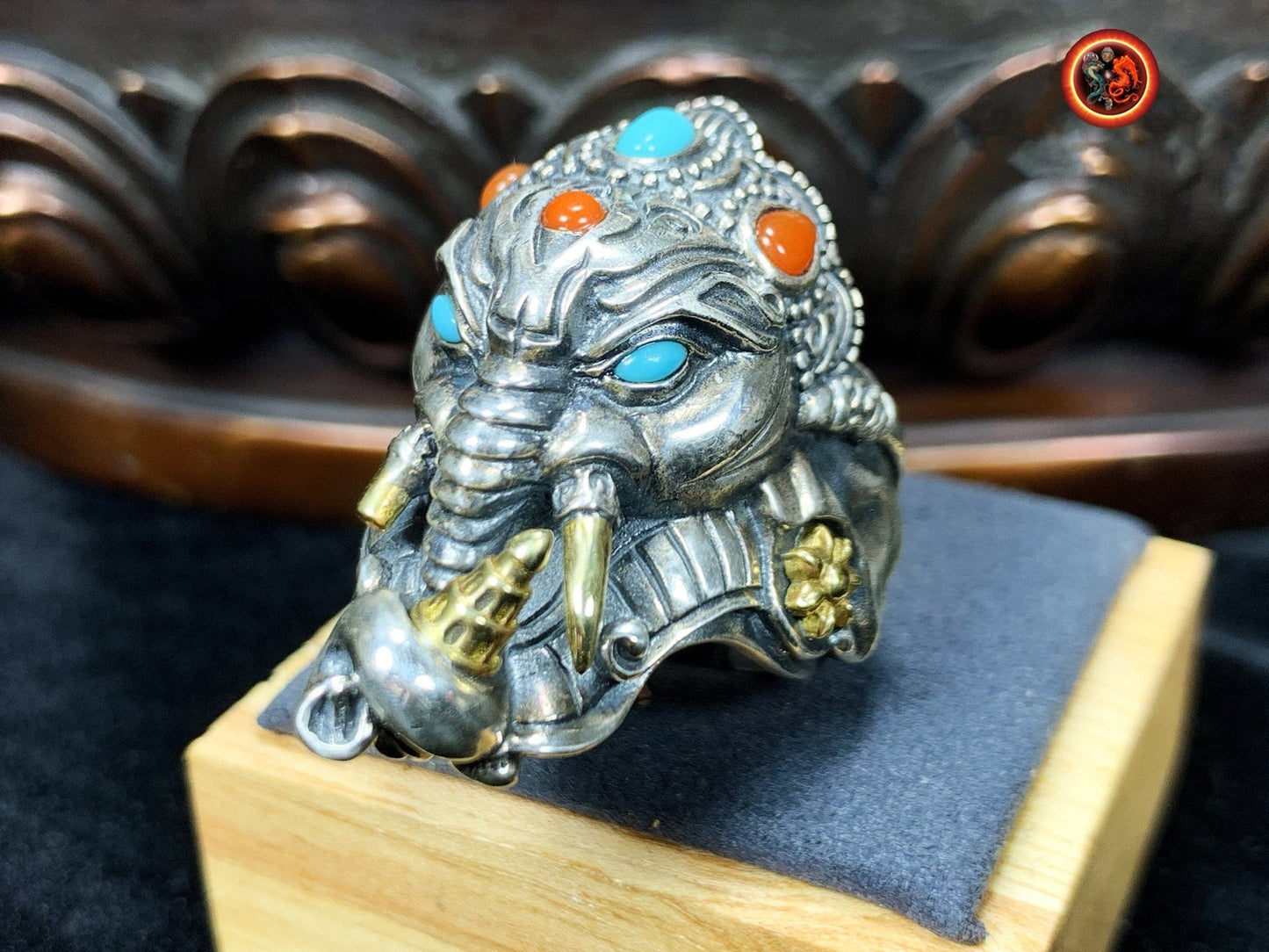
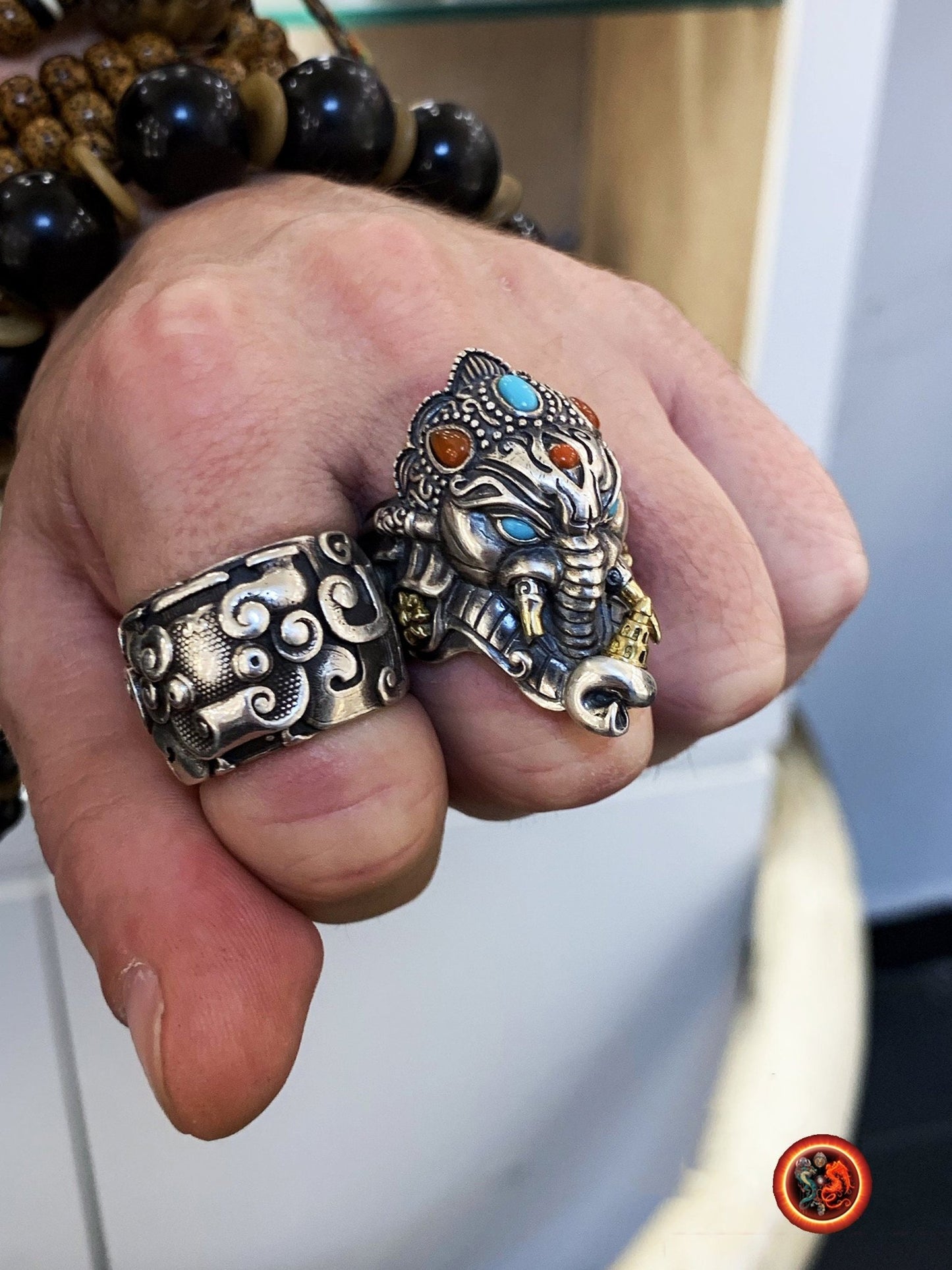
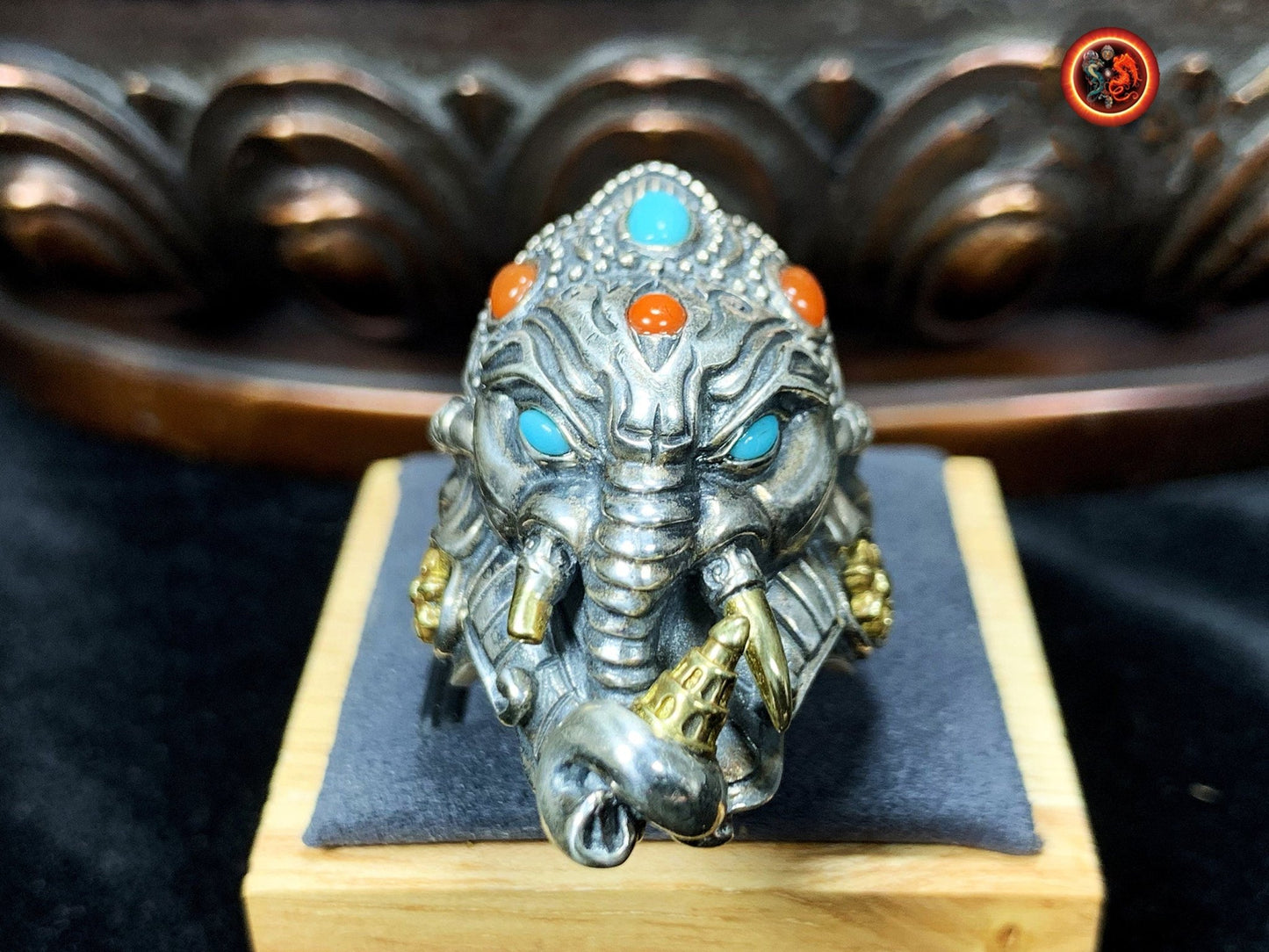
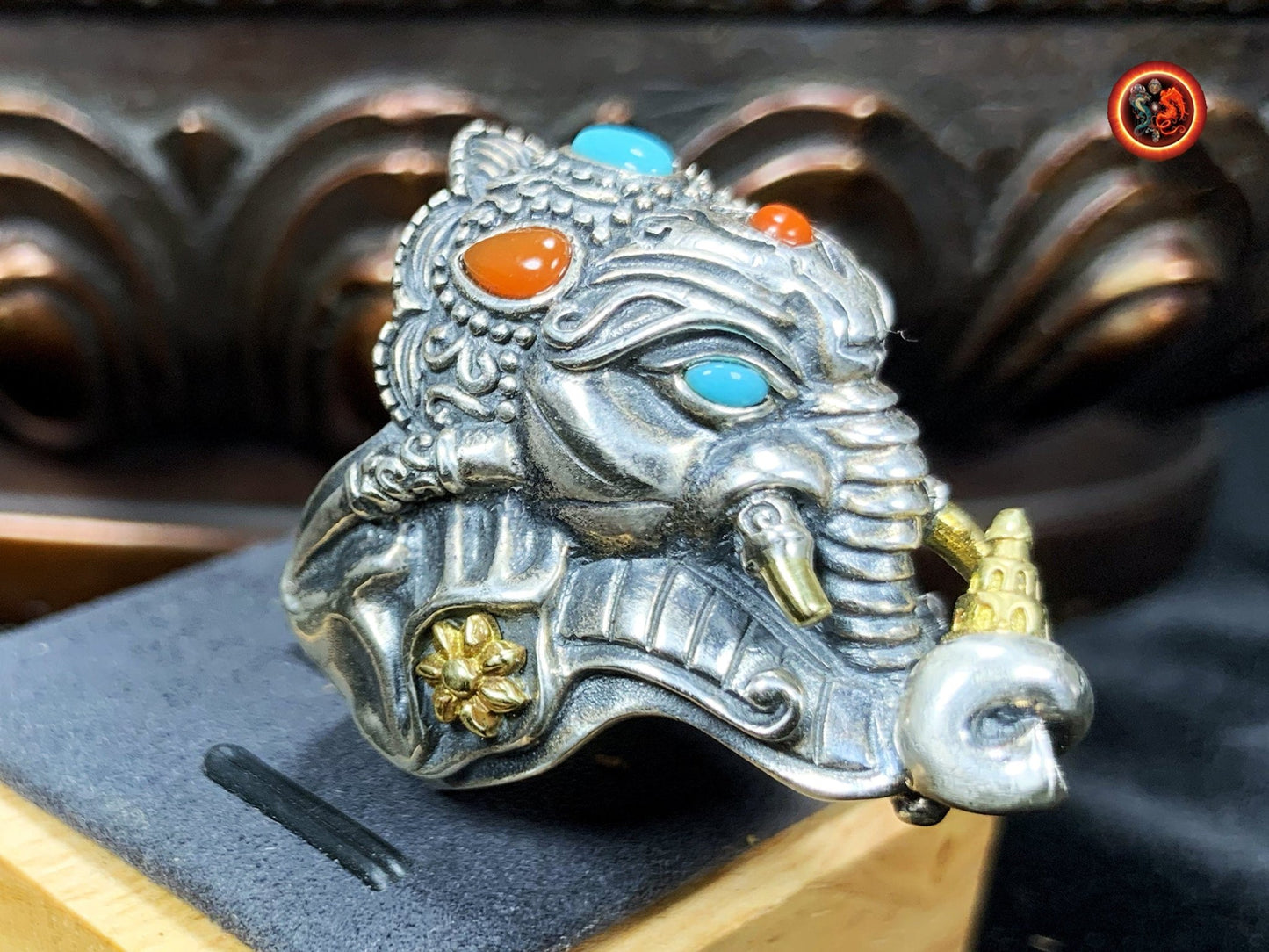
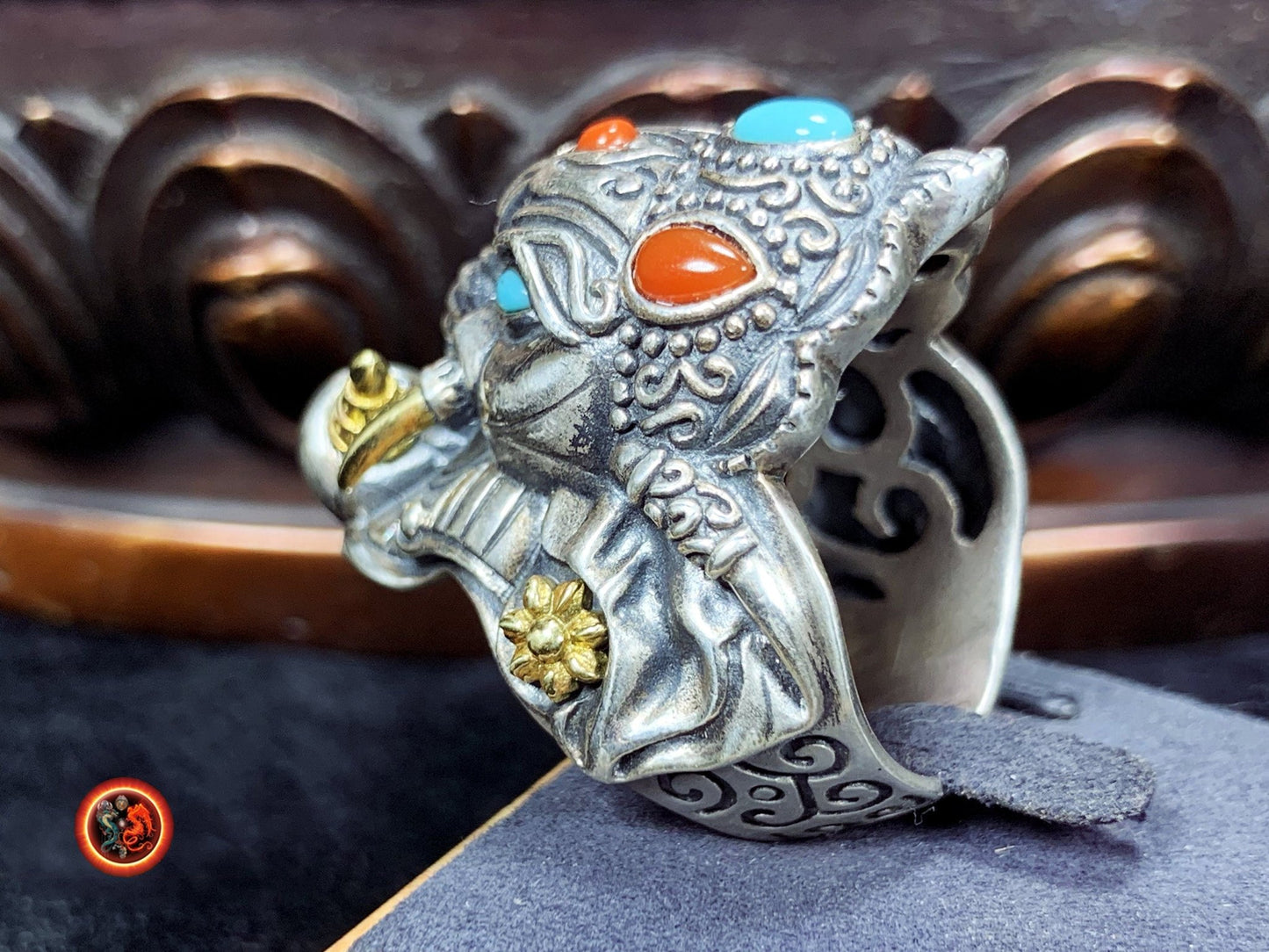
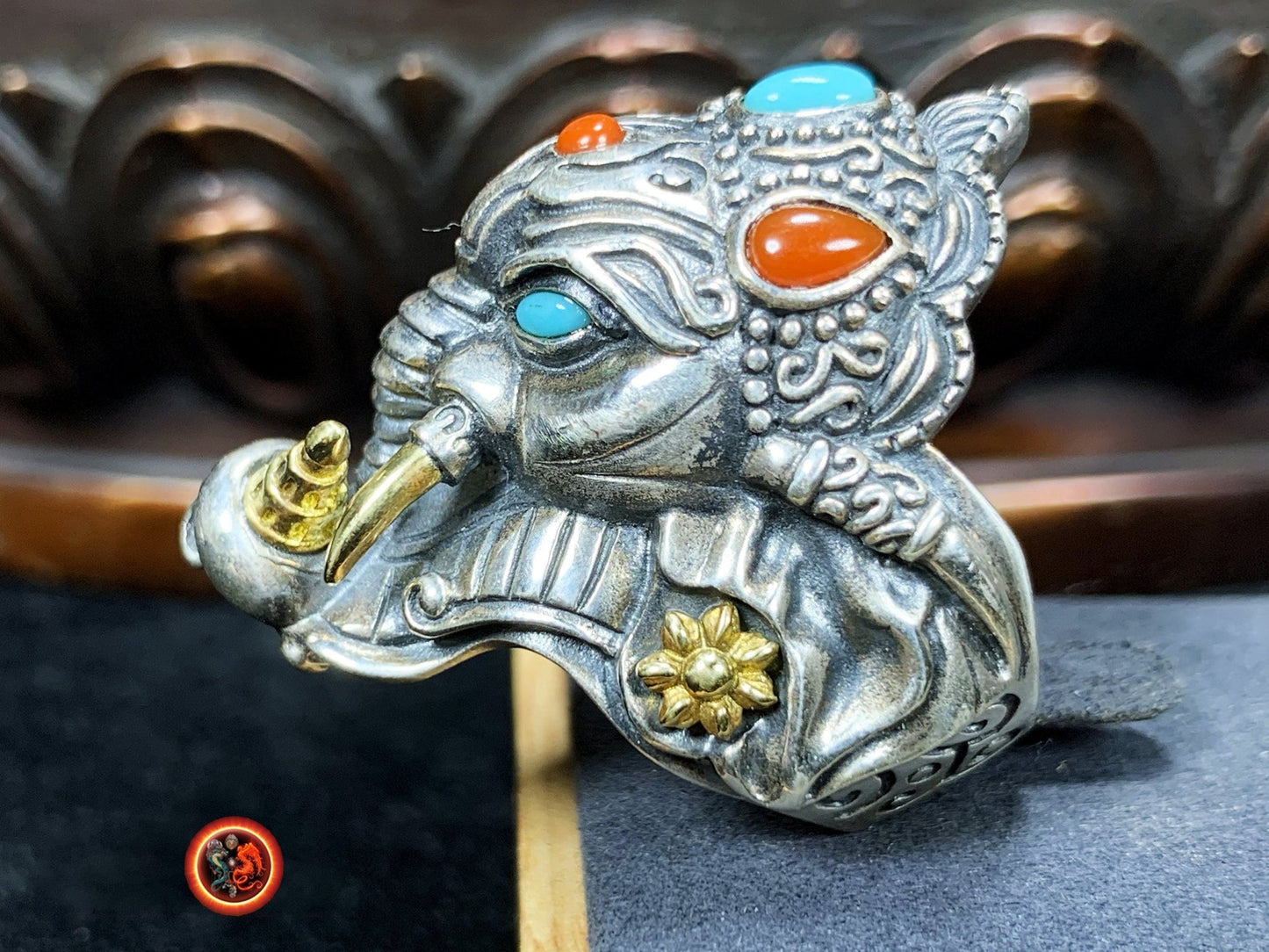
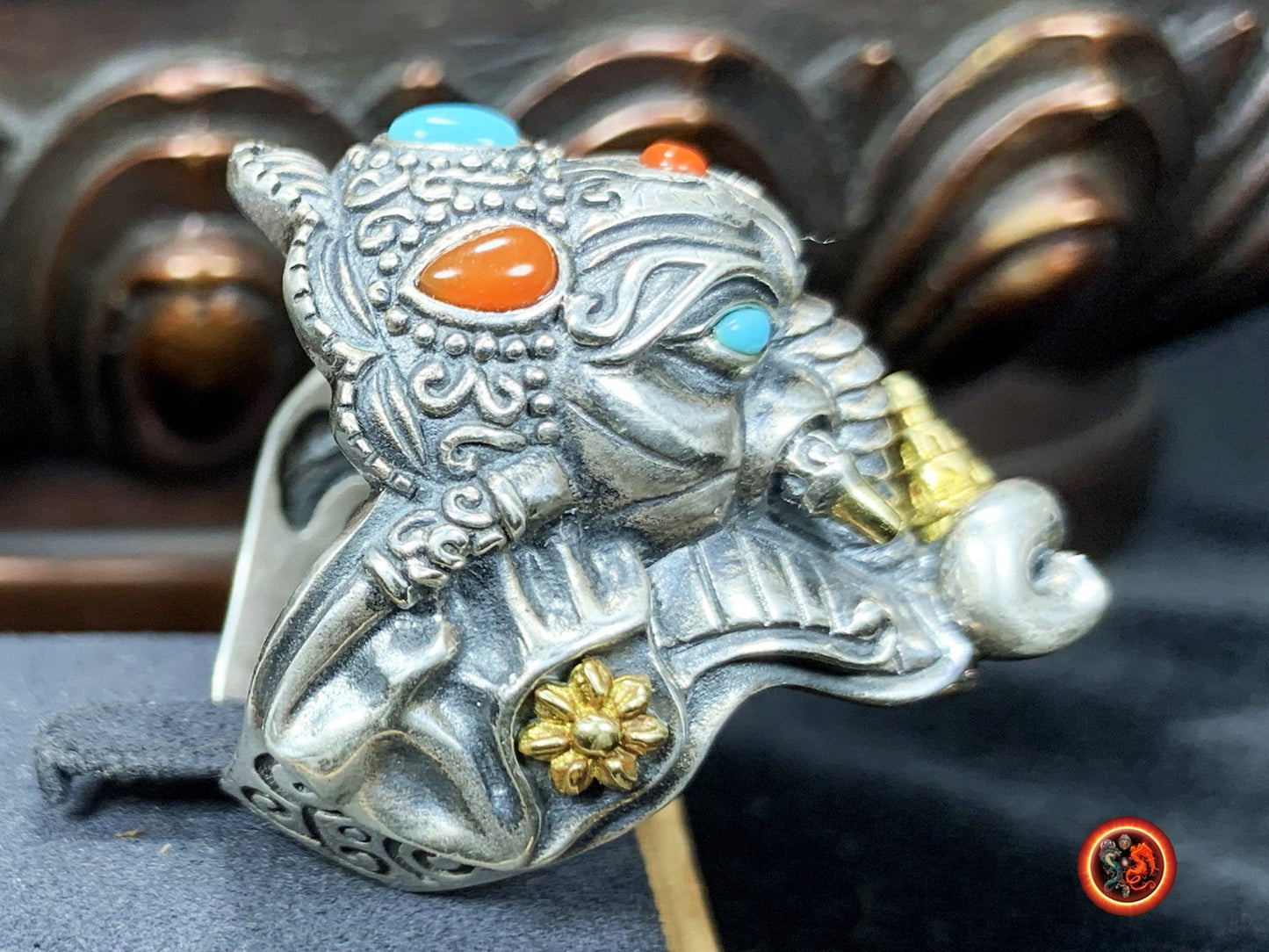
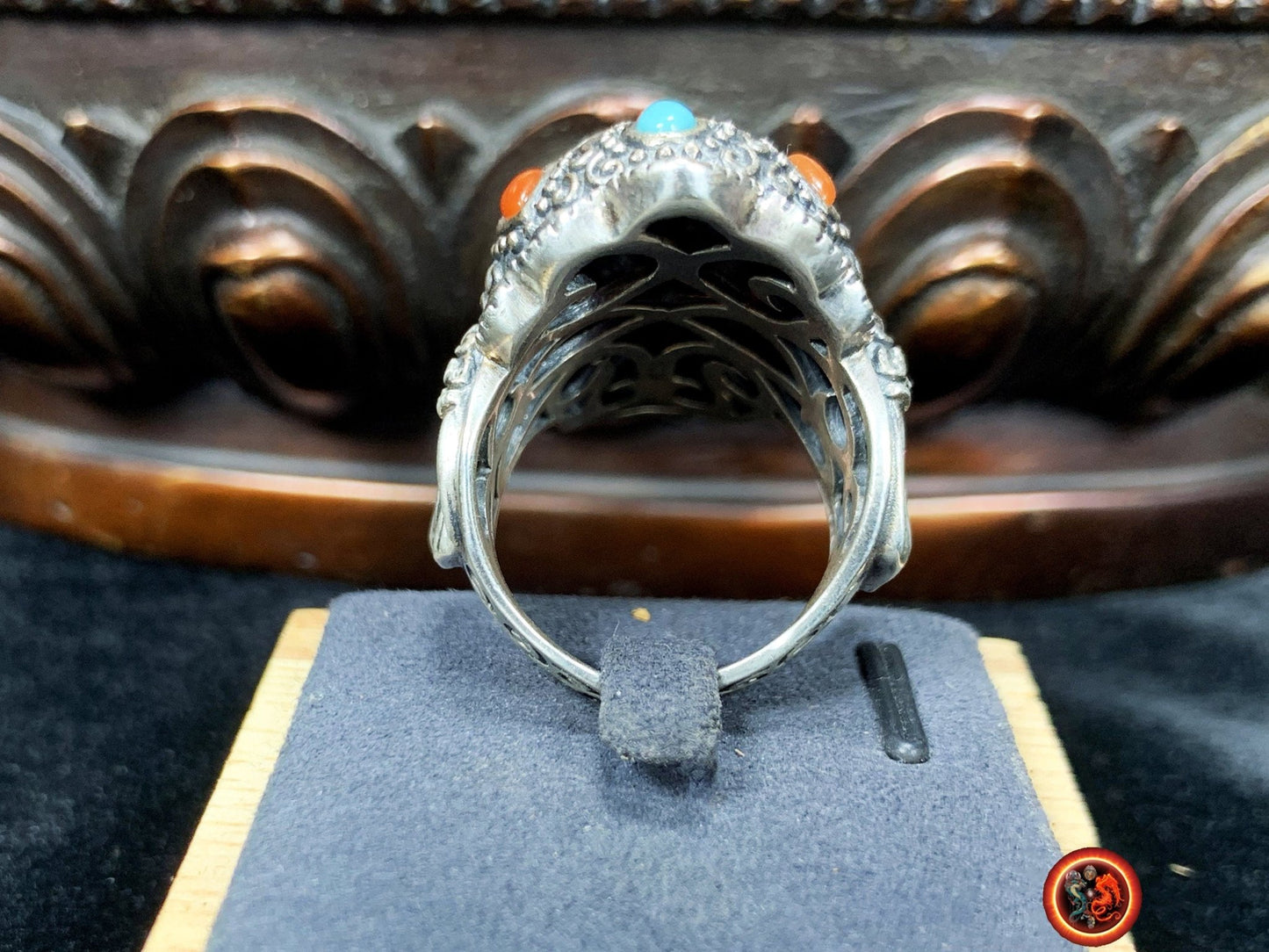
ring, signet ring Ganesh
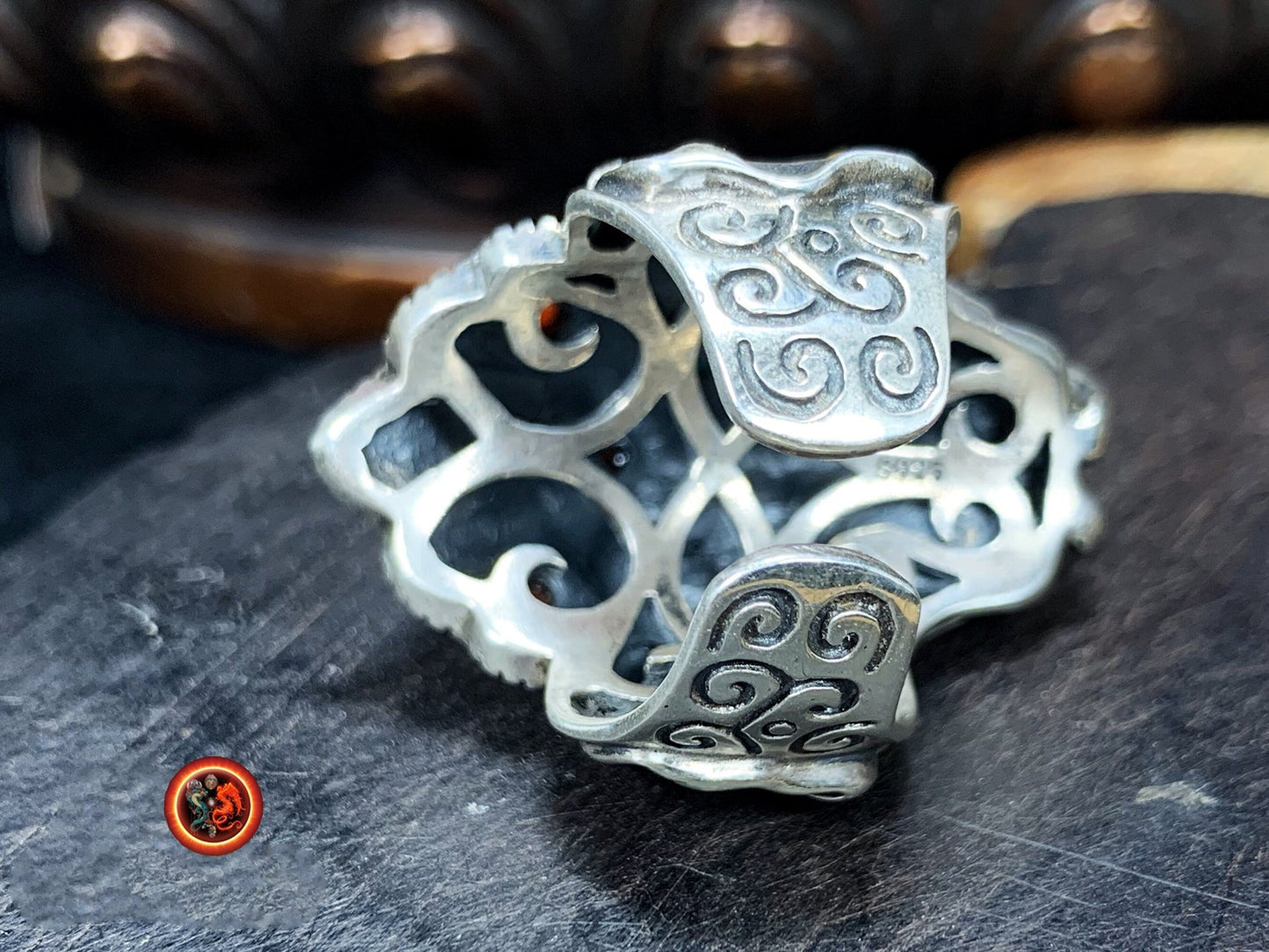
hallmarked 925 silver
copper
natural "sleeping beauty" Arizona turquoises
agate called "nan Hong". This unusual volcanic agate gets its deep red color from its natural cinnabar content.
As a gemologist graduated from the National Institute of Gemmology in Paris, all our stones are appraised and certified. . open ring therefore adjustable to all finger sizes.
GANESH
Ganesh in vajrayana.
One who removes obstacles. A legend says that a fight took place between the two ganesh, which the Buddhist won and tore off the head of the Hindu to replace his own.
More seriously, Ganesh was incorporated into Buddhism by his tantric form which originated in India in Odisha then traveled first to Nepal through Indian traders, and to China, then to Japan which we will talk about a little further down, the divinity having taken an interesting place in the shingon and tendai forms of Buddhism of the Archipelago.
The Elephant God Ganesh (or Ganesha/Ganapati, also sometimes called siddhi data) is one of the most popular gods of Hinduism and is also widely represented in the Temples of Theravada Buddhism (India, Thailand, Indonesia.. .) than in those of Vajrayana (Tibet, Nepal...) . I
He plays an important role in Tantrism and is present in the Tibetan pantheon where he is recognized mainly as a deity of wealth but is also part of the attributes of certain wrathful, somewhat frightening, terrible, secretive and fearful deities, removing obstacles.
Apart from Tibet, the deity has left few traces in China, no doubt swallowed up with the Chinese esoteric current Tangmi, centered on the Buddha Vairocana, who disappeared from 845, the date on which the full rise of Buddhism, its golden age between the period between the Sui and Tang dynasties extending from the beginning of the 7th century to 845 came to an abrupt end.
Emperor Tang Wuzong, of the Taoist faith, issues an edict against the Manichaeans, Buddhists and Nestorians, religions of foreign origin. After the persecution, only the Chan and Pure Land currents remain visibly. The typically Chinese esoteric Buddhism will nevertheless leave some traces, blending into the two surviving schools. Then, Tibetan Lamaism took the vacant place becoming an imperial religion under the Yuan dynasty, as well as the last dynasty, the Manchu Qing dynasty.
In short, the Tangmi or "secret art of the Tang" disappeared completely in China. Ganesh's Japanese name is Shōten (聖天) or Kangiten (歓喜天), Japanese Buddhism considers him to be a manifestation of Shō Kannon Bosatsu (聖観音菩薩). In Japanese, the kanji 天 is used as an equivalent of the Hindu Deva.
The cult of Kangiten began in Japan around the 8th-9th century. Importation due to Kukai (July 31, 774 - April 22, 835) scholar and official at the Japanese imperial court (early Heian period), holy founder of the Shingon esoteric Buddhist school, during his trip to China in 804 , in order to initiate the tantric form of Buddhism. There he met the eminent Buddhist scholar Pranja from the region of Gandhara, the cradle of the Mahayana or great vehicle, a region located in the northwest of present-day Pakistan.
Pranja, a former student of Nalanda, a prestigious center of Buddhist studies in northern India, was an important importer of Buddhist texts in China. After a trip of a decade in China, Kukai returned to Japan and introduced with his return, Tantric Buddhism and introduced several Hindu deities including Ganesh, thus founding the Shingon current, ensuring the survival of the Chinese Tangmi somewhere.
Then you have to go 3 decades after the death of Kukai better known as Kōbō-Daishi, to find the first texts concerning the cult of Ganesh / Kangiten in Japan.
The "Sho Kangiten Shikiho" or "Ritual of Sho Kangiten" composed around 861 detailing the various tantric rituals. In Japanese statuary and iconography, Kangiten is mainly represented in union with his consort, a female Kangiten, commonly called "Shakti" or "feminine energy".
These representations, erotic embrace, symbolizing the unions of male and female energies, widely used in tantric forms are called "Yab Yum". Just like the story of the Indian Ganesh, Kangiten began as a malevolent god who could create obstacles and therefore had to be worshiped in order to avoid trouble.
But over time, he became a Japanese god of joy and happiness. Ganesh is the god of wisdom, intelligence and prudence, among other patron saints of schools and teachers.
In Japan, as in Thailand, he is mainly invoked for wealth and financial success, prayed by merchants but is also the God of artists and all "creatives". Kangiten is considered to be endowed with great power, considered a protector of temples, and generally worshiped by players, actors, geishas, and people of the so-called floating world.
Due to Kangiten's esoteric sexual nature, her image is often obscured. Mantras are often prescribed in ritual texts to appease the deity and even to drive away this obstacle maker. Rice wine (sake), radishes (daikon), and "bliss-buns" (kangi-dan), a deep-fried confectionery filled with red bean paste that is based on the modak offered to Ganesha, are offered to the god.
The divine role of wealth is reminiscent of the Taoist form of the 10th century Chinese monk Milofo, who arguably took Ganesh's place in this role. It is the god who removes both material and spiritual obstacles for his worshippers. He is the son of Shiva and Parvati, the husband of Siddhi, success and Riddhi, wealth. The Buddhist Ganesh has his two tusks intact.
The Hindu ganesh has only one tusk, having broken one to write the vedas. Nowadays, 250 Japanese temples practice Kangiten worship, the most active center is Hozanji temple, located on the eastern slope of the eastern mount of Mount Ikoma outside Osaka city, founded by the charismatic Japanese monk in 17th century Tankai known as Hozan (1629- 1716). A legend surrounds the origin of the foundation of the temple.
Hozan's quest for supernatural powers or "siddhis" failed due to the insurmountable obstacles posed by Kangiten. Around 1678 the master of Tankai revealed to him the existence of Mount Ikoma, a miraculous place that is neither dream nor reality". On these revelations, Hozan, in order to appease the elephant god, made an idol of Kangiten to make him the guardian of the place by imploring him that in return the divinity will protect him and help him to reach the siddhis we date the construction of this temple around 1680