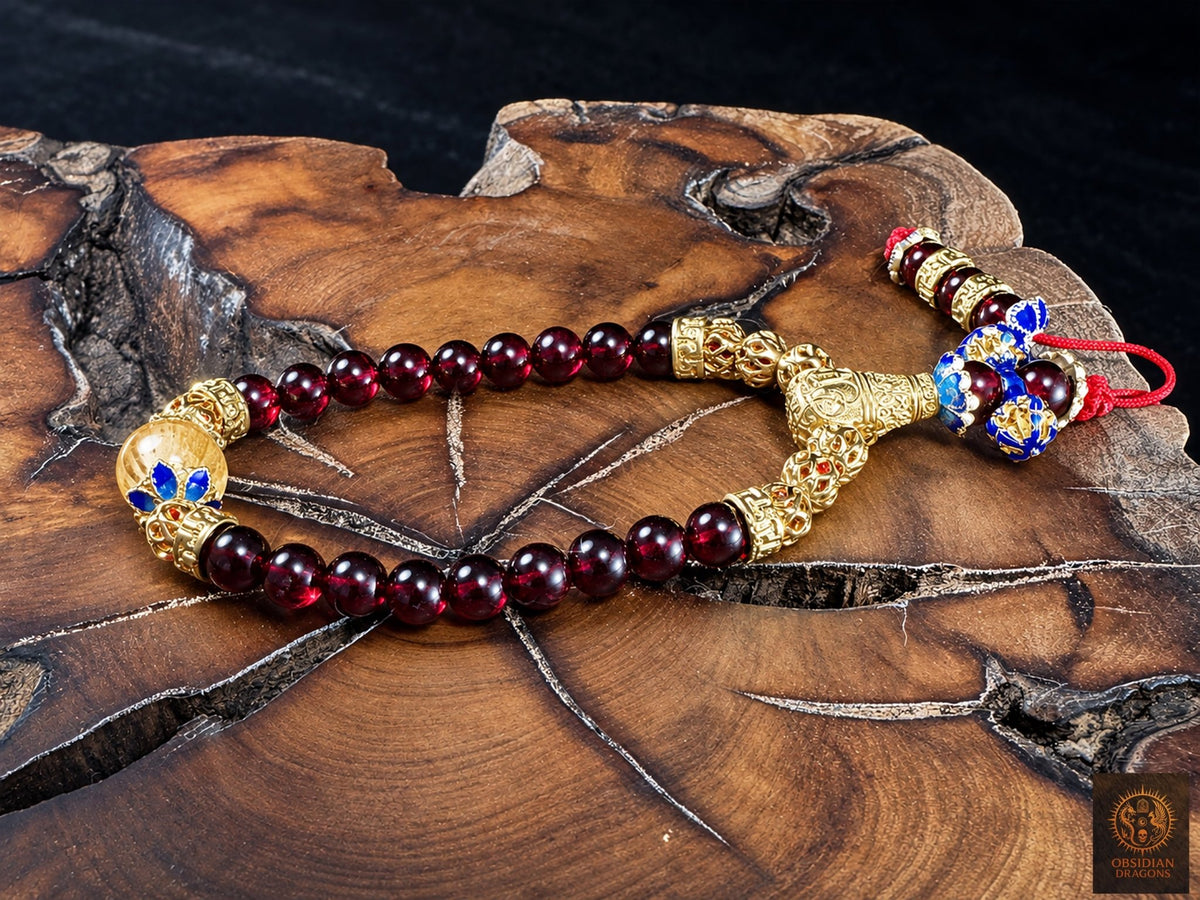
Mozambique almandine garnet and faceted Brazilian citrine mala bracelet – handcrafted 18-bead Buddhist Shibazi, dorje (vajra) and Beijing cloisonné enamel on gold-plated bronze: meditation, grounding and inner strength.
Contractual photos and video. You will receive exactly the garnet mala bracelet shown in the photos.
📿 Features of this garnet and citrine mala bracelet
As a gemmologist graduated from the National Institute of Gemmology (ING – Paris, France), I personally selected and examined the almandine garnet beads as well as the gem-quality faceted citrine. I paid particular attention to the nature of the gemstones, the quality of the garnet polish, the faceting of the citrine, the harmony of the chromatic nuances, and the precision of the cloisonné enamel decorations adorning the flowers and the dorje in gold-plated bronze.
👐 Handcrafted creation: bracelet designed and assembled by me.
📿 Type of bracelet : Shibazi wrist mala composed of eighteen main beads, to which are added the central citrine, the Guru bead and the decorative finishing elements.
🔴 Main beads : 18 high-quality almandine garnet beads, from Mozambique, 6 mm in diameter.
💎 Central bead: gem-quality Brazilian citrine, faceted, 10 mm in diameter.
✨ Metal elements : beads, flowers and spacers in gold-plated bronze.
🌸 Enamel decoration: gold-plated bronze flowers adorned with Beijing cloisonné enamel, in blue shades.
🪷 Guru bead : gold-plated bronze, measuring 14 mm in height, 7 mm in width and 8 mm in thickness.
⚡ Finish under the Guru: dorje, also called vajra, in gold-plated bronze and cloisonné enamel.
🔴 Ornaments around the dorje : two garnet beads, accompanied by gold-plated bronze flowers and cloisonné enamel.
🧵 Cord: red two-strand cord, extending the composition with dangling finishes.
🔗 Adjustment system: sliding knot placed under the finish, allowing the bracelet to be tightened and loosened.
🌺 Cord ends: each of the two strands ends with three almandine garnet beads, surrounded by gold-plated bronze flowers and cloisonné enamel, as well as gold-plated bronze spacers.
⚖️ Total weight: 24 grams.
📏 Wrist circumference suitable : from 16 to 18 cm, for a small wrist.
🎨 Color palette : deep red of the garnets, bright yellow of the citrine, blue of the enamels, gold of the metal elements and red of the cord.
18-bead garnet and citrine mala bracelet: Shibazi and cloisonné dorje
I created this garnet mala bracelet around a meeting of colors that I particularly like: the deep red with the purplish shade of almandine, the yellow light of the citrine and the blue of the enamels, highlighted by the gold-plated bronze elements. The eighteen main beads form a fine circle, while the Guru bead, the dorje and the two terminal strands give the whole an assertive ornamental presence.
This garnet and citrine mala bracelet retains the architecture of an 18-bead Shibazi, this small rosary associated with Chinese Buddhist culture. I designed and assembled it myself, paying as much attention to the selection of the gemstones as to their proportions, the transitions between the materials and the design of the finishes.
On the wrist, the garnet beads reveal the delicacy of the assembly. In the hand, the details invite you to take the time to look: a facet of citrine, an enameled flower, the relief of a golden bead. This is how I like to approach natural stone jewelry: through knowledge of the material, and then through the personal relationship one can form with it.
Mozambique almandine garnet and the depth of red
Garnet is a group of minerals comprising several species, including almandine, pyrope, spessartine, grossular and andradite. Speaking of almandine garnet therefore provides essential precision about the nature of the stone. The compositions of natural garnets can also feature mixtures of several species from this group.
Almandine is an iron and aluminum silicate belonging to the garnet group. Its ideal chemical formula is Fe₃Al₂(SiO₄)₃. It crystallizes in the cubic system and generally has a hardness between 7 and 7.5 on the Mohs scale. Its luster is vitreous; its colors can range from deep red to reddish-brown or purplish-red.
For this handcrafted garnet mala bracelet, I chose a series of small beads whose red forms a coherent whole. In lit views, the transparency visible in certain areas gives the garnets luminous accents; in softer light, their color appears darker and more intimate.
The 6 mm diameter of the garnet beads allows a fine line to be maintained around the wrist. Their presence remains sensitive to the touch, and their regular succession forms the body of this almandine garnet bracelet. The origin from Mozambique and the quality of the selection contribute to the identity of this handcrafted creation.
A faceted Brazilian citrine at the center of the bracelet
Citrine is the yellow variety of quartz, with the formula SiO₂. Citrine quartz has a hardness of 7 on the Mohs scale. Its transparency, color and the quality of the cutting work directly influence its appearance in jewelry.
I placed here a 10 mm faceted Brazilian citrine, whose size creates a clearly visible focal point among the small garnets. Its facets present the stone from several angles and vary the reflections as the hand moves. The gem-quality citrine was chosen for its luminous presence in this composition.
The term "gem quality" refers to the material's suitability for jewelry: its transparency, appearance, color and cutting work. The quality of a citrine is assessed through these characteristics, within the context of the creation that welcomes it.
This mala bracelet with citrine thus has two visual rhythms. The row of garnets follows the contour of the wrist; the central citrine bead holds the gaze. Its yellow introduces a luminous breath into a palette dominated by deep red and gold.
Gold-plated bronze and Beijing cloisonné
The gold-plated bronze beads, golden spacers and enameled flowers punctuate the assembly. Their color accompanies the warmth of the citrine and highlights the red of the garnets. Certain openwork parts allow the gaze to circulate through the ornaments, which preserves lightness in a composition rich in details.
Beijing cloisonné refers to a Chinese enameling tradition whose principle consists of delimiting decorative areas with metal partitions, then filling them with enamel. In the classic technique, the firings, polishing and finishing bring out the design of the partitions and the brilliance of the colors. This know-how brings another quality of surface to the jewelry than that of polished stones or gilded metal.
In this mala bracelet, the blue of the cloisonné enamel returns around the citrine, on the dorje and in the flowers of the finishes. This repetition gives continuity to the whole. The cloisonné flowers are not just isolated touches: they connect the different parts of the assembly through their design and color.
This shibazi bracelet with gold-plated bronze elements thus combines the depth of the gemstones with the finesse of the decorative work. I composed this handcrafted garnet bracelet with cloisonné enamel by seeking continuity between the circle of beads, the central finish and the two strands of the cord.
What is an 18-bead Shibazi?
The name Shibazi, also transcribed Shíbāzǐ 十八子, designates in this context a small rosary of eighteen main beads. Historical specimens preserved in Chinese museums show that this structure can accommodate distinctive beads, a "Buddha head" and suspended elements, sometimes made of different materials.
In my almandine garnet shibazi bracelet, the eighteen main beads make up the counting circle. The citrine, the Guru bead, the metal elements and the decorative garnets of the finishes complete this architecture. To practice counting by eighteen, it is the garnets of the main body that are followed.
This 18-bead mala bracelet therefore belongs to a precise typology of wrist malas. The term mala, from Sanskrit mālā, evokes the garland. In its devotional use, the Buddhist rosary accompanies the repetition of a sacred name, a prayer or a mantra, with the regular passage of the beads between the fingers.
To delve deeper into this history and the different ways of using a mala,
I invite you to read my article dedicated to the origin, the meaning and the use of the Buddhist rosary.
The history of the shibazi and the adornments of the Qing dynasty
The history of the shibazi is located at the meeting of Buddhist practice and personal adornment. Recitation beads provided a structure that artisans and users gradually enriched, by choosing materials, colors and ornaments that they valued.
Under the Qing dynasty, highly elaborate shibazi were made for the Chinese court. The collections of the Palace Museum in Beijing notably preserve bracelets of eighteen beads of jadeite, tourmaline, coral or aromatic wood, completed by distinctive beads and pendants. Some specimens are explicitly associated with the women of the imperial court.
The National Museum of the Palace in Taipei indicates that from the mid-18th century, these small rosaries also had a role as auspicious adornment and gift. They could be worn on the wrist, handled in the hand or suspended from the clothing. The devotional dimension and the pleasure of wearing a beautiful object met in the same use.
My garnet mala bracelet fits into this meeting between material, ornament and attention. Its composition is contemporary. It takes up the structure of a Chinese mala of eighteen beads and combines it with gemstones from Mozambique and Brazil, cloisonné elements and a dorje linked to the iconography of esoteric Buddhism.
The eighteen dhātu and our way of perceiving the world
A common symbolic reading brings the eighteen beads close to the eighteen dhātu, also called the eighteen domains of perception or domains of experience. This Buddhist notion brings together six faculties, six corresponding objects and six consciousnesses.
The six faculties are sight, hearing, smell, taste, bodily sensitivity and mental faculty. Their objects are forms and colors, sounds, smells, flavors, tangible objects and mental objects. The six corresponding consciousnesses are visual, auditory, olfactory, gustatory, tactile and mental.
In this reading of Chinese Buddhism, experience is understood through the meeting of a faculty, an object and a consciousness. The symbolism of the eighteen grains can thus become an invitation to observe what we perceive, then the way we react to it.
A sound can arouse an emotion. An image can awaken a memory. A thought can lead to other thoughts. The passage from one bead to the next offers a regular gesture around which one can learn to recognize these movements. For me, this dimension gives the garnet Buddhist bracelet a very concrete philosophical depth.
Interpretations of the number eighteen vary according to the teachings. The Lingyin Temple also presents the mala of eighteen beads as a practical form obtained by dividing the 108 grains into six parts. Six cycles of eighteen beads correspond to 108 recitations. This counting logic completes the contemplative reading of the eighteen dhātu.
The Guru bead and the return to attention
The Guru bead constitutes a landmark in the organization of the mala. In Tibetan use, it can represent the relationship between the practitioner and their spiritual master. It also marks the beginning and the end of a cycle of counting.
I chose for this creation a Guru bead in gold-plated bronze, whose relief gives a particular presence to the finish.
In my eyes, it introduces an idea of transmission in this garnet mala bracelet. The gesture can be repeated, but it benefits from being accompanied by an intention. Returning to the Guru at the end of a passage can become the opportunity to regain this intention and to notice where attention was focused during the recitation.
The cloisonné dorje and the firmness of compassion
Under the Guru bead appears the cloisonné dorje, surrounded by two garnets and enameled flowers. This dorje in gold-plated bronze constitutes one of the most recognizable elements of the bracelet.
The Tibetan term dorje corresponds to the Sanskrit vajra. In Buddhist symbolism, the vajra evokes indestructibility and the clarity of the awakened mind. In its ritual association with the bell, it represents compassionate action and intention, while the bell represents wisdom. It is an important symbol of Vajrayāna, the "vehicle of the vajra", and of different traditions of tantric Buddhism.
The symbolism of the vajra gives a direction to my reading of this creation. Inner strength can be developed with a firm will to look clearly at one's reactions and to take care of what matters. Compassion sometimes involves this firmness: holding a just intention, recognizing what sustains suffering and choosing a more conscious way of acting.
This garnet and citrine bracelet with cloisonné dorje can therefore be worn as a reminder of this personal requirement. Choosing a garnet bracelet with dorje is also choosing a symbol that one can deepen over time, according to one's sensitivity and practice.
To learn more about the dorje
I invite you to consult my study: Vajra- Dorjé: destroying ignorance
Grounding, confidence and clarity of mind
The deep red of the garnets evokes warmth, attachment and determination for me. The citrine brings a luminous opening, while the gilding gives solemnity to the details. The blue of the enameled flowers introduces a freshness that balances these warm colors.
In this garnet mala bracelet, I perceive a form of contained passion. Its ornamental richness remains carried by a row of small beads, which preserves its delicacy. It has an intimate presence on the wrist and another, more detailed, when you take it in your hand to observe it.
When I use the word "energies" about it, I am talking here about what its composition can evoke: grounding, momentum, confidence and clarity of mind. These words give a direction to a symbolic reading. The bracelet can accompany the desire to move forward with more presence, to regain a forgotten intention or to keep a sensitive link with one's practice.
The flowers suggest blooming; the circle, continuity; the red cord physically connects all parts of the creation. I see in this combination a warm strength, which takes on its full meaning when it meets a personal story.
Garnet and citrine in lithotherapy
In lithotherapy, red garnet is often associated with vitality, passion, courage, and grounding. Some approaches link it to the root chakra, with a vocabulary of stability and presence. The symbolism of garnet can thus accompany an intention of perseverance, self-fidelity, or commitment to a project.
Citrine in lithotherapy is frequently associated with joy, optimism, confidence, and abundance. It is often linked to the solar plexus chakra, willpower, and self-assertion. The meaning of citrine, in this contemporary language, can evoke a willingness to welcome possibilities and to act with greater confidence.
The combination of garnet and citrine in lithotherapy allows for a coherent intention for this bracelet: to cultivate the drive to act and maintain a clear direction. Abundance can be understood here in a personal sense, as the attention paid to resources, connections, and possibilities already present in life.
I present these correspondences as beliefs and symbolic interpretations, whose therapeutic effects attributed to the stones are not scientifically established. Mineralogy, Buddhist traditions, and lithotherapy offer different readings, each deserving to be placed in its context. This jewelry can accompany a personal ritual or a time of contemplation.
Why this shibazi is precious
The value of this shibazi bracelet rests on the quality of the materials and the care of the assembly. The almandine garnets form a regular row, the faceted citrine brings its play of light, and the cloisonné flowers extend the design to the ends of the two strands.
I worked it as a handmade bracelet where each part contributes to the whole. The selection of the gems, their diameters, the presence of the Guru and the return of the blue of the enamels give this designer jewelry a coherence that can be appreciated up close.
Its value can also become emotional or spiritual. An object worn during an important period, given with an intention or used regularly in practice acquires a special place in the life of its owner. The beauty of the material then meets a personal memory. It is this possibility that interests me in the creation of a spiritual jewelry.
Use of this garnet and citrine mala bracelet
This 18-bead Buddhist bracelet in natural stones can accompany the recitation of mantras, prayers, or the name of a Buddha. Its main beads serve as markers to follow the repetitions with the fingers. It can also be used as a meditation bracelet, by associating the passing of the beads with the observation of the breath.
Worn daily, this wrist mala can become a support for concentration and a reminder of the attention given to the body, the word, and the spirit. The touch can invite to take a break, to notice a reaction, or to return to a chosen intention.
It also has a decorative function. Its aesthetic interest accompanies its dimension as an object of devotion, a small rosary, or a companion of contemplation, depending on the relationship its owner wishes to maintain with it.
How to use this garnet mala bracelet
Take the bracelet comfortably in one hand and start with a garnet from the main circle, near the Guru bead. Gently move the beads between the fingers. For each garnet, you can associate a complete and natural recitation or breath, without trying to impose an artificial rhythm.
To count to eighteen, follow the eighteen main garnets. The citrine, the metallic elements, and the decorative garnets of the finishes retain their role as markers or ornaments. After six complete passes, you will have completed 108 repetitions. The sliding knot allows you to slightly loosen the bracelet to facilitate handling, then adjust it again on the wrist.
In certain Tibetan practices, the mala is turned over when returning to the Guru in order to start again in the other direction, out of respect for the master. The gestures vary according to the traditions; a person following a particular teaching may keep the way of doing that was transmitted to them.
For a personal practice of mindfulness, the bracelet can be used directly. The Lingyin Temple reminds us that the usefulness of the beads lies above all in the practice they accompany. The richness of the ornaments of this model invites a slow and delicate stringing of the beads, avoiding pulling on the dorje or the enameled flowers.
A mala bracelet for a small wrist
This adjustable mala bracelet for a wrist of 16 to 18 cm is aimed at a person who appreciates small beads and elaborate finishes. The weight of 24 grams, the diameter of the garnets, and the presence of the dangling strands allow you to understand its balance before choosing it.
The sliding knot system makes it an adjustable bracelet: it allows you to loosen the assembly to handle it, then tighten it for wearing. The decorative elements remain visible on the hand depending on how the bracelet is positioned.
It may interest a Buddhist practitioner, a person sensitive to contemplation, a gem lover, or someone looking for a handcrafted creation bearing a precise cultural reference. Each can approach it through what attracts them: the color of the stones, the cloisonné work, the history of the shibazi, or the meaning of the dorje. Such an object can also be given as a gift to accompany a personal stage, with an intention of confidence, presence, or fidelity to a commitment.
How to care for a garnet and citrine bracelet
For the care of the bracelet, I recommend wiping it with a soft and clean cloth after wearing. If necessary, a barely damp cloth can be used to clean the garnet and the citrine, followed by immediate drying. The care must take into account the entire assembly, which combines stones, plating, enamel, and cord.
The care of the citrine requires avoiding sudden temperature changes and prolonged exposure to intense light, which can change the color of certain citrines. The garnets and enamels must be protected from shocks. For the protection of the enamels and the plating, favor a gentle touch and avoid abrasive rubbing.
Remove the bracelet before showering, swimming, sports, or manual work. Avoid contact with perfume, cosmetics, chlorinated or salt water, and household products. For this assembly, I advise against soaking, ultrasonic cleaning, and steam. Handle the sliding knot gently, without pulling on the enameled elements, and monitor the condition of the cord over time.
Keep this garnet and citrine bracelet separately in a soft pouch, away from humidity and strong heat. If you wish to associate it with a symbolic purification ritual, a moment of contemplation and the renewal of your intention allow you to do so without exposing the creation to salt, water, or heat.
A personal creation by Obsidian Dragons
As a designer artisan and gemmologist graduated from the National Institute of Gemmology in Paris, I am interested as much in the nature of the stones as in the way a piece of jewelry takes meaning for the person who wears it. In this garnet mala bracelet, I have brought together materials chosen for their quality and presence, a structure of eighteen beads, and finishes that extend the design into the details.
You can find other creations and different materials in my collection of malas and Buddhist rosaries. Each offers another encounter between the material, the gesture, and the sensitivity of its owner.
Gemmological and cultural references
The mineralogical data can be explored in more detail in the Handbook of Mineralogy sheets dedicated to almandine and quartz, as well as in the GIA presentations on the garnet group and the citrine. The GIA also offers advice for the care of citrine and the care of garnet.
For cultural context, the collections of the Palace Museum in Beijing and the National Palace Museum in Taipei document the small eighteen-bead rosaries. The Walters Art Museum presents the symbolism of the vajra. The Cham Shan Temple explains the association between eighteen beads and eighteen areas of experience, while the Lingyin Temple describes several uses of Buddhist beads. These resources allow you to continue discovering the materials and traditions brought together in this creation.
Frequently Asked Questions
Why is this mala bracelet called Shibazi 18 beads?
The eighteen main beads of almandine garnet form the counting circle. The central citrine, the Guru bead, and the decorative garnets of the finishes are added to this structure. For recitation, six passes over the eighteen garnets correspond to 108 repetitions.
What wrist size is it suitable for?
This garnet and citrine mala bracelet is suitable for a wrist circumference of 16 to 18 cm. Its sliding knot allows you to adjust the tightness.
Do you need to be Buddhist to wear this bracelet?
You can wear it as jewelry, as a meditation support, or as a reminder of a personal intention, while respecting the cultural and spiritual references of its composition.
What metal are the golden elements made of?
The metallic beads, spacers, flowers, Guru bead, and dorje are gold-plated bronze. The flowers and the dorje also feature a cloisonné enamel decoration.
Can it be worn in the shower or while swimming?
Remove it before showering and swimming to preserve the cord, the plating, and the enamels. To clean it, use a soft cloth, barely damp if necessary, then dry it immediately.
Will I receive the bracelet shown in the photographs?
Yes. The photographs and the video are contractual: you will receive exactly the bracelet shown on this sheet.