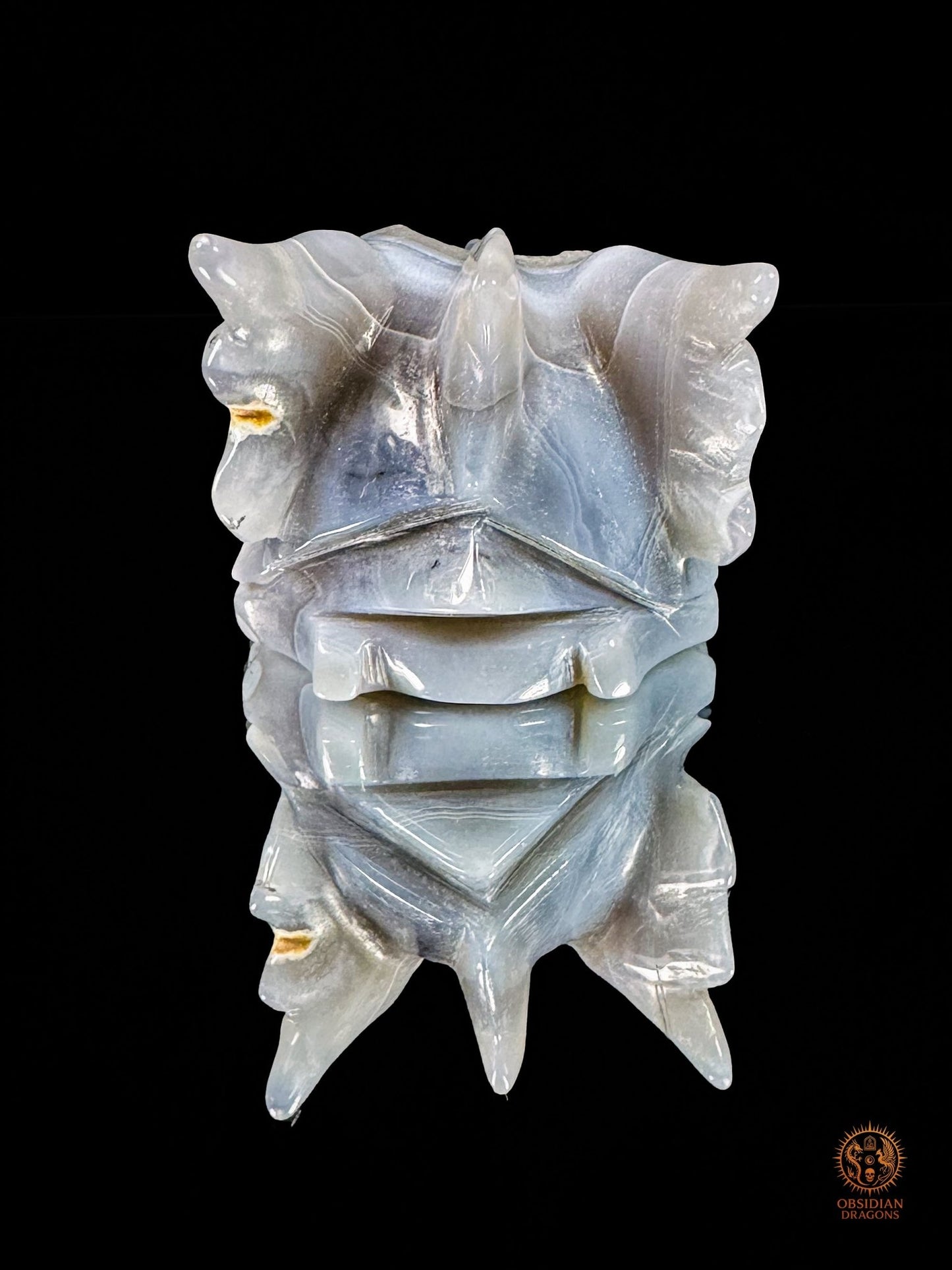
Brazilian Quartz Geode Dragon Skull with Perimorphosed Calcite Inclusion – Artisan Lapidary Sculpture, Secondary Crystallization on Carbonate Matrix, Volcanic Hydrothermal Formation, Mineral Transmutation Totem, Dragon Head for Draconic Meditation, Unique Collector's Item and Cabinet of Curiosities.
🜂 Memory of Transformation – Internal Alchemy
This dragon skull is a very special unique piece, sculpted with demanding lapidary mastery into a natural quartz geode, whose cavity contains a calcite inclusion partially covered by a secondary quartz crystallization. This dragon head reveals a complex mineral architecture, where several geological phases interact within the same volume.
These geodes form in volcanic cavities resulting from gas bubbles trapped in basaltic flows. Over millions of years, hydrothermal fluids rich in silica (SiO₂) penetrate these empty spaces and initiate quartz growth according to its trigonal system. In this particular specimen, an intermediate phase of carbonate crystallization gave rise to a calcite formation, later partially covered by a secondary quartz deposit. This perimorphosis phenomenon testifies to a succession of distinct geochemical events, revealing a rare mineral dynamic.
At the heart of this dragon skull, calcite acts as a fossilized memory of an earlier stage, while the quartz that enveloped it inscribes a second crystalline generation on its surface. Light circulates differently on these two materials: more diffuse and satiny on calcite, more vivid and structured on drusy quartz. This duality creates an unusual optical depth, almost stratified in time.
In this natural composition, this artisanal dragon embodies the real transformation inscribed in the stone. It reveals not only a crystalline cavity, but a superimposed geological history — a mineral alchemy where one phase covers another without completely erasing it.
A true metamorphosis dragon skull, it acts as a witness to successive cycles: dissolution, crystallization, covering, stabilization. It accompanies meditation with an energy different from previous specimens, more mnemonic, evoking the invisible layers that make up all inner transformation.
A mineral totem of internal alchemy, this dragon skull reminds us that matter itself bears the trace of its own mutations. Here, light is not born from a simple cavity: it emerges from a dialogue between two minerals, two times, two states of crystallization.
🔹 Dimensions and gemological characteristics of this Quartz Geode Dragon Skull with Calcite Inclusion
As a graduate gemologist from the National Institute of Gemology in Paris (ING), this Dragon Skull is certified as a natural quartz geode with calcite inclusion, undyed, unstabilized, unreconstituted, and non-synthetic.
🪨 Material:
Natural quartz geode (SiO₂) with a carbonate inclusion partially covered by secondary siliceous crystallization.
• Quartz: trigonal crystal system, internal drusy crystallization with secondary perimorphic deposition
• Calcite: calcium carbonate (CaCO₃), trigonal crystal system, formed prior to siliceous recrystallization
• Observed phenomenon: partial perimorphosis – quartz growth on the surface of pre-existing calcite
• Hydrothermal genesis in a basaltic volcanic environment, geochemical evolution in several phases
🌍 Origin:
Brazil – Minas Gerais (deposits renowned for the diversity of their crystallization sequences and the quality of their complex geodes)
🎨 Color:
• Quartz: colorless to translucent, clear vitreous luster, micro-light diffusion on drusy points
• Calcite: more milky to slightly satiny hue, softer reflection
• Optical interaction between carbonate surface and siliceous covering, creating a stratified visual reading
🛠️ Finish: Artisan lapidary sculpture made entirely by hand
• Respect for natural interfaces between quartz and calcite
• Preservation of the perimorphic zone as a mineralogical focal point
• Controlled orientation to enhance the superposition of crystalline phases
• Selective polishing: external surface softened / internal crystallization left natural
📏 Length: 12 cm
📐 Width: 7 cm
📦 Height: 6 cm
⚖️ Weight: 0.532 kg
The weight of this Dragon Skull reflects a balanced compactness between siliceous mass and carbonate inclusion. This intermediate density gives it clear physical stability while maintaining a subtle internal reading of its different mineral phases.
🧬 Unique piece:
The presence of calcite partially covered by secondary quartz crystallization makes this Dragon Skull geologically unique. Each formation stage — carbonate precipitation then siliceous recrystallization — corresponds to specific physicochemical conditions impossible to artificially reproduce in this natural configuration.
No other geode exactly reproduces this perimorphic sequence.
🛠️ The lapidary challenge:
Working a geode with a calcite inclusion implies:
• Precise reading of quartz / calcite interfaces
• Taking into account hardness differences (Quartz: 7 / Calcite: 3 on the Mohs scale)
• Mastering mechanical constraints to avoid chipping or separation
• Fine control of pressure and vibrations during cutting
The difference in behavior between crystallized silica and carbonate requires a progressive and meticulous approach. The success of this Dragon Skull relies on the balance between respecting successive geological phases and technical mastery of sculpting.
🔬 About quartz / calcite perimorphosis
Perimorphosis is a mineralogical phenomenon corresponding to the growth of one mineral on the surface of another, without the initial mineral completely disappearing. It is not a complete pseudomorphosis (where the original mineral is replaced), but a partial or total covering preserving the internal matrix.
In the present case, calcite (CaCO₃), a carbonate mineral crystallizing in the trigonal system, formed during a distinct geochemical phase within the volcanic cavity. Subsequently, a new hydrothermal episode rich in dissolved silica (SiO₂) allowed the crystallization of quartz according to its own trigonal system, directly on the surface of the pre-existing calcite.
This process involves:
• A modification of physicochemical conditions (pH, temperature, ionic saturation)
• An evolution of the composition of hydrothermal fluids
• A temporal succession of distinct mineral precipitations
The calcite surface served as a nucleation substrate for quartz crystals. The carbonate faces promoted the adhesion of the first siliceous nuclei, which then developed into secondary crystallization.
From a mineralogical point of view, this association is particularly interesting due to the difference in chemical composition and hardness:
• Quartz: SiO₂ – hardness 7 (Mohs) – three-dimensional covalent bond
• Calcite: CaCO₃ – hardness 3 (Mohs) – more fragile carbonate structure
The stable coexistence of these two phases indicates a relatively calm hydrothermal equilibrium after carbonate deposition, allowing siliceous crystallization without complete dissolution of calcite.
The visible simultaneous presence of both minerals constitutes a natural geochemical archive, inscribing in the stone the trace of successive evolutionary conditions.
From a scientific perspective, this phenomenon perfectly illustrates the capacity of hydrothermal environments to produce polyphasic mineral assemblages, bearing witness to a system in progressive mutation rather than linear formation.
🔹 An essential collector's item for any cabinet of curiosities
This Dragon Skull in a quartz geode with perimorphosed calcite inclusion goes beyond simple formal singularity: it constitutes a true sculpted mineralogical document. In the world of the cabinet of curiosities, where each object must combine natural rarity, structural complexity, and visual presence, this piece occupies a unique place.
Here, the cavity does not only reveal a classic drusy crystallization. It exposes a superposition of phases: an initial carbonate matrix, then a secondary siliceous deposit that embraced and partially covered the calcite. This stratified reading introduces a tangible geological depth. The gaze circulates between the times of formation.
Under directional lighting, the contrast becomes particularly expressive. The quartz, harder and more vitreous, captures light with sharpness. The calcite, softer and more satiny, diffuses a gentler luminosity. This coexistence creates a subtle, almost pedagogical optical dialogue, revealing two mineral states within the same architecture.
In a scientific or mineralogical cabinet of curiosities, this Dragon Skull plays a structuring role. It enriches the space with its internal complexity. It illustrates the succession of hydrothermal environments, the variability of geochemical conditions, and nature's ability to produce coherent polyphasic assemblages.
Its balanced dimensions and stable mass give it a measured yet assertive presence. Placed on a discreet base, integrated into a collection of Brazilian geodes, or presented as a central piece in a display case dedicated to recrystallization phenomena, it attracts attention by the sheer force of its internal structure.
Beyond aesthetics, it is part of a demanding collecting approach. Quartz/calcite perimorphosis constitutes a distinctive mineralogical criterion. This type of association testifies to a rare sequential geochemical evolution, difficult to encounter in such a legible configuration.
Intended for discerning collectors, enthusiasts of complex mineralogy, admirers of objects witnessing deep time, and aesthetes of the scientific cabinet of curiosities, this Dragon Skull represents much more than a sculpture: it embodies a compact geological archive, a natural stratification frozen in stone — an essential piece for any collection built with discernment and exacting standards.
🌫️ Why "Memory of Transformation – Internal Alchemy"?
This Dragon Skull is named "Memory of Transformation – Internal Alchemy" because it does not show a single crystallization, but a layered mineral history, visible to the naked eye. It is a real transformation, inscribed in the matter.
This "memory" is visible in the very texture of the cavity. Calcite diffuses light gently, almost like a mineral skin. Quartz, more vitreous, fragments and structures it into micro-splinters. Two optical behaviors, two natures, two times – superimposed, not replaced. The piece then becomes an archive: it shows how nature transforms, covers, stabilizes... without necessarily destroying.
"Internal Alchemy" thus refers both to a scientific reality – succession of phases, perimorphosis, secondary crystallization – and a refined symbolic interpretation: the idea that authentic transformation does not consist of erasing, but of integrating. This dragon skull evokes mutation as a stratified process: a new state that forms in contact with the old, revealing it in a different way.
Memory of Transformation – Internal Alchemy thus expresses the essence of this specimen:
a piece where the stone exposes the silent narrative of its own metamorphoses.
DRAGON SKULL:
The dragon skull is among the great archetypal figures traversing symbolic, initiatory, and alchemical traditions. It unites two fundamental polarities: the dragon, a principle of movement, power, and transformation, and the skull, a receptacle of consciousness, memory, and inner knowledge.
In a contemplative reading, the dragon skull is perceived as a guardian of the threshold. Where the crystal skull evokes clarity, purification, and vibrational uplift, the dragon skull introduces active dynamism, vital impulse, and the capacity for mutation. The crystal illuminates. The dragon sets in motion. One reveals light; the other provides the strength to inhabit it.
On an alchemical level, the dragon is traditionally associated with the mercurial principle: a fluid, unstable, and fertile force, capable of dissolving to recompose. The dragon skull then becomes the very image of conscious transmutation — the passage from one state to another, the transformation of density into clarity, the organization of chaos into intelligible form.
Therefore, the dragon skull embodies the energy of rebirth and the controlled traversal of cycles. It represents the ability to integrate one's own internal forces, to structure intensity rather than succumb to it.
The dragon skull is an architecture of transformation:
the encounter between mineral matter, archaic memory, and the power of conscious evolution.
DRACONIC MEDITATION:
Draconic meditation uses the dragon skull as a focus for concentration and inner activation. It is not about capturing a mythified external force, but about mobilizing symbolic energy inscribed in matter and consciousness.
Through its presence, the dragon skull acts as an anchor point. Its archetypal form stimulates the deep imagination, while its mineral structure stabilizes attention. It becomes a mediator between instinctive power and inner lucidity — between intensity and control.
Integrating a dragon skull into a contemplative practice means working with the notion of conscious transformation. The dragon represents raw energy, movement, the ability to cross thresholds. The skull embodies memory, structure, and mental clarity. Their union invites transformation without dispersion, mobilizing strength without losing one's center.
Draconic meditation thus promotes inner affirmation, overcoming personal resistances, and harmonizing internal dynamics. It is a structured exploration of the forces at play within oneself.
👉 To delve deeper into this subject and learn more about draconic meditation and the secrets of dragon skulls,
📎 I invite you to consult my dedicated article, "Meditating with a Dragon Skull – Draconic Meditation"
✨ If this piece resonates with you, don't let it become a mere memory of contemplation.
A Dragon Skull made of quartz geode with perimorphosed calcite inclusion is not a reproducible object.
This specimen exists in this form, with this precise stratification, this quartz/calcite superposition, this unique internal architecture.
It cannot be reproduced.
It cannot be ordered identically.
It can only be acquired… or missed.
🜂 Offer your collection a piece where the stone exposes its own metamorphosis.
Add to your cabinet of curiosities a sculpted geological archive, a mineral memory transformed into presence.
Explore the dragon skull collection
If this piece speaks to you, other mineral architectures await you.
Each Dragon Skull presented in the Obsidian Dragons collection is based on an authentic geological formation, rigorous gemological analysis, and sculpture that respects the internal structure.
No model is reproduced.
Each specimen is an irreversible variation of deep time.
→ Discover other Dragon Skulls available by clicking on this link