
🚚 Free delivery - returns within 14 days after delivery


Obsidian dragons
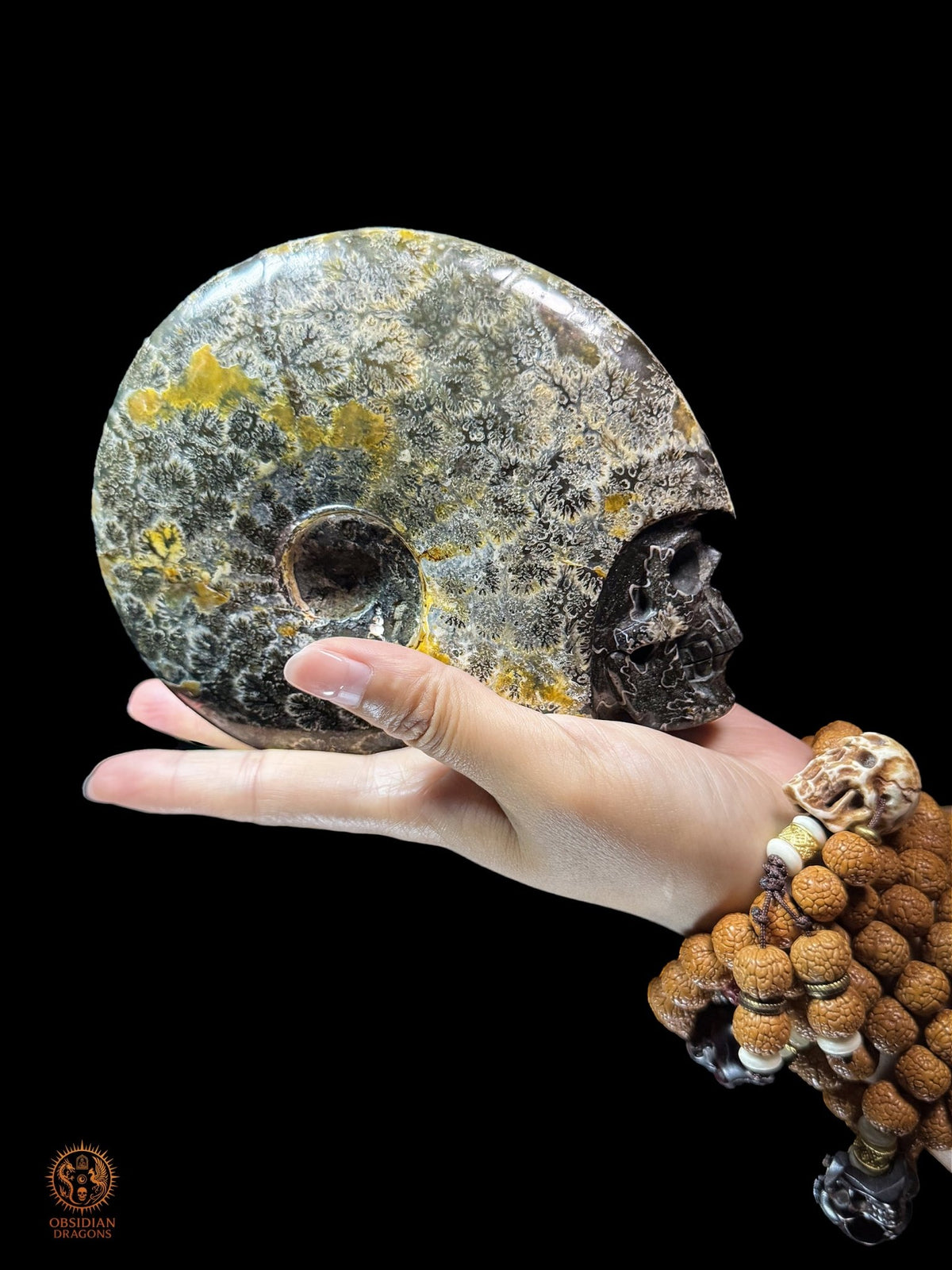
Fossilized ammonite skull (Cleoniceras) from Madagascar - Unique
Fossilized ammonite skull (Cleoniceras) from Madagascar - Unique
Couldn't load pickup availability
Cleoniceras Fossil Ammonite Skull from Cretaceous Madagascar – Unique Esoteric Mineral Sculpture in Natural Calcite, a Rare Marine Fossil Over 100 Million Years Old, a Symbolic Collector's Item Blending Art, Paleontology, and Earth's Memory
Artwork Summary:
💀 Cleoniceras fossil ammonite skull. Unique handcrafted mineral sculpture made from a genuine marine fossil over 100 million years old. This exceptional collector's item combines Earth's geological memory, the art of sculpture, and the natural beauty of calcite with remarkable red iridescence.
📏 Dimensions: 14 × 12.5 × 4 cm
⚖️ Weight: 0.869 kg
Unique piece, photos and video are contractual; you will receive exactly this Fossil Ammonite Skull.
There are works that seem to transcend the boundaries between eras: between the living world and the mineral world, between science and symbolism, between Earth's history and human creativity.
This Cleoniceras fossil ammonite skull is a unique and rare handcrafted work, born from the encounter between a Cretaceous marine fossil over 100 million years old and the precise skill of a sculptor capable of revealing a human form within a material shaped by time.
This exceptional mineral sculpture made from natural Madagascan ammonite combines the geological memory of an extinct ancient marine cephalopod with contemporary artistic creation. The original spiral of the ammonite, preserved in the fossilized calcite, here becomes the support for a sculpted skull, creating a collector's piece where paleontology meets mineral art and contemplation.
Every detail of this handcrafted sculpted skull tells a story that began long before the appearance of humanity: that of a living organism evolving in the Cretaceous oceans, whose shell slowly transformed into a true mineral archive of our planet.
The natural structures of the Cleoniceras, its characteristic internal lines, and its mineral nuances reveal a unique architecture, enriched by remarkable natural red iridescence that seems to retain an ancient light trapped in the stone for millions of years.
In a symbolic interpretation, the skull represents consciousness, inner knowledge, and transformation, while the ammonite evokes the eternal cycles of nature, the movement of time, and the deep memory of the Earth.
This ammonite sculpture is a truly rare collector's item, intended for fossil enthusiasts, mineral art lovers, collectors of exceptional objects, and lovers of cabinets of curiosities.
At the crossroads of paleontology, artisanal sculpture, mineralogy, and esoteric symbolism, this Cleoniceras ammonite skull from Madagascar represents a unique encounter between a material over 100 million years old and human creativity.
A work where the Earth began its story millions of years ago, and where the artist's hand now gives it a new existence: that of a fragment of the past transformed into a timeless symbol of wisdom, transformation, and terrestrial memory.
💀 Detailed Description of this Fossil Ammonite Skull
As a gemologist graduated from the National Gemological Institute of Paris, each piece offered by Obsidian Dragons is carefully selected according to criteria of authenticity, mineral quality, and aesthetic value.
This Cretaceous Cleoniceras fossil ammonite skull is a unique handcrafted piece, sculpted directly from a genuine natural fossil from Madagascar. It is neither a mold nor an industrial reproduction: every detail of this sculpture depends on the original structure of the fossil, making this example absolutely singular and irreproducible.
This creation combines the natural beauty of a fossilized ammonite with meticulous artistic work, revealing a human skull shape within a mineral material over 100 million years old.
📏 Dimensions of this Fossil Sculpture
This Cleoniceras fossil ammonite skull features balanced proportions highlighting both the sculpted form of the skull and the natural architecture of the ammonite:
📏 Length: 14 cm
🏛️ Height: 12.5 cm
📐 Width: 4 cm
⚖️ Weight: 0.869 kg
Its size allows for ideal display in a mineralogical collection, a prestigious cabinet of curiosities, a library, or a space dedicated to exceptional natural objects.
The elongated shape of the fossil emphasizes the original spiral of the ammonite, while the skull sculpture creates a striking contrast between the natural geometry of the fossil shell and the human representation.
🔬 Nature of the Fossil: a Cretaceous Cleoniceras Ammonite
This sculpture was made from a genuine Cleoniceras fossil ammonite, an ancient marine cephalopod that lived during the Lower Cretaceous period, approximately 100 to 110 million years ago.
Ammonites were marine mollusks related to modern nautiluses, squids, and octopuses. Their spiral shell, divided into different internal chambers, constituted a complex natural architecture that allowed the animal to control its buoyancy in the ancient oceans.
The Cleoniceras genus is particularly sought after by fossil collectors for several reasons:
🌀 its harmonious spiral coiling;
🔬 its delicate and characteristic internal suture lines;
💎 its spectacular mineral structures revealed after cutting and polishing;
🌍 the exceptional preservation quality of many specimens from Madagascar.
Over tens of millions of years, the original ammonite shell gradually transformed into mineral material. The biological structures were preserved in fossil form, creating a true natural archive of the Cretaceous marine world.
🌍 Geographical Origin: Madagascar
This ammonite comes from Madagascar, a region renowned worldwide for its exceptional Cretaceous ammonite deposits.
During this distant period, the territories corresponding to modern-day Madagascar were associated with ancient marine environments of Gondwana. The ocean floors of that era gradually preserved the shells of extinct organisms, allowing their fossilization over geological ages.
Malagasy ammonites are particularly valued by collectors for:
🌊 their prestigious geological origin;
💎 their natural mineral contrasts;
🌀 their often remarkably visible internal structures;
✨ their unique color variations linked to fossilization processes.
Each Malagasy fossil thus possesses its own natural signature, created by an impossible-to-reproduce geological history.
🔥 Remarkable Natural Red Iridescence of the Fossil Calcite
One of the most interesting features of this ammonite lies in its natural red iridescence, visible depending on the light orientation.
These shades ranging from deep red to copper, sometimes accompanied by golden reflections, are not artificially added: they are the result of natural processes related to fossilization and the internal structure of the mineral material.
During the transformation of the ammonite shell into a fossil, the internal spaces were gradually replaced or filled by minerals, mainly calcite (calcium carbonate – CaCO₃).
Within this fossil calcite, fine crystalline structures, variations in mineral thickness, and internal microstructures can cause interference phenomena with light. These interactions create these natural iridescence effects that give the fossil a particular visual depth.
The possible presence of mineral traces, particularly certain iron oxides present in fossil-bearing environments, can also contribute to the warm tones observed.
These colors are therefore the consequence of an extremely long geological history: they bear witness to the natural transformations undergone by this ancient marine shell for over 100 million years.
💎 A Unique Fossil Piece Between Science and Artistic Creation
This skull sculpted from a Cleoniceras fossil ammonite brings together several stories in a single work:
🌊 that of an ancient cephalopod living in the Cretaceous oceans;
⏳ that of a slow fossilization process that transformed a biological shell into mineral material;
🗿 that of an artisan who revealed a human form within this ancient material;
✨ that of a contemporary work destined to pass through time in a private collection.
Every relief, every shade of calcite, and every natural structure contributes to the unique identity of this sculpture.
This fossil ammonite skull from Madagascar is a true collector's item where the memory of the Earth meets human artistic expression.
🌀 Genesis of Cleoniceras Fossil Ammonites from Madagascar
Cleoniceras fossil ammonites from Madagascar are among the most prized specimens for collectors of Cretaceous fossils. Their interest lies in the exceptional combination of several elements: a prestigious geological origin, excellent preservation of internal structures, and a particularly remarkable shell architecture.
These fossils bear witness to a major chapter in the history of marine life, when the Cretaceous oceans hosted a great diversity of cephalopods that are now extinct.
🌊 Cleoniceras: Marine Cephalopods of the Lower Cretaceous
Cleoniceras belong to the ammonite group, cephalopod mollusks that lived in the Mesozoic oceans, between the Triassic and the end of the Cretaceous.
The Cleoniceras genus is particularly representative of the Lower Cretaceous, specifically the Aptian and Albian stages, a period approximately between 125 and 100 million years ago.
Like other ammonites, Cleoniceras possessed an external spiral shell composed mainly of calcium carbonate. This shell was organized into different internal chambers separated by septa.
The animal occupied only the last growth chamber, while the previous chambers formed a complex structure allowing for buoyancy regulation.
This organization explains the richness of the patterns observable today in polished fossils: the suture lines and internal structures correspond directly to the original biological architecture of the animal.
🗺️ Madagascar in the Cretaceous: an Ancient Marine Environment
Cleoniceras ammonites used for creating fossil sculptures primarily come from deposits located in Madagascar, a region that has now become a global reference for Cretaceous ammonite fossils.
More than 100 million years ago, Madagascar had a very different geographical configuration from what we know today.
At that time, the island was still part of the ancient supercontinent Gondwana and was bordered by marine areas favorable to the development of abundant cephalopod fauna.
Cretaceous seas covered certain regions that would later become land. Ammonites then lived in these marine environments where they evolved among many other now extinct organisms.
After their death, their shells settled on the ocean floor before being progressively buried in sediments.
⏳ The Fossilization Process of Ammonites
The transformation of an ammonite shell into a fossil is an extremely slow phenomenon that spans several tens of millions of years.
The process includes several major geological stages:
🌊 1. Accumulation in Marine Sediments
After the animal's death, the shell settles on the seabed. It can be rapidly covered by sedimentary particles, limiting its complete destruction.
🪨 2. Progressive Burial
Over time, layers of sediment accumulate above the shell. Pressure gradually increases while organic elements disappear.
💎 3. Mineralization
The internal spaces of the shell can be gradually filled by mineral solutions circulating in the rocks.
In the case of Madagascan ammonites, calcite (CaCO₃) plays a major role in the preservation and transformation of the original shell.
The internal structures are thus replaced or consolidated by minerals, allowing for the preservation of the ammonite's complex architecture.
🌀 4. Revelation of Internal Structures
When the fossil is cut and then polished, the various internal parts appear, the septa separating the chambers, the complex suture lines, as well as the mineral variations linked to fossilization.
These patterns constitute a true anatomical signature of the ammonite.
🔬 Suture Lines: a Characteristic of Cleoniceras
One of the most remarkable features of Cleoniceras ammonites lies in their ammonitic suture lines.
These structures correspond to the areas where the internal septa of the shell meet its outer wall.
In ammonites, these lines are much more complex than in modern nautiluses. They form branched and extremely detailed patterns, comparable to natural mineralized lace.
In Cleoniceras from Madagascar, these internal patterns are particularly appreciated because they often appear with great finesse after polishing.
They allow collectors and specialists to directly observe part of the internal organization of an organism that disappeared tens of millions of years ago.
💎 Why are Cleoniceras Ammonites from Madagascar Sought After?
Cleoniceras fossil ammonites from Madagascar hold a special place in paleontological collections for several reasons:
✨ Remarkable Geological Origin
Madagascar possesses some of the best-known Cretaceous ammonite deposits in the world.
✨ Excellent Preservation
Many specimens exhibit clearly visible and well-preserved internal structures.
✨ Exceptional Natural Aesthetics
The contrasts between calcite, fossil structures, and mineral variations create unique patterns.
✨ Great Diversity of Forms and Sizes
Each ammonite has its own morphology, coloration, and geological history.
🌍 A Mineral Testimony of a Lost World
The ammonite constitutes a natural archive allowing us to observe a period when the Cretaceous oceans hosted a biodiversity that is now extinct.
Each specimen preserves traces of several successive stages:
🌊 the life of a cephalopod in ancient seas;
⏳ its burial in marine sediments;
💎 its progressive transformation into fossil material;
🔬 its discovery and study by humans.
This Cleoniceras fossil ammonite skull from Madagascar is thus based on a material whose history began over 100 million years ago, when this ancient organism was still evolving in the Cretaceous oceans.
A true geological archive of the Earth, preserved in the form of a contemporary mineral sculpture.
🗿 The Art of Sculpture: this Ammonite Skull is a Work of Art
Creating a sculpture from an ancient fossil is a dialogue between the artist's gaze and a form already shaped by millions of years of Earth's history.
In this work, the artisan works with a material that already possesses its own identity, its own lines, its own volumes, and its own natural imperfections.
The challenge then is to reveal a new form without erasing the original history of the fossil.
This Ammonite Skull is a true mineral work of art, born from the encounter between ancient material and precise human intervention, where sculpture extends the work begun by nature.
🗿 Revealing a Hidden Form within the Material
Each fossil has a unique structure that influences artistic creation.
The artist must observe the natural form of the ammonite, understand its internal architecture, and imagine how the skull's representation can harmoniously integrate into this particular material.
Sculpture then becomes a work of discovery: making a presence appear that seems to already be waiting to be revealed.
Gradually, under the sculptor's hand, volumes take shape:
💀 the contours of the skull emerge from the fossil material;
👁️ anatomical cavities and reliefs appear;
🌀 the natural spiral of the ammonite becomes an essential element of the composition;
💎 the textures and nuances of the fossil calcite directly contribute to the final expression of the work.
The result is a sculpture where the human form and the natural structure of the ammonite complement each other.
⚒️ The Precision of Exceptional Craftsmanship
The creation of a skull carved from a fossilized ammonite requires great technical mastery.
The fossil has a complex internal organization that must be respected at every stage of the work.
The artisan must work with:
🔬 the natural structures of the fossil calcite;
🌀 the original lines of the ammonite;
💎 the variations in material density;
✨ the specific characteristics of each specimen.
Every gesture must be carefully considered, as excessive intervention could permanently alter a piece that can never be reproduced.
Sculpture is, therefore, based on a subtle balance between precision, patience, and respect for the natural material.
🎨 A Meeting of Contemporary Sculpture and Natural Art
This creation belongs to a world where the boundaries between art and nature become almost imperceptible.
The ammonite's spiral, its textures, mineral contrasts, and natural iridescence become elements of artistic language.
The carved skull brings a human dimension to this ancient material, creating a dialogue between:
🌍 the geological memory of the Earth;
🗿 human creativity;
💎 the intrinsic beauty of natural materials.
This approach aligns with the spirit of artists who seek not to dominate nature, but to collaborate with it to create unique works.
💀 The Skull as a Timeless Sculptural Form
Throughout art history, the skull has fascinated artists with its visual power and symbolic richness.
Its recognizable structure, complex volumes, and universal connection to the human being make it a privileged subject in many artistic traditions.
In this sculpture, the skull becomes a timeless form inscribed in a material itself beyond time.
The encounter between human representation and the fossil ammonite creates a work where two stories converge:
that of a marine organism that disappeared more than 100 million years ago;
and that of human artistic creation capable of giving new expression to this ancient material.
✨ A Unique Work Impossible to Reproduce
In the field of mineral art, some pieces have a particular value because their uniqueness depends not only on the artistic work but also on the natural history of the material used.
Even an artisan using exactly the same technique could never create two identical works.
This Ammonite Skull is an original creation, resulting from the encounter between an exceptional natural fossil and the expertise of a sculptor.
🏛️ A Work Destined for Mineral Art Collections
Due to its unique character, this sculpture goes beyond a simple decorative object.
It belongs to the world of exceptional natural works: pieces capable of attracting the eye, arousing curiosity, and prompting reflection on the relationship between humans, matter, and time.
In a private collection, a cabinet of curiosities, a library, or a space dedicated to rare objects, this skull carved from an ammonite becomes a central piece, both an artistic work and a testament to a history that began long before our time.
A creation where nature shaped the material for millions of years, and where the artist now offers it a new life in the form of a unique mineral sculpture.
🔮 Symbolic and Esoteric Reading of this Ammonite Skull
For millennia, certain natural forms and symbols have accompanied humanity in its quest to understand the world and itself.
This Skull carved from a fossilized ammonite brings together two powerful archetypes: that of the human form, associated with consciousness and inner knowledge, and that of the spiral, present in nature from the first life forms to the great structures of the universe.
This encounter creates a work whose interpretation goes beyond simple aesthetic representation. It becomes a support for contemplation about time, evolution, transformation, and the deep connection between human beings and the Earth.
💀 The Skull: A Symbol of Knowledge and Passage
In many artistic and philosophical traditions, the skull is not only associated with the end of existence, it also represents a reminder of consciousness, lucidity, and the search for meaning.
The skull invites us to go beyond the immediate appearance of things to contemplate what remains beyond visible transformations.
In this sculpture, it can be interpreted as:
🧠 The Symbolic Seat of Consciousness
The shape of the skull evokes thought, memory, and the human capacity to observe, understand, and question the world.
🌑 The Symbol of Stripping Down to the Essential
Stripped of all external appearance, the skull represents what remains when the human being returns to their profound essence.
🔥 A Symbol of Inner Transformation
It reminds us that every personal evolution sometimes involves a break with an old way of existing to make way for a new understanding.
The skull becomes less a representation of disappearance than a symbol of passage: that of a consciousness evolving through the different stages of existence.
🌀 The Ammonite Spiral: The Eternal Movement of Transformation
The spiral is one of the oldest and most universal forms observed in nature.
It appears in the growth of living organisms, in certain plant structures, in cosmic phenomena, and in many human artistic expressions.
In this work, the natural spiral of the ammonite can be contemplated as a symbolic representation of perpetual movement.
It evokes:
🌀 The Inner Journey
The spiral suggests a journey towards oneself, a movement that progressively explores different dimensions of existence before returning to its center.
🌱 Evolution in Cycles
It reminds us that transformation is not always a linear progression, but a path composed of successive stages, new beginnings, and metamorphoses.
🌌 Unity between Microcosm and Macrocosm
The same spiraling growth logic appears in many natural structures, creating a symbolic link between human beings and the great rhythms of the universe.
Associated with the skull, this spiral becomes the symbol of a consciousness inscribed in a movement vaster than its own existence.
🌍 The Encounter Between Human Consciousness and the Memory of the Earth
This sculpture unites two radically different time scales.
On one side, the human being, whose individual existence is measured in decades.
On the other, the fossil ammonite, whose history began over 100 million years ago in the ancient oceans of the Cretaceous period.
This encounter creates a profound symbolic reflection:
Human consciousness contemplates a material that existed long before it.
The present dialogues with an almost inconceivable past.
Thought meets the mineral memory of the planet.
In this interpretation, the fossil becomes a link between different epochs of the Earth, reminding us that every human existence belongs to a much vaster history.
🔥 The Symbol of Metamorphosis: From Life to Stone, From Stone to Art
The history of this piece itself can be considered a metaphor for transformation.
Once, this ammonite was a living organism evolving in the ancient oceans.
Over time, its shell transformed into fossil material.
Millions of years later, this mineral material was chosen by an artisan to become a sculpture.
Three states succeed each other:
🌊 Organic Life: the marine animal in its natural environment;
💎 Mineral Memory: the fossil preserving the imprint of a vanished world;
🗿 Artistic Creation: the material transformed into a work carrying new meaning.
This succession symbolically illustrates a universal principle: transformation does not mean disappearance, but a change of form.
🪞 A Symbolic Mirror of the Inner Self
Placed in a contemplative space, this sculpture can be considered an object inviting introspection.
The skull symbolically looks inward.
The spiral invites a journey.
The fossil reminds us of the depth of time.
Together, these elements compose an image of the inner journey: understanding one's own path, accepting necessary transformations, and recognizing one's place in a larger whole.
This work can thus accompany personal reflection around fundamental questions:
🌑 What ancient forms must we transform to evolve?
🌀 What cycles do we repeat in our own existence?
🌍 What relationship do we have with the natural world of which we are a part?
✨ A Symbolic Work Between Matter, Consciousness, and Eternity
This fossil Cleoniceras Ammonite Skull from Madagascar can be contemplated as an encounter between three dimensions:
💀 Human consciousness, represented by the skull;
🌀 The eternal cycles of nature, expressed by the ammonite's spiral;
🌍 The deep memory of the Earth, preserved in the fossil material.
Beyond its aesthetic character, this sculpture offers a silent meditation on time, transformation, and our relationship with the great natural forces that surround us.
A work where a form born in ancient oceans becomes, millions of years later, a symbol of inner knowledge, evolution, and connection with the immense history of our planet.
🧘 Spiritual Dimension and Symbolic Uses of this Ammonite Skull
Beyond its artistic and paleontological dimension, this fossil Cleoniceras Ammonite Skull can be considered an object of contemplation inviting us to slow down, observe, and reflect on the great cycles that connect human beings to the natural world.
In many traditions, certain objects become supports for inner reflection, capable of accompanying a personal journey around self-knowledge, transformation, and the search for balance.
This sculpture brings together material from an extremely ancient past and a universally recognizable human form. It thus creates a silent dialogue between the history of the Earth and the inner experience of the contemplator.
🌍 A Symbolic Link with the Deep Memory of the Earth
A fossil ammonite carries within it a temporality that far exceeds the human scale.
Contemplating material born in the Cretaceous oceans symbolically invites us to broaden our perception of time and become aware of the immensity of natural cycles.
In a meditative approach, this sculpture can represent:
🌍 Anchoring in the Present Moment
Facing material over 100 million years old, daily concerns can be placed in a broader perspective.
🪨 The Stability and Patience of Nature
The fossil reminds us that certain transformations require extremely long periods and that every evolution follows its own rhythm.
🌱 The Continuity of Life
Even after the disappearance of the original organism, its imprint remains in a new form, reminding us that all existence leaves a trace.
The fossil thus becomes a symbol of continuity, connecting ancient times to the present moment.
🧘 A Support for Meditation and Introspection
The presence of the skull in this work can accompany reflection around consciousness and inner observation.
In a contemplative practice, it can invite exploration of several dimensions:
🪞 Self-Observation
The skull becomes a symbolic mirror for questioning one's thoughts, choices, and one's own journey.
🌑 Acceptance of Transformations
It reminds us that every stage of life involves changes, passages, and sometimes the abandonment of old forms to allow for new evolution.
🔥 The Search for the Essential
Stripped of all external appearance, the symbol of the skull invites us to look beyond the superficial and return to what has true inner importance.
In this approach, the sculpture becomes a starting point for personal reflection.
🌀 The Spiral as an Energetic Path and Inner Movement
The natural spiral of the ammonite can be contemplated as a symbolic representation of the movement of existence; it suggests a path that evolves in cycles: returning to certain points while moving forward differently.
It can evoke:
🌀 Returning to the Center
The spiral reminds us of the importance of finding an inner space of calm and stability despite external movements.
🌿 Progressive Evolution
It suggests that every experience, even difficult, can contribute to a deeper transformation.
🌌 Harmony with Natural Rhythms
It invites us to observe the cycles present in nature and to recognize that human beings also belong to these universal movements.
The fossil spiral becomes a symbol of a journey rather than a simple aesthetic motif.
🔥 A Symbolic Representation of Rebirth
The very history of this ammonite can be interpreted as a metaphor for transformation.
An ancient marine organism traversed the ages.
Its shell changed its nature to become mineral matter.
This material was then transformed by human hands into an artistic work.
Each stage represents a new expression of existence:
🌊 life;
💎 memory;
🗿 creation.
This principle can be likened to the inner journey of the human being, where ancient experiences progressively become a source of understanding and wisdom.
🏛️ An Object of Contemplation in a Personal Space
Installed in a library, office, meditative space, or private collection, this fossil ammonite skull can become a focal point inviting calm and reflection.
It can symbolically accompany:
🧘 moments of meditation;
📖 periods of study or inner search;
🌿 reflection on the relationship between humans and nature;
🔥 periods of personal change or transition.
Its presence recalls an essential idea: humans are not separate from Earth's history, but part of a much vaster process of which they are a momentary expression.
✨ A Work Between Ancient Matter and Human Consciousness
This Cleoniceras fossil ammonite skull from Madagascar can thus be contemplated as a symbol uniting three dimensions:
🌊 Origin: an ancient life form born in the Cretaceous oceans;
💎 Transformation: matter that has traversed millions of years to become a fossil;
🧘 Consciousness: the human gaze capable today of recognizing, interpreting, and giving meaning to this history.
This work proposes a silent dialogue between matter and spirit, between the deep past of the planet and the inner quest of the human being.
A piece where time becomes matter, where matter becomes art, and where art becomes an invitation to contemplation.
🔮 Explore the Spiritual Use of a Skull
To learn more about the many ways to integrate this rare and exceptional fossil ammonite skull into your spiritual practices, discover our blog article:
"Meditating with a Crystal Skull."
You will find detailed advice and advanced techniques to fully exploit the potential of this unique skull.
🏺 Collector's Item – Prestigious Cabinet of Curiosities
Certain natural works possess a particular presence: they are not merely objects one owns, but pieces that tell a story, attract the eye, and invite discovery.
This ammonite skull belongs to this rare category of objects located at the boundary between scientific collection, mineral art, and exceptional artwork.
It combines three universes traditionally sought after by collectors:
🌍 The memory of Earth, represented by a marine fossil over 100 million years old;
🗿 Artistic creation, revealed by meticulous sculptural work;
💎 The unique collector's item, whose every detail depends on a natural history impossible to reproduce.
🏛️ The Spirit of Cabinets of Curiosities
Since the Renaissance, cabinets of curiosities have gathered rare objects intended to awaken curiosity, spark wonder, and connect different fields of knowledge.
Exceptional minerals, fossils, natural works, scientific objects, and artistic creations were brought together in the same endeavor: to observe the wonders of the world and understand the links between nature, time, and human creativity.
This sculpture is fully in line with this tradition.
It could naturally find its place in:
🏺 a contemporary cabinet of curiosities;
💎 a private mineralogical collection;
🦴 a collection dedicated to rare fossils;
🎨 a space dedicated to natural art and mineral sculptures;
📚 an enlightened amateur's library.
💎 A Piece for Collectors of Unique Objects
Unlike mass-produced decorative objects, this sculpture has its own identity.
Its value lies in the exceptional combination of several elements:
✨ a genuine natural fossil;
🌀 a unique internal structure linked to the geological history of the ammonite;
💀 an original artisanal sculpture;
🔥 natural red iridescences specific to this specimen;
🌍 a Malagasy origin recognized in the world of fossils.
Each ammonite possesses a mineral composition, nuances, reliefs, and internal structures that can never be exactly reproduced.
Even with the same sculpting technique, a second identical work could not exist.
This singularity makes each skull sculpted from a fossil ammonite a true author's piece.
🗿 Between Scientific Object and Artistic Work
Great collections have often sought objects capable of uniting knowledge and beauty.
This fossil ammonite skull possesses this dual dimension:
🔬 It bears witness to a precise natural history, that of the ancient Cretaceous oceans and the extinct organisms that populated them.
🎨 It also becomes a contemporary work where fossil matter is transformed into an expressive creation.
This meeting between science and art corresponds to the very spirit of prestigious collections: to preserve not only a rare object, but also a history.
🌌 A Central Piece for a Personal Collection
By its visual presence and unique character, this sculpture can become a centerpiece in an environment dedicated to exceptional objects.
Placed on antique furniture, in a library, a display case, or a contemplation space, it naturally attracts attention with its contrast between:
🌀 the perfect geometry of the fossil spiral;
💀 the universal shape of the human skull;
🔥 the colorful reflections of iridescent calcite;
⏳ the immense history contained within the matter.
It then becomes an object that provokes curiosity, raises questions, and creates a dialogue between the observer and the millions of years it represents.
✨ A Natural Work Transformed into Contemporary Heritage
Some pieces transcend eras because they possess a history that goes beyond their appearance.
This ammonite began its existence in the ancient seas of the Cretaceous period.
It then underwent geological transformations, burial, fossilization, and the erosion of time.
Finally, it met the human eye and the hand of an artisan to become a unique sculpture.
This succession of stages gives birth to an object where:
🌊 the history of life;
💎 mineral memory;
🗿 artistic expression;
🏺 the passion of collectors.
This ammonite skull is a prestigious collector's item: a fragment of a lost world transformed into a timeless work, destined to join a collection where natural beauty meets knowledge and human imagination.
✨ A Unique Encounter Between Earth's Memory and Human Art
This Cleoniceras fossil ammonite skull from Madagascar is a fragment of natural history transformed into an exceptional work of art.
A unique piece where over 100 million years of geological history meet the precision of a master sculptor.
No other ammonite possesses exactly the same structures, the same nuances, the same natural red iridescence, or the same history.
💎 This work exists as a single specimen.
Intended for collectors of rare fossils, enthusiasts of mineral art, lovers of cabinets of curiosities, and individuals sensitive to objects imbued with history, it now awaits to join a collection where it can continue its journey through time.
🌍 Treat yourself to a silent witness of the Cretaceous oceans.
🌀 Welcome into your space a work where nature, art, and the memory of Earth become one.
✨ Discover this unique piece and let a fragment of eternity enter your collection.
💀 Explore our vast collection of crystal skulls
Discover our wide selection of crystal skulls, unique and powerful pieces, available online by clicking now on the following link: 📎 Crystal Skulls - Fine Stone Skulls - Unique Skulls
Partager



Return conditions for a Zen purchase
We offer you a money back guarantee within 14 days after delivery of your order.
If you are not completely satisfied with your purchase, please contact us to arrange a return of the product and a refund.
Except for returns, shipping is free on all orders.
-

100% secure payment
3 times interest-free option with Scalapay
-

Free delivery in France and internationally
14 days money back guarantee after delivery (see our conditions of sale)
-

Excellent customer service
Live chat
Whatsapp +33674049312


Let customers speak for us
from 951 reviewsCrâne en Malachite Naturelle 3kg - Rare et exceptionnel

Merci pour tout, la communication, les facilités et la qualité des produits.

Comme a son habitude, Jeremy a des pièces exceptionnelles. Ce collier est une merveille absolue. Encore MERCI pour toutes ces merveilles.

Merci pour cet objet de magnifique qualité
Chaque détail, la qualité de sa réalisation
Les explications qui l'accompagnent..
En font un objet superbe comme support de méditation
En font un très bel objet de collection...
Merci

Très contente jolie pièce je recommande

Magnifique grande sphere . Superbes couleurs et tres haute qualité. Promesses largement tenues. Envoie rapide. Confiance totale pour un prochain achat.

Bonjour,
Je suis complètement satisfait de ce magnifique Mala Phurba en obsidienne. Les gemmes sont sublimes et sont d'une excellente qualité. La livraison de Chine en moins de 10 jours et dans un emballage hermétique c'est tout simplement exceptionnel. Merci pour ce sublimissime Mala.
Et merci pour se produit issu de l'artisanat.
Namaste

Le Mala a été livré très rapidement et je vous en remercie.
C’est notre fille qui l’a réceptionné, elle m’a confirmé que c’était une très belle pièce. Elle nous rejoint dans deux semaines, mon époux le découvrira alors et en fera le meilleur usage…
Merci pour le partage de votre passion ! 🙏🏽

bracelet puissant, je suis content de mon achat

Cet artisan est gémologue, il travaille avec des artisans qui sont des vrais artistes, je suis bluffé par la qualité des ouvrages sur l’argent et sa qualité. Quand à la qualité des pierres pas besoin d’être gémologue pour voir la qualité exceptionnelle des pierres, encore une fois le travail de sculpture est exceptionnel.
Mon mala traditionnel est une pure merveille dans la tradition originelle. Le ghau est une merveille qui me comble.
Bref que dire de plus :). Allez sur son site.
PS : vendeur qui connait son métier et les traditions bouddhistes ce qui est un plus en plus :)

Ce crâne est un Etre de Lumière. Attirant , inspirant , "parlant".
Il est un Ami qui tire mes pensées vers le Haut.
Ses énergies vibrent à des fréquences élevées. Il est puissant dans la douceur.
Un crâne de Dragon m'assite également. Merveilleux !

Très beaux bracelet et très puissants

Magnifique crâne givré de l'Himalaya.

cette chevalière est tres bien réalisé, avec beaucoup de détails, je suis heureux de l'avoir
