
🚚 Free delivery - returns within 14 days after delivery


Obsidian dragons
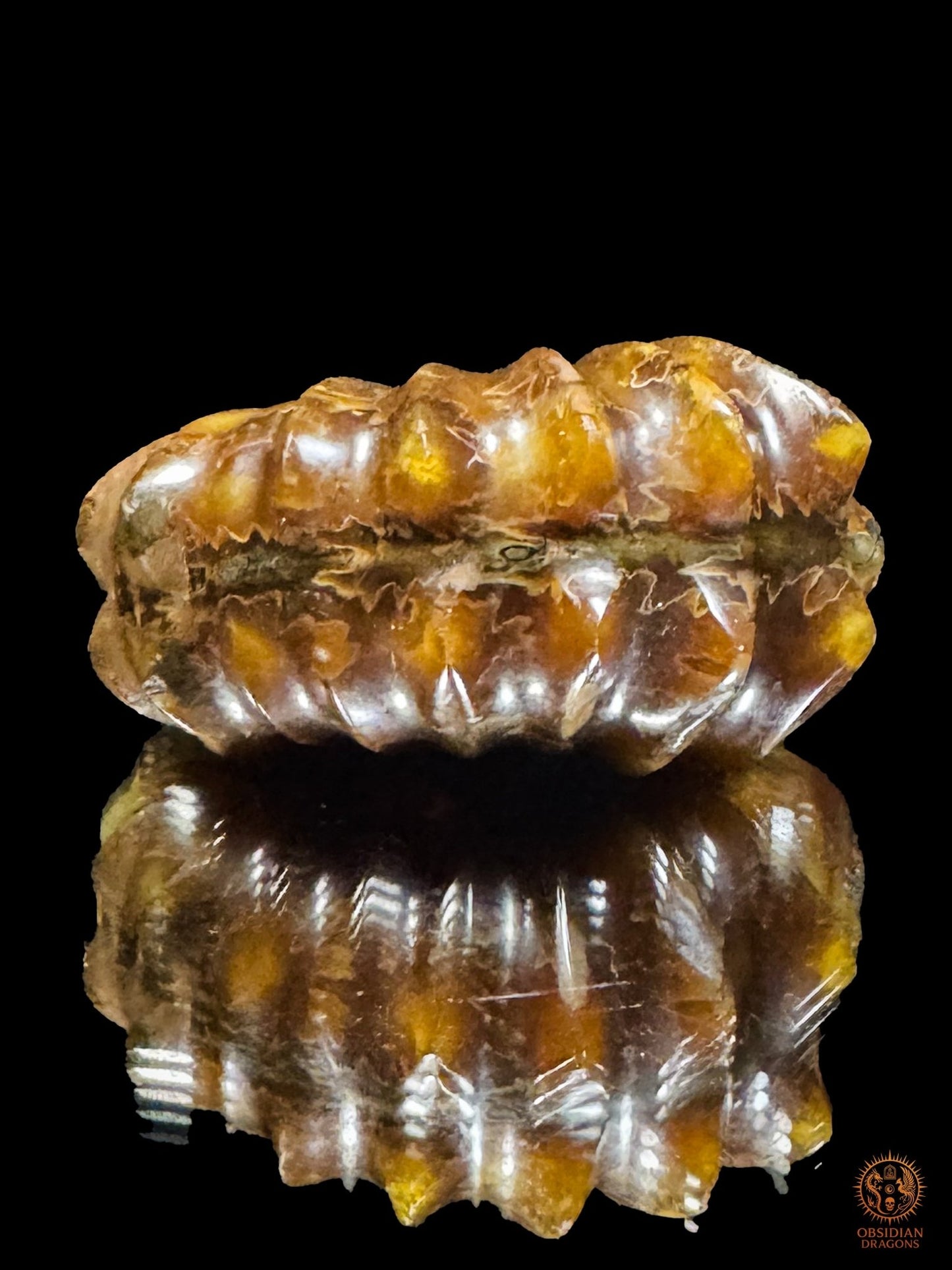
Rare fossilized ammonite skull Douvilleiceras
Rare fossilized ammonite skull Douvilleiceras
Couldn't load pickup availability
Fossilized Douvilleiceras Ammonite Skull from the Lower Cretaceous of Madagascar – Unique Mineral Sculpture in Natural Calcite, a Rare Genuine Marine Fossil Over 100 Million Years Old, an Ancient Extinct Cephalopod Ammonite Transformed into a Paleontological and Esoteric Work of Art, a Mineral Relic Symbolizing Earth's Memory, Eternal Cycles, Transformation, and Rebirth, a Prestigious Collector's Item Bridging Cabinets of Curiosities, Fossil Science, Ancestral Art, and Cosmic Energy.
Artwork Summary:
This skull was handcrafted from a genuine marine fossil over 100 million years old. This unique mineral sculpture in natural calcite combines paleontology, fossil art, and ancestral symbolism in a rare collector's piece for enthusiasts of fossils, mineral art, and cabinets of curiosities.
📏 Dimensions: 7 × 6 × 2 cm
⚖️ Weight: 0.158 kg
Unique piece, photos and video are contractual, you will receive exactly this Skull sculpted from a fossilized ammonite.
There are works that seem to abolish the boundaries between eras: between ancient life and mineral matter, between science and symbol, between the deep memory of the Earth and human creativity.
This Douvilleiceras fossil ammonite skull is a unique and rare handcrafted work, born from the encounter between a genuine marine fossil from the Lower Cretaceous, over 100 million years old, and the meticulous craftsmanship of a sculptor capable of revealing a human form at the heart of matter shaped by geological time.
This exceptional sculpture in fossil ammonite from Madagascar combines the natural beauty of an ancient extinct cephalopod shell with contemporary artistic creation. The Douvilleiceras, once inhabited by a marine creature evolving in the oceans of the Cretaceous, now becomes the support for an ammonite skull sculpture, giving birth to a collector's piece where paleontology, mineral art, artisanal sculpture, and symbolic contemplation meet.
Every detail of this fossil sculpture tells a story that far exceeds the human scale: that of a marine organism that lived in a vanished world, that of slow fossilization that transformed a biological structure into mineral memory, and then that of artistic intervention that offered a new existence to this ancient matter.
The natural structure of this fossil Douvilleiceras ammonite, with its characteristic spiral architecture, original reliefs, and natural calcite nuances, gives this work a completely unique identity. The warm hues of the material, its variations in transparency, and its fossil textures seem to retain the light of an ancient ocean, imprisoned in stone for millions of years.
In an artistic and esoteric reading, this ammonite skull represents the encounter between two forms of memory: that of the Earth, preserved in the fossil, and that of the human being, symbolized by the skull. The ancestral spiral of the ammonite evokes the eternal cycles of nature, the movement of time, and the perpetual transformation of all existence.
The skull, in turn, becomes a symbol of consciousness, inner knowledge, and rebirth. Far from being merely a representation of human finitude, it recalls the capacity for transformation, the acceptance of life's cycles, and the search for the essential.
This fossil ammonite sculpture belongs to the world of exceptional natural works, mineral art objects, and prestigious cabinets of curiosities. It is aimed at collectors of rare fossils, paleontology enthusiasts, lovers of unique mineral sculptures, and those who seek pieces with an authentic history that goes beyond their simple appearance.
A truly unique collector's item, this Douvilleiceras fossil ammonite skull brings together three fascinating temporalities: the biological time of an ancient marine cephalopod, the geological time of fossilization, and the human time of artistic creation.
A work where the Earth began the story more than 100 million years ago, where time transformed a marine relic into mineral memory, and where the artist's hand now offers it a new dimension: that of a timeless sculpture between fossil science, ancestral art, symbolism, and fascination for the origins of life.
💀 Detailed description of this Fossil Ammonite Skull
As a certified gemologist from the National Institute of Gemology in Paris, every piece offered by Obsidian Dragons is carefully selected based on criteria of authenticity, mineral quality, and aesthetic value.
This Douvilleiceras fossil ammonite skull from the Lower Cretaceous is a unique and rare handcrafted work, carved directly from a genuine natural fossil originating from Madagascar. It is neither a mold nor an industrial reproduction: every detail of this sculpture depends on the original structure of the fossil, its natural characteristics, and its geological history, making this specimen an absolutely singular and irreproducible collector's item.
This creation combines the beauty of an ancient fossilized ammonite with meticulous artistic work, revealing a human skull shape at the heart of mineral matter that has traversed over 100 million years of Earth's history.
📏 Dimensions of this fossil sculpture
This Douvilleiceras fossil ammonite skull features a compact and balanced format, highlighting both the symbolic presence of the sculpture and the natural structure of the fossil:
📏 Length: 7 cm
🏛️ Height: 6 cm
📐 Width: 2 cm
⚖️ Weight: 0.158 kg
Thanks to its harmonious proportions, this sculpture can be easily integrated into a fossil collection, a prestigious cabinet of curiosities, a library, an office, or a space dedicated to exceptional natural objects.
Despite its relatively compact size, this work has a strong visual presence: the shape of the skull seems to emerge directly from the ancient fossil shell, creating a fascinating dialogue between the natural geometry of the ammonite and human artistic intervention.
🔬 Nature of the fossil: a Douvilleiceras ammonite from the Lower Cretaceous
This sculpture was made from a genuine fossil Douvilleiceras ammonite, an ancient marine cephalopod mollusk that lived during the Lower Cretaceous period, approximately 100 to 110 million years ago.
Douvilleiceras belong to the family Douvilleiceratidae, a group of ammonites characterized by robust shells, distinctive ornamentation, and a particularly recognizable spiral architecture.
Like all ammonites, Douvilleiceras possessed an external shell divided into several internal chambers separated by septa. This complex organization allowed the animal to control its buoyancy in ancient oceans.
During the fossilization process, the original shell material gradually transformed. Ancient biological structures were preserved in mineral form, primarily in a fossil calcite matrix, allowing us today to observe a true natural archive of an organism that disappeared tens of millions of years ago.
Douvilleiceras is notably distinguished by:
🌀 a powerful and harmonious spiral architecture;
🔬 natural reliefs characteristic of Lower Cretaceous ammonites;
💎 fossil material rich in textures and mineral variations;
🌊 a prestigious paleontological origin linked to the ancient marine environments of Madagascar.
🌍 Geographical origin: Madagascar
This fossil Douvilleiceras ammonite comes from Madagascar, a region globally renowned for the exceptional richness of its Cretaceous fossil deposits.
Over 100 million years ago, the territories corresponding to modern-day Madagascar were associated with ancient marine environments where numerous species of cephalopods, including ammonites, lived.
After the animal's death, its shell settled on the ocean floor before gradually being buried in sediments.
Over millions of years, geological transformations slowly modified this ancient biological structure, eventually creating fossil material capable of preserving the imprint of a vanished world.
Each fossil ammonite from Madagascar thus has its own identity, resulting from a unique combination:
🌊 of its original marine environment;
⏳ of the precise conditions of fossilization;
💎 of the mineral transformations undergone over the ages;
🌀 of its natural architecture preserved through time.
This Douvilleiceras fossil ammonite skull represents the encounter between an authentic geological archive and a contemporary artistic creation, where every detail carries the memory of a story that began in the oceans of the Cretaceous.
🌀 Genesis of fossil Douvilleiceras ammonites from Madagascar
Fossil Douvilleiceras ammonites from Madagascar are exceptional witnesses to the marine biodiversity of the Lower Cretaceous. Their scientific interest lies in their belonging to a group of cephalopods now extinct, but also in the remarkable quality of preservation of many specimens from Malagasy fossiliferous formations.
These fossils allow us to study a major period in Earth's history, when the Cretaceous oceans were populated by a multitude of marine life forms, among which ammonites represented one of the most diversified groups.
🌊 Douvilleiceras: Lower Cretaceous ammonites
Like all ammonites, Douvilleiceras were marine cephalopod mollusks.
Unlike modern cephalopods which lack an external shell, ammonites possessed a spiral external shell.
This shell fulfilled several essential functions:
🌊 animal protection;
🌀 maintenance of buoyancy thanks to internal chambers;
🔬 adaptation to various marine environments of the Cretaceous.
The particular morphology of Douvilleiceras is characterized by a generally thick shell, marked coiling, and well-developed external ribs, elements that contribute today to their recognition by specialists and collectors.
The genus Douvilleiceras belongs to the family Douvilleiceratidae, a group of ammonites that lived mainly during the Lower Cretaceous, notably during the Upper Aptian and Lower Albian, approximately 110 to 100 million years ago.
During the Lower Cretaceous, the oceans of the planet were very different from those we know today.
Continents were still evolving, sea levels were often high, and vast shallow areas favored the development of rich marine ecosystems.
Douvilleiceras evolved in these ancient seas alongside a great diversity of organisms:
🐚 other ammonites;
🦈 fish and marine reptiles;
🪸 reef organisms;
🦐 numerous marine invertebrates.
Like other ammonites, they gradually grew by adding new chambers to their shell. Each growth stage left a visible trace in the current fossil architecture.
The shell thus recorded a part of the animal's biological history, from its early developmental stages to its last growth chamber.
🗺️ Madagascar in the Lower Cretaceous: an ancient marine domainDouvilleiceras ammonites from Madagascar originate from regions that are now land, but were once part of ancient marine environments.
In the Lower Cretaceous, Madagascar occupied a different position on the globe. The island still belonged to the vast geological context resulting from the gradual fragmentation of Gondwana, an ancient supercontinent that included Africa, Antarctica, India, Australia, and Madagascar.
The marine areas surrounding this region offered favorable conditions for the development of an abundant fauna of cephalopods.
When ammonites died, their shells could settle on the seafloor and be quickly covered by sediments.
This succession of events allowed for their exceptional preservation in certain Malagasy geological formations.
⏳ The long fossilization process of DouvilleicerasThe transformation of an ammonite shell into a fossil is an extremely slow process, extending over tens of millions of years.
After the animal's death, several successive steps occur:
🌊 1. Deposition in marine sediments
The shell settles on the ocean floor and can be quickly protected by the accumulation of sedimentary particles.
This covering limits its mechanical destruction and favors its preservation.
🪨 2. Gradual burial
Over time, new layers of sediment gradually cover the shell.
Pressure increases, organic elements disappear, and chemical conditions evolve around the fossil.
💎 3. Mineral transformation
Chemical exchanges with waters circulating in the rocks allow for recrystallization and mineral transformation, which can notably lead to the formation of fossil calcite.
Internal cavities can be filled with minerals, thus preserving the general organization of the shell.
🔬 4. Revelation of fossil structures
When the fossil is extracted, cut, and polished, its internal architecture becomes visible.
The successive chambers, septa, and growth lines then reveal the original organization of an organism that disappeared more than 100 million years ago.
🔬 Scientific Characteristics of Douvilleiceras Fossils
Douvilleiceras have several identifying features:
🌀 A strongly structured shell
Their shell has a peculiar morphology with regular coiling and visible external ornamentation.
These characteristics allow paleontologists to distinguish different genera and species of ammonites.
🧬 Preserved growth traces
Each ammonite preserves the history of its biological development.
Variations in shape, rib spacing, and shell organization reflect the different growth phases of the animal.
🔬 Complex internal architecture
The internal septa formed a sophisticated structure separating the different chambers of the shell.
The junction between these septa and the outer wall formed the famous ammonitic suture lines, true anatomical signatures used in the scientific study of ammonites.
💎 Why are Douvilleiceras from Madagascar so sought after?
Douvilleiceras fossil ammonites hold a special place in scientific and private collections for several reasons:
✨ A prestigious paleontological origin
They bear direct witness to marine life in the Early Cretaceous.
✨ Distinctive morphology
Their shell has an easily recognizable and particularly aesthetic architecture.
✨ Excellent fossil preservation
Some specimens precisely reveal their internal structures and growth details.
✨ Natural aesthetic value
The contrasts between fossil material, calcite, mineral textures, and color variations make each specimen unique.
🌍 A natural archive of the evolution of life
A fossil Douvilleiceras ammonite preserves several levels of history:
🌊 the existence of a marine animal in the Cretaceous oceans;
🪨 its burial in ancient seabeds;
💎 its progressive transformation into fossil material;
🔬 its discovery and study tens of millions of years later.
This ammonite skull thus rests on material whose origin dates back to a time when continents, oceans, and life forms were profoundly different from those of today.
A true geological archive, allowing us to contemplate, in a contemporary artistic form, an ancient page in the history of planet Earth.
🗿 The art of sculpture: this ammonite skull is a work of art
Creating a fossil ammonite skull is a true dialogue between the artistic vision of the craftsman and a natural structure already shaped by more than 100 million years of geological history.
Unlike a sculpture made from a homogeneous block, working on a fossil ammonite requires composing with material that is alive in its mineral expression: its irregular volumes, its variations in texture, its natural lines, and its specific characteristics.
The artist does not start from a blank slate. They must observe the fossil, understand its architecture, identify its visual strengths, and reveal a form that can exist in harmony with the original history of the stone.
In this work, the skull seems to emerge from its very structure, as if the human form were hidden within this mineral memory and waiting to be revealed.
🗿 Revealing a hidden presence in the material
Each ammonite has a unique identity.
Even before human intervention, the fossil already possesses:
🌀 a particular spiral organization;
💎 mineral nuances specific to its geological history;
🔬 reliefs and textures impossible to reproduce;
🌍 traces of a world that disappeared millions of years ago.
The sculptor's role is then to reveal a new interpretation of this material without erasing its origin.
Gradually, the artisanal work reveals:
💀 the characteristic volumes of the human skull;
👁️ the depth of the anatomical cavities and reliefs;
🌀 the continuity between the natural spiral of the ammonite and the sculpted form;
✨ the balance between polished surface, fossil textures, and natural details.
The sculpture becomes a meeting between what nature has created and what human beings are capable of imagining.
⚒️ The precision of a craftsman faced with material 100 million years old
Sculpting a fossil ammonite requires a particularly delicate approach.
Each intervention must take into account the specific characteristics of the material:
💎 the hardness of fossil calcite;
🌀 the internal organization inherited from the original shell;
🔬 areas of fragility related to fossilization;
✨ natural details that are essential to preserve.
The craftsman must proceed with patience and precision, as each modification is definitive.
A fossil ammonite is not a material that can be easily replaced: it carries a unique history that can never exist a second time.
This constraint transforms each sculpture into a profoundly personal creation, where technique must constantly adapt to the specificities of the fossil.
🎨 A work where nature becomes a creative partner
This sculpture belongs to a particular universe where the boundary between natural object and artistic work becomes almost invisible.
The ammonite brings:
🌍 the memory of the planet;
🌀 a natural geometry millions of years old;
💎 a mineral beauty created by geological processes.
The artist brings:
🗿 an aesthetic intention;
⚒️ artisanal savoir-faire;
✨ a new symbolic interpretation.
The result is a hybrid work where two histories meet:
that of the Earth having shaped the material for millions of years;
and that of the human being capable of revealing new meaning in this material.
💀 The skull as a timeless artistic subject
Throughout art history, the skull has fascinated creators with its visual power and its ability to convey profound ideas.
It appears in many artistic traditions, not only as an anatomical representation, but also as a basis for reflection on the human condition, time, and knowledge.
In this work, the skull acquires a particular dimension because it is inscribed in a material that existed long before the appearance of humanity.
The human form then becomes the meeting point between two temporalities:
💀 that of human consciousness;
🌊 that of an ancient, vanished marine world.
This opposition creates a strong artistic tension: a representation of the human being appears at the heart of a fossil from an era when no human yet existed.
🌀 The balance between natural form and human creation
In this Douvilleiceras fossil ammonite skull, the natural spiral, mineral textures, and sculpted form work together as a unique composition.
The ammonite retains its primary identity:
🌊 a testimony to ancient marine life;
🪨 an authentic fossil structure;
💎 a material created by geological transformations.
The sculpture adds a human dimension:
🗿 a presence;
💭 an interpretation;
✨ an invitation to contemplation.
The work is born precisely from this subtle balance between intervention and respect for nature.
✨ A unique and non-reproducible handcrafted creation
In the world of mineral art, certain works hold a particular value because their uniqueness lies in the encounter between exceptional material and a precise artistic gesture.
Even with the same technique, it would be impossible to exactly reproduce this sculpture.
The reason is simple: no two fossil ammonites have exactly:
🌀 the same internal architecture;
💎 the same mineral nuances;
🔬 the same traces of fossilization;
🌍 the same geological history.
Each detail belongs to this specific specimen.
This Douvilleiceras fossil ammonite skull is therefore a truly unique handcrafted work, born from the collaboration between ancient material shaped by the Earth and the hand of an artist capable of revealing a new expression.
🏛️ A sculpture between contemporary art and natural heritage
This creation naturally finds its place in the world of mineral art collections, cabinets of curiosities, and exceptional objects.
It brings together several domains usually separated:
🔬 paleontology, by its fossil origin;
💎 mineralogy, by its material transformed into calcite;
🗿 sculpture, by the artisanal work carried out on the fossil;
🎨 contemporary art, by its aesthetic interpretation.
More than a simple representation of the skull, this work offers a visual reflection on the encounter between nature and human creativity.
An ammonite born in the oceans of the Cretaceous, transformed by time into stone, then revealed by the craftsman in a new form: that of a timeless mineral sculpture.
🔮 Symbolic and esoteric reading of this ammonite skull sculpture
Since the first human civilizations, certain natural forms have been considered to carry a symbolic language capable of connecting human beings to the great mysteries of existence.
This Douvilleiceras fossil ammonite skull combines two profoundly ancient archetypes: the skull, associated with consciousness, knowledge, and transition, and the spiral of the ammonite, a universal symbol of movement, evolution, and natural cycles.
This encounter between a human form and a structure born in the Cretaceous oceans creates a work that invites an inner reading, where matter becomes a support for reflection on time, transformation, and the place of human beings in the immense history of the Earth.
💀 The skull: symbol of consciousness and inner transformation
In many philosophical, artistic, and spiritual traditions, the skull goes far beyond its simple anatomical representation.
It often represents a return to essentials, an invitation to go beyond appearances to contemplate what remains when external forms disappear.
In this sculpture, the skull can be interpreted as:
🧠 A symbol of consciousness
The shape of the skull recalls the human faculty to think, observe, and seek a deeper understanding of the world around us.
It represents the mind capable of contemplating its own journey and questioning its origin.
🌑 A symbol of stripping away
The skull evokes the abandonment of the superficial and a return to a more essential dimension of existence.
It reminds us that behind appearances, possessions, and human constructs lies a more fundamental reality: that of being.
🔥 A symbol of metamorphosis
In an esoteric reading, the skull is not solely linked to an end, but also to a transition to a new stage.
It evokes the ability to transform old experiences into knowledge, trials into wisdom, and the past into inner strength.
🌀 The ammonite spiral: the path of eternal cycles
The spiral is one of the oldest and most pervasive forms in the natural world.
It appears in the growth of many organisms, in certain plant structures, in cosmic phenomena, and in the very organization of this ancient ammonite shell.
In this work, the fossil spiral can be contemplated as a symbol of the perpetual movement of existence.
It evokes:
🌀 The inner journey
The spiral suggests a journey towards oneself, a progressive movement where each step brings one closer to the center while integrating previous experiences.
It reminds us that inner knowledge is not a linear path, but an evolution made up of discoveries, returns, and transformations.
🌱 Cycles of rebirth
The fossil ammonite testifies to a fundamental principle of nature: nothing disappears completely, everything transforms.
An ancient marine life form became stone, and then this stone became a work of art.
This succession of states can be interpreted as a metaphor for rebirth and continuity.
🌌 The union between microcosm and macrocosm
The ammonite spiral symbolically reminds us that the same fundamental movements seem to appear at different scales of nature.
It creates an imaginary link between the intimate history of human beings and the great rhythms of the universe.
🌍 A mineral memory connecting man and Earth
This sculpture creates a dialogue between two timescales that are almost impossible to compare.
Human beings contemplate matter that existed tens of millions of years before their appearance.
The human gaze thus encounters a memory that far transcends its individual existence.
In a symbolic approach, this fossil ammonite becomes a bridge between:
🌊 the ancient living world, that of a cephalopod evolving in the Cretaceous seas;
💎 the mineral world, that of matter transformed by the deep forces of the Earth;
🧘 the inner world, that of human consciousness capable of giving meaning to this encounter.
The fossil then becomes a representation of the continuity between all forms of existence.
🔥 Transformation as a universal principle
The very history of this work has a particular symbolic dimension.
Before becoming a sculpture, this material underwent several metamorphoses:
🌊 a marine creature lived in the ancient oceans;
⏳ its shell was preserved and transformed for millions of years;
💎 it became fossil material carrying the memory of a vanished world;
🗿 it was finally revealed by the human hand in a new form.
This succession recalls a principle present in many traditions: transformation is not destruction, but an evolution towards a new state.
The ancient matter becomes the bearer of new meaning.
✨ A symbolic work between consciousness, time and rebirth
This Douvilleiceras ammonite fossil skull can thus be contemplated as the union of three symbolic forces:
💀 The skull, an expression of human consciousness and inner search;
🌀 The ammonite spiral, a symbol of cycles, movement, and evolution;
🌍 The fossil, a deep memory of the Earth and a testament to time that transcends the human scale.
Beyond its aesthetics and paleontological origin, this sculpture offers a silent reflection on our own existence: we ourselves are beings in transformation, part of a history infinitely vaster than our individual passage.
A work where ancient marine life turned stone now meets human consciousness, giving birth to a timeless symbol of memory, evolution, and rebirth.
🧘 Spiritual Dimension and Symbolic Uses of this Ammonite Skull
Beyond its paleontological and artistic value, this Douvilleiceras ammonite fossil skull can be contemplated as an object of inner reflection, a symbolic support inviting to explore the notions of presence, balance, and connection with the great natural cycles.
Some works offer a contemplative experience. Through its form, its history, and the encounter between the human skull and the ancient ammonite, this sculpture evokes a silent dialogue between matter, consciousness, and time.
This spiritual dimension is not based on a specific religious function, but on the universal capacity of natural forms to awaken imagination, introspection, and contemplation.
🧘 An object of contemplation and introspection
In many philosophical traditions, the contemplation of an ancient natural object allows us to become aware of the depth of the world around us.
This ammonite skull symbolically acts as a reminder to slow down, observe, and reconnect the human gaze with a much vaster temporality than that of everyday life.
Facing this sculpture, several reflections can emerge:
🌿 Consciousness of the present
The fossil reminds us that every moment is part of a much larger story. The material we observe today has traveled millions of years to reach us.
It thus invites us to pay a different kind of attention to the present moment and to consider the unique value of each existence.
🌍 The feeling of belonging to life
Even transformed into stone, this ancient ammonite preserves the memory of a vanished life form.
It reminds us that human beings are not separate from the natural world, but belong to a much broader biological and terrestrial history.
🪨 Acceptance of change
This work symbolically illustrates that everything evolves: the living becomes mineral, matter changes form, and each transformation can give rise to a new expression.
🌀 The spiral as a symbol of harmony and evolution
The natural spiral of the ammonite constitutes one of the most powerful symbolic elements of this sculpture.
Since antiquity, the spiral has been associated with movement, development, and cycles of transformation.
In a spiritual reading, it can represent:
🌀 Movement towards balance
The spiral evokes a progressive journey, an inner evolution where each experience contributes to the construction of being.
It reminds us that personal development is not always a straight line, but a journey composed of successive stages.
🌱 Permanent evolution
The ammonite testifies to continuous growth: each new chamber of its shell corresponded to a stage of its existence.
Symbolically, it can be perceived as a representation of learning, maturation, and the evolution of consciousness.
🌌 Harmony with natural rhythms
The spiral reminds us that nature has its own movements and cycles.
It invites us to observe transformations not as ruptures, but as natural passages that are part of a broader balance.
💀 The skull as a symbol of wisdom and transcendence
In many symbolic traditions, it also represents knowledge, acquired wisdom, and the ability to look beyond appearances.
It can be interpreted as:
🧠 A symbol of lucidity
The skull represents the seat of thought and consciousness. It recalls the human capacity to question its existence and to seek a deeper understanding of the world.
🔥 A symbol of passage
The skull evokes the great transitions of existence: changes, renewals, and moments when the individual transforms internally.
🌑 A symbol of detachment
It reminds us that external forms are temporary and encourages reflection on what truly holds inner value.
Associated with the fossil ammonite, it takes on a particular dimension: human consciousness symbolically appears at the heart of a matter that existed long before humanity.
🌊 A symbolic connection with the ancient forces of the Earth
This sculpture carries a particular dimension linked to its fossil origin.
It contains a real material history that began in the oceans of the Cretaceous period.
In a spiritual and symbolic approach, this ammonite can be considered a link between:
🌊 The ancient forces of life, represented by the extinct cephalopod;
🌍 The deep forces of the Earth, having transformed this shell into fossil material;
🧘 Human consciousness, capable today of contemplating and interpreting this memory.
It becomes a symbol of continuity between the realms of the living, the mineral, and consciousness.
🔥 Symbolic uses in a personal space
Thanks to its history and visual presence, this Douvilleiceras ammonite fossil skull can naturally find its place in various spaces dedicated to reflection or contemplation.
It can symbolically accompany:
🧘 a meditation space, as an object promoting introspection and concentration;
📚 a library or study space, as a reminder of the pursuit of knowledge;
🏛️ a cabinet of curiosities, as an object linking science, art, and natural memory;
🌿 a personal space dedicated to calm, as a representation of life's cycles and transformations.
A work whose symbolic power arises from the history it carries and the personal interpretation each person can attribute to it.
✨ A sculpture between matter, consciousness, and transformation
This Douvilleiceras ammonite fossil skull symbolically brings together three fundamental dimensions:
🌍 The memory of the Earth, preserved in the fossil;
🌀 The eternal movement of cycles, expressed by the ammonite spiral;
🧘 Human consciousness, represented by the sculpted skull.
This work becomes an invitation to contemplate our own place in time.
An ancient marine life form, turned to stone after millions of years, now meets the human gaze and becomes a symbol of continuity, inner evolution, and harmony with the great cycles of nature.
🔮 Explore the Spiritual Use of a Skull
To learn more about the many ways to incorporate this rare and exceptional ammonite fossil skull into your spiritual practices, discover our blog post:
"Meditating with a Crystal Skull".
You will find detailed advice and advanced techniques to fully exploit the potential of this unique skull.
🏺 Collector's Item – Prestige Cabinet of Curiosities
Some works possess a particular presence: fragments of history capable of establishing a silent dialogue with those who contemplate them.
This ammonite skull belongs to the very special world of collectible items sought after for their rarity, authenticity, and the emotion they convey.
At the crossroads of paleontological object, mineral sculpture, and work of art, this creation naturally finds its place in a prestige cabinet of curiosities, alongside remarkable fossils, exceptional minerals, historical objects, and creations testifying to the ancestral link between human beings and the natural wonders of our planet.
🏛️ A work intended for private collections
Cabinets of curiosities were born from the desire to gather objects capable of telling the story of the world in all its diversity: rare stones, ancient fossils, artisanal works, natural curiosities, and testimonies of the great stages of Earth's history.
This collecting tradition is based on an essential idea: some objects possess a value that transcends their simple appearance.
They become supports for knowledge, contemplation, and transmission.
This ammonite skull fits perfectly into this philosophy.
A unique piece whose existence depends on the improbable encounter between:
💎 an exceptional natural fossil;
🗿 precise craftsmanship;
🌍 a geological history impossible to reproduce.
Each collector who welcomes such a work thus becomes the temporary custodian of a fragment of natural history shaped long before the appearance of human civilizations.
💎 A rare piece for the discerning collector
In the world of mineral and paleontological collections, rarity is not solely based on the age of a material.
It also arises from the association of several criteria:
✨ the authenticity of the natural specimen;
🔬 its scientific interest;
🎨 its aesthetic quality;
🗿 its artistic interpretation;
🌍 its unique character.
This sculpture combines these different dimensions.
The fossil ammonite is already a sought-after piece for its origin and history, but its artisanal transformation into a sculpted skull gives it an additional identity: that of a truly singular work of mineral art.
No other ammonite can possess exactly the same proportions, textures, nuances, or natural composition.
📚 An object between science, art, and transmission
The pieces present in the most remarkable cabinets of curiosities often have a common particularity: they allow for building a bridge between several fields of knowledge.
This work thus brings together:
🔬 paleontology, by its fossil origin and its testimony to ancient marine life;
💎 mineralogy, by the natural transformations that gave rise to its current material;
🎨 art, by human intervention revealing a new aesthetic form;
🏛️ collection, by its vocation to be preserved and transmitted.
It can thus become a central piece in a collection dedicated to rare fossils, natural sculptures, ancient minerals, or exceptional objects related to the mysteries of the Earth.
🕯️ A unique presence in a collection space
Due to its compact format and singular character, this ammonite skull possesses an ideal presence for display in a chosen environment:
🏛️ a cabinet of curiosities display case;
📚 a library dedicated to natural sciences;
🗿 a space dedicated to mineral works;
✨ a private collection seeking pieces with strong identity.
Its interest lies as much in what it is as in what it evokes.
Each gaze at this sculpture reveals a different dialogue: that of the passionate fossil collector, that of the art lover, that of the curious fascinated by the traces left by lost worlds.
🌍 A natural heritage transformed into an exceptional work
Some collector's items span generations because they carry a story that human beings cannot recreate.
This ammonite began its existence in the oceans of the Lower Cretaceous, underwent millions of years of geological transformations, and was then revealed in a new form by the hand of the craftsman.
Today, it joins the very particular world of rare objects that are not only owned, but also preserved, admired, and transmitted.
A fragment of Earth's memory transformed into a timeless collector's item, destined to find its place in a cabinet of curiosities where science, art, and fascination for natural wonders meet.
✨ A unique piece, destined to transcend time
There are objects that one simply acquires, and others that one chooses because they carry a story.
This fossilized ammonite skull of Douvilleiceras from the Lower Cretaceous of Madagascar belongs to this second category: a rare work where the memory of an ancient ocean meets human sensibility, where over 100 million years of natural history dialogue with the gesture of an artisan.
A true collector's item, every detail of this sculpture is unique and can never be reproduced identically.
If this exceptional work resonates with your passion for rare fossils, mineral art objects, and treasures from the Earth's memory, it now awaits to join a collection capable of preserving all its value and beauty.
🌍 Offer this Cretaceous archive a new home.
🏛️ Add to your collection today a unique mineral sculpture, born over 100 million years ago and revealed by the hand of the artisan.
This piece is unique. Once acquired, it can never be replaced.
💀 Explore our vast collection of crystal skulls
Discover our wide selection of crystal skulls, unique and powerful pieces, available online by clicking now on the following link: 📎 Crystal Skulls - Fine Stone Skulls - Unique Skulls
Partager



Return conditions for a Zen purchase
We offer you a money back guarantee within 14 days after delivery of your order.
If you are not completely satisfied with your purchase, please contact us to arrange a return of the product and a refund.
Except for returns, shipping is free on all orders.
-

100% secure payment
3 times interest-free option with Scalapay
-

Free delivery in France and internationally
14 days money back guarantee after delivery (see our conditions of sale)
-

Excellent customer service
Live chat
Whatsapp +33674049312


Let customers speak for us
from 952 reviewsEnvoie rapide, le bracelet est incroyable et plus beau qu’en photo. Les réponses aux questions via whatsapp sont quasi instantanées. Je recommande vivement!!!

Crâne en Malachite Naturelle 3kg - Rare et exceptionnel

Merci pour tout, la communication, les facilités et la qualité des produits.

Comme a son habitude, Jeremy a des pièces exceptionnelles. Ce collier est une merveille absolue. Encore MERCI pour toutes ces merveilles.

Merci pour cet objet de magnifique qualité
Chaque détail, la qualité de sa réalisation
Les explications qui l'accompagnent..
En font un objet superbe comme support de méditation
En font un très bel objet de collection...
Merci

Très contente jolie pièce je recommande

Cette sphère en Obsidienne Mentohuichol est magnifique et rayonne une énergie puissante et primordiale. C'est une pièce de collection rare et une compagne précieuse qui va me soutenir et m'accompagner dans mes pratiques énergétiques et spirituelles. MERCI Jérémy

Magnifique grande sphere . Superbes couleurs et tres haute qualité. Promesses largement tenues. Envoie rapide. Confiance totale pour un prochain achat.

Bonjour,
Je suis complètement satisfait de ce magnifique Mala Phurba en obsidienne. Les gemmes sont sublimes et sont d'une excellente qualité. La livraison de Chine en moins de 10 jours et dans un emballage hermétique c'est tout simplement exceptionnel. Merci pour ce sublimissime Mala.
Et merci pour se produit issu de l'artisanat.
Namaste

Le Mala a été livré très rapidement et je vous en remercie.
C’est notre fille qui l’a réceptionné, elle m’a confirmé que c’était une très belle pièce. Elle nous rejoint dans deux semaines, mon époux le découvrira alors et en fera le meilleur usage…
Merci pour le partage de votre passion ! 🙏🏽

bracelet puissant, je suis content de mon achat

Très beaux bracelet et très puissants

Magnifique crâne givré de l'Himalaya.

cette chevalière est tres bien réalisé, avec beaucoup de détails, je suis heureux de l'avoir
