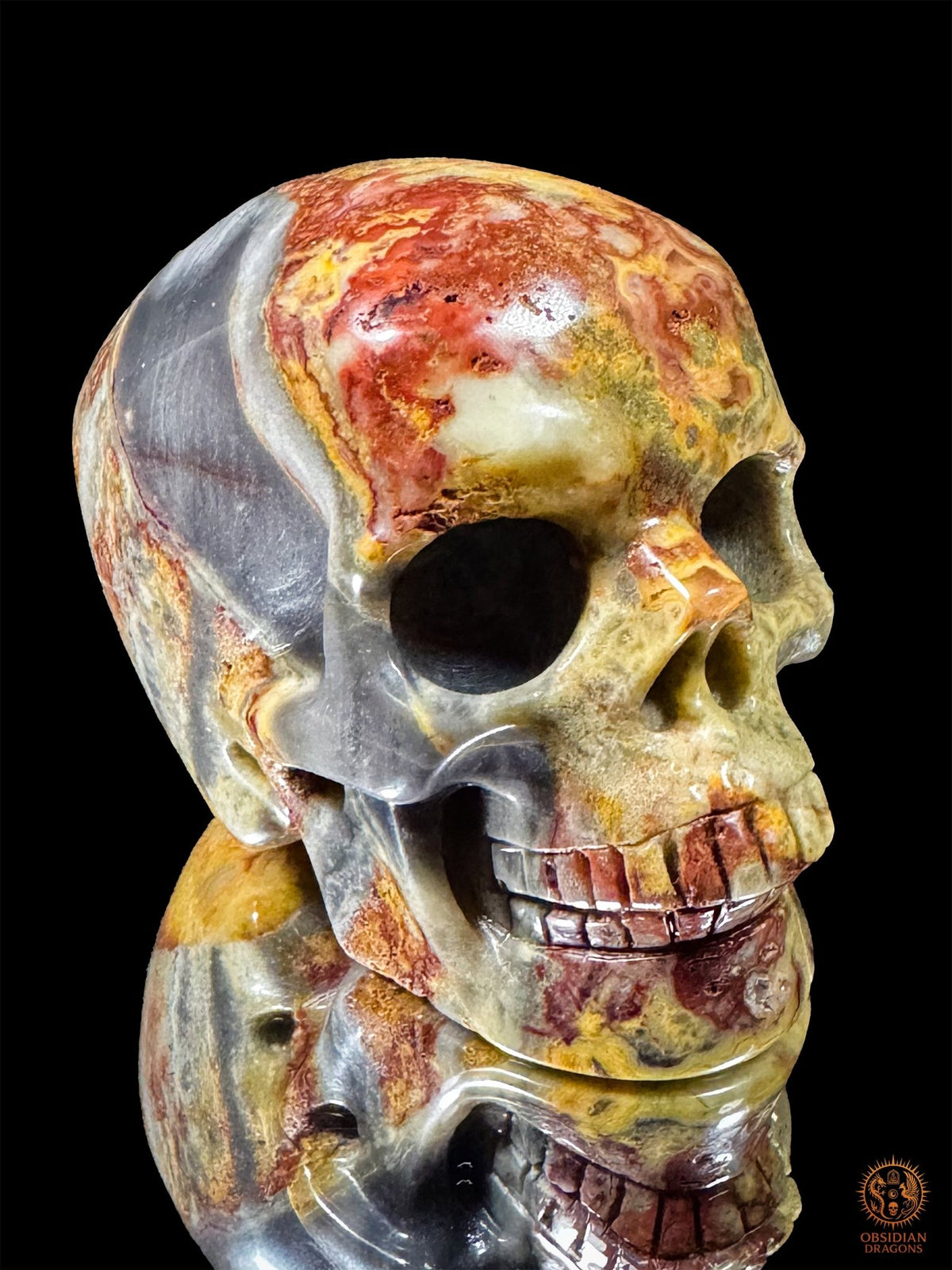
Madagascar Polychrome Jasper Skull – Unique Handcrafted Sculpture with Multicolored Mineral Patterns: Meditation, Symbolic Grounding, and the Memory of the Earth
Contractual photos and video, unique piece, you will receive exactly the Madagascar Polychrome Jasper Skull presented here.
💀 Technical characteristics of this Madagascar polychrome jasper skull
As a gemmologist graduated from the National Institute of Gemmology (ING, Paris, France), I pay particular attention to the identification of materials and the observation of their natural structures.
This skull is handcrafted from natural Madagascar polychrome jasper, a siliceous material with a very fine grain. Its shades of red, ochre, cream, and bluish gray, as well as the arrangement of its natural patterns, contribute to the unique character of this piece.
🪨 Material: natural polychrome jasper.
🔬 Structure : very fine-grained siliceous material.
🌍 Stone origin: Madagascar.
🖐️ Craftsmanship: handcrafted sculpture.
📏 Length : 7 cm.
📐 Height: 6 cm.
↔️ Width: 5 cm.
⚖️ Weight: 327 grams.
✨ Finish: polished and shiny surface, revealing the colors and patterns of the stone.
🎨 Colors: brick red, yellow ochres, cream shades, bluish gray, and brown passages.
🌀 Patterns: colored patches, sinuous contours, and localized concentric patterns, with a large rounded gray area at the back.
💎 Singularity: unique piece, characterized by its natural visual composition and sculptural work.
Madagascar Polychrome Jasper Skull: Unique Handcrafted Sculpture, Mineral Landscape, and Symbolic Grounding
The gaze first encounters the colors. A brick red crosses the forehead, joins yellow ochres, and reveals cream shades. On the temples, large patches of bluish gray give another depth to the face. The stone seems to contain several landscapes, which the sculpture reveals when you change the angle.
This Madagascar polychrome jasper skull is a unique handcrafted piece, sculpted by hand. It combines the pleasure of observing a natural material, the presence of a mineral face, and the questions that the shape of the skull gives rise to: our relationship with time, memory, and what deserves our attention.
What particularly strikes me about this piece is the harmony between its design and its volumes. The warm colors occupy the forehead, the gray areas highlight the sides, and the sinuous patterns extend into the jaw. Each profile offers a different reading.
A mineral sculpture with earth colors and bluish gray contrasts
The polychromy directly contributes to the expression of this jasper skull. On the forehead, the red and yellow areas compose a dense design, punctuated by lighter passages. Nested contours appear in places, while the temples feature large gray surfaces bordered by warm shades.
At the back, a large rounded gray patch, surrounded by ochre and red, particularly catches the attention. On one profile, the colored contours tighten; on the other, they become broader. This diversity gives the piece a singular character even in the parts discovered after the face.
This sculpted skull features deep orbits that contrast with the polish of the forehead. The cheekbones are marked, the jaw clearly defined, and the teeth deliberately geometric. This stylized anatomy allows the material to fully participate in the mineral sculpture. The light follows the curves and changes the readability of the details depending on the viewing angle.
The front, three-quarter, profile, and back views allow you to follow this continuity. A natural stone skull is also discovered in movement: a discreet area on a photograph sometimes becomes the detail that catches the eye when you turn the piece.
What is Madagascar polychrome jasper?
Polychrome jasper is a term describing multicolored jasper. The word "polychrome" designates the coexistence of several colors; it informs about the appearance of the material. In its common gemmological sense, jasper is a very fine-grained siliceous material, whose associated constituents contribute to its color and opacity.
Microcrystalline quartz or cryptocrystalline quartz is found in it, that is to say, extremely small crystals. The formula for quartz is SiO₂. Natural jasper forms a compact mineral aggregate; its constituents and their proportions can vary. Jasper classifications also have certain differences between gemmological, petrological, and commercial uses.
The composition of polychrome jasper must therefore be approached with this nuance. Silica constitutes the essential framework of the material, while the accessory constituents influence its textures and colors. The precise identification of each area requires appropriate observations or analyses.
Appreciated as an ornamental rock, jasper lends itself to carving and polishing. In this natural Madagascar polychrome jasper skull, its interest lies in the meeting of colored patches and irregular contours that remain visible across the entire volume.
How does polychrome jasper form? Silica, deposits, and silicification
A material resulting from several possible geological processes
The formation of polychrome jasper must be placed within the broader mechanisms of the formation of fine siliceous materials. Depending on the deposits, silica can precipitate from solutions, redistribute within deposits, or participate in the replacement and consolidation of pre-existing material.
Silicification designates the input and fixation of silica in a rock or another material. It can occur through impregnation, cementation, or replacement. The deposits and subsequent transformations lead to a compact, very fine-grained structure. The geological origin of jasper can thus involve different stages and different environments.
The work of Grenne and Slack on Norwegian jaspers describes, for example, silica- and iron-rich precursors deposited in a marine environment influenced by hydrothermal plumes. This example documents a particular mechanism. Its application to another stone would require a study of the deposit concerned.
The role of mineral colorations
Mineral colorations result notably from constituents present in the siliceous material. Iron oxides play an important role in many jaspers: hematite, with the formula Fe₂O₃, can give red tints when it is in the form of fine particles.
Goethite, an iron oxyhydroxide with the formula FeO(OH), can contribute to yellow, ochre, or brown tints. The distribution, size, and association of these mineral pigments contribute to the diversity of colors. These general mechanisms help to understand a ferruginous palette; they do not constitute an analysis of each of the patches on this skull.
For its gray and cream areas, the photographs allow the appearance to be described precisely, but attribution to specific mineral phases would require further examination. The visible curves and concentric patterns are not enough to reconstruct each stage of formation.
Madagascar, the origin of the material of this piece
This skull is sculpted from Madagascar polychrome jasper. Origin here designates the origin of the stone. It allows this piece to be located without attributing to the name of the country alone a uniform formation history.
For this natural stone from Madagascar, the precise deposit and age of formation are not documented in this sheet. Its geological history is therefore approached through the characteristics of the material and the general mechanisms of jasper. This precision gives full value to the questions that the stone opens, while maintaining a description faithful to the available information.
Why is this Madagascar polychrome jasper skull a unique piece?
Its singularity begins in the stone. The boundaries between the colors, their arrangement, and the details of the textures compose a design unique to this piece. It continues in the orientation of the block: the sculpted surface crosses these structures and makes them appear in specific places on the face.
This Madagascar polychrome jasper skull, a unique piece, is recognized by its red and ochre forehead, its large gray side patches, and the rounded pattern at the back. Its two profiles show different distributions, which the photographs allow you to examine.
The handcrafted sculpture adds its choices of proportions and finish: depth of the orbits, relief of the cheekbones, contours of the jaw, and design of the teeth. Uniqueness rests on the whole formed by this material and this work. Another sculpture made in the same spirit would present a different mineral composition.
Lapidary art: making natural patterns and the face dialogue
A handcrafted polychrome jasper skull requires working with a material whose colors vary within the volume. In lapidary art, the release of forms and lapidary polishing make these changes perceptible from different angles.
This handcrafted Madagascar polychrome jasper skull features a shiny surface that follows the large curves of the cranium. The polish highlights the color contacts; the eye cavities provide areas of shadow that give the face its depth.
I love this meeting between handcrafted work and natural patterns. A red passage crosses part of the forehead, a gray patch hugs a temple, and darker shades appear in the teeth. This natural stone sculpture invites you to look at how the material and form respond to each other.
Sculpted jasper in history: material, know-how, and objects of meaning
Jasper and other fine siliceous materials have held an ancient place in the arts of engraving and sculpture. Their suitability for polishing and the diversity of their designs have contributed to their use in engraved gems and worked objects. The GIA notably recalls the historical uses of chalcedony in cameos and intaglios.
The Metropolitan Museum of Art thus preserves an Egyptian scarab in green jasper, dated to the Middle Kingdom, around 2030–1640 BCE. This object testifies to an ancient work of jasper. Its material, its era, and its context remain distinct from those of this contemporary polychrome jasper sculpture.
This comparison allows you to appreciate a continuity of gesture: choosing a material, giving it a shape, and making that shape an object to which you pay particular attention. Meaning is then built in a cultural context and in the personal relationship maintained with the object.
The symbolism of the skull: awareness of time and memento mori
The symbolism of the skull touches on an essential human experience: recognizing the structure of our own head and becoming aware of the fragility of existence. It can evoke mortality, memory, thought, and the value we place on our lives.
In European vanitas of the 17th century, the skull often accompanies objects that evoke knowledge, pleasures, or the passage of time. The Still Life: Allegory of the Vanities of Human Life by Harmen Steenwyck, painted around 1640, offers a documented example. The memento mori, "remember that you will die," invites you to look at what is fleeting and to reflect on our priorities.
With this Madagascar polychrome jasper skull, this reflection meets a material whose colors remind us of the earth and landscapes. It can be seen as an invitation to inhabit the time we are given more consciously, to take care of what we love, and to recognize the place of our experiences in a larger whole.
Impermanence and contemplation in Buddhist thought
Buddhism makes the observation of change an important aspect of practice. The Satipaṭṭhāna Sutta includes a contemplation of the body and its transformation, down to the separate bones and their disintegration. These passages invite you to recognize the condition of the body and to develop lucid attention.
A contemporary skull sculpture can resonate with this reflection on impermanence. Its presence before you offers a personal reminder: the body changes, thoughts pass, and circumstances transform. Contemplation can then guide the gaze toward the quality of presence you wish to maintain today.
This cultural reference gives a possible depth to the encounter with the piece. Everyone remains free to approach it through their own sensitivity, a spiritual practice, or simple curiosity for a sculpted form.
Polychrome jasper skull: warm grounding, symbolic vitality, and inner strength
In my eyes, this piece evokes a warm grounding. The red and ochre tones suggest momentum, while the gray patches bring an impression of calm and restraint. Their coexistence gives the face an assertive presence, crossed by nuances.
The word "energy" here designates a feeling and a spiritual reading. Symbolic grounding can take the form of a return to one's foundations, to breathing, and to concrete attention. Symbolic vitality evokes the desire to participate in life, to create, or to resume a path with greater consistency.
The inner strength that this sculpture inspires in me lies in the possibility of welcoming several movements within oneself. One can feel momentum and need rest, seek a direction, and take time to reflect. The colors remain different, while composing the same face. This image can accompany personal introspection.
A guardian of the inner landscape
In an esoteric reading, this Madagascar polychrome jasper skull can become a guardian of the inner landscape. The colored patches evoke territories, the contours recall paths, and the passages between the shades suggest transitions.
One can recognize in it an image of one's own journey: experiences that have left a mark, habits that one questions, or directions that one wishes to clarify. The sculpture offers a space for these questions. Its meaning becomes clearer over the time you spend observing it.
The localized concentric patterns also introduce the image of a center to return to. The large rounded design at the back can become a point of contemplation different from the face. The same piece thus allows several ways of placing the gaze and letting a reflection mature.
Earth, fire, and the movement of water: a reading of the elements
The mineral mass can evoke the earth, the warm colors fire, and the sinuous lines the movement of water. This figurative language allows you to reflect on stability, commitment, and flexibility. It is a personal symbolic proposal, which everyone can adapt to their practice.
The meeting of these images suggests a way of moving forward: maintaining foundations, nurturing momentum, and accepting to adjust one's direction. The material then becomes a mineral landscape in which you choose the correspondences that nourish your contemplation.
Properties of polychrome jasper in lithotherapy
The symbolic properties of polychrome jasper can be read here around stability, warmth, presence, and the integration of contrasts. The virtues attributed to polychrome jasper belong to the language of spiritual correspondences and the personal experience of those who explore them.
Approaching polychrome jasper and lithotherapy with rigor requires distinguishing these interpretations from the physical characteristics of the material. Colors, structure, and reaction to light can be observed; the meanings associated with the stone are constructed through a personal approach.
The place of this sculpture can be that of an object to which an intention is entrusted, a visual reminder, or a companion for contemplation. The relationship develops through the attention paid to it and through the qualities one chooses to cultivate in their own life.
🧘 How to meditate with a polychrome jasper skull?
Meditation with a skull can begin with a simple exercise in observation. This meditation skull offers precise landmarks: a color boundary, a curve of the forehead, the depth of an orbit, or a pattern on the profile.
Place the sculpture in front of you on a stable surface. Choose a comfortable position that allows you to keep your shoulders relaxed and your gaze resting effortlessly. Take a few moments to feel your support and let your breathing follow its natural rhythm.
Then direct your attention to a detail. Observe its shape, its nuances, and the way light reflects on it. When thoughts wander, notice this movement and gently return to the chosen point. The practice is built through these successive returns.
An attentive presence through sight and touch
You can also hold this polychrome jasper skull in your hands, above a secure support. Its weight of 327 grams, its temperature to the touch, and its volumes offer concrete sensations. Let your attention explore them simply, adjusting how you hold the piece to remain comfortable.
Associating polychrome jasper and meditation can also take the form of reflection: what place should I give my energy today? What deserves more consistency? What aspects of my experience do I want to look at with more clarity? One question is enough to open a space for introspection.
An initial session of five to ten minutes allows you to discover this approach. To finish, broaden your attention to your breathing, sounds, and the environment. This meditation support accompanies a personal rhythm, which can evolve over time through practice.
Memory of the Earth and Akashic exploration
The expression of the memory of the Earth finds here a material and poetic meaning. Mineral structures offer clues about the formation and transformations of a rock. In a spiritual reading, they can evoke continuity, transmission, and the traces that time leaves in a story.
The idea of Akashic connection belongs to the esoteric realm. It opens, for some practitioners, a space for reflection on memory and intuition. An inner experience can be received as such and become material for reflection; its interpretation remains personal.
To deepen the practice and spiritual readings associated with skulls,
I invite you to discover our article Meditating with a crystal skull: Akashic connection.
It extends this encounter between observation, intention, and inner exploration.
Who is this polychrome jasper skull for?
This collector's skull is for people who like discovering a natural material from several angles. In a mineralogical collection, it offers an opportunity to observe worked jasper, its color transitions, and the way the sculpture crosses its pattern.
A cabinet of curiosities enthusiast can appreciate a collectible object that brings together natural history, craftsmanship, and reflection on time. In a library, on a desk, or near other pieces, this decorative skull brings a visual presence marked by colors and the contrast of volumes.
It is also suitable for a person sensitive to contemplation or who wishes to give a concrete form to an intention. Curiosity about patterns can be the starting point; the philosophical or spiritual reading then develops according to each person's affinities.
Its format allows it to be made into a personal piece, which one takes the time to turn in their hands. The gaze can return to a familiar detail and discover elsewhere a nuance previously unnoticed.
Taking care of your polychrome jasper skull
To preserve the appearance of this polished stone, handle the sculpture gently and choose a stable location. The reliefs of the teeth, jaw, and cheekbones deserve special attention during movement.
A soft, clean cloth is suitable for removing dust and fingerprints. If necessary, use a slightly damp cloth, then dry carefully. Protect the polish from abrasive products, harsh cleaners, and salt baths.
If you associate a personal ritual with the piece, it can take the form of a quiet time, an intention, or a gesture of care. Gentle material maintenance is enough to take care of the sculpture daily.
A piece to discover in our collection of crystal skulls
In contemporary usage, the expression "crystal skulls" often brings together sculptures made from different gem materials. Jasper retains its own nature: a very fine-grained mineral aggregate whose colors and structures contribute to the expression of the piece.
Find this mineral skull and other sculptures in our collection of crystal skulls. Each material offers its textures, reflections, and patterns, and each sculpture opens a different way of looking.
This polychrome jasper skull, a unique handcrafted piece, is presented to you from several angles to allow you to appreciate its character. The red and ochre forehead, the gray temples, and the patterns that extend to the back compose the precise face of the piece you will receive.
Frequently asked questions about this polychrome jasper skull
What material is this skull sculpted from, and what is its origin?
It is handcrafted from natural polychrome jasper from Madagascar. This siliceous material with very fine grain presents a multicolored palette, with red, ochre, cream, and bluish-gray nuances on this specimen.
Why is this polychrome jasper skull a unique piece?
The distribution of colors, the contours of the mineral areas, and their position in the sculpture compose a pattern unique to this piece. The work on the orbits, cheekbones, and jaw, and the polishing complete this identity. Another sculpture would present a different combination of patterns and nuances.
Will I receive exactly the skull presented in the photographs?
Yes. The photographs and video are contractual: you will receive exactly this unique piece, with the colors and patterns presented from its different angles.
What are its dimensions and weight?
This skull measures 7 cm in length, 6 cm in height, and 5 cm in width. Its weight is 327 grams. The view in hand also allows you to appreciate its scale.
Why is it featured in a collection of crystal skulls?
In contemporary usage, this designation brings together sculptures made from different gem materials. Here, the material is polychrome jasper, a very fine-grained mineral aggregate. Its interest lies notably in its polychromy and natural patterns.
Can this skull be used for meditation?
Yes. Its curves and color transitions offer points of support for observation. You can place it in front of you or hold it comfortably in your hands, let your breathing follow its natural rhythm, and gently return to the chosen detail when attention wanders. A few minutes are enough to discover this approach.
What symbolic properties can be associated with it?
In a spiritual reading, this polychrome jasper skull can evoke grounding, symbolic vitality, inner strength, and the integration of contrasts. Its shape also invites reflection on impermanence and the value of the present time. These correspondences belong to a personal interpretation and can evolve with your relationship to the piece.
Do you need to practice lithotherapy to appreciate this sculpture?
You can appreciate it for its colors, its lapidary work, or its place in a mineralogical collection. It can also accompany a contemplative approach, a philosophical reflection, or a spiritual practice, according to your sensitivity.
How to maintain this polychrome jasper skull?
Remove dust and fingerprints with a soft, clean cloth. If necessary, use a slightly damp cloth, then dry carefully. Protect the polish from abrasive products, harsh cleaners, and salt baths. Handle the sculpture gently, especially around the teeth and jaw, and place it on a stable support.