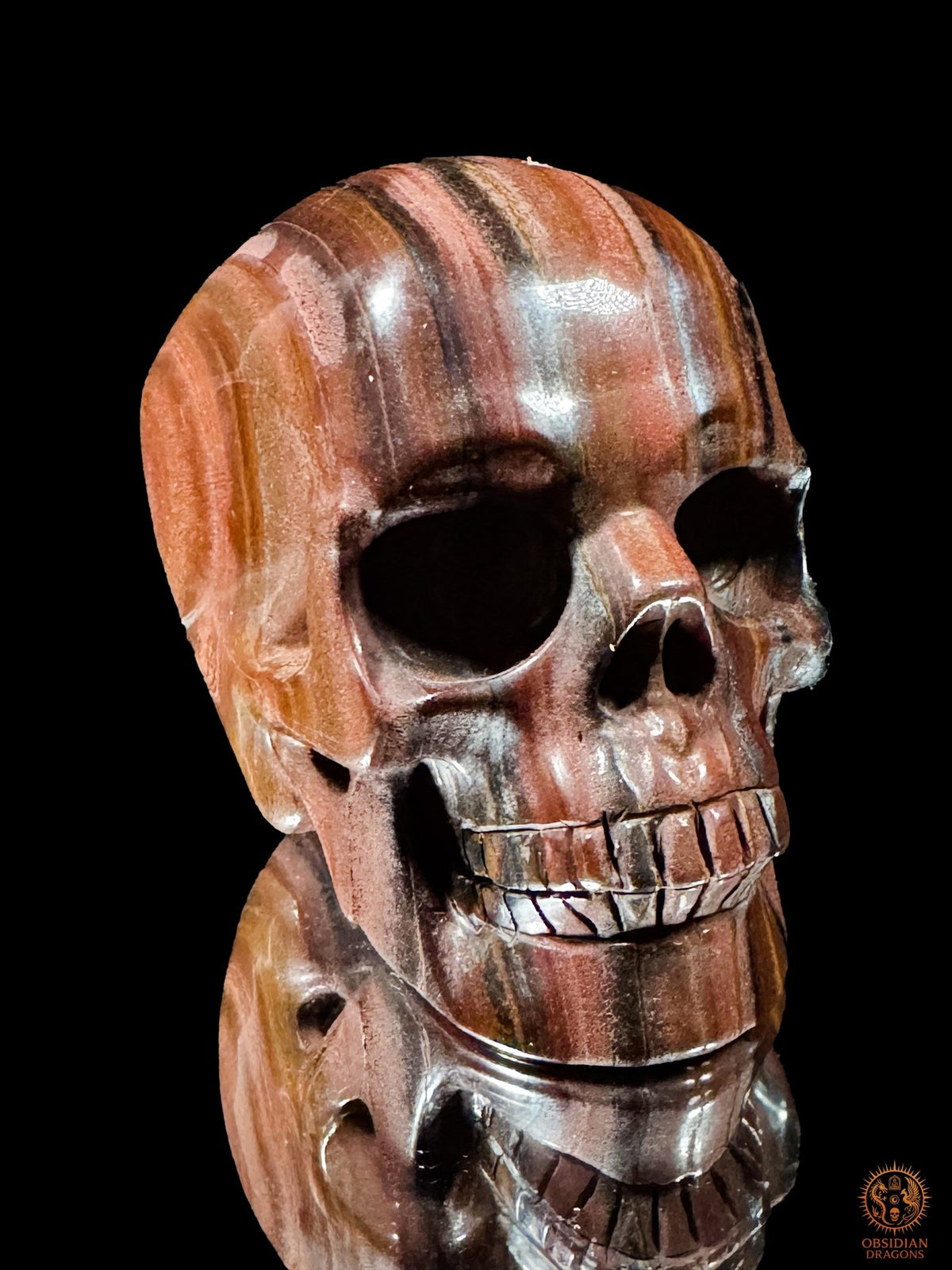
South African Tiger Iron Skull – Unique Handcrafted Sculpture Combining Red Jasper, Hematite, and Tiger’s Eye: Meditation, Symbolic Grounding, and Inner Strength
Contractual photos and video, unique piece; you will receive exactly the Tiger Iron Skull presented here.
💀 Technical Characteristics of This Tiger Iron Skull
As a gemmologist graduated from the National Institute of Gemmology (ING, Paris, France), I pay particular attention to the identification of materials and the observation of their natural structures. This skull is handcrafted from natural South African tiger iron, a composite rock characterized by the combination of red jasper, hematite, and tiger’s eye. Its banding, nuances, and natural patterns contribute to the unique character of this piece.
🪨 Material: natural tiger iron, also known as Tiger Iron, a composite rock.
🔬 Characteristic composition: combination of red jasper, hematite, and tiger’s eye.
🌍 Origin of the stone: South Africa.
🖐️ Fabrication: handcrafted sculpture.
📏 Length : 7 cm.
📐 Height: 6 cm.
↔️ Width: 5 cm.
⚖️ Weight: 360 grams.
✨ Finish : polished and shiny surface, highlighting the mineral banding and the stone’s reflections.
🎨 Colors : shades of red, brown, copper, and gold, combined with dark and metallic gray bands.
🌀 Patterns : natural bands across the face and curved patterns on the profiles, with a particularly pronounced concentric design on one temple.
💎 Uniqueness : unique piece, characterized by its natural mineral design and sculptural work.
South African Tiger Iron Skull: Handcrafted Sculpture, Geological Memory, and Inner Strength
There are stones whose patterns catch the eye before their form is even recognized. Brown-red meets dark bands, copper nuances, and fine golden passages. The sculpture gives this banded material a face, while the natural lines continue across the forehead, temples, and jaw.
What particularly interested me about this piece was the harmony between its mineral design and its volumes. From the front, the vertical bands give the gaze a direction. From the side, they curve and form a particularly pronounced concentric pattern on one of the temples. The stone thus changes its appearance as the skull is turned in the hand.
This hand-sculpted tiger iron skull can be observed closely, held comfortably, or given a place in a collection. This natural stone skull is a unique handcrafted piece that I chose for the presence of its material, the expression of its sculpture, and the possibilities for contemplation it opens.
A Mineral Sculpture with Red, Dark, and Golden Bands
The dominant tones of this tiger iron skull are those of red earth, almost brick-red, crossed by brown, ochre, and black to metallic gray passages. The golden reflections appear in thinner bands, while some areas feature a metallic luster that follows the contours of the cheekbones and temples.
The eye sockets are deep. They contrast with the shine of the forehead and give the face an attentive, vigilant expression. The teeth are stylized and clearly defined; the cheeks and jaw extend this anatomy interpreted by the sculptor. This is a stone skull sculpture whose character stems as much from these proportional choices as from the natural patterns of the rock.
On one temple, the concentric patterns offer a privileged viewing point. Their design evokes a center surrounded by several contours, while the opposite profile features broader curves. This natural asymmetry allows two different landscapes to be discovered in a single mineral sculpture.
The photographs show these differences from the front, side, and back. The views in the hand also provide a concrete indication of scale. The polish reacts to the light: depending on the viewing angle, an area may appear brighter, darker, or more copper-toned.
What is Tiger Iron? A Composite Rock Called Tiger Iron
Tiger iron, also known by its English name Tiger Iron, is a lapidary term designating a composite rock characterized by the combination of red jasper, hematite, and tiger’s eye areas. The proportions and arrangement of these constituents vary from piece to piece. This diversity makes tiger iron an ornamental rock sought after for its contrasts and mineral banding.
The composition of tiger iron explains most of its palette. Red jasper corresponds to a very fine siliceous material, colored by iron compounds. Hematite is an iron oxide, with the formula Fe₂O₃, whose luster can be metallic. Quartz, with the formula SiO₂, constitutes the main material of tiger’s eye. Silica and iron oxides thus contribute, in different forms, to the identity of this stone.
Tiger’s eye has a particular texture: its polycrystalline quartz is combined with oriented fibrous inclusions derived from amphiboles and their alteration products. It is this organization that produces chatoyancy, that characteristic shifting light effect. The golden to brown hues are linked to iron compounds formed during alteration.
The combination of these materials gives this natural tiger iron skull its visual richness. The mineral bands form an ensemble where color, texture, and the reflection of light change from one area to another.
How Does South African Tiger Iron Form?
From Ancient Deposits to Banded Rock
To understand the formation of tiger iron, this material must be placed within the history of banded iron formations, designated by the abbreviation BIF, for Banded Iron Formation. These rocks combine iron-rich layers and silica-rich layers.
Their history begins in ancient aquatic environments, particularly marine ones, where dissolved substances precipitated and deposited. Variations in chemical conditions contributed to the production of alternating layers. The oxidation of dissolved iron plays a role in this history, although the precise mechanisms may vary depending on the formation.
With burial and subsequent transformations, the deposits become rocks. Recrystallization, the circulation of fluids, and the deformation of the layers can then alter their structure. Banding visible today can therefore preserve the trace of several successive stages.
In South Africa, the tiger’s eye deposits studied in the Northern Cape, particularly around Prieska, are associated with folded banded iron formations. Field studies there describe lenses and veins whose distribution is linked to the structure of the host rocks.
Silicification, Fibers, and Mineral Transformations
The genesis of tiger’s eye areas requires an additional nuance. The classic model describes the transformation of fibrous crocidolite veins, a variety of amphibole, through silicification and alteration. Field observations in South Africa support a succession of transformations of this type.
Other studies, notably those by Heaney and Fisher, have proposed the associated growth of quartz and fibers during the successive opening and sealing of fractures. These interpretations have been the subject of scientific debate. It would therefore be reductive to present the formation of all this material as a complete and uniform replacement of fibers by silica.
The geological history carried by this skull thus brings together deposits, stresses, fluids, and transformations. The main lines we follow today from the forehead to the jaw constitute the visible part of a history much longer than that of the sculpture.
Why Is This Tiger Iron Skull a Unique Piece?
Uniqueness begins in the rock. The thickness of the bands, their nuances, curves, and contacts form a design unique to this piece. It continues in the way the sculpture traverses these structures: a different orientation of the block would have revealed a different mineral face.
This tiger iron skull, a unique piece, is notably recognizable by its vertical banding on the face, its golden passages, and the concentric pattern on one temple. These characteristics are linked to the material and the way its volumes were revealed.
The closed contours observed in profile may result from the intersection of curved or deformed bands with the sculpted surface. Their appearance is not sufficient to identify them as agate growth rings or fossil structures. Natural geometry retains its share of complexity here.
The handcrafted sculpture finally adds its own choices: the depth of the orbits, the expression of the jaw, the design of the teeth, the balance of the curves, and the finish. Even another sculpture made in the same spirit would present a different combination.
Lapidary Art: Reading the Stone and Revealing a Face
A handcrafted tiger iron skull requires working with heterogeneous material. The task consists of giving coherence to the volume while allowing the contrasts of the stone to contribute to the expression of the face.
In lapidary art, sculpture and lapidary polishing are intimately linked. The reliefs reveal the structures from different angles; the polish makes their boundaries and reflections more legible. On this piece, the shiny surface follows the large curves of the cranium and highlights the transitions between the colored areas.
I love this meeting between a hand-sculpted work and a design that nature had already begun. The lines sometimes become an axis of the forehead, sometimes a contour of the temple, sometimes a variation in the teeth. This natural stone sculpture thus preserves the pleasure of a progressive discovery.
The Symbolism of the Skull: Memory, Consciousness, and Memento Mori
The symbolism of the skull lies in a very simple human experience: recognizing the shape of our own head when individual features have disappeared. The skull evokes mortality, but also thought, memory, and the question of what gives a life its value.
In European vanitas, particularly present in 17th-century painting, it often accompanies books, instruments, precious objects, or signs of passing time. The memento mori, “remember that you will die,” invites us to look at the fragility of existence and the fleeting nature of possessions.
Buddhism also approaches the transformation of the body as a subject of contemplation. The Satipaṭṭhāna Sutta includes meditations on its different states, down to the bones and their disintegration. These passages incorporate the awareness of change into a practice of observation. A contemporary mineral skull can offer a personal visual reminder of this reflection on impermanence.
In the iconography of Tibetan Buddhism, the skull cup called kapāla appears notably with figures such as Mahākāla, in a precise ritual and doctrinal context.
At Obsidian Dragons, these references interest me because they make the gaze more aware. Placed near books or in a quiet space, a skull can remind us to devote time to what truly deserves our attention.
Tiger Iron Skull: Symbolic Grounding, Inner Strength, and Discernment
In my view, this piece evokes a calm inner strength. The earth tones, the presence of dark bands, and the continuity of the lines give an impression of solidity. The golden passages introduce a finer light, like an invitation to maintain a clear direction.
The word “energy” here describes a feeling and a spiritual interpretation. In this context, symbolic grounding can mean finding one’s footing, taking the time to make a decision, or staying present when thoughts become scattered. The weight of the skull in the hand and the observation of its curves can become very concrete points of return.
The courage this sculpture evokes in me is that of looking at a situation honestly. Discernment then comes: recognizing what requires action, what requires patience, and what can be set aside. Perseverance is seen in this continuity of bands that cross the volume while changing direction.
The concentric pattern on one temple brings another image: that of a center to return to. Each person will be able to recognize something different in it, depending on their history, their current state, and their sensitivity to the material.
A Symbolic Guardian of the Threshold
An esoteric interpretation can make this tiger iron skull a symbolic guardian of the threshold. The threshold represents that moment when we leave a habit, end a period, or choose a new direction.
Iron then suggests constancy and a will shaped by experience. Red can evoke commitment to life; the golden nuances, the lucidity with which we move forward. These correspondences form an imaginary language that can be used to clarify an intention.
The succession of layers also offers an image of personal construction. Our experiences remain different, sometimes contradictory, while participating in a common history. Contemplating this skull can provide space for this introspection, without requiring an immediate answer.
Tiger Iron Properties in Lithotherapy
The symbolic properties of tiger iron are often discussed around stability, courage, and determination. The virtues attributed to tiger iron stem from these contemporary correspondences and the personal experience of practitioners.
Approaching tiger iron and lithotherapy with rigor requires distinguishing these interpretations from the physical properties of the rock. No specific therapeutic action of this sculpture is scientifically established. Its place can be that of an object to which one associates an intention, a support for contemplation, or a personal reminder of qualities one wishes to cultivate.
The spiritual interest of the piece is built in the relationship one maintains with it: the time devoted to observing it, the questions it brings to mind, and the attention paid to one’s own experience.
How to Meditate with a Tiger Iron Skull?
Meditation with a skull can take the form of a simple practice, based on observation and returning to the present moment. This meditation skull offers visual and tactile cues: a golden line, a dark contour, the curve of a temple, or the contact of the stone in the palm.
Place the skull in front of you on a stable surface, at a height that allows you to maintain a comfortable posture. Let your breathing follow its natural rhythm. Take a few moments to feel your footing and notice your surroundings, then gently direct your gaze toward a detail of the sculpture.
You can follow a band from the forehead to the jaw, or let your attention rest on the concentric pattern of one temple. When thoughts wander elsewhere, notice it and return to the chosen detail. Concentration is practiced in this repeated movement of returning, with gentleness.
If you prefer a tactile approach, hold the skull in your hands above a secure support. Observe its temperature upon contact, its weight, and its volumes. These sensations can support an attentive presence, particularly when one wishes to return to something concrete.
To combine tiger iron and meditation with personal reflection, you can choose a question: What decision requires more clarity today? What do I want to devote my time to? What quality deserves to be cultivated with constancy?
Five to ten minutes is enough to begin. End by broadening your attention to your body, the sounds, and the room where you are. This meditation guide supports a personal journey whose pace remains entirely your own.
Earth memory and Akashic exploration
The expression Earth memory has two levels of interpretation here. In rock, structures preserve material evidence of geological transformations. In a poetic or spiritual approach, these layers can evoke continuity, experience, and what remains perceptible after the passage of time.
To explore this approach further,
I invite you to read our article Meditating with a crystal skull: Akashic connection.
It opens up a space for reflection on the skull as a companion in spiritual practice and on the esoteric interpretations associated with meditation.
Who is this ironstone skull intended for?
This collector's skull is primarily intended for people who appreciate the harmony between a natural material and a sculpted form. In a mineralogical collection, it allows you to observe a worked rock from several angles and to follow the way its structures appear on the surface.
A cabinet of curiosities enthusiast may see it as a collector's item that brings together natural history, craftsmanship, and reflection on time. In a library, on a desk, or near other sculptures, this decorative skull brings the contrasts of a banded material and a striking visual presence.
It can also accompany someone who enjoys contemplation or is looking for an object to give concrete form to an intention. No esoteric practice is necessary to appreciate its beauty: interest can begin with curiosity about the bands, colors, and the sculptural work.
Its size is suitable for close observation. It allows you to make it a personal piece, one that you take the time to turn in your hand rather than discovering only from a distance.
Caring for your ironstone skull
To preserve the polished finish, handle the sculpture gently and place it on a stable support. The contours of the jaw, teeth, and cheekbones deserve special attention when moving it.
A soft, clean cloth is suitable for removing fingerprints and dust. If necessary, use a slightly damp cloth, then carefully dry the surface. Avoid abrasive products, salt baths, and harsh cleaners.
To support a spiritual practice, you can dedicate a moment of silence to the object or renew the intention you associate with it. This personal approach requires no special material treatment.
Frequently asked questions about this ironstone skull
What is the difference between ironstone and tiger's eye?
Tiger's eye refers to a chatoyant quartz material. Ironstone generally combines areas of tiger's eye with red jasper and hematite. This combination explains its palette and contrasts. The name of the material of this sculpture is therefore indeed ironstone.
What is the composition of ironstone?
Its characteristic composition brings together red jasper, hematite, and tiger's eye, with varying proportions. It is a composite rock: the term does not refer to a mineral species possessing a unique chemical formula.
How does South African ironstone form?
Its history is part of that of banded iron rocks and subsequent transformations. The stages that produce the tiger's eye areas involve fibrous textures, quartz, and alteration. The age of the initial deposit and that of the subsequent transformations may differ.
Why is this ironstone skull a unique piece?
Its band pattern, curves, and nuances belong to the chosen piece of stone. The craftsmanship meets them in a way unique to this sculpture. The concentric pattern of a temple and the lines of the face allow you to recognize this piece in particular.
Can this skull be used for meditation?
Yes. It can serve as a visual or tactile support in a practice of mindful presence. Observing a detail and returning to your breath is a simple way to begin. Its use depends on your sensitivity and the chosen intention.
Is it a crystal skull?
In contemporary usage in shops and by collectors, this expression brings together different mineral sculptures. This skull is made of ironstone, a composite rock containing quartz, among other things. The designation of its material remains distinct from that of a rock crystal skull.
Discover the Obsidian Dragons collector skulls
This ironstone skull joins our collection of crystal skulls, where each material brings a different relationship to form, light, and time.
What I love about this piece is the possibility of moving from very precise observation to a more intimate reflection. You can follow a dark band, watch how a reflection moves, pause on the pattern of a temple, then return to a question you already carried within yourself. The stone preserves its structures; the sculpture gives them a presence with which everyone can build their own relationship.