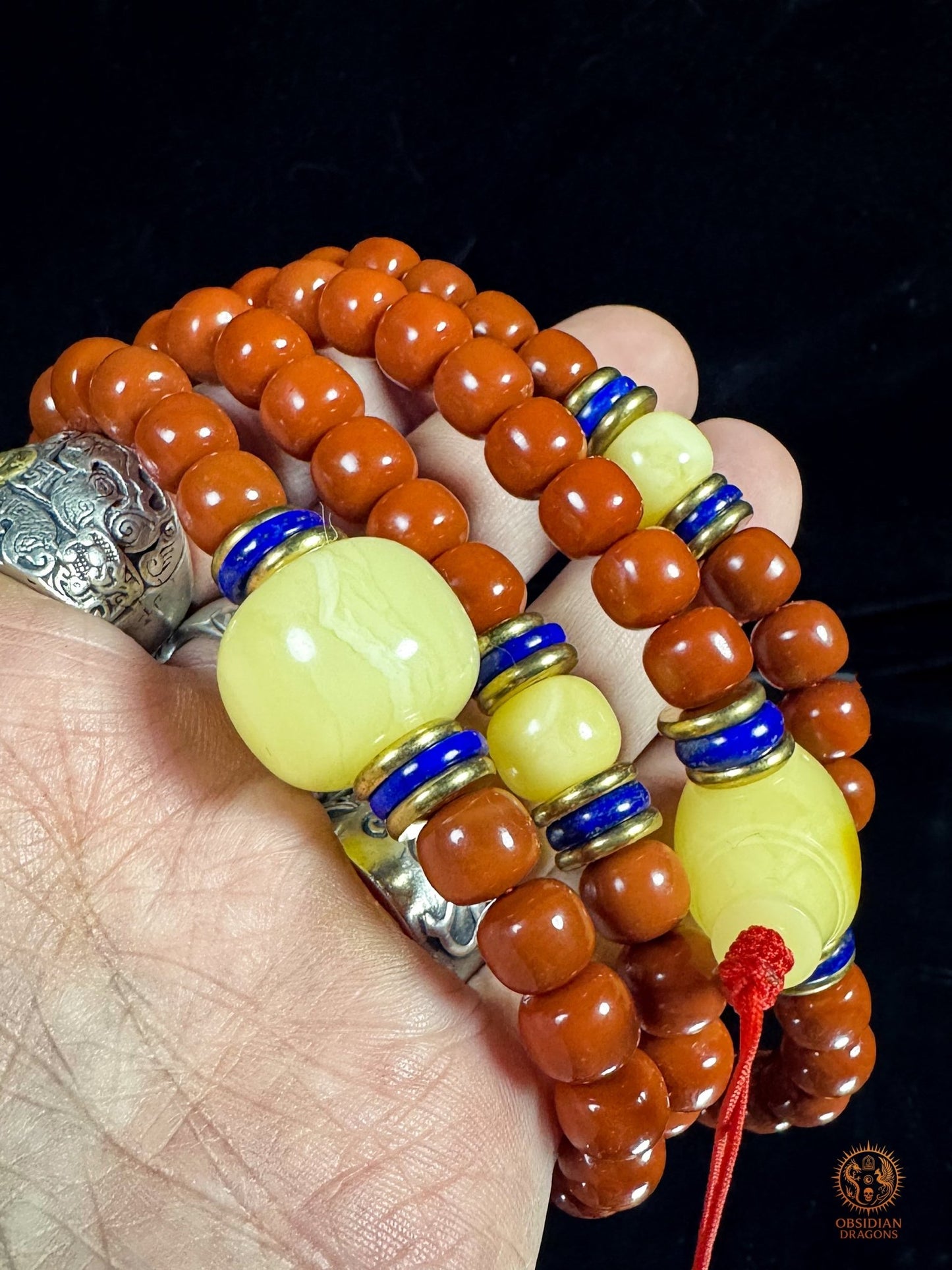
108-bead Mala in Baoshan (Yunnan) Nan Hong agate, natural Burmese royal amber (Hukawng), Afghan Sar-e-Sang lapis lazuli – exceptional materials, a high-collection piece.
As a gemologist and mala creator, once a quarter I allow myself to craft a mala with exceptional materials.
More for a demonstration of my dual skills (science and tradition) than a mala intended for immediate sale.
This 108-bead Nan Hong agate Mala falls into this category.
I have gathered here an extremely demanding selection of Baoshan Nan Hong agate, in its most sought-after quality: saturated, homogeneous red, without white matrix intrusion, with a so-called "oily" texture, characteristic of higher grades from historical Yunnan deposits. The chromatic density comes from a high concentration of iron oxides (microcrystalline hematite), finely dispersed in the siliceous matrix, giving the stone this continuous red depth, without faded areas or translucent dilution.
To this mineral rarity, I have associated natural Burmese royal amber, from Hukawng. This is neither pressed nor reconstituted amber, but natural and solid fossil resin from the Cretaceous period, cut from compact blocks. Its milky yellow, waxy hue, typical of "royal" amber, presents a dense and stable structure with a silky surface, distinct from more common transparent ambers. Its superior hardness compared to Baltic amber and its ancient geological age make it a highly collectible organic material.
The choice of Nan Hong and royal amber (red and yellow) is not solely about chromatic balance. Red and yellow have been the imperial colors of traditional China for centuries.
🔴 Red: A symbol of vitality and prosperity, dominated architecture and official seals.
🟡 Yellow: Reserved for the Emperor, it embodied centrality, earth, and celestial authority.
Under the Ming and Qing dynasties, these two colors structured the aesthetics of Beijing's Forbidden City: vermilion walls, imperial yellow glazed roofs, textiles, and adornments reserved for the court.
Associating Baoshan Nan Hong and Burmese royal amber means bringing together two materials whose chromatic resonance echoes this imperial heritage, where color, power, and symbolism were one.
The ensemble is punctuated by natural lapis lazuli from Sar-e-Sang, Afghanistan, selected for the depth of its indigo blue and the fineness of its pyrite, balancing the composition.
This 108-bead Nan Hong agate Mala is a demonstration of mineralogical coherence, rigorous gemological selection, and respect for the traditional codes of the Buddhist rosary.
📿 About Buddhist rosaries
The Buddhist rosary, called a mala, is a traditional recitation and meditation aid used for centuries in the various schools of Mahayana and Vajrayana Buddhism. A 108-bead Buddhist mala generally consists of 108 main beads, a number symbolizing the totality of mental veils to be crossed and the completeness of a mantra cycle.
📖 To learn more about the symbolism and role of malas in the Buddhist tradition.
Discover my complete article on the meaning of malas and the traditions of the malakara on my blog: 📎 "All about the mala - Buddhist rosary"
💎 Technical and gemological details of this 108-bead Nan Hong & amber Mala
As a certified gemologist from the National Gemological Institute (ING, Paris), I personally select each component used in this 108-bead Nan Hong agate & amber Mala, and all materials used are certified natural, untreated, undyed, and unreconstituted.
🔹 Main body of the mala
Each element of this 108-bead Nan Hong agate Mala has been chosen for its mineral consistency, stability, and high-grade quality.
The body of this artisanal mala is composed of:
- 108 natural Nan Hong agate beads
Deposit: Baoshan, Yunnan Province (China)
Composition: microcrystalline chalcedony (SiO₂)
Shape: barrel beads
Dimensions of each bead: 8 mm long x 9 mm diameter
Exceptional quality : homogeneous saturated red, complete absence of white areas.
Texture: dense appearance with "oily" finish characteristic of high grade
The compact microcrystalline structure of Baoshan Nan Hong gives it excellent density and high wear resistance. The high concentration of iron oxides (finely dispersed hematite) is the origin of this continuous chromatic depth, without dilution or marked translucent effect.
🔹 Counter-beads and central beads in royal amber
This 108-bead Nan Hong mala includes:
- 1 central natural royal amber bead
Dimensions: 16 mm wide x 20 mm diameter
- 2 natural royal amber counter-beads
Dimensions: 8 mm wide x 11 mm diameter
- 1 carved natural royal amber Guru bead
Dimensions: 26 mm (height) x 16 mm (width) x 16 mm (depth)
Deposit: Hukawng, Myanmar
The amber used is of the highest grade, meaning it is a natural Cretaceous fossil resin, not pressed, not reconstituted, and not heated.
Its milky yellow, waxy hue corresponds to the "royal amber" variety, characterized by a dense and stable internal structure, distinct from more common transparent ambers.
🔹 Spacers and finishes of this 108-bead Nan Hong agate Mala
- Spacers in copper and lapis lazuli
- Finishing beads in natural lapis lazuli
- Deposit: Sar-e-Sang, Afghanistan
The lapis lazuli from Sar-e-Sang, a legendary deposit, is renowned for the depth of its indigo blue and the fineness of its pyrite inclusions. It provides a balanced mineral punctuation to the dominant red and yellow of the whole.
🔹 Traditional mounting
I personally strung this 108-bead Nan Hong Mala on a cord ending with a sliding knot, allowing for fluid adjustment for practice.
- Adjustable tension
- Stable structure
- Tension adapted to the significant weight of the piece
The mounting has been designed to support a high total mass while ensuring durability and comfort of use.
🔹 General dimensions of this 108-bead Nan Hong agate Mala
- Total length: 46 cm
- Weight: 145 grams
- Dense and massive presence
- Suitable for practice, wearing as a 108-bead mala necklace, and collection
A weight rarely achieved for a 108-bead mala of this size, indicating exceptional material density.
🔬 Formation, composition, causes of color, and remarkable deposits of Nan Hong agate
🌋 Geological formation
Nan Hong agate is a variety of microcrystalline chalcedony (SiO₂) formed in volcanic contexts associated with magmatic activities of the Upper Permian (≈ 250 million years ago).
Its formation results from three main phases:
1️⃣ Initial volcanic activity
Eruptions produce basaltic flows rich in vacuoles (cavities left by gas bubbles during magma cooling).
2️⃣ Hydrothermal circulation
Hydrothermal fluids laden with silica infiltrate these cavities through geological fractures.
Silica gradually precipitates as compact microcrystalline quartz, forming the chalcedony matrix.
3️⃣ Incorporation of ferric elements
During this precipitation, ferrous elements present in the geochemical environment are incorporated into the siliceous matrix.
Under oxidizing conditions, iron transforms into ferric oxides (Fe³⁺),precipitating primarily as hematite (Fe₂O₃), responsible for the red coloration.
The complete formation requires millions of years of geological stability.
🧪 Mineralogical composition of Nan Hong agate
- Main matrix: microcrystalline silica (SiO₂)
- Structure : fibrous aggregates of quartz and moganite
- Chromogenic elements: iron oxides (mainly hematite)
- Internal structure : compact to dense microcrystalline
The quality of Nan Hong directly depends on:
- the compaction of the siliceous matrix
- the fineness of the ferric particles
- the homogeneity of their dispersion
- A fine and regular dispersion produces a saturated and uniform color.
🔴 Causes of Nan Hong agate color
The red hue of Nan Hong primarily comes from trivalent iron oxides (Fe³⁺), mainly hematite, finely dispersed in the siliceous matrix.
Several factors influence the shade:
- Iron concentration: The higher it is, the more saturated the color.
- Redox conditions: In a strongly oxidizing environment → vivid red. In a less oxidizing environment → darker or slightly purplish hues.
- Size of ferric particles: Very fine particles produce a dense and homogeneous red.
⚠️ About "cinnabar spots" (朱砂点)
In Chinese tradition, red inclusions are often called "cinnabar spots."
It is important to clarify that this term is cultural and descriptive, not strictly gemological.
Cinnabar (HgS, mercury sulfide) is a distinct mineral.
In Nan Hong, the red coloration is mainly due to hematite (Fe₂O₃), not cinnabar.
The expression "cinnabar spots" therefore refers to a traditional Chinese visual analogy, but does not constitute a real mineralogical identification.
🏔️ Remarkable deposits
🔹 Baoshan (Yunnan)
Historical and today highly sought-after deposit.
Main characteristics:
- Dense and compact structure
- Homogeneous and saturated red
- So-called "oily" texture (胶质感)
- Very low presence of white areas
Baoshan Nan Hong is considered the most stable and homogeneous.
🔹 Liangshan (Sichuan)
More recent deposit on the market.
Characteristics:
- Sometimes coarser structure
- Possibility of more pronounced translucency
- Colors ranging from vivid red to orangey-red
- Compaction is generally lower than in Baoshan.
💎 To conclude this chapter
High-quality Nan Hong is the result of a rare combination:
- high concentration of iron oxides,
- homogeneous microcrystalline dispersion,
- compact siliceous matrix,
- stable geological conditions over long periods.
Specimens with a uniform saturated red, without white matrix or translucent dilution, are statistically rare.
It is this geological rarity that explains the difficulty of gathering 108 homogeneous beads from the same quality level to create this 108-bead Nan Hong agate Mala.
🔬 Formation, composition, and causes of color of Burmese amber - Specificities of royal amber and differences with Baltic amber.
🌲 Geological formation of Burmese amber
Burmese amber, also called burmite, is a fossil resin dating from the Middle Cretaceous, estimated to be about 99 million years old.
Its formation follows a multi-step process:
1️⃣ Resin exudation
Primitive conifers from the Cretaceous (probably related to ancient Araucariaceae or Cupressaceae) secrete resin in response to injuries or environmental stress.
2️⃣ Rapid burial
The resin is rapidly buried in sediments rich in clays and volcanic materials, limiting its complete oxidation.
3️⃣ Polymerization and fossilization
Under pressure and over millions of years, the resin undergoes:
- progressive polymerization
- loss of volatile compounds
- molecular rearrangement
thus becoming a stable fossil organic material: amber.
Burmese amber is distinguished by a high degree of polymerization, explaining its superior density and hardness.
🧪 Chemical composition of Burmese amber
Burmese amber is a fossilized organic resin, secreted by ancient conifers, Araucariaceae or conifers related today to tropical araucarias, that lived in the Upper Cretaceous (99 million years ago).
Unlike Baltic amber, which is a fossilized organic resin secreted by conifers of the Pinaceae group (Pinites succinifer (paleobotanical name)), that lived during the Eocene epoch (40 to 45 million years ago).
The general composition of Burmese amber includes:
- Organic polymers derived from terpenes
- Fossilized resin acids
- Complex aromatic compounds
Compared to Baltic amber (succinite), Burmese amber contains:
- A lower proportion of succinic acid
- A more compact molecular structure
- A more stable polymerized network
Its hardness is slightly higher (≈ 2.5 to 3 on the Mohs scale), making it more resistant to polishing and wear.
🟡 Causes of Burmese amber's color
The color of Burmese amber ranges from reddish-brown to deep yellow, including honey, cognac, or milky tones.
The determining factors are:
- The presence of internal microbubbles
- Microscopic organic inclusions
- Post-depositional chemical alterations
Royal amber (milky yellow)
The "royal amber" variety is characterized by:
- Milky opacity
- Homogeneous light diffusion
- Waxy texture
This opacity is due to a high concentration of microscopic microbubbles and dispersed micro-inclusions, creating internal light scattering (scattering effect).
Unlike transparent ambers, royal amber does not seek translucency but visual density and a satiny depth.
💎 Specificities of royal amber in this 108-bead Nan Hong agate mala
The royal amber used in this 108-bead Mala features:
- A compact mass cut from a solid block
- No reconstitution or compression
- No heating or treatment
- A homogeneous waxy texture
Its milky yellow hue evokes diffused, stable, and deep light.
In the context of this 108-bead Nan Hong agate Mala, it acts as:
- An organic counterpoint to the mineral density of Nan Hong
- A chromatic balance to the saturated red
- An ancient, fossil material, stabilized by time.
🏮 Symbolism of Nan Hong in Chinese scholarly culture
Nan Hong already belonged to the aesthetic and symbolic universe of ancient China. Its dense red was part of a culture where color was a language.
In imperial China, red embodied life, prosperity, legitimacy, and moral rectitude. Under the Han dynasty, which permanently structured administration and scholarly culture, the color red became inseparable from the official seal. The cinnabar seal paste marked imperial documents with a deep red imprint, a symbol of authority and validation. Red conferred status.
Even if seals were carved from various materials — jade, bronze, precious stones — the red imprint remained the essential element. In this symbolic continuity, a high-quality, homogeneous, dense Nan Hong, without dilution or white intrusion, naturally evokes this tradition. It carries a visual gravity that recalls the stable imprint of a scholarly seal.
From the Tang and Song dynasties, scholars and calligraphers developed a true culture of the personal seal. They signed their works with stones chosen for their density, internal consistency, and chromatic stability. Deep red then became the sign of intellectual authority and an asserted presence. The so-called "oily" texture so appreciated in Baoshan Nan Hong precisely corresponds to this aesthetic: a dense, compact, polished material, whose depth seems contained rather than dispersed.
A uniform red evokes rectitude. A stable color suggests a stable nature.
On a cosmological level, red is associated with the element Fire. A fire contained within matter. Baoshan Nan Hong, by its compactness and depth, precisely embodies this idea: a present, but stabilized, power.
In this 108-bead Nan Hong agate Mala, this stone is part of a cultural memory. That of the seal, the signature, authority. Bringing together 108 homogeneous beads, without chromatic break, is like assembling a stable red continuity, comparable to a regular calligraphy line or the repeated imprint of a scholarly seal.
📿 Use of this 108-bead Nan Hong agate Mala
This 108-bead Nan Hong agate Mala, with its material density, weight, and the exceptional quality of its components, is part of a real, assumed, and structured practice.
Weighing 145 grams, it offers a marked physical presence in the hand. This mass stabilizes the gesture, slows the pace, and imposes a certain gravity in recitation. During a mantra practice, the succession of 108 beads creates a regular tactile continuity. Nan Hong, with its compactness and slightly satiny texture, glides smoothly while maintaining enough grip to prevent any rushing.
The central royal amber acts as an axis. Its visual softness contrasts with the mineral density of Nan Hong. When passing the Guru bead, the practitioner pauses, turns the mala, and resumes the cycle without crossing the central bead. This return movement is symbolically an inner turning.
This mala can be used in three main ways.
As a support for daily recitation, for a specific mantra, in simple counting or multiple cycles.
As an object of silent meditation, simply letting the beads circulate between the fingers without vocalization.
As a piece of presence, worn around the neck, not as a decorative jewel, but as a constant reminder of an inner commitment.
It can also be placed on a personal altar. In this case, it becomes an object of contemplation. The saturated red of Nan Hong and the milky yellow of royal amber create a stable, almost architectural visual polarity. The presence of lapis lazuli structures the whole like a deep punctuation.
Over time, the natural patina of Nan Hong and amber will evolve slightly with skin contact. The material will live. It will stabilize even further.
✨ Making this exceptional piece your own
This 108-bead Nan Hong agate Mala is for those who understand the value of an ancient material, the coherence of a demanding assembly, and the symbolic force of an object conceived in its totality—geological, cultural, and spiritual.
Bringing together 108 homogeneous beads of Baoshan Nan Hong, a solid Burmese royal amber, and a Sar-e-Sang lapis lazuli is not a common operation. It is a rare convergence.
If this piece resonates with your demands, your practice, or your mineral sensitivity, it awaits you.
I only create a few malas of this level per year.
This one exists today. It will only exist once.
🔗 Discover our collection of authentic malas
Each Buddhist mala I create is a unique piece; this natural 108-bead Nan Hong agate Mala represents only one facet of my spiritual and artisanal expertise.
🧵 All my malas are handcrafted, using certified natural stones and materials, in compliance with spiritual traditions and artisanal ethics.
👉 Discover our collection of authentic malas and find the sacred companion that will resonate with your personal journey.