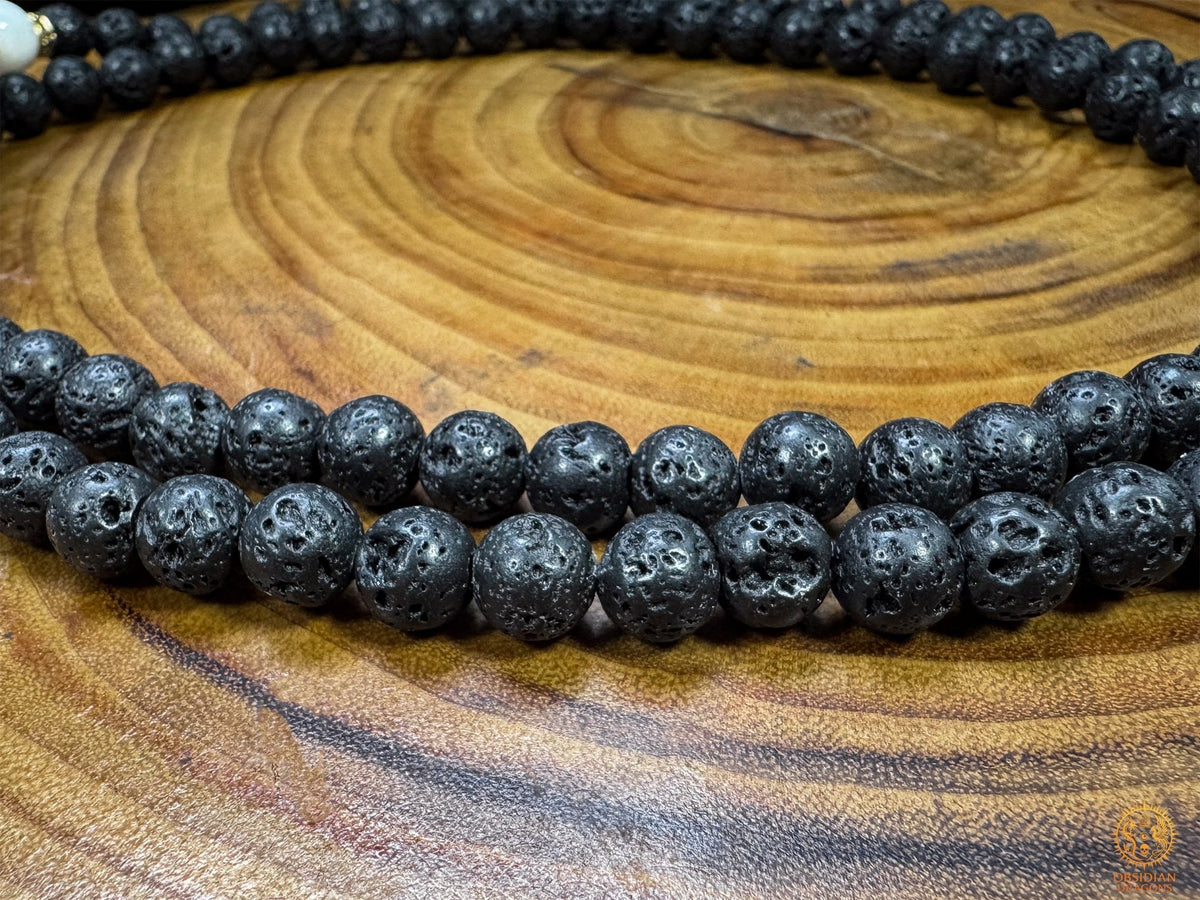
Handcrafted Buddhist mala with 108 lava stone beads, tridacna mother-of-pearl, and reconstituted cinnabar lotus – meditation and inner transformation
Photos and video are contractually binding; you will receive exactly this 108-bead mala made of lava stone, mother-of-pearl, and cinnabar
I entirely designed and handcrafted this Buddhist mala with 108 beads made of black lava stone, white tridacna mother-of-pearl, and reconstituted cinnabar, with a specific intention: to express the journey of inner transformation through three materials with profoundly different origins and characteristics.
Black lava stone symbolizes the strength of change and perseverance in the face of adversity; white tridacna mother-of-pearl evokes clarity of mind and serenity; finally, red cinnabar, adorned with a double-sided engraved lotus, represents the aspiration for wisdom and awakening.
Each material, color, and detail was deliberately chosen to give coherence to this personal creation.
Technical information about this 108-bead mala made of lava stone, mother-of-pearl, and cinnabar
🔬 Gemological expertise: As a gemologist graduated from the National Institute of Gemology (ING, Paris, France), I personally examined the materials making up this 108-bead mala to control their nature, verify the declared treatments, and identify any identifiable imitations. The reconstituted nature of the cinnabar is expressly stated.
📿 Handcrafted : As a malakara, artisan mala maker, trained in the Tibetan region of Gyaltran in northern Yunnan, I entirely designed and assembled this handcrafted mala, from selecting the materials to arranging this 108-bead Buddhist rosary.
🪨 Main beads : 108 spherical beads made of natural black volcanic lava stone, featuring a porous texture characteristic of vesicular volcanic rocks.
📏 Diameter of the main beads : 8 mm.
⚪ Separator beads: Three beads made of natural tridacna mother-of-pearl (Tridacna), commercially known as tridacna mother-of-pearl, composed mainly of aragonite (CaCO₃).
📐 Diameter of the separator beads: 9 mm, placed every 27 main beads, dividing the mala into four sections of 27 beads.
🪷 Guru bead: A finishing bead made of natural tridacna mother-of-pearl, measuring 16 mm in length, 10.37 mm in width, and 9 mm in thickness.
🔴 Cinnabar bead: Decorative element made of reconstituted cinnabar, with a declared cinnabar (mercury sulfide, HgS) content of 90%, red in color, adorned with a lotus engraved on both sides.
📐 Dimensions of the cinnabar bead: 15.22 mm wide × 10 mm high × 4.34 mm thick.
✨ Interstitials and ornaments: Small decorative and interstitial elements made of gold-plated brass, placed between certain beads to highlight the contrasts between the materials.
🧵 Cord: Black cord specially designed for making malas, selected for its high resistance and the strength of the assembly.
📿 Cord finish: Two terminal strands, each adorned with two natural lava stone beads and one tridacna mother-of-pearl bead.
📏 Total length of the mala: 56 cm.
⚖️ Total weight: 103 grams.
🎨 Dominant colors: Volcanic black, milky white, cinnabar red, and gold.
🙏 Use: 108-bead Buddhist rosary intended primarily for counting mantras and meditative practice. It can also be worn as a handcrafted piece of jewelry.
🪷 Symbolism of the creation: Deliberate combination of black lava stone, white tridacna mother-of-pearl, and red cinnabar lotus to express three dimensions of the inner journey: transformation, clarification, and the aspiration for awakening.
Black lava stone: a material born of fire
The 108 main beads are carved from natural basaltic volcanic rock commonly known as lava stone.
This material forms during the cooling of volcanic products derived from magma. The numerous cavities visible on the surface of the beads testify to its vesicular structure, characteristic of certain volcanic rocks in which gases left their mark during solidification.
In the design of this mala, this geological origin takes on a metaphorical dimension. Lava stone represents transformation: a material that was once molten, now solid, symbolizing the changes and trials that shape existence.
In lithotherapy, lava stone is associated with grounding, stability, and inner strength.
Tridacna mother-of-pearl: clarity at the heart of this handcrafted Buddhist rosary
Three white separator beads placed at intervals of 27 lava beads pace the mala. They are accompanied by a guru bead also made of tridacna mother-of-pearl, as well as two white beads integrated into the cord ends.
The tridacna is a marine bivalve mollusk belonging to the Tridacnidae family. Its shell is composed mainly of aragonite, a crystalline form of calcium carbonate (CaCO₃), organized in interlaced lamellar structures.
Commercially known as "tridacna mother-of-pearl," this material is distinguished by its white color and delicately milky appearance.
Mother-of-pearl holds a special place in the history of precious materials associated with Buddhism.
It is traditionally linked to the seven treasures of Buddhism (saptaratna), mentioned notably in the Sūtra of Amitābha and the Lotus Sūtra.
In this creation, the whiteness of the tridacna was chosen to represent inner clarification, serenity, and purity of intention. It introduces a visual and symbolic transition within the sequence of black volcanic beads.
In lithotherapy, mother-of-pearl is associated with soothing and emotional harmony.
Red cinnabar and the lotus: an aspiration for awakening
Below the guru bead is an oval bead made of reconstituted cinnabar, with a declared cinnabar content of 90%, adorned with a lotus engraved on each of its two sides.
Cinnabar is a mineral with the chemical formula HgS, composed of mercury sulfide. Its characteristic red color earned it an important place in the history of Chinese pigments and artistic practices. It also holds a special place in the history of Taoist alchemy, where it played a role in ancient research on the transformation of matter, longevity, and immortality.
The bead used here is not made of a solid block of cinnabar: it is a reconstituted material combining cinnabar with a binder.
Its red color was deliberately chosen to evoke transformation and symbolic vitality.
The lotus motif introduces a more directly Buddhist dimension.
Rooted in the mud, the lotus develops its stem through the water before blooming on the surface. In Buddhist thought and iconography, this image expresses, among other things, the possibility of cultivating purity, wisdom, and compassion in the midst of a world marked by difficulties and attachments.
The lotus is also one of the eight auspicious symbols of Buddhism, called Ashtamangala.
Its double-sided engraving is a personal aesthetic and symbolic choice here: no matter which side is presented, the lotus remains visible, as a reminder of the aspiration for awakening in all circumstances of existence.
108 beads and three separator beads: a structure derived from Buddhist tradition
The composition of this mala follows a traditional organization of the Buddhist rosary, with 108 main beads divided into four groups of 27 by three distinct separator beads.
In Tibetan Vajrayāna Buddhism as well as in several Mahāyāna schools (notably Pure Land, Chinese Chan, Korean Seon, as well as the Japanese traditions of Jōdo-shū, Nichiren, Tendai, and Shingon), 108-bead Buddhist rosaries accompany different spiritual practices. Depending on the schools, they are used to count mantra recitations, invocations of Buddhas, and prayers, or serve as devotional objects. Their form and use vary according to the traditions.
In Buddhist traditions, the number 108 is the subject of several doctrinal interpretations. It is notably associated with the 108 mental afflictions, called kleśa in Sanskrit, including the different forms of attachment, aversion, and ignorance that perpetuate suffering.
In the Zhiguan fuxing chuanhong jue (止觀輔行傳弘決), a commentary on the Chinese Tiantai school written by Zhanran (711–782), the enumeration of the 108 mental afflictions is explained based on the six sensory faculties, the reactions they arouse, and their inscription in the three times: past, present, and future.
The number 108 also appears in the Aṭṭhasata Sutta (Saṃyutta Nikāya 36.22), which distinguishes 108 categories of sensations according to a different classification. In the use of the mala, each bead can thus become a support for recitation and mindfulness, symbolically reminding the practitioner of the inner work through which they seek to recognize and overcome their mental conditioning.
The three separator beads make it possible to identify the different sections of the rosary. This organization into groups of 27 is also attested in historical Tibetan malas.
The guru bead marks the junction of the two ends of the rosary and constitutes a special reference point in its use. Its spiritual meaning varies according to Buddhist traditions.
To learn more about the meaning of malas
discover our study dedicated to the origin, meaning, and use of the Buddhist mala.
An authentic handcrafted mala designed as an inner journey
The combination of lava stone, tridacna, and cinnabar expresses a specific intention of mine: to give material form to the idea of inner transformation.
Lava stone represents changes and perseverance in the face of adversity. The white tridacna beads evoke the search for clarity and serenity. Finally, the red lotus constitutes the visual culmination of this composition, reminding us of the aspiration to develop wisdom and compassion.
Transformation, clarification, and awakening thus form the three symbolic dimensions of this mala.
Designed to accompany mantra recitation or meditation, it can also be appreciated as a handcrafted creation whose materials, colors, and proportions tell a story.
Care and precautions
To preserve the materials and finishes of this handcrafted mala, opt for gentle cleaning with a soft, dry cloth. Avoid immersion in water, chemicals, perfumes, acidic cleaners, as well as ultrasonic or steam cleaning processes.
Tridacna mother-of-pearl, mainly composed of calcium carbonate, is sensitive to acidic substances. The gold-plated brass elements must be protected from excessive rubbing and abrasive products.
Because the reconstituted cinnabar contains mercury sulfide, the red bead must not be heated, sanded, or abraded. Its use as an element of a worn piece of jewelry requires a prior assessment of the safety of the finished material.
Keep the mala away from impacts and avoid excessive pulling on the two terminal cords.
To discover other compositions and materials,
explore our collection of handcrafted malas and 108-bead Buddhist rosaries.
Frequently asked questions about this 108-bead mala made of lava stone, mother-of-pearl, and cinnabar
Are the three tridacna mother-of-pearl separator beads counted among the 108 beads?
No. The 108 counting beads are exclusively the black lava stone beads. The three white tridacna mother-of-pearl separator beads serve as additional markers, allowing the four sections of 27 beads to be identified by touch.
The guru bead and the decorative beads on the terminal cords are also not included in this count.
How do I use this mala to perform a complete cycle of recitation?
In Tibetan practice, recitation begins with the first bead immediately following the guru bead. Each main bead corresponds to one recitation of the chosen mantra.
When the practitioner returns to the guru bead after one full round, they turn the mala to continue in the opposite direction, without crossing this particular bead. This gesture notably expresses respect for the spiritual teacher.
Why do 108 recitations sometimes correspond to only 100 counted mantras?
The eight additional recitations provide a margin intended to compensate for possible errors in pronunciation, distractions, or lapses in attention.
Thus, a physical cycle of 108 beads can be counted as 100 recitations within the framework of this particular practice.
Is this lava stone mala reserved for a particular mantra or Buddhist deity?
The composition of this mala does not require any particular mantra. The red lotus expresses the symbolic intention of its creation, but does not in itself constitute a ritual dedication to a specific deity.
Its use can therefore be adapted to the owner's spiritual practice, while respecting, where applicable, the instructions of their school or teacher.
Should this mala be blessed before use?
A blessing may be considered depending on the tradition followed by the practitioner.