


Obsidian dragons
Tibetan Mahakala Tantric Mala, unique collector's piece
Tibetan Mahakala Tantric Mala, unique collector's piece
Couldn't load pickup availability
Mahākāla Tibetan Tantric Mala – Unique piece with 108 talipot seeds, antler carvings, DZI, dorje, phurba and symbolism of impermanence
Contractual photos and video, you will receive exactly this 108-bead Tibetan tantric mala
A unique piece dedicated to impermanence and spiritual transformation
The design of this Tibetan tantric mala took me 32 hours of work, from selecting the 108 talipot seeds from Sri Lanka to assembling the six pendants, antler carvings and Guru finish. I sought a balance between the richness of the tantric representations, the diversity of materials and the natural gradient of shapes and colors, achieved notably by the heat treatment of the seeds.
I placed Mahākāla at the center of this creation for its dimension as a protector of the Dharma. Around him, the skeletal figures and skulls evoke impermanence and the mortal condition; Acala, the phurba and the kartika refer to determination and the overcoming of obstacles; the dorje and the bell remind of the union of wisdom and compassion. Ganesh and the two DZI beads bring a talismanic dimension, traditionally associated with protection, favorable circumstances and prosperity.
This association of symbols expresses my own reading of tantric Buddhism: the awareness of impermanence is not an invitation to fear death, but to consider existence differently, its attachments and the transformations it imposes.
It nevertheless retains the fundamental architecture of the traditional Buddhist mala, rosary intended notably for counting mantras. Its 108 main beads are divided into four sections of 27, while its two counters allow to follow the successive cycles of recitation.
I designed this mala as a unique collector's piece, intended both for practice and contemplation as well as for lovers of sculptures and Buddhist spiritual traditions.
Technical information of this Tibetan tantric mala
🔬 As a gemmologist graduated from the National Institute of Gemmology (ING, Paris, France), I personally appraised the materials composing this Tibetan tantric mala, paying particular attention to their nature, their origin, their characteristics and their possible treatments.
🪢 As a malakara trained in the Tibetan region of Gyaltran, in northern Yunnan, I entirely designed and assembled this Tibetan mala, from the choice of materials to the organization of its different tantric pendants and symbolic elements.
General characteristics
📿 Nature of the object: Tibetan tantric mala of artisanal creation, unique collector's piece.
📏 Total length : 63 cm.
⚖️ Total weight: 222 grams.
⏳ Actual making time: 32 hours of personal artisanal work, excluding the prior creation of the sculptures by specialized artisans.
🌴 Main beads: 108 talipot palm seeds (Corypha umbraculifera), of 10 mm diameter × 8 mm thickness. Dense, homogeneous and healthy material, without cracks or cavities, careful polishing,well-centered drillings
🎨 Coloration: gradient from ivory white to caramel brown, obtained by chromatic selection of seeds having undergone a heat treatment called kaose (烤色). Coloration mastered, demanding chromatic selection
🧵 Main cord: high-resistance special mala black cord, of 3 mm thickness.
🏵️ Structure: three main counter-beads dividing the 108 seeds into four sections of 27, with four additional ornamental pendants, two mantra counters and a complex Guru finish.
🛠️ Making: selection of materials, design of the whole, chromatic sorting, distribution of sculpted elements, assembly, complementary drilling of the Guru bead and making of the tassels done personally by hand.
The 108 talipot seeds
🌿 Botanical identification: Corypha umbraculifera, family Arecaceae.
🌏 Botanical origin of the species : India and Sri Lanka; precise geographical origin of the batch of seeds, Sri Lanka.
📐 Unit dimensions: 10 mm diameter × 8 mm thickness.
✨ Preparation : shaped, drilled and polished seeds.
🔥 Treatment : heating intended to produce different color nuances; the coloration is not presented as the result of natural aging.
Central counter-bead — Mahākāla

🦌 Material: antler wood coming from naturally fallen wood during the shedding of cervids.
🗿 Representation: Mahākāla head sculpted in the round, with third eye, visible fangs, hair adorned with skulls and cadaverous representation on the lapel.
📐 Dimensions: 43.33 mm height × 32.64 mm width × 30.28 mm depth.
First pendant — Skeletal figure and endless knot

💀 Two miniature skulls: tea-stained buffalo bone, each of 7.45 mm height × 6.89 mm diameter.
💎 Intercalary: Hubei turquoise, China, of 8.16 mm diameter × 4.66 mm thickness.
🔴 Two intercalaries: Brazilian carnelian, of 6 mm diameter each.
⭕ Ring bead: tea-stained buffalo bone, of 11.59 mm diameter × 9.94 mm thickness.
🦌 Main sculpted bead: antler wood, with skeletal figure inspired by the Citipati on one side and Dharma wheel on the other.
📐 Sculpture dimensions : 31.85 mm length × 11.74 mm diameter.
♾️ Terminal pendant: buffalo bone plate sculpted in diamond shape, adorned with the endless knot, measuring 49.63 mm from one corner to the opposite.
Second pendant — Meditating skeleton and phurba

💎 Intercalaries: two Hubei turquoise discs, China.
🔴 Cylindrical mantra bead: cinnabar composite material, announced at 90% cinnabar, bearing Om Mani Padme Hum, of 11.86 mm height × 9.05 mm diameter.
💀 Three miniature skulls : tea-stained buffalo bone.
🔴 Round bead : composite material announced at 50% cinnabar, of 8.48 mm diameter.
🦌 Main sculpture: antler wood representing a meditating skeleton, with crown of five skulls on one side and kartika on the other.
📐 Sculpture dimensions: 24.19 mm height × 14.74 mm width × 13.94 mm thickness.
🗡️ Terminal phurba: tea-stained buffalo bone, sculpted in Tibetan ritual dagger shape, of 52.47 mm length × 13.74 mm diameter.
Third pendant — Great Man DZI and boar tusk

💀 Miniature skulls: three buffalo bone elements.
💎 Intercalaries: five Hubei turquoise elements, China.
🔴 Mantra bead: composite material announced at 50% cinnabar, bearing Om Mani Padme Hum, of 8.80 mm diameter.
🌩️ Decorative bead: composite material announced at 50% cinnabar, engraved with Chinese pattern 云雷纹 (yúnléiwén), or « clouds and thunder », of 11.68 mm diameter.
🧿 Main DZI: authentic contemporary made DZI bead, so-called « Great Man » model, of 28.47 mm length × 12.03 mm diameter.
🐗 Terminal pendant: natural boar tusk, of 42.68 mm length.
Fourth pendant — Acala, dorje and talipot ring

💎 Intercalaries: two Hubei turquoise elements, China.
🔴 Carnelian intercalaries: five elements coming from Brazil.
💀 Miniature skulls: three buffalo bone elements.
🦌 Main sculpture: wrathful head in antler wood attributed to Acala (Acalanātha), notably presenting fangs oriented in opposite directions.
📐 Sculpture dimensions: 16.05 mm height × 11.28 mm width × 14.42 mm thickness.
⚡ Dorje : buffalo bone sculpture, of 27 mm length × 9.52 mm diameter.
⭕ Terminal ring: talipot seed shaped into ring, of 20.75 mm diameter.
📍 Positioning of third and fourth pendants: opposite arrangements, each at 13 beads after a side counter-bead and 14 beads before the central head of Mahākāla.
The two mantra counters

📿 Composition: two independent counters of ten beads each, so twenty additional buffalo bone beads, not included in the 108 main seeds.
📐 Bead diameter: 6 mm.
⚡ Dorje counter: sculpted buffalo bone termination, of 32.77 mm length × 9.34 mm diameter.
🔔 Bell counter: sculpted buffalo bone termination, of 30.48 mm length × 14.85 mm width.
🌈 Tibetan tassels : two long multicolored tassels, entirely made by hand during the assembly of this creation.
Finish — Guru bead, Ganesh and three-eyed DZI

🎋 Guru bead: polished solid bamboo, called bamboo with gold threads (jīnsī zhú/ 金丝竹) in Chinese wenwan craftsmanship.
📐 Guru bead dimensions: 40 mm height × 17 mm width × 16 mm thickness.
🛠️ Personal transformation: two additional holes were made in the Guru bead to attach two symmetrical side pendants.
💀 Composition of each side pendant: four small buffalo bone skulls, a turquoise spacer, and a buffalo bone end piece carved with a dorje.
⚡ Dimensions of the carved end pieces: 18 mm high × 11.29 mm wide × 9.55 mm thick each.
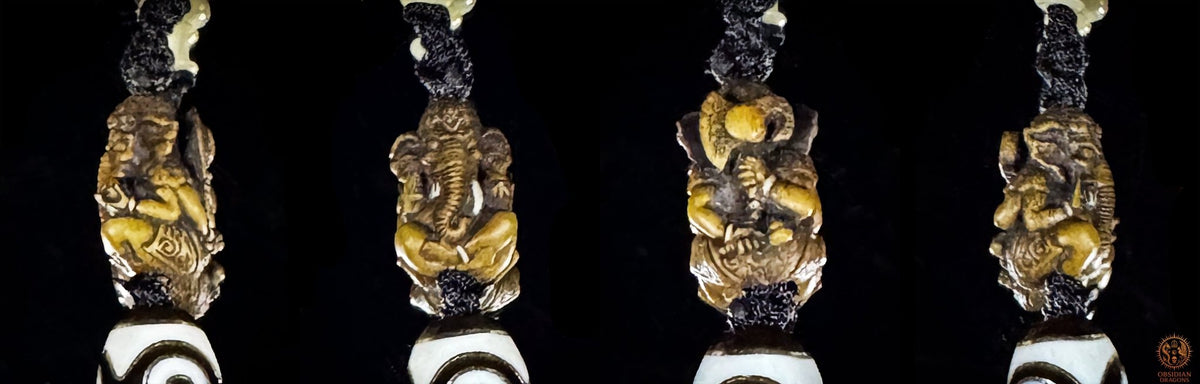
🐘 Ganesh sculpture: carved from antler, depicting the elephant-headed deity and a visible axe on the reverse.
📐 Dimensions of Ganesh: 24.90 mm high × 13.64 mm wide × 12.85 mm thick.

🧿 Three-eyed DZI: authentic DZI bead, 19.64 mm long × 14.86 mm in diameter.
🔴 Red bead: Tibetan glass paste, 15.07 mm long × 13.14 mm in diameter.
🧵 Ends of the two black strands: each includes three small buffalo bone skulls and two turquoise spacers.
Identification of materials, origins, and treatments
🌴 Talipot seeds: Corypha umbraculifera, a natural plant material that has been worked and heat-treated. Origin: Sri Lanka
🦌 Antler: wood from naturally shed antlers, used for the Mahākāla, secondary figures, Acala, and Ganesh sculptures. Origin: Heilongjiang, Northern China
💀 Buffalo bone: material used for the miniature skulls, counters, and several ritual ornaments. Some pieces were dyed by immersion in tea.
💎 Turquoise: Hubei province, China.
🔴 Carnelian: Brazil.
🎋 Jīnsī zhú bamboo: polished solid bamboo used in Chinese collector's crafts; Origin: Myanmar
🧿 DZI: two beads with traditional patterns, including a contemporary Great Man DZI and a three-eyed DZI. Geographical origin: Gyaltran, a Tibetan province in northern Yunnan
🔴 Cinnabar: composite materials containing cinnabar according to the established characteristics of the elements, with stated contents of 50% or 90% depending on the beads. Mineral cinnabar is a mercury sulfide with the formula HgS.
🐗 Boar tusk: natural animal material; geographical origin not specified.
🔴 Red glass paste: vitreous material used in the Guru finish, distinct from natural stones and coral.
The 108 talipot seeds: a chromatic composition from white to deep brown
This palm tree from the Arecaceae family is native to India and Sri Lanka, among other places.
In China, these beads are marketed under the name 菩提根 (pútígēn), literally "Bodhi root". However, this is a commercial name: the beads come from the palm tree's seeds, not from the roots of the Bodhi tree (Ficus religiosa). This ethnobotanical identification is notably addressed in the scientific study Seeds used for Bodhi beads in China.
The uniqueness of this mala lies in its gradual 108-shade gradient, ranging from ivory white to cream, then to golden yellow, caramel, and deep brown.
These colors come from a traditional and accepted heat treatment. They should therefore not be confused with a patina acquired solely through decades of use.
The assembly required careful selection of the beads, not only according to their tone, but also according to their brightness, saturation, and place in the chromatic progression. The goal was to create a continuous visual transition despite the interruptions imposed by the counter-beads and the different pendants.
This organization gives the mala its particular rhythm. The eye follows the color variations before encountering the sculptures, then returns to the beads whose succession maintains the unity of the composition.
In my view, this progression evokes the incessant change to which phenomena are subjected.
Mahākāla: the protector of the Dharma at the center of the composition
The central sculpture represents Mahākāla, whose Sanskrit name means "Great Black" and can also be associated with the concept of "Great Time".
In Vajrayāna Buddhism, Mahākāla belongs to the great protective figures of the Dharma. His wrathful appearance, far from representing ordinary human anger, expresses in the tantric tradition a powerful spiritual activity, aimed at protecting the teachings and overcoming obstacles.
To explore his forms and history further,
our article dedicated to Mahākāla, the Great Black King and protector of the Dharma presents the main aspects of his iconography.
The reliefs of his face express the power of the representation: intense gaze, third eye, visible fangs, and a coiffure animated by sculpted strands in which several skulls appear. The different faces reveal three-dimensional work that cannot be appreciated from the front view alone.
The reverse presents another dimension of the sculpture, with hair details and a cadaverous representation that extends the theme of impermanence.
The material itself contributes to the piece's identity. The antler wood comes from naturally shed wood from deer, which is then worked by a specialized artisan. The light and brown shades of the material complement the volumes of the sculpture.
In the composition, Mahākāla occupies a privileged position: he forms the figurative center around which the other representations are organized.
The skeletal figures: contemplating impermanence
The miniature skulls and Citipati skeletal figures are omnipresent in this mala.
The Citipati, Lords of the Charnel Grounds
In Tibetan tantric Buddhism, the Citipati are protective figures generally represented in the form of a pair of dancing skeletons. Their macabre dance evokes the impermanence of all existence, the fragility of the body, and the illusory nature of attachments.
Far from symbolizing a fascination with death, the Citipati remind us that awareness of our mortal condition can become a path to wisdom and spiritual liberation. The skeletal figures carved on this mala are inspired by this tantric iconography, where contemplating death paradoxically invites a better understanding of life.
This tradition constitutes one of the main cultural references for the secondary sculptures of the mala.
First pendant: the wheel of the Dharma, the Citipati, and the endless knot
A skeletal figure inspired by the Citipati occupies one side of the sculpture, while the wheel of the Dharma appears on the other. This opposition brings together two fundamental dimensions of Buddhist thought: awareness of death and the path that allows one to be liberated from ignorance.
The skeletal figures remind us that the body, possessions, and all conditioned existence are destined to change. The wheel of the Dharma refers to the Buddha's teachings, their transmission, and the path of understanding that leads to liberation.
The endless knot, or Śrīvatsa, extends this reflection. Counting among the eight auspicious symbols of Buddhism, the Aṣṭamaṅgala, its apparent beginningless and endless intertwining is notably associated with the interdependence of phenomena, the continuity of the teachings, and the union of wisdom and compassion.
I wished to bring these three representations together around a single idea: awareness of our finitude should not lead to despair, but to a clearer understanding of the bonds that unite us to the world. Nothing has an independent and immutable existence; every phenomenon appears, transforms, and disappears in relation to other causes and conditions.
This reflection joins the Buddhist principle of conditioned production, pratītyasamutpāda.
Second pendant: the five wisdoms, the kartika, and the phurba
The presence of a meditating skeleton, crowned with five skulls, introduces one of the most characteristic themes of tantric iconography: the transformation of human passions into wisdom.
In the representations of wrathful deities of Vajrayāna, the crown of five skulls symbolizes the transmutation of the five poisons of the mind: ignorance, attachment, aversion, pride, and jealousy, into five wisdoms.
The meditating skeleton, stripped of all carnal appearance, remains in the attitude of contemplation. Its representation evokes detachment from the body and the illusions to which human beings identify.
On the reverse appears the kartika, a curved ritual knife whose blade represents, in tantric iconography, the wisdom capable of cutting through ignorance and attachments.
The phurba, tantric Buddhism ritual dagger, extends this symbolism. This Buddhist ritual object is used to ritually fix, master, or subdue disruptive forces.
The presence of the mantra Om Mani Padme Hum, associated with Avalokiteśvara, reminds us however that the wrathful dimension of Vajrayāna cannot be reduced to destruction. It can express a spiritual activity guided by compassion.
The association of these symbols evokes a demanding transformation: recognizing the passions that cloud the mind, understanding their nature, and working to convert them into wisdom rather than remaining under their sway.
Third pendant: the Great Man DZI, favorable encounters, and protection
With the Great Man DZI this pendant introduces a more directly talismanic dimension.
The Great Man motif is associated with the appearance of benevolent people, protectors, advisors, and supporters capable of intervening favorably during a lifetime, an influential or providential person whose help can change the course of a situation.
In Buddhism, the concept of kalyāṇamitra, or spiritual friend, highlights the importance of those who accompany a person on their path and help them develop discernment and understanding.
Finally, the natural boar tusk brings a more instinctive dimension to the composition. I associated it with this pendant for what it evokes to me: the vigor, courage, and determination necessary to face trials.
In this reading, protection does not come exclusively from an external force: it can also take the form of an encounter, a teaching, a just advice, or the courage to continue one's path.
The traditional meanings attributed to DZI beads are explored further in our article dedicated to Tibetan DZI, their patterns, and their talismanic traditions.
Fourth pendant: Acala, the Immovable, and the wisdom of the dorje
Acala, or Acalanātha, means "the Immovable". This wrathful deity holds an important place in several traditions of esoteric Buddhism, notably in Japan under the name Fudō Myōō.
His fearsome appearance does not represent uncontrolled anger. It expresses the unwavering determination of awakened wisdom in the face of ignorance and the obstacles that hinder the spiritual path.
Our study devoted to Acala, king of knowledge and protector of the Dharma also presents its iconography and its different traditions.
The dorje, or vajra, which accompanies this representation, reinforces this symbolic orientation. Associated with lightning and diamond, it evokes in Vajrayāna the power and indestructibility of wisdom capable of dispelling ignorance.
The talipot ring finishing the suspension is a personal choice of composition. Its circular shape reminds me of the continuity of spiritual commitment, despite the changes and trials of existence.
The association of Acala and the dorje takes on a particular meaning here: being immovable does not mean refusing change, but cultivating a determination that is not carried away by circumstances.
I deliberately placed this suspension opposite that of the DZI of the Great Man. Their arrangement allows for a complementary reading: on one hand, the favorable encounters and the support we receive; on the other, the inner strength, perseverance, and discernment that we must develop ourselves.
These two dimensions remind us that the spiritual journey depends both on the conditions we encounter and on how we choose to respond to them.
Two mantra counters: the union of wisdom and compassion
On a Tibetan mala, the function of the two counters is to track the cycles of practice, but their presence also reminds us that the repetition of sacred syllables is accompanied by intention, concentration, and work on the mind.
In Vajrayāna Buddhism, the dorje and the bell form an inseparable ritual pair. Their association expresses one of the essential principles of the tantric path: wisdom and compassionate method must be developed together.
The dorje, or vajra, symbolizes the indestructible power of awakened method. Its nature as diamond and lightning evokes a determination capable of piercing through illusions and dispelling ignorance. The Tibetan bell, or drilbou, represents the wisdom that recognizes the emptiness of phenomena, their lack of independent and permanent existence.
Compassion without wisdom risks remaining prisoner to a mistaken understanding of reality, while wisdom separated from compassion loses its vocation to contribute to the liberation of beings.
I finished these two counters with long multicolored tassels made by hand. Their threads evoke to my eyes Tibetan prayer flags, whose wind is traditionally considered to carry blessings and benevolent wishes.
I wanted to evoke a prayer that does not remain locked in individual experience, but opens up to all beings.
The Guru finish: spiritual transmission, Ganesh, and three-eyed DZI
In Vajrayāna Buddhism, the Guru bead represents the spiritual master and the relationship that unites the disciple to the one who transmits the teachings to them. When counting mantras, it marks the end of a cycle; according to usage, the practitioner then turns their mala rather than crossing this bead.
This meaning gives the finish an importance that goes beyond its sole function of assembly.
I chose to extend this Guru bead with a representation of Ganesh, or Gaṇapati, an elephant-headed deity whose origins belong to Hinduism, but whose presence is also attested in several traditions of tantric Buddhism.
In Tibetan tantric Buddhism, Ganapati has a special place, whose meaning varies according to the lineages and the forms under which he appears.
In the Sakya tradition, Mahārakta Ganapati, a red twelve-armed form, belongs to the Thirteen Golden Dharmas and more precisely to the group of the Three Great Reds. Associated with the tantric cycle of Cakrasaṃvara, he intervenes in practices related to the power of influence, the acquisition of wealth, and the creation of favorable circumstances.
In the Nyingma tradition, Rakta Ganapati, also called Tsogdak Marpo, appears notably in the teachings of revealed treasures (terma). This form is associated with abundance and prosperity.
Ganapati however presents another dimension in tantric iconography: under the name of Vināyaka, he can embody the obstacles to be mastered. He appears notably at the feet of six-armed Mahākāla, an image of the submission of the forces that hinder the spiritual path.
Obstacles can be overcome, while favorable conditions and material resources can become means at the service of spiritual accomplishment.
The small sculpture presents an axe, an attribute traditionally associated with the faculty of cutting away obstacles and, in a spiritual reading, the attachments that hinder the inner journey.
This symbolism joins the intention that I gave to the whole finish: favorable circumstances are precious, but they only truly take their meaning when they allow to progress in knowledge and self-mastery.
Under Ganesh, the three-eyed DZI introduces a complementary talismanic dimension. In the popular beliefs surrounding DZI beads, this motif is notably associated with the three aspirations that are happiness, prosperity, and longevity.
The two small side suspensions, adorned with skulls and finished with carved dorjes, voluntarily reintroduce the symbolism of impermanence and wisdom within this assembly devoted to favorable conditions.
The presence of skulls reminds us that neither wealth, nor success, nor even longevity allow to escape the transitory nature of existence.
I wanted to bring together in this finish two aspirations that are not necessarily contradictory: seeking favorable conditions for existence, while learning not to become a prisoner of them.
The Guru bead, Ganesh, the three-eyed DZI, and the dorjes compose a personal reflection on the transmission of teachings, obstacles, prosperity, and detachment.
A symbolic reading: from impermanence to wisdom
The skulls and skeletal figures remind us of the transitory nature of existence. Mahākāla introduces the protection of the Dharma and the power of wrathful representations. The phurba, the kartika, and Acala evoke the mastery of obstacles and the overcoming of ignorance. The dorje and the bell remind us of the complementarity of wisdom and compassionate method.
The DZI and Ganesh add references to favorable encounters and prosperity.
These different themes can be brought together in the same interpretation: recognizing impermanence, facing the obstacles of existence, and developing a wisdom that is never separated from compassion.
The presence of ornaments related to prosperity does not necessarily contradict this orientation. In a philosophical reading, favorable circumstances can be viewed as means allowing to practice, to learn, and to act for the benefit of others, rather than as an exclusively material end.
A mala intended for practice, contemplation, and collection
With its 108 main beads and its two mantra counters, this creation retains the counting function proper to the Buddhist mala.
Its architecture allows the recitation and manipulation of the seeds. However, its weight of 222 grams, the presence of detailed sculptures, and the length of the suspensions require careful use, particularly to avoid shocks and friction between the ornaments.
The presence of composite materials with cinnabar also imposes specific precautions, detailed in the chapter devoted to maintenance.
This mala is addressed mainly to collectors of Asian arts, lovers of sculptures and ritual objects, people sensitive to the iconography of Vajrayāna, and those who seek a personal handcrafted creation rather than a standardized-made rosary.
It will also find its place in a cabinet of curiosities devoted to natural materials, spiritual traditions, and decorative arts of Asia.
There is only one copy of this composition. Its 32 hours of making, its particular architecture, the selection of its 108 seeds, and the gathering of its sculptures constitute the material history of this piece.
Maintenance and conservation precautions of this Tibetan tantric mala
This mala brings together plant, animal, and mineral materials whose conservation requirements differ. It must be handled as a handcrafted collection piece featuring sculptures and delicate suspensions.
To preserve its talipot seeds, its deer antler elements, its carved bones, and its bamboo finish, avoid immersion, water cleaning, chemicals, sudden temperature changes, and strong humidity variations.
Do not leave the mala exposed for a long time to direct sunlight, near a heater, or in a humid environment.
The turquoises must be protected from aggressive products, heat, and repeated friction.
Particular attention must be paid to the cinnabar composite beads. Cinnabar contains mercury in the form of mercury sulfide (HgS). Never heat, sand, drill, or abrade these elements, nor put them in your mouth.
The long multicolored tassels must be delicately untangled by hand, without excessive pulling. The main cord and the sculpture attachments must be checked periodically, particularly in case of repeated use for recitation.
For collection conservation, favor a protective storage and a support allowing to distribute the weight without exerting prolonged tension on the drillings or on the most fragile elements.
This unique piece was designed to bring together the function of the mala, the material presence of a sculptural assembly, and the symbolic depth of Asian tantric traditions. Its conservation and use must respect this double nature of a practice object and a handcrafted collection creation.
This unique creation is part of my work in designing Buddhist and tantric malas, where the choice of materials, spiritual traditions, and handcrafted know-how occupy an essential place.
To discover my other creations, explore the collection of handcrafted Buddhist malas and meditation rosaries by Obsidian Dragons.
Frequently asked questions around this Tibetan tantric mala
Do you need to be a practitioner of Tibetan Buddhism to own this mala?
No. This mala can be acquired for its artistic, cultural, and symbolic interest, regardless of any religious practice. However, some tantric practices require specific initiations and instructions, which do not come from the simple possession of an object.
Does this mala belong to a particular lineage of Tibetan Buddhism?
Its composition does not reproduce a ritual model prescribed by a particular school. It gathers iconographic references present in different traditions of Vajrayāna, according to a personal organization coming from my work as a malakara.
Has this mala received a religious consecration?
No ritual consecration is claimed in this presentation. A practitioner wishing to integrate it into a specific practice can consult their spiritual master to determine if a blessing or consecration is appropriate to their tradition.
Can you wear this mala with Mahākāla or Ganesh facing forward?
Yes. Its composition allows to highlight either the central sculpture of Mahākāla, or the Guru finish with Ganesh and the three-eyed DZI, as shown by the worn photographs. This freedom of presentation is aesthetic and does not constitute a ritual prescription.



Return conditions for a Zen purchase
We offer you a money back guarantee within 14 days after delivery of your order.
If you are not completely satisfied with your purchase, please contact us to arrange a return of the product and a refund.
Except for returns, shipping is free on all orders.
-

100% secure payment
3 times interest-free option with Scalapay
-

Free delivery in France and internationally
14 days money back guarantee after delivery (see our conditions of sale)
-

Excellent customer service
Live chat
Whatsapp +33674049312


Let customers speak for us
Magnifique! Absolument ravie il est trés beau! Et en plus ma divinité favorite! Et ce parfum est un vrai bonheur envoûtant ! MERCI infiniment particulièrement à Zhou-li (j'espère bien l'orthographier), merci beaucoup

Tout est parfait, merci de votre envoi rapide et du règlement des frais de douane de votre côté.
Bonne continuation !

Quel bonheur de recevoir ce mala ! J'ai adoré découvrir une pièce à l'énergie totalement neutre, qui s'est animée et a pris toute sa force dès le premier tour. On ressent tout le soin et l'art de la création. Merci Jérémy.
Marie

Envoie rapide, le bracelet est incroyable et plus beau qu’en photo. Les réponses aux questions via whatsapp sont quasi instantanées. Je recommande vivement!!!

Je suis très satisfait de mon achat.
Je recommande fortement.

Crâne en Malachite Naturelle 3kg - Rare et exceptionnel

Merci pour tout, la communication, les facilités et la qualité des produits.

Comme a son habitude, Jeremy a des pièces exceptionnelles. Ce collier est une merveille absolue. Encore MERCI pour toutes ces merveilles.

Merci pour cet objet de magnifique qualité
Chaque détail, la qualité de sa réalisation
Les explications qui l'accompagnent..
En font un objet superbe comme support de méditation
En font un très bel objet de collection...
Merci

Magnifique grande sphere . Superbes couleurs et tres haute qualité. Promesses largement tenues. Envoie rapide. Confiance totale pour un prochain achat.

Le Mala a été livré très rapidement et je vous en remercie.
C’est notre fille qui l’a réceptionné, elle m’a confirmé que c’était une très belle pièce. Elle nous rejoint dans deux semaines, mon époux le découvrira alors et en fera le meilleur usage…
Merci pour le partage de votre passion ! 🙏🏽

bracelet puissant, je suis content de mon achat

Très beaux bracelet et très puissants

Magnifique crâne givré de l'Himalaya.

cette chevalière est tres bien réalisé, avec beaucoup de détails, je suis heureux de l'avoir
