Bronze Tibetan Phurba with Authentic 21-Eyed DZI: Vajrayāna Ritual Dagger for Protection, Wish Fulfillment, and Spiritual Transformation.
Contractual photos and videos: you receive the item shown, along with its stand.
Summary of this Phurba:
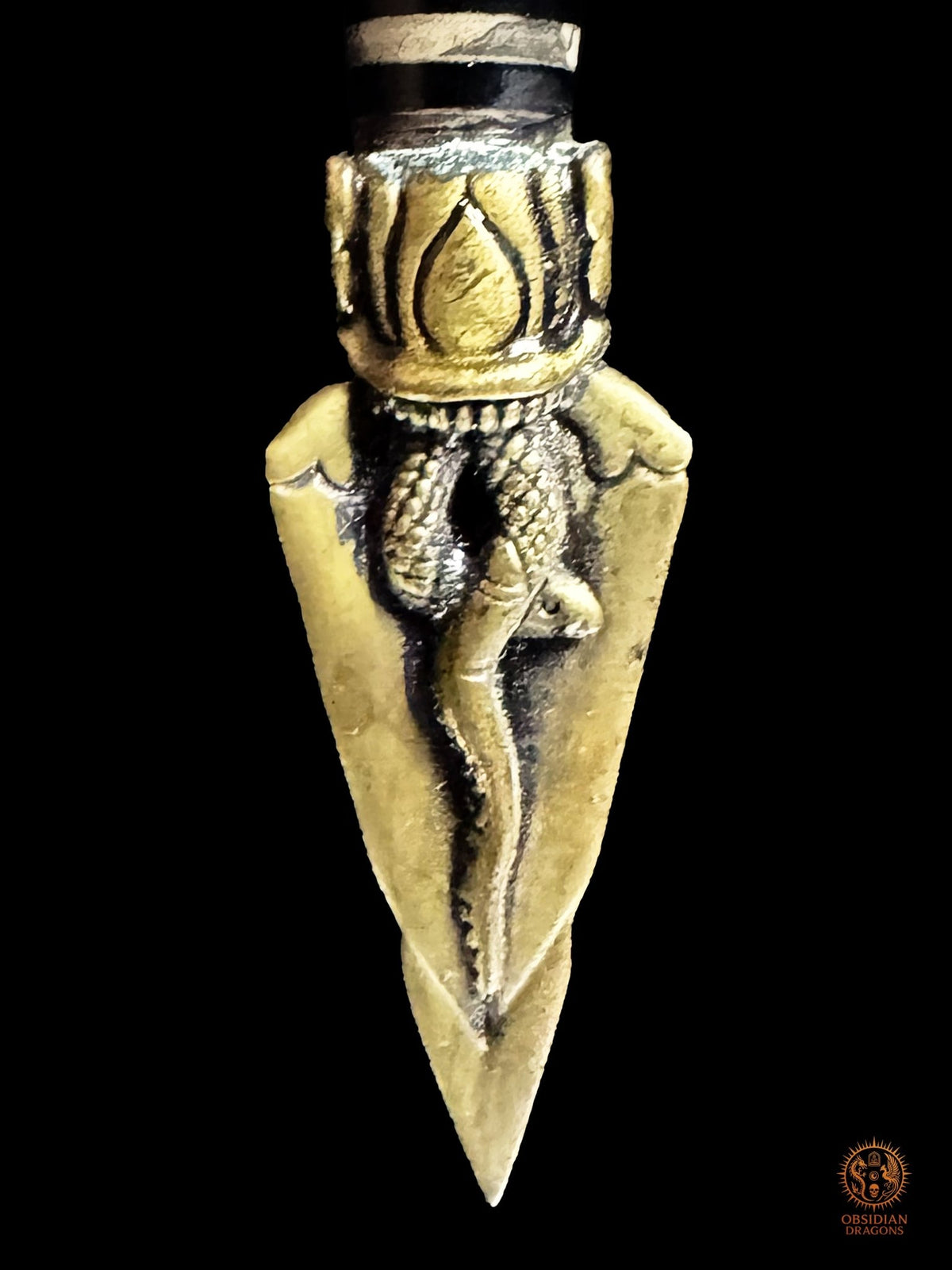
This bronze Tibetan Phurba with a 21-eyed DZI combines the transformative power of the Buddhist ritual dagger with one of the rarest and most coveted DZI beads. It is 14 cm long with a diameter of 14 mm, weighs 75 grams, and comes with its display stand. |
Twenty-one eyes open to the world, a single point directed towards the obstacle. The entire symbolic power of this bronze Tibetan Phurba with a 21-eyed DZI stems from this encounter. At its center, the authentic Tibetan bead gathers gazes, intentions, and possibilities; around it, wrathful figures and the tripartite blade give this energy direction. The object impresses with the density of its bronze, the profound contrast of black and ivory, and this dialogue between vision, protection, and transformation.
This collector's item with a 21-eyed DZI thus brings together two symbolic languages from the Himalayan world. The DZI gathers, observes, and amplifies. The Phurba fixes, directs, and transforms. One represents the extent of possibilities; the other gives them an axis.
Technical specifications
🔱 Object: Contemporary Tibetan Phurba
👁️ Central element: authentic 21-eyed DZI
✨ Materials: bronze and black and ivory DZI bead
📏 Length: 14 cm
⭕ Diameter: 14 mm
⚖️ Weight: 75 grams
☸️ Tradition: Tibetan Buddhism and Vajrayāna
🛡️ Main symbolism: spiritual protection, amplification of intentions, transformation of obstacles, and fulfillment of aspirations
🧘 Destination: contemplation, meditation, altar, or collection
🏛️ Presentation: Bronze Phurba supplied with stand
The Phurba, ritual dagger of Tantric Buddhism
The Tibetan word phur pa, often transliterated as Phurba, Phurbu, or Phurpa, refers to a ritual dagger whose Sanskrit equivalent is kīla, literally meaning peg or nail. Its form is that of a Tibetan ritual dagger, but its significance does not relate to ordinary combat. In Tantric Buddhism, it belongs to the realm of spiritual action: to fix what wanders, to immobilize what disturbs, and to pierce the illusions that prevent the mind from recognizing its true nature.
The Buddhist Phurba is closely linked to Vajrakilaya, called Dorje Phurba in the Tibetan tradition. This wrathful deity of Vajrayāna embodies an unwavering compassion. His fearsome appearance gives visible form to the determination necessary to put an end to ignorance, attachment, and aversion.
In the religious history of Tibet, the Phurba is also associated with Padmasambhava, the 8th-century Indian master to whom tradition attributes a major role in the establishment of Tantric Buddhism on the Tibetan plateau. Spiritual narratives show him using the Kīla to subdue forces hostile to the Dharma and redirect them towards a protective function. This idea is crucial: the wrathful power transforms what opposed enlightenment so that this energy ceases to do harm.
The Dorje Phurba thus belongs to a logic of transmutation. It represents the ability to face disturbing forces, both internal and external, and then to deprive them of their power to mislead. This is why this sacred Tibetan dagger can be understood as a symbol of spiritual protection, purification, and mastery of obstacles.
👉 To delve deeper into the history, composition, and uses of this ritual object, discover our article on the 📎 symbolism of the Phurba in Tantric Buddhism.
The tripartite blade and the transformation of the three poisons
The triangular blade with three faces is one of the essential characteristics of the Tantric Phurba. Its three edges can be interpreted on several levels. They refer notably to the three worlds of Buddhist cosmology, to the three times, and, in the interpretation most directly related to inner practice, to the three Buddhist poisons that perpetuate suffering.
The first of these poisons is ignorance, as the inability to see phenomena as they are.
The second is greed, the desire-attachment that seeks to grasp and retain what, by nature, remains impermanent.
The third is aversion, a movement of rejection that turns into aggression when reality no longer matches our expectations.
The three-faced dagger represents the simultaneous transformation of these three tendencies. Ignorance is transmuted into wisdom;
attachment opens into generosity;
aversion is liberated into compassion.
The three faces converge towards a single point, as if the contradictory movements of the mind finally found a common center.
In this Tibetan Phurba with DZI, this convergence acquires an additional depth. The multiplicity of eyes belongs to the bead; the unity of direction belongs to the blade. The DZI broadens vision, while the point prevents intention from scattering.
The 21-eyed DZI, a rare and coveted Tibetan bead
At the center of this bronze Phurba is a Tibetan 21-eyed DZI. DZI are patterned beads whose exact origin remains shrouded in mystery. Long present in Tibetan and Himalayan cultures, they have been treasured as jewelry, family heirlooms, prestige symbols, and Tibetan protective amulets. Their Tibetan name, gzi, conveys the idea of brilliance, splendor, and radiance.
On their dark surface appear lines, bands, and circular shapes traditionally called "eyes." These signs have fueled a vast symbolic language. The number, arrangement, and shape of the patterns contribute to the identity of each Tibetan DZI bead, even if all the meanings currently circulating do not necessarily come from an ancient and homogeneous religious corpus.
The 21-eyed DZI is presented, in contemporary talismanic traditions and esoteric interpretations, as one of the rarest and most sought-after DZI. It is sometimes described as a synthesis: instead of expressing an isolated quality, it would magnify the attributes of other beads and concentrate them into a single one. From this idea come the notions of spiritual power, amplification of intentions, and fulfillment of wishes associated with it.
Beyond the fulfillment of desires, this bead is said to strengthen its guardian's connection to the spiritual world, promote harmony with higher forces, and offer protection against negative influences.
The true interest of the 21-eyed DZI also lies in what it demands of its guardian: to examine their desires with lucidity, to distinguish deep aspiration from fleeting impulse, and to take responsibility for what they wish to see happen.
👉 To discover the history of these beads, their patterns, and their different meanings,
consult our guide dedicated to 📎 the origin, mysteries, and powers of Tibetan DZI beads.
The twenty-one eyes as a map of accomplishment
According to the esoteric beliefs that accompany it, the 21-eyed DZI is said to increase the magical power inherent in its guardian. It would act as an amplifier of desires, giving more strength to intentions and promoting the realization of what the being most deeply wishes for. Where other DZIs are associated with a particular virtue (protection, prosperity, wisdom, harmony, or clairvoyance), this one would gather, magnify, and concentrate them into a single bead.
This reputation gives it a special place in the talismanic tradition. The 21-eyed DZI would represent a form of total accomplishment: the moment when previously dispersed forces converge and begin to act in a single direction. It thus becomes the symbol of an inner potential reached its highest degree of concentration.
Esoteric texts and narratives dedicated to this bead sometimes use an expression: the 21-eyed DZI would help its owner reach a "demigod state" because it would favor the realization of their dreams and the elevation of their spiritual faculties.
But this symbolic power is never presented as entirely free or devoid of responsibility. The holder of such a bead must remain pious and pure of heart. This condition is essential: the greater the power of accomplishment, the clearer the intention that guides it must be. The DZI also compels its guardian to examine the nature of that desire.
Beyond the manifestation of desires, the 21-eyed DZI is also reputed to strengthen the connection with the spiritual world. It would foster intuition, inner communication, and harmony with higher forces. Its many gazes symbolically form a consciousness seeking to perceive the invisible relationships between events, intentions, and their consequences.
This bead is also associated with powerful protection against negative energies and harmful influences. Its twenty-one eyes can be seen as so many watchmen arranged around the being. They observe, prevent, and symbolically maintain a space of spiritual security. This protection represents the ability to recognize what disturbs the mind before that influence takes possession of it.
From the first to the fifth eye: establishing the foundations
The first eye represents mental clarity and wisdom. It paves the way by inviting one to see things as they are, without distorting them through fear, desire, or prejudice.
The second eye symbolizes inner strength and protection against negative energies. It reminds us that true protection begins with a stability that external events cannot easily shake.
The third eye represents harmony and balance in all aspects of life. It teaches that lasting accomplishment cannot exist when body, emotions, thoughts, and actions move in opposite directions.
The fourth eye symbolizes prosperity and material wealth. This abundance is not necessarily separate from spirituality: it can be understood as the ability to welcome necessary resources, use them with discernment, and circulate them fairly.
The fifth eye represents health and vitality. It evokes the energy that sustains existence, the strength to continue one's path, and attention to the overall balance of the being.
These first five gazes constitute the foundations of the mapping: seeing clearly, remaining protected, seeking balance, embracing prosperity, and preserving vital momentum.
From the sixth to the tenth eye: opening up to others and to consciousness
The sixth eye symbolizes love and harmonious relationships. It reminds us that personal success loses some of its meaning when it cannot be shared or when it is built at the expense of human connections.
The seventh eye represents luck and favorable opportunities. It is associated with the ability to recognize opening doors, and then to have the courage and lucidity necessary to step through them.
The eighth eye symbolizes inner peace and tranquility of mind. It teaches that external accomplishment is not enough when the being remains agitated, divided, or trapped by their own thoughts.
The ninth eye represents compassion and benevolence towards all living beings. With it, the gaze ceases to be solely directed towards oneself and begins to embrace the suffering, dignity, and aspirations of others.
The tenth eye symbolizes spiritual evolution and enlightenment. It marks the transition from a search based on possession towards a quest for understanding, liberation, and awakening.
From the sixth to the tenth gaze, the path widens. The being learns to love, to recognize favorable opportunities, to find peace, to develop compassion, and to orient their existence towards a vaster consciousness.
From the eleventh to the fifteenth eye: overcoming obstacles without losing one's heart
The eleventh eye represents protection against negative influences and obstacles. It does not promise an existence free of trials, but the ability not to be diverted from one's axis when they appear.
The twelfth eye symbolizes intuition and spiritual guidance. It corresponds to a knowledge that does not always come from reasoning, but which sometimes allows one to sense the right direction.
The thirteenth eye represents creativity and self-expression. It invites the guardian to give visible form to what still remains within them: a vision, a work, a word, or a singular way of inhabiting the world.
The fourteenth eye symbolizes resilience and strength in the face of life's challenges. It reminds us that power is also measured by the ability to rise again, to learn, and to continue the journey.
The fifteenth eye represents the opening of the heart and unconditional compassion. It leads beyond mere sympathy to remind us that true wisdom cannot be separated from benevolence.
These five eyes form the core of the trial. They teach one to recognize obstacles, listen to intuition, create, resist, and maintain compassion amidst difficulties.
From the sixteenth to the twenty-first eye: manifesting, uniting, and accomplishing
The sixteenth eye symbolizes clarity of intentions and the manifestation of desires. It invites one to precisely formulate what one wishes to see happen, but also to understand the deep motivations that nourish this wish.
The seventeenth eye represents the harmony between the body, mind, and soul. It unites the different dimensions of being so that thought, intention, and action cease to contradict each other.
The eighteenth eye again symbolizes protection against harmful influences. Its presence at this stage of the journey reminds us that the more powerful an intention becomes, the more it must be preserved from confusion, fear, and forces that could derail it.
The nineteenth eye represents healing and regeneration. This meaning should be understood in its spiritual context: it evokes inner restoration, renewal, and the ability to symbolically rebirth after a period of breakdown or exhaustion. It does not constitute a medical claim.
The twentieth eye symbolizes spiritual elevation and connection with higher planes. It represents openness to a reality vaster than individual existence and the search for harmony with spiritual forces.
The twenty-first eye embodies the fulfillment of the deepest wishes. It is the culmination of this progression, the point where the qualities of the twenty preceding eyes converge and become a single force.
This final gaze crowns a path during which desire has been examined, balanced, protected, and purified. Fulfillment only becomes possible after clarity, wisdom, compassion, resilience, and the harmonization of being.
The exceptional power attributed to the 21-eyed DZI is precisely based on this idea of totality. It symbolically magnifies the characteristics of the other beads and gathers them into one: wisdom, inner strength, balance, prosperity, vitality, love, luck, peace, compassion, spiritual evolution, protection, intuition, creativity, resilience, open-heartedness, manifestation, harmony, regeneration, elevation, and accomplishment.
This concentration explains why the 21-eyed bead is so sought after and why it holds a unique place among collectible DZIs. It reminds us that all power calls for responsibility, that all manifestation begins with an intention, and that all true intention must remain guided by a pure heart.
The 21-eyed DZI can thus be contemplated as a complete map of existence: twenty-one gazes to understand the different forces that shape a life, twenty-one steps to transform desire into conscious aspiration, and a single center where all these qualities converge.
Why unite a Phurba and a 21-eyed DZI?
This Tibetan ritual dagger with a 21-eyed DZI represents a unique encounter between two complementary symbolic universes.
The DZI represents vision, vigilance, and amplification. The Phurba represents decision, fixation, and transformation. The first unfolds twenty-one perspectives on the possibilities of existence; the second gathers them into a single direction. Thus placed at the center, the authentic DZI becomes like the conscious heart of the Buddhist ritual dagger.
This alliance can be read as an inner movement. Consciousness first observes the obstacle. It distinguishes its true nature, recognizes the fear, attachment, or illusion that feeds it, then formulates a clear intention. The Phurba concentrates this intention, the tripartite blade transforms the three poisons, and the point directs all energy towards a single goal.
The DZI sees what needs to be understood.
The Phurba fixes what should no longer wander.
The blade transforms what needs to be overcome.
Their association thus unites two forms of protection. The protective DZI evokes vigilance, recognizing disturbing influences before they invade the mind. The protective Phurba represents spiritual action that immobilizes them and deprives them of their power. One watches; the other intervenes.
This complementarity also gives a deeper meaning to the manifestation of desires. The DZI symbolically amplifies intention, but the Phurba subjects it to the test of transformation. It reminds us that a true wish often requires cutting off attachments, fears, and habits that prevent its realization.
The Buddhist Phurba with an authentic DZI is a Buddhist talisman of wisdom and discernment. It does not represent unlimited power, but oriented power, placed in the service of a spiritual path and contained by the purity of the heart.
A Tibetan Bronze Phurba
The metal body of this Phurba is made of bronze. From a metallurgical perspective, the word bronze refers to a family of copper-based alloys, traditionally associated with tin, but whose precise composition can vary.
Bronze has a long history in the creation of sculptures, liturgical objects, and Himalayan sacred art. Its density gives this piece a noticeable weight despite its compact size. Its golden tones, darkened in the recesses, highlight the volumes of the handle, the wrathful faces, and the serpentine motifs accompanying the blade.
This alternation of light and shadow is particularly suited to the iconography of the Phurba. The luminous reliefs seem to emerge from a dark background, like consciousness when it begins to recognize what remained hidden. The black and white DZI brings geometry amidst the sculpted profusion. The metal is movement; the bead is gaze.
Over time, a bronze sculpture can develop or deepen its patina. This surface transformation is part of the metal's life and often highlights the reliefs of Tibetan craftsmanship. However, it should be allowed to evolve naturally, without attempting to aggressively strip or polish the object.
By its material, format, and composition, this Tibetan bronze Phurba with a DZI bead possesses a dense presence. It can find its place on an altar, in a meditative space, or among collectible Buddhist ritual objects.
A Tibetan ritual object, contemplative and collectible
This Phurba can be approached in several ways depending on the sensitivity of its guardian. Each respects the symbolic nature of the object without claiming to replace a ritual transmission.
As an object of contemplation
In a quiet space, this Tibetan Phurba offers a particularly rich support for contemplation. The gaze sweeps over the twenty-one eyes, follows the bronze ornaments, then stops at the tip. This visual movement naturally leads from dispersion to concentration.
The bead invites one to examine a situation from multiple angles. The blade then reminds us that contemplation is not always enough: a time comes when one must choose, act, and transform.
As a symbol of protection
The object can be kept as a Tibetan amulet, Tibetan talisman, or symbol of spiritual protection. The DZI evokes vigilance and protection against negative influences; the Phurba represents mastery of obstacles and transmutation of negative energies.
This protection expresses the will to preserve a clear inner space, to recognize what disturbs the mind, and not to abandon one's direction when adversity arises.
As an object of meditation and intention
This Phurba with DZI can accompany personal work on the concentration of intention. The reading of the DZI as an amplifier of intentions recalls the need to precisely formulate what one wishes to cultivate. The blade then invites one to identify what must be abandoned for this aspiration to take shape.
It then becomes an object of meditation on the relationship between desire and responsibility, between spiritual power and compassion, between spiritual clairvoyance and righteous action.
As a collector's item
The combination of a richly sculpted bronze and a rare 21-eyed DZI distinguishes this piece from more conventional Phurbas. This collector's Phurba can join a collection dedicated to Tibetan Buddhist art, Himalayan sacred art, DZI beads, or Vajrayana Buddhist instruments.
Its weight gives it a tangible density while preserving the elegance of a compact object. Delivered with its stand, it can be displayed horizontally so that the entirety of its structure remains visible: wrathful figures, central bead, and three-sided blade.
Care tips
👐 Handling — Handle the Phurba with clean, dry hands. Avoid gripping it solely by the central bead so as not to stress its setting.
⚠️ Impact protection — Although bronze is durable, the reliefs, the point, and the DZI can be damaged by a fall. Replace the object on its stand after handling.
🧽 Cleaning — Dust the bronze and the bead with a soft, dry cloth or an extremely soft brush. Do not use abrasive products, metal brushes, or polishing paste on the DZI.
💧 Humidity — Avoid immersion, persistently humid atmospheres, perfumes, solvents, and chemicals. Excessive humidity can alter the metal's surface and weaken certain assembly areas.
✨ Patina — If the bronze darkens over time, do not necessarily try to restore its new shine. A natural patina can enhance the modeling and contribute to the object's character.
A meeting between the twenty-one gazes and the single point
This Tibetan bronze Phurba with a 21-eyed DZI is based on an essential contrast. The bead multiplies the gazes while the blade reduces all directions to a single point. The DZI opens up the field of possibilities; the Phurba reminds us that no accomplishment can be born without concentration, discernment, and transformation.
The twenty-one eyes symbolically represent the ability to perceive existence in all its richness: wisdom, protection, harmony, prosperity, vitality, love, luck, peace, compassion, spiritual evolution, intuition, creativity, resilience, open-heartedness, inner coherence, regeneration, and accomplishment. The Buddhist ritual dagger brings this abundance of qualities back to a simple question: what will we do with them?
The Phurba reminds us that obstacles are the form of nurtured fear, an attachment that has become a prison, or an illusion that one refuses to examine. The DZI, for its part, reminds us that all transformation begins with a gaze broad enough not to confuse the symptom and the cause.
Together, they form a symbol of protection and prosperity, vigilance and action, spiritual connection and accomplishment. But their deepest teaching may lie in the responsibility they impose: the more powerful the intention becomes, the clearer it must be; the greater the power, the purer the heart must remain.
This object is thus intended for those who are not just looking for a spiritual Tibetan decoration, a prosperity talisman, or a collectible Buddhist object. It represents the possibility of looking with lucidity, choosing with wisdom, and acting without losing compassion.
Twenty-one eyes to understand. One point to transform. A pure heart to give accomplishment its rightful direction.
Discover our complete collection of Buddhist ritual objects
Immerse yourself in the spiritual world of Obsidian Dragons through a selection of Phurbas, Dorjes, Vajras, Kartikas, and other objects from Tibetan Buddhist art. Each piece is chosen for the quality of its material, the richness of its iconography, and the depth of the symbolic language it conveys.
📎 Explore our complete collection of Buddhist ritual objects on Obsidian Dragons now.