

obsidian dragons
Monumental Tibetan Bronze Phurba – Vajrayana Art
Monumental Tibetan Bronze Phurba – Vajrayana Art
Couldn't load pickup availability
Monumental Tibetan Bronze Phurba – Vajrayana Ritual Dagger, Vajrakilaya, Mahakala and Vajrasattva, from the three poisons to the vajra of enlightenment.
Photos and video are contractual; you will receive exactly this Tibetan phurba. The price includes international Fedex express shipping and customs fees for Europe.
Essential characteristics of this exceptional Tibetan phurba
🔱 Type : Monumental Tibetan phurba with stand
🟤 Main material : Bronze
🎨 Finish : Polychrome bronze
📏 Total height : Approximately 102 cm (40 inches)
📐 Base dimensions: Approximately 33 × 33 cm (13 x 13 inches)
⚖️ Total weight: Approximately 10 kg (22 lbs)
🗡️ Structure : Removable phurba inserted into its stand
☸️ Iconographic tradition : Vajrayana art / Tibetan Buddhism
🙏 Main figures represented : Ṣaḍbhuja Mahākāla, Vajrakīlaya, and Vajrasattva
💀 Symbolic elements: Triangular blade, three monstrous faces, makara, nāga, skull motif, and vajra finial
Its dimensions make this Tibetan bronze phurba as much a collectible Buddhist ritual object as a sculpture meant to be studied in its entirety.
An extraordinary Tibetan phurba: 102 cm of bronze and Vajrayana iconography
There are objects that can be understood in a few seconds. And then there are others that force us to slow down, observe, compare, revisit a detail, and ultimately reconsider the whole.
This monumental Tibetan bronze phurba undeniably belongs to the latter category.
With its 102 cm height, imposing 33 × 33 cm base, and total weight of approximately 10 kg, this piece far exceeds the usual scale of a handheld Tibetan ritual dagger. It becomes a true monumental Buddhist sculpture, constructed vertically as a succession of iconographic registers, each seeming to extend the previous one.
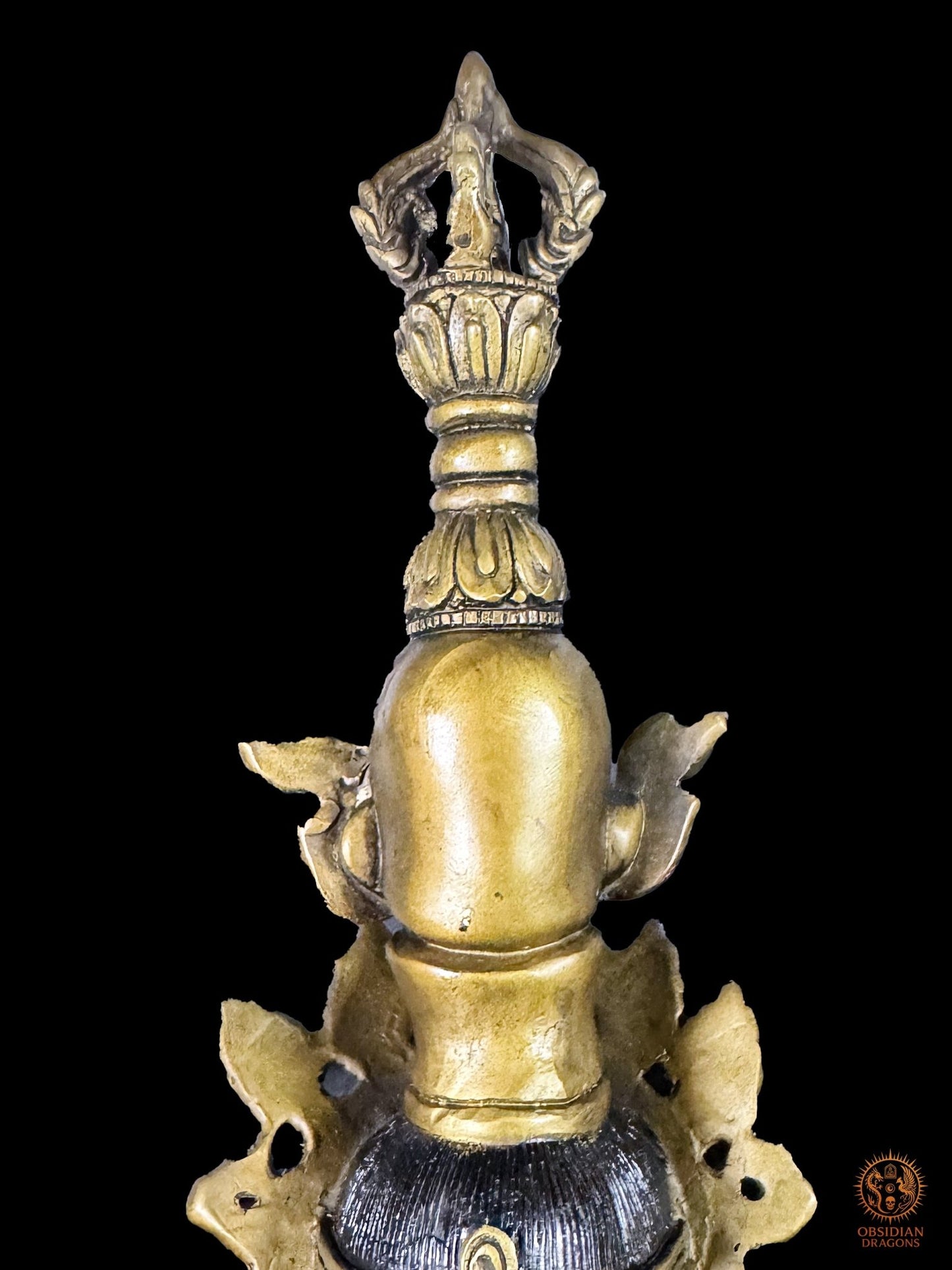
The gaze begins at a triangular base populated by three monstrous faces. It then encounters the blade of the kīla, the nāga, the makara, Ṣaḍbhuja Mahākāla, the wrathful faces of Vajrakīlaya, and then Vajrasattva. A skull motif finally precedes the vajra, or dorje, which crowns the entire composition.
Taken separately, each of these elements belongs to the vocabulary of Tibetan Buddhist art and Vajrayana Buddhism.
Arranged along this vertical axis, they allow for another interpretation.
This monumental phurba can be contemplated as a representation of inner transformation: starting from the forces that hinder being, severing the three poisons, traversing the wrathful manifestations of enlightened activity, purifying obscurations, recognizing impermanence, and finally ascending towards what the vajra most profoundly expresses: the adamantine, indestructible dimension of the awakened mind.
It is therefore not just a Buddhist ritual dagger enlarged to the dimensions of a sculpture.
It is an object that can be read.
A sculpture to observe from every angle
This monumental piece has a physical presence difficult to fully capture through photography.
That's why it has been documented from numerous angles:
General views from the front, side, three-quarters, and back; details of the base; triangular mouth; blade; nāga; makara; Ṣaḍbhuja Mahākāla; wrathful faces; Vajrasattva; skull motif, and dorje finial.
A photograph showing it being held also allows for an immediate understanding of its true scale.
This documentation allows for the examination of the piece's construction as one would examine a collectible Buddhist sculpture, providing access to the volumes, bronze irregularities, polychromy, patina, and different faces that a frontal view cannot reveal.
The polychrome bronze deliberately retains its nuances, variations, and marks inherent to its制造.
These particularities are part of the object.
Art object, ritual object, and collector's item
This sculpture stands at the crossroads of several worlds.
It is a Tibetan ritual object by its form, a Vajrayana sculpture by its iconographic program, and also a Tibetan Buddhist bronze art object by its grandeur and sculptural craftsmanship.
And it becomes a Buddhist collector's item due to its monumental character.
However, we do not present this object as a substitute for an initiation or teaching transmitted by a qualified master.
In Vajrayana, the ritual use of a phurba belongs to specific traditions, with their lineages, transmissions, and practices.
Nevertheless, it remains possible to study, contemplate, and respect this object for what it reveals about the history of forms, Buddhist philosophy, and the extraordinary richness of Vajrayana iconography.
Between the science of the object and spiritual interpretation
Studying such an exceptional and rare Buddhist object requires two opposing precautions.
The first is not to reduce everything to mere material.
To say only that we have before us 10 kg of sculpted and polychrome bronze would be accurate, but insufficient.
The second is not to invent a doctrine where the object does not allow it to be demonstrated.
That is why we deliberately distinguish between the two levels here.
What iconography allows us to establish
The phurba or kīla belongs to the ritual vocabulary of Tantric Buddhism.
Its three-sided blade has traditional symbolism linked to the three poisons.
The makara and nāga belong to the Himalayan iconographic vocabulary.
The large six-armed figure is identifiable as Ṣaḍbhuja Mahākāla.
The three-headed register refers to Vajrakīlaya.
The peaceful upper figure is Vajrasattva.
The summit is crowned by a vajra.
What the composition invites us to interpret
That the sculpture can be understood as a progression from obstacles to purification and then towards the adamantine state.
That the succession wrath → peace is not a contradiction but a transformation.
That the skull placed before the vajra can act as a symbolic threshold between conditioned existence and the indestructible.
That the whole can ultimately be contemplated as a visual teaching on the path to enlightenment.
What is a Phurba?
The Tibetan phurba, called phur ba in Tibetan and kīla in Sanskrit, is one of the most recognizable instruments of Himalayan Buddhist Tantrism.
Its shape evokes that of a dagger, but its function is not that of an ordinary weapon. The ritual phurba belongs to the domain of tantric practices in which obstacles, ignorance, or disruptive forces (the three poisons) are symbolically fixed, mastered, and transformed.
Historical examples preserved in museum collections show that the Tibetan kīla can be accompanied by its own stand. The Metropolitan Museum of Art notably holds a Tibetan phurba with a stand dating from the late 14th or early 15th century and recalls the fundamental association of this instrument with Vajrakīla and with the symbolic suppression of obstacles to enlightenment.
This 20th-century piece revives this tradition on an unusual scale.
To delve deeper into the history, function, and general symbolism of this instrument,
our study dedicated to the phurba, the ritual dagger of Tantric Buddhism provides context for this piece within the broader traditions of Vajrayana.
Phurba, kīla, Dorje Phurba: a dagger that does not seek to wound
Using the word "dagger" can be misleading.
The Buddhist phurba indeed has a point, a blade, and a shape that can resemble a weapon. Yet, its language primarily belongs to ritual and inner transformation.
In the traditions of Tantric Buddhism, the apparent violence of certain images should not necessarily be understood as a glorification of violence. Wrathful deities, fangs, flames, skulls, and ritual weapons express a radical activity: one that no longer negotiates with ignorance when it itself becomes the cause of suffering.
Vajrayana wrath is thus not simply anger.
It can be understood as an irreducible compassion, an energy powerful enough to cut through what traps the mind in its own constructs.
It is from this perspective that the Buddhist kīla, sometimes called Dorje Phurba, takes on its philosophical dimension.
It fixes what wanders, pierces what resists, cuts through what obscures.
But the true battlefield of this confrontation is not external to the human being, it is within their own mind.
The base: three monstrous faces at the gates of transformation

The interpretation of this monumental Tibetan phurba begins with its base.
It adopts a massive triangular architecture. Each of its three sides bears a monstrous face, with bulging eyes and an open maw. In the center is an equally triangular cavity designed to directly receive the tip of the phurba.
They should be understood as the three poisons, the figures of forces to be subdued, obstacles, obscurations, or disordered powers to which the activity of the kīla responds.
In Buddhism, the three poisons (triviṣa in Sanskrit) are the three fundamental afflictions that keep beings in the cycle of saṃsāra.
☸️ Ignorance — moha / avidyā : the lack of knowledge of the true nature of reality, considered the fundamental root of the other poisons.
🔥 Greed, attachment, or desire — rāga / lobha : the tendency to grasp, possess, and attach to beings, objects, sensations, and the idea of a permanent "self."
🐍 Aversion, hatred, or anger — dveṣa : the rejection of what displeases us, which can take the form of anger, hostility, or hatred.
This triad is fundamental in Buddhist thought:
Ignorance does not simply mean a lack of information. It is the inability to correctly recognize the nature of phenomena and of oneself.
Desire-attachment transforms experience into appropriation: wanting to hold onto what changes, possessing what cannot be possessed permanently, building one's stability on what is precisely unstable.
Aversion or hatred constitutes the opposite movement: violently pushing away what disturbs the image we wish to maintain of the world and ourselves.
The triangular blade: cutting the three poisons

The triangular blade with three edges of the phurba can precisely be interpreted as the transformation or destruction of the three poisons:
🗡️ Ignorance → wisdom
🗡️ Attachment → detachment / discernment
🗡️ Aversion → compassion
It is better to speak of "transmutation" or "symbolic destruction of the three poisons" rather than destruction in the literal sense. In Vajrayāna, the phurba does not represent a weapon intended for external destruction: it subjugates obstacles and cuts through the forces of ignorance that hinder enlightenment.
The three-sided blade of the phurba is one of the best-documented elements of its traditional symbolism.
The three edges of the ritual dagger are explicitly associated with cutting ignorance, desire, and hatred, described as the three root poisons that keep beings in the cycle of birth, death, and rebirth.
The phurba with a triangular blade therefore does not symbolically destroy three external enemies; it attacks three internal mechanisms.
It is here that the monumentality of this sculpture takes on an almost pedagogical dimension: the Tibetan bronze phurba literally stages the idea that no progress towards enlightenment is possible without confrontation with what obstructs the path.
The nāga: serpentine power along the kīla

As one moves up the blade, serpentine forms identifiable as nāga appear.
Nāga hold an ancient and complex place in the religious cultures of India and then the Himalayas. Associated with the aquatic and underworld, they can be guardians, holders of treasures, or powers capable of both protecting and disrupting.
In the iconography of this Vajrayana phurba, the nāga serpents physically accompany the blade and reinforce the impression of controlled energy, channeled around the central axis.
They also contribute to the sculpture's deeply three-dimensional character: the eye cannot grasp all their forms from a single viewpoint.
This piece was not designed as a flat image, as it requires one to walk around it.
The makara: threshold between the blade and the world of deities

At the top of the blade, a particularly expressive makara head appears.
The makara is a composite mythological creature from the Indian cultural world, associated with water and capable of combining different animal characteristics. In representations of Vajrakīlaya, the relationship between makara and kīla is well attested: some forms of Vajrakīla have a lower body in the shape of a phurba, the blade of which descends precisely from the open mouth of a makara.
On our piece, its long trunk, mouth, eye, and direct relationship with the nāga make its identification particularly clear.
It forms a true iconographic threshold.
Below it is the blade, and above it begins the register of the great wrathful figures.
Ṣaḍbhuja Mahākāla: the six-armed protector

Above the makara stands one of the most powerful figures in the entire composition: Ṣaḍbhuja Mahākāla, the six-armed Mahākāla.
Mahākāla belongs to the great family of dharmapāla, the protectors of the Dharma, in his wrathful aspect: wide-open eyes, fangs, wrathful expression, multiple arms and ritual attributes.
In tantric language, this terrifying face expresses the awakened activity's ability to remove obstacles to the path.
Himalayan Art Resources documents several traditions of Shadbhuja Mahakala, "the Six-Armed Lord," particularly in the Shangpa Kagyu and Gelug lineages, as well as variations whose attributes may differ.
This iconographic diversity is important in the study of our sculpture: the six arms and general morphology allow for a convincing identification of Ṣaḍbhuja Mahākāla, while also inviting caution when it comes to attributing each held object to a particular canonical sub-form.
Mahākāla appears here as a Buddhist protector located exactly after the blade register.
The progression is significant.
After symbolically cutting the three poisons, the open path still needs protection.
To learn more about this essential figure in Tibetan Buddhism,
our article Mahākāla – The Great Black King and Protector of the Dharma explores his history, various manifestations, and function as a Tibetan protective deity.
Vajrakīlaya: when awakened activity takes a wrathful form

Above Ṣaḍbhuja Mahākāla appear three wrathful faces arranged around the axis of the phurba.
This three-headed structure refers to Vajrakīlaya, also known as Vajrakīla, Vajrakumāra or Dorje Phurba.
Vajrakīlaya holds a fundamental position in the kīla tradition. Himalayan Art Resources describes its classic form as a wrathful deity with three faces and six arms, while the Metropolitan Museum recalls the deep association of the phurba with Vajrakīla.
In tantric traditions, Vajrakīlaya's terrifying aspect represents one of the most radical expressions of compassion.
When an obstacle is deeply rooted, awakened activity does not necessarily take the peaceful form of discursive teaching. It becomes capable of penetrating, immobilizing, and transforming what had previously sustained illusion.
Lotsawa House describes Vajrakīlaya as a wrathful form of Vajrasattva and as the expression of the awakened activity of the buddhas, intended in particular to subjugate forces of confusion and obstacles to the Dharma.
To learn more about this deity and its relationship with the phurba,
see our study Vajrakīla – Dorje Phurba, deity purifying karma.
Vajrasattva: after wrath, purification

The contrast is striking.
After fangs, flames, bulging eyes, and wrathful expressions, a calm, symmetrical, almost motionless face suddenly appears.
This figure is identified here as Vajrasattva.
Vajrasattva — Dorje Sempa in Tibetan — holds a major place in the purification practices of Vajrayana Buddhism. Himalayan Art Resources describes him as the "Buddha of purification" and his traditional iconography shows him peaceful, adorned as a bodhisattva, usually holding a vajra and a bell.
His presence immediately above the Vajrakīlaya register is particularly coherent.
Vajrakīlaya can be understood as the wrathful manifestation of Vajrasattva.
The former confronts, The latter purifies.
They can express two modalities of the same awakened activity: the strength needed to cut through obstruction and the peaceful clarity that remains when that obstruction ceases to occupy the entire field of mind.
In the ascending reading of this sculpture, Vajrasattva Vajrayana thus marks an essential shift.
The path no longer just fights but begins to clear.
The skull: looking at impermanence without turning away

Between Vajrasattva and the crowning dorje appears a skull motif.
The skull is omnipresent in tantric iconography: skull cups, crowns, ornaments of wrathful deities or references to charnel grounds brutally remind us of what ordinary consciousness often prefers to forget.
Everything that is born changes, things that are composed fall apart, The body itself does not escape this law.
In this composition, the motif can therefore be contemplated as a Buddhist memento mori, a reminder of impermanence and the need not to confuse what changes with a permanent essence.
In the philosophical reading of this particular piece, its placement is remarkably powerful: after purification, the gaze must still pass through the very idea of its own disappearance.
The vajra or dorje: the adamantine culmination
At the very top of the monumental Tibetan phurba is finally the vajra, called dorje in Tibetan.
The Sanskrit word vajra contains the idea of both diamond and thunderbolt: that which is both irresistible and indestructible.
The Rubin Museum describes the vajra as one of the fundamental instruments of tantric practices and notes that, when associated with the bell, it contributes to the symbolism of the union of method and wisdom. Another vajra in its collections is explicitly described as an "adamantine" or "indestructible" scepter.
In our ascending reading, its position at the summit is not insignificant.
The journey begins in the monstrous jaws of the base, thus passing through the three poisons. It encounters the serpentine forces and the makara. It passes through Mahākāla and the protective power. It confronts Vajrakīlaya and wrathful activity. It finds peace in Vajrasattva. It finally encounters the skull and impermanence, and only then does the vajra appear, a symbol of enlightenment.
The Tibetan dorje can thus be understood, within the context of this composition, as the culmination of the journey: the discovery of a dimension that no longer depends on the constructions that the blade symbolically cut through from the base.
To delve deeper into the history and symbolism of this instrument,
see our blog post: Vajra – Dorje, striking down ignorance.
A bottom-up reading: from poison to enlightenment
It would be unwise to claim that all Tibetan phurbas must necessarily be "read" from bottom to top.
The phurba is first and foremost a Buddhist ritual instrument and not a symbolic comic strip with a universal direction of reading.
This monumental sculpture, however, presents a particular organization coherent enough to suggest this interpretation.
1. The three monstrous faces
They open the composition into the realm of still disordered forces: obstacles, passions, obscurations, and resistances.
2. The kīla point
It penetrates directly into their triangular receptacle, killing the three poisons with its blade.
3. The three faces of the blade
They traditionally refer to the cutting of ignorance, desire-attachment, and aversion-hatred: the three Buddhist poisons represented by the three monstrous faces of the base.
4. The nāga and the makara
The energy is no longer simply chaotic: it is integrated into the ritual architecture of the phurba.
5. Ṣaḍbhuja Mahākāla
The Buddhist dharmapāla protects the path and expresses an activity that refuses to let obstacles regain control of the way.
6. Vajrakīlaya
Wrathful activity reaches its most direct expression linked to the kīla itself.
7. Vajrasattva
The wrathful power reveals its peaceful dimension: purification of obscurations and return to clarity.
8. The skull
Impermanence remains unavoidable. Even the identity one tried to purify must be regarded as conditioned and transient.
9. The vajra
At the very top remains the image of the adamantine: that which the Vajrayana tradition uses to express the indestructibility and activity of the awakened mind.
Thus, this monumental Buddhist phurba can be contemplated as a visual teaching:
recognize what hinders;
pierce it;
transform the three poisons;
protect the path;
convert wrath into awakened activity;
purify;
accept impermanence;
awaken to the adamantine.
Wrath in Vajrayana: a terrifying appearance in service of transformation
To an outsider to Vajrayana Buddhism, wrathful deities might seem paradoxical.
Why does a tradition associated with compassion produce such terrifying faces?
Because tantric language does not always seek to reassure.
Some peaceful representations teach through harmony.
Wrathful forms teach through disruption.
Vajrakīlaya, Mahākāla, and other Tibetan wrathful deities should therefore not be equated with "demons" in the Western sense of the term.
Their appearance expresses a protective and transformative activity, protectors capable of destroying obstacles that hinder progress towards enlightenment.
This is also what makes this Vajrayana phurba philosophically interesting.
The path represented is not about suppressing the energy of anger, fear, or death as if they never existed.
It is about transforming them.
From this perspective, Buddhist tantrism does not necessarily deny what is dark; it refuses to give it the last word.
A monumentality that is not just a matter of dimensions
A 1-meter phurba is obviously impressive due to its size.
But it would diminish this piece to see it only as a "giant phurba."
Its monumentality primarily comes from the fact that its height allows the iconography to unfold.
The sculpture transforms the axis of the Tibetan kīla into a true vertical journey.
Each level constitutes a transition.
The base is not independent of the blade.
The blade is not independent of the makara.
The makara leads to Mahākāla.
Mahākāla prepares the register of Vajrakīlaya.
Vajrakīlaya finds its peaceful counterpart in Vajrasattva.
Vajrasattva is surmounted by the reminder of impermanence.
And the entire edifice resolves into the vajra.
This coherence allows it to transcend mere decorative accumulation.
The gaze is never condemned to remain on a single motif; it naturally ascends.
From monster to vajra: a philosophy sculpted in bronze
At first glance, one might be drawn to the power of this large Tibetan bronze phurba. At second, by its extraordinary accumulation of details.
This monumental Tibetan phurba is probably not for someone simply looking for a decorative object.
It speaks to those who recognize in a piece of sacred art the encounter between matter, history, symbol, and thought; to those who are willing to take the time to look, to understand, and to let a work gradually reveal what it contains.
With its 102 cm of polychrome bronze, its profoundly three-dimensional architecture, and this exceptional succession of figures, symbols, and iconographic registers, this phurba possesses a presence that photographs can only imperfectly render.
To acquire it is to bring into one's collection not only a monumental Buddhist sculpture, but a work that can be observed, studied, and rediscovered from ever-changing angles.
Discover our complete collection of Buddhist ritual objects
Immerse yourself in the spiritual world with our exclusive selection of Buddhist ritual objects.
Each carefully chosen piece combines authenticity and sacred symbolism to enrich your practices and meditative space.
📎 Explore our complete collection of Buddhist ritual objects on Obsidian Dragons now.



Return conditions for a Zen purchase
We offer you a money back guarantee within 14 days after delivery of your order.
If you are not completely satisfied with your purchase, please contact us to arrange a return of the product and a refund.
Except for returns, shipping is free on all orders.
-

100% secure payment
3 times interest-free option with Scalapay
-

Free delivery in France and internationally
14 days money back guarantee after delivery (see our conditions of sale)
-

Excellent customer service
Live chat
Whatsapp +33674049312


Let customers speak for us
Quel bonheur de recevoir ce mala ! J'ai adoré découvrir une pièce à l'énergie totalement neutre, qui s'est animée et a pris toute sa force dès le premier tour. On ressent tout le soin et l'art de la création. Merci Jérémy.
Marie

Envoie rapide, le bracelet est incroyable et plus beau qu’en photo. Les réponses aux questions via whatsapp sont quasi instantanées. Je recommande vivement!!!

Crâne en Malachite Naturelle 3kg - Rare et exceptionnel

Merci pour tout, la communication, les facilités et la qualité des produits.

Comme a son habitude, Jeremy a des pièces exceptionnelles. Ce collier est une merveille absolue. Encore MERCI pour toutes ces merveilles.

Merci pour cet objet de magnifique qualité
Chaque détail, la qualité de sa réalisation
Les explications qui l'accompagnent..
En font un objet superbe comme support de méditation
En font un très bel objet de collection...
Merci

Très contente jolie pièce je recommande

Cette sphère en Obsidienne Mentohuichol est magnifique et rayonne une énergie puissante et primordiale. C'est une pièce de collection rare et une compagne précieuse qui va me soutenir et m'accompagner dans mes pratiques énergétiques et spirituelles. MERCI Jérémy

Magnifique grande sphere . Superbes couleurs et tres haute qualité. Promesses largement tenues. Envoie rapide. Confiance totale pour un prochain achat.

Bonjour,
Je suis complètement satisfait de ce magnifique Mala Phurba en obsidienne. Les gemmes sont sublimes et sont d'une excellente qualité. La livraison de Chine en moins de 10 jours et dans un emballage hermétique c'est tout simplement exceptionnel. Merci pour ce sublimissime Mala.
Et merci pour se produit issu de l'artisanat.
Namaste

Le Mala a été livré très rapidement et je vous en remercie.
C’est notre fille qui l’a réceptionné, elle m’a confirmé que c’était une très belle pièce. Elle nous rejoint dans deux semaines, mon époux le découvrira alors et en fera le meilleur usage…
Merci pour le partage de votre passion ! 🙏🏽

bracelet puissant, je suis content de mon achat

Très beaux bracelet et très puissants

Magnifique crâne givré de l'Himalaya.

cette chevalière est tres bien réalisé, avec beaucoup de détails, je suis heureux de l'avoir
