

Obsidian dragons
Handcrafted nine-dragon jade sculpture
Handcrafted nine-dragon jade sculpture
Couldn't load pickup availability
Handcrafted Guardian Dragon Sculpture in Nine-Dragon Jade (Hua'an Yu) – Feng Shui Statue on Fujian Landscape-Stone Base, Symbol of Protection, Power, Sovereignty, Transformation, and Yang Energy
Contractual photos and video: you will receive exactly this Nine-Dragon jade sculpture.

This sculpture is the Threshold Guardian of an exclusive Obsidian Dragons diptych. Its black base evokes anchoring, protection, and mastery of territory, while its counterpart on a copper base embodies vision and discernment. Each piece is offered separately. Discover the Jiulong Jade Dragon of Discernment on a copper base
Features of this handcrafted stone dragon sculpture
As a certified gemmologist from the National Gemmology Institute (ING, Paris, France), I have personally examined this natural stone Dragon. I have verified the nature of the rock, as well as the absence of visible treatment, dyeing, artificial stabilization, or reconstruction.
🐉 Subject : dragon head and long neck
🗿 Object type: handcrafted mineral sculpture, art object, and collector's sculpture
💚 Material: Nine-Dragon Jade, traditionally called Hua'an Yu — 华安玉
🔬 Gemmological nature : gem-rock, polymineral calc-silicate skarn with dominant diopside
🇨🇳 Material origin : Fujian province, China, Jiulong River basin
🎨 Colors: light green to greyish green, white, cream, and deeper shades
🌫️ Appearance : ribboned patterns, natural veins, and cloudy structures
✋ Work: handcrafted and polished dragon sculpture
🖤 Presentation : dragon sculpture on a black base
📏 Total height with base: 41.5 cm
📐 Dragon height alone: 32 cm
↔️ Depth: 14 cm
⚖️ Total weight: 2.805 kg
🧭 Symbolism: protection, vigilance, inner strength, sovereignty, transformation, prosperity, and Yang energy
🔒 Availability: total exclusivity Obsidian Dragons
A guardian dragon with asserted power
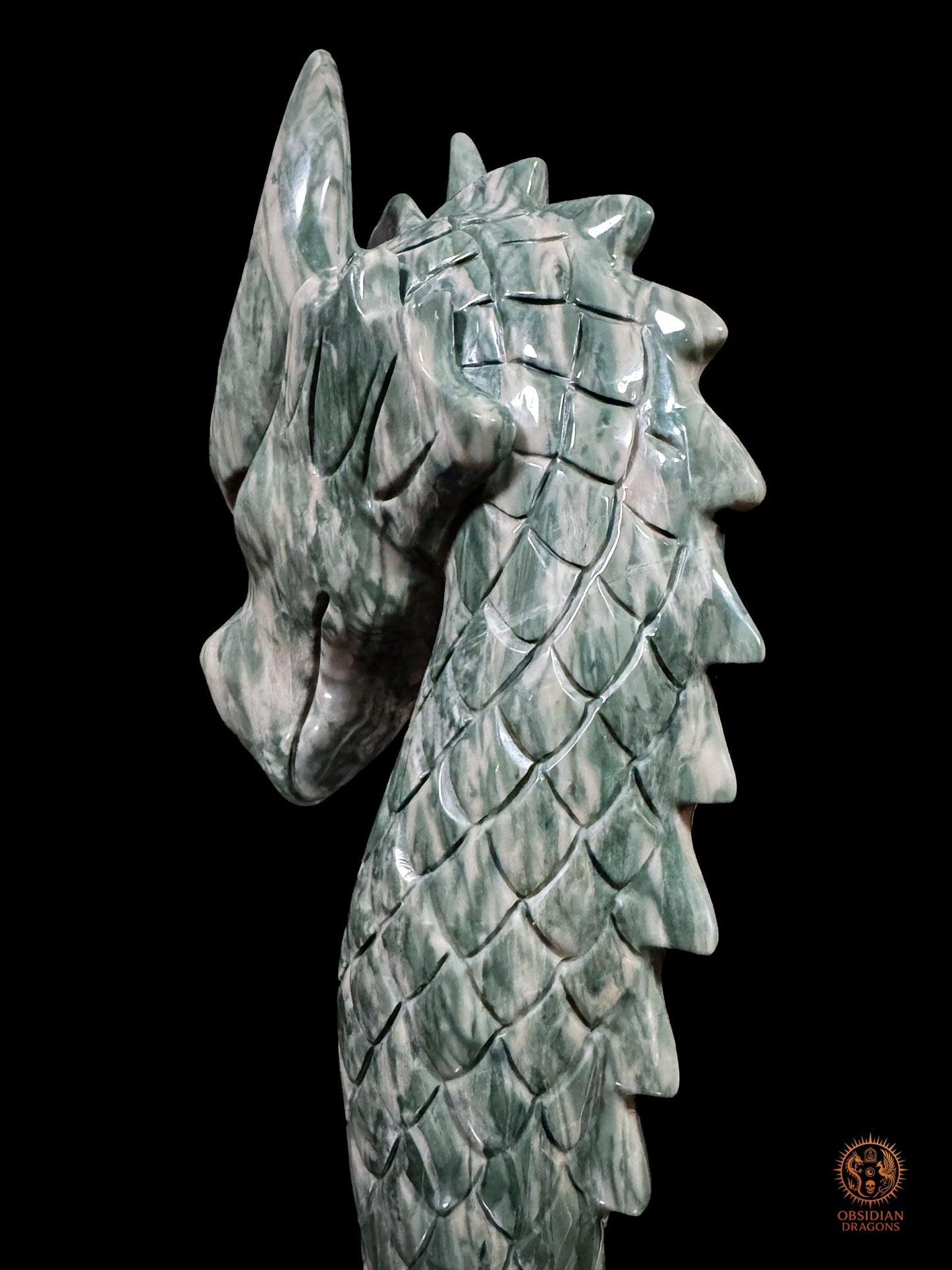
With its vertical silhouette, long scale-covered neck, raised horns, and deeply sculpted gaze, this natural stone dragon sculpture seems to survey the space.
Its mouth remains closed. It is neither depicted in attack nor caught in the tumult of a fight. All its power seems contained in its stillness. It observes, measures, and waits.
With a total height of 41.5 cm, of which 32 cm is for the dragon alone, a depth of 14 cm, and a weight of 2.805 kg, this piece possesses a presence that far exceeds that of a simple decorative object. Presented on its black base, it stands like a guardian, a fragment of a mountain transformed into a creature, a figure suspended between earthly matter and the world of myth.
This handcrafted Nine-Dragon jade sculpture is a total Obsidian Dragons exclusive.
An extraordinary Nine-Dragon jade sculpture
What is striking first is its verticality.
The sculptor chose to concentrate the dragon's entire presence in its head and the powerful curve of its neck. This decision gives it the appearance of a sentinel emerging from an invisible world.
The black base fades beneath the stone. From a distance, the dragon appears to float in darkness. Its vertical silhouette becomes an axis around which the gaze can circulate: from the long horns to the snout, from the face to the rows of scales, then from the scales to the base of the neck.
This construction gives the piece a totemic dimension. Its height, weight, and slenderness make it a large dragon sculpture, capable of becoming the centerpiece of an office, a library, a meditation space, or a cabinet of curiosities.
Despite the 2.805 kg of the ensemble, the base gives it an astonishing sense of elevation. This opposition between the actual mass of the stone and the apparent lightness of the composition fully contributes to its mystery.
A dragon handcrafted in stone
This natural stone dragon sculpture is a testament to true stone carving craftsmanship.
The horns were carved from the mass to extend the verticality of the ensemble. The carved arches give depth to the gaze. The nostrils, the folds of the snout, and the lateral volumes of the face introduce subtle variations of expression depending on the angle from which the sculpture is viewed.
The sculpted scales follow the curve of the neck instead of forming a uniform decoration. Their succession guides the gaze upwards and accentuates the sensation of movement. The sculpted horns, long and slender, give the dragon a majestic bearing without making it aggressive.
The polish reveals the patterns of the material while maintaining the legibility of the stone carving. The hollows remain dark, the reliefs catch the light, and the natural veins freely traverse the sculpture.
This is precisely what is expected of true lapidary craftsmanship. The sculptor must learn to read the block, understand its internal lines, anticipate its contrasts, and find the form capable of interacting with them.
This handcrafted mineral sculpture thus has two authors: geology, which created the rock's patterns, and the human hand, which gave them the form of a dragon.
Nine-Dragon Jade: between scientific truth and Chinese tradition
The name of this stone might suggest it is a particular variety of jadeite or nephrite. This is not the case.
Nine-Dragon Jade, called Hua'an Yu — 华安玉 in China, is neither jadeite nor nephrite in the strict sense of modern gemmology. It belongs to another category: that of gem-rocks, meaning polymineral rocks that are beautiful, compact, and resistant enough to be polished and used for ornamentation.
From a scientific perspective, Hua'an Yu is a polymineral metamorphic rock of the calc-silicate skarn type. Its composition is dominated by diopside, notably accompanied by tremolite, actinolite, quartz, feldspars, wollastonite, calcite, and opaque minerals.
The most rigorous designation is therefore diopside-dominant skarn.
This precision is important. In Western gemmology, the word jade refers only to two materials: jadeite and nephrite. In China, the character 玉 — yù — has a much broader meaning. It can refer to any stone considered noble due to its polish, beauty, resistance, history, and the moral or spiritual values that a civilization has associated with it.
Hua'an Yu is therefore a Chinese cultural jade, but not a gemmological jade.
This distinction does not diminish its value in any way. On the contrary, it helps understand what makes this Chinese ornamental stone so special: it lies at the intersection of two perspectives. Western science describes it as a contact rock rich in diopside; Chinese culture recognizes it as a stone of nobility, endurance, and contemplation.
To delve deeper into its history, composition, and the differences between cultural jade, jadeite, and nephrite,
I invite you to consult my complete investigation: What is Nine-Dragon Jade? Hua'an Yu, a gemmological and cultural investigation
A Chinese natural stone born in Fujian
Nine-Dragon Jade comes from Fujian province, in southeast China, specifically from the geological basin associated with the Jiulong River valley — 九龙江.
Jiulong literally means "Nine-Dragon River." It is to this river landscape that the stone owes its poetic name.
The history of Hua'an Yu begins with the formation of carbonate and siliceous deposits in a Triassic marine environment. Much later, the ascent of granitic magmas subjected these rocks to thermal contact metamorphism. Under the effect of heat and chemical exchanges, new calc-silicate minerals developed, including diopside.
The rock gradually recrystallized into a dense and coherent polycrystalline mosaic. This structure gives it its resistance, low porosity, and ability to take a durable polish.
Erosion and water movements then contributed to exposing the blocks and revealing their internal structures. Variations in composition produce the natural ribboned patterns, clouds, sinuous lines, and chromatic contrasts characteristic of this Fujian stone.
In this Hua'an Yu sculpture, green and greyish shades alternate with green and white veins. Some areas appear hazy; others resemble reliefs, waterways, or rock strata. The cloudy structure of the material prevents the eye from settling on a uniform color.
The stone changes depending on the angle, distance, and light.
The dragon as a landscape-stone
In Chinese tradition, certain stones are contemplated for their ability to symbolically contain a landscape.
These stones are called shān shuǐ shí — 山水石, literally "mountain and water stones" or landscape-stones.
Their veins can evoke a mountain range, a river, a mist, a cliff, or a cloud-covered sky. They then become miniature landscapes: fragments of nature vast enough for the imagination to wander through.
Hua'an Yu fully belongs to this aesthetic universe.
In this sculpture, the mineral bands traverse the forehead, horns, snout, and scales without ever mechanically following the limits of the form. Geology maintains its own movement. The sculpture therefore does not imprison the material: it offers it a new interpretation.
The dragon seems to emerge from a landscape that existed long before it.
One could even invert this proposition: perhaps it is not a dragon depicted in a Chinese landscape-stone, but a mountain that chose to take the form of a dragon.
This idea aligns with an essential concept of Chinese lapidary art: the craftsman reveals the form they believe they recognize in the block. Stone carving then becomes less a domination of the material than a dialogue with it.
Between Chinese dragon and contemporary fantasy imagery
This sculpture does not reproduce the iconography of an ancient imperial dragon.
Its face, its large horns, the power of its snout, and the vertical construction of its neck belong to medieval fantasy imagery.
It can be seen as a Chinese dragon sculpture due to its material, its cultural origin, and its relationship with mountains, waters, and Qi. But it also remains a contemporary art object, capable of speaking to Western dragon collectors, fantasy enthusiasts, and lovers of Gothic aesthetics.
It stands between several worlds:
🏮 between Chinese art and contemporary fantasy;
🐉 between traditional sculpture and modern creation;
☯️ between Feng Shui object and mineral artwork;
🪨 between contemplative stone and high-end decorative sculpture;
🔬 between the rigor of gemmology and the freedom of symbol.
This ambiguity prevents it from becoming a simple folkloric reproduction. This dragon possesses its own identity.
What this dragon sculpture emanates
This piece primarily radiates an impression of controlled power.
Its authority comes from its calm, its stillness, and the depth of its gaze.
Its closed mouth suggests energy conserved rather than dispersed. Its raised horns extend its upward movement. Its long neck allows it to visually dominate the space without appearing massive. This jade dragon watches.
Its attitude evokes inner strength, vigilance, and discernment, but also a form of symbolic protection. It also expresses sovereignty and nobility, controlled courage, as well as an impression of mystery and depth. Added to this is a feeling of stability and an idea of transformation, while the entire sculpture invites silence and contemplation.
This totemic sculpture does not give the impression of uncontrolled force. On the contrary, it represents the ability to possess great energy without becoming imprisoned by it.
The guardian dragon
In a symbolic and esoteric interpretation, this dragon can be understood as a guardian of the threshold.
A threshold represents the passage between two periods of life, between an old state and a new identity, between what one accepts to leave behind and what one chooses to protect from now on.
The dragon's position, its attentive gaze, and its stillness give it the attitude of a sentinel. It remains in its place, aware of its strength, as if guarding the boundary between the inside and the outside.
This interpretation makes it a protective dragon, but its protection must be understood as a symbol. It recalls the need to remain vigilant, to preserve one's boundaries, and to recognize what deserves to enter our space.
The guardian dragon then represents the ability to say no, to protect one's integrity, and to master one's own boundaries. It also embodies discernment in the face of appearances, fidelity to one's values, and the preservation of strength always available when circumstances demand it.
This dragon statue symbolizing strength and protection can thus accompany a period during which it becomes necessary to reclaim one's space, authority, or inner direction.
Sovereign power
Sovereignty here refers to the ability to govern one's own inner territory, to make decisions, and no longer surrender one's energy to external perception.
The majestic dragon does not ask for permission to exist. It does not seek to convince. Its presence is enough.
It becomes the symbol of natural authority, of confidence gained through experience, and of ambition now mastered. It also embodies fidelity to a vision and a refusal to diminish oneself to reassure others.
This is why this sculpture will naturally find its place in the office of an entrepreneur, a creator, a leader, or anyone building a project that requires endurance and determination.
The Dragon, a Figure of Transformation
The dragon defies ordinary classifications.
It belongs to the earth through its serpentine body, to water through its connection with rivers and rain, to air through its ability to traverse clouds, and to fire through the breath attributed to it by Western imagination.
It crosses elements and changes states without losing its identity.
This symbolic mobility makes it a powerful figure of transformation. The dragon can accompany periods during which existence forces one to leave a form that has become too restrictive: life changes, reconstruction, business creation, transitioning from one age to another, or reclaiming one's freedom.
Stone, on the contrary, evokes stability and longevity.
The encounter between the dragon and the Hua'an Yu therefore creates a subtle balance.
Between Earth, Water, and Sky
The verticality of this dragon sculpture on a pedestal also allows for a cosmological interpretation.
The stone comes from the earth. Its patterns recall water, rivers, and mists. The horns point towards the sky. The dragon thus symbolically unifies three levels of the world.
The base represents anchoring.
The neck expresses elevation.
The head embodies consciousness and vigilance.
The sculpture becomes an axis between matter and spirit, between geological depth and celestial space. It can be contemplated as a representation of the union of earth and sky, a principle present in many spiritual traditions.
The lines of the Hua'an Yu then resemble a circulation of Qi within matter. They follow the volumes, disappear into hollows, reappear on reliefs, and give the dragon an impression of inner movement.
The Symbolic Resonance of the Nine Dragons
This rock comes from the Jiulong River, the River of Nine Dragons, which flows through the Hua'an Yu's region of origin.
This name, however, creates a particularly strong symbolic resonance.
In traditional Chinese numerology, nine is considered the highest Yang number. It evokes accomplishment, duration, fullness, and sovereignty. Its historical association with the emperor explains the repeated presence of groups of nine dragons in Chinese imperial architecture and arts.
The symbolism of the number nine thus naturally aligns with that of the dragon: Yang energy, elevation, authority, prosperity, and longevity.
In this piece, the dragon is not multiplied nine times. It is the material itself that bears the name of the Nine Dragons. The creature and the stone thus respond to each other with rare coherence.
The Dragon in Feng Shui
In Feng Shui, the dragon is traditionally associated with power, protection, prosperity, and the circulation of active Yang energy.
It also has a deep relationship with water. Chinese dragons are linked to rivers, clouds, rain, and the fertility of the land. They are regulators, capable of setting the world's forces in motion while maintaining their balance.
The green dragon is associated with the East, spring, renewal, and growth. The natural colors of this green jade dragon sculpture evoke this symbolism, without the piece claiming to precisely represent the traditional Qinglong.
In a Feng Shui space, a dragon representation can symbolically support:
🛡️ the protection of a place;
💼 professional determination;
🌱 the growth of a project;
💰 prosperity;
🔥 motivation and creativity;
🌀 the circulation of vital breath;
☯️ harmony between activity and mastery.
To delve deeper into the creature's place in Feng Shui culture
discover our article: The Dragon in Feng Shui: Strength and Energy
Where to place this protective Feng Shui dragon sculpture?
This sculpture has a strong enough presence to become the visual focal point of a room. Its placement must therefore be chosen with care.
In an entrance hall
Placed in a sufficiently large entrance hall, it can be interpreted as a guardian dragon. It marks the separation between the outside and the intimate space while welcoming the visitor with an immediately perceptible presence.
In an office
This dragon sculpture for an office is particularly suitable for entrepreneurs, artists, leaders, and people involved in a long-term project. It can serve as a reminder of the need to maintain a vision, protect one's decisions, and not dissipate one's energy.
In a library or cabinet of curiosities
Amidst books, minerals, art objects, or ancient pieces, this sculpture for a cabinet of curiosities fully develops its scholarly dimension. It simultaneously becomes a dragon art object, a natural stone specimen, and a fragment of culture.
In a contemplation space
The Hua'an Yu is a landscape stone. Its veins can be followed like a river or a mountain path. The sculpture can therefore accompany reading, meditation, or simply a moment of silence.
In a contemporary, fantasy, or gothic interior
Its black base, its sleekness, and its powerful face allow it to integrate into modern decor, Chinese decor, esoteric decor, fantasy decor, or gothic decor.
It does not need to be surrounded by many objects. On the contrary, a free space around it will strengthen its presence.
Due to its weight and height, it must be installed on a stable, solid piece of furniture, away from the edge, and in a place where it is not likely to be bumped.
Who is this sculpture for?
This Nine Dragons jade dragon sculpture is for those who seek more than a decorative statue.
It may be of particular interest to:
🐉 collectors of dragons and mythical creatures;
💎 collectors of minerals, natural stones, and cultural Chinese jades;
🗿 lovers of stone sculpture and mineral sculpture;
🏛️ collectors of contemporary sculptures and art objects;
☯️ enthusiasts of Feng Shui, Taoism, and Chinese culture;
🌫️ lovers of landscape stones and shān shuǐ;
🛡️ individuals symbolically seeking a guardian dragon for their home or office;
👑 entrepreneurs, creators, and leaders sensitive to notions of sovereignty and vision;
🔥 individuals going through a period of transformation or reconstruction;
🧘 individuals seeking a meditation stone or an object of contemplation;
📚 lovers of Chinese philosophy and scholarly aesthetics;
🖤 enthusiasts of esoteric, fantasy, or gothic decor;
🗝️ owners of a cabinet of curiosities;
🎁 individuals seeking an exceptional gift for a collector;
🔒 enthusiasts of creations unavailable through ordinary commercial channels.
This natural stone dragon statue is not meant to disappear into the background. It is for a person who accepts that an object has its own presence and becomes one of the symbolic centers of their space.
Care and Handling Tips
This polished natural stone is stable, dense, and resistant, but the delicacy of the horns and certain sculpted reliefs require careful handling.
To preserve this artwork:
👐 handle it with both hands, supporting both the stone and its base simultaneously;
🚫 never grasp it by the horns, muzzle, or scales;
🧱 install it on a flat, stable, and sufficiently solid surface;
🧽 remove dust with a soft, dry cloth;
💧 if necessary, use a very slightly damp cloth, then dry immediately;
🧪 avoid chemicals, solvents, and abrasive cleaners;
🔊 do not use ultrasonic devices or steam cleaning;
☀️ avoid prolonged exposure to intense heat sources;
📦 carefully protect the horns and reliefs during any movement.
An Obsidian Dragons Exclusive
This extraordinary sculpture was created for its presence, for the quality of its lapidary work, and for the way its natural patterns complement the dragon's form.
It brings together what profoundly defines the world of Obsidian Dragons: gemmological rigor, dragon culture, artisanal craftsmanship, symbolic thought, and an aesthetic situated between the mineral, the sacred, and the fantastic.
It can be described as a jade dragon statue, a natural stone dragon sculpture, a mineral artwork, or a Feng Shui object. Yet, none of these designations suffice in isolation.
It is both stone and creature.
Geological matter and inner landscape.
Collector's item and symbolic guardian.
Earthly force and movement towards the sky.
This Nine Dragons jade dragon sculpture, offered exclusively by Obsidian Dragons, is destined to become the centerpiece of a collection and the imposing presence in a chosen space.
🌿 Explore our collection of Spiritual Arts and Feng Shui Sculptures
Discover also our symbolic sculptures inspired by the great archetypes of Feng Shui: protective dragons, legendary creatures, spiritual guardians, and natural stone totems. Each of these works helps to purify, elevate, and balance energies in your interior environment.



Return conditions for a Zen purchase
We offer you a money back guarantee within 14 days after delivery of your order.
If you are not completely satisfied with your purchase, please contact us to arrange a return of the product and a refund.
Except for returns, shipping is free on all orders.
-

100% secure payment
3 times interest-free option with Scalapay
-

Free delivery in France and internationally
14 days money back guarantee after delivery (see our conditions of sale)
-

Excellent customer service
Live chat
Whatsapp +33674049312


Let customers speak for us
Quel bonheur de recevoir ce mala ! J'ai adoré découvrir une pièce à l'énergie totalement neutre, qui s'est animée et a pris toute sa force dès le premier tour. On ressent tout le soin et l'art de la création. Merci Jérémy.
Marie

Envoie rapide, le bracelet est incroyable et plus beau qu’en photo. Les réponses aux questions via whatsapp sont quasi instantanées. Je recommande vivement!!!

Crâne en Malachite Naturelle 3kg - Rare et exceptionnel

Merci pour tout, la communication, les facilités et la qualité des produits.

Comme a son habitude, Jeremy a des pièces exceptionnelles. Ce collier est une merveille absolue. Encore MERCI pour toutes ces merveilles.

Merci pour cet objet de magnifique qualité
Chaque détail, la qualité de sa réalisation
Les explications qui l'accompagnent..
En font un objet superbe comme support de méditation
En font un très bel objet de collection...
Merci

Très contente jolie pièce je recommande

Cette sphère en Obsidienne Mentohuichol est magnifique et rayonne une énergie puissante et primordiale. C'est une pièce de collection rare et une compagne précieuse qui va me soutenir et m'accompagner dans mes pratiques énergétiques et spirituelles. MERCI Jérémy

Magnifique grande sphere . Superbes couleurs et tres haute qualité. Promesses largement tenues. Envoie rapide. Confiance totale pour un prochain achat.

Bonjour,
Je suis complètement satisfait de ce magnifique Mala Phurba en obsidienne. Les gemmes sont sublimes et sont d'une excellente qualité. La livraison de Chine en moins de 10 jours et dans un emballage hermétique c'est tout simplement exceptionnel. Merci pour ce sublimissime Mala.
Et merci pour se produit issu de l'artisanat.
Namaste

Le Mala a été livré très rapidement et je vous en remercie.
C’est notre fille qui l’a réceptionné, elle m’a confirmé que c’était une très belle pièce. Elle nous rejoint dans deux semaines, mon époux le découvrira alors et en fera le meilleur usage…
Merci pour le partage de votre passion ! 🙏🏽

bracelet puissant, je suis content de mon achat

Très beaux bracelet et très puissants

Magnifique crâne givré de l'Himalaya.

cette chevalière est tres bien réalisé, avec beaucoup de détails, je suis heureux de l'avoir
