High-Copper Violet Bronze Kalachakra Statue – Tibetan Yab-Yum Sculpture of Kalachakra and Vishvamata, 24-Armed Wheel of Time from Gyalthang Vajrayana Craftsmanship.
|
Key Features — This high-copper violet bronze Kalachakra statue depicts Kalachakra and Vishvamata in Yab-Yum, symbolizing the union of wisdom and compassion at the heart of Vajrayana Buddhism. Handcrafted by master bronzesmiths from Gyalthang, northern Yunnan, this 24-armed Tibetan sculpture measures 29 × 22 × 9 cm and weighs 3.180 kg. Its coppery patina, flame mandorla, and remarkable openwork make it a sacred and collectible work of art with an exceptional presence.
|
This bronze Kalachakra statue represents one of the most complex and striking figures in Tibetan Tantric Buddhism. Kalachakra appears here in union with Vishvamata in the sacred Yab-Yum posture. Their bodies, multiple faces, and multitude of arms unfold in the center of a flame mandorla, forming a composition of great visual power.
Handcrafted from high-copper violet bronze, its dimensions give this work remarkable density and material presence. Depending on the light, its coppery brown patina reveals coppery, red, golden, brown, and almost silver nuances that animate each face, hand, and attribute.
This artisanal Buddhist sculpture from northern Yunnan comes from a workshop in the Tibetan region of Gyalthang, also known as Gyaltran. Its Tibetan master bronzesmiths specialize in creating bronzes for temples and lamaseries. Blending sacred Tibetan art, technical virtuosity, and symbolic intensity, this Kalachakra sculpture possesses the presence of a true devotional and collectible work.
Statue Characteristics
🕉️ Representation: Kalachakra in Yab-Yum with Vishvamata
☸️ Tradition: Tibetan Buddhism, Vajrayana Buddhism
🗿 Type: Buddhist bronze sculpture and Tibetan tantric statue
🔶 Material: violet bronze, high-copper bronze
✨ Finish: coppery brown patina with red, golden, and silver highlights
🛠️ Craftsmanship: artisanal bronze made by Tibetan master bronzesmiths
🏔️ Origin: Tibetan region of Gyalthang or Gyaltran, northern Yunnan
🏛️ Workshop: specialized in bronzes for Buddhist temples and lamaseries
📏 Height: 29 cm
↔️ Width: 22 cm
↕️ Depth: 9 cm
⚖️ Weight: 3.180 kg
A High-Copper Violet Bronze Kalachakra Statue
The term "violet bronze" here refers to a bronze rich in copper. It primarily characterizes the metal's composition and the particular depth of its tones. The most exposed reliefs capture warm reflections, while the hollows retain deep shadows that enhance the readability of the iconography.
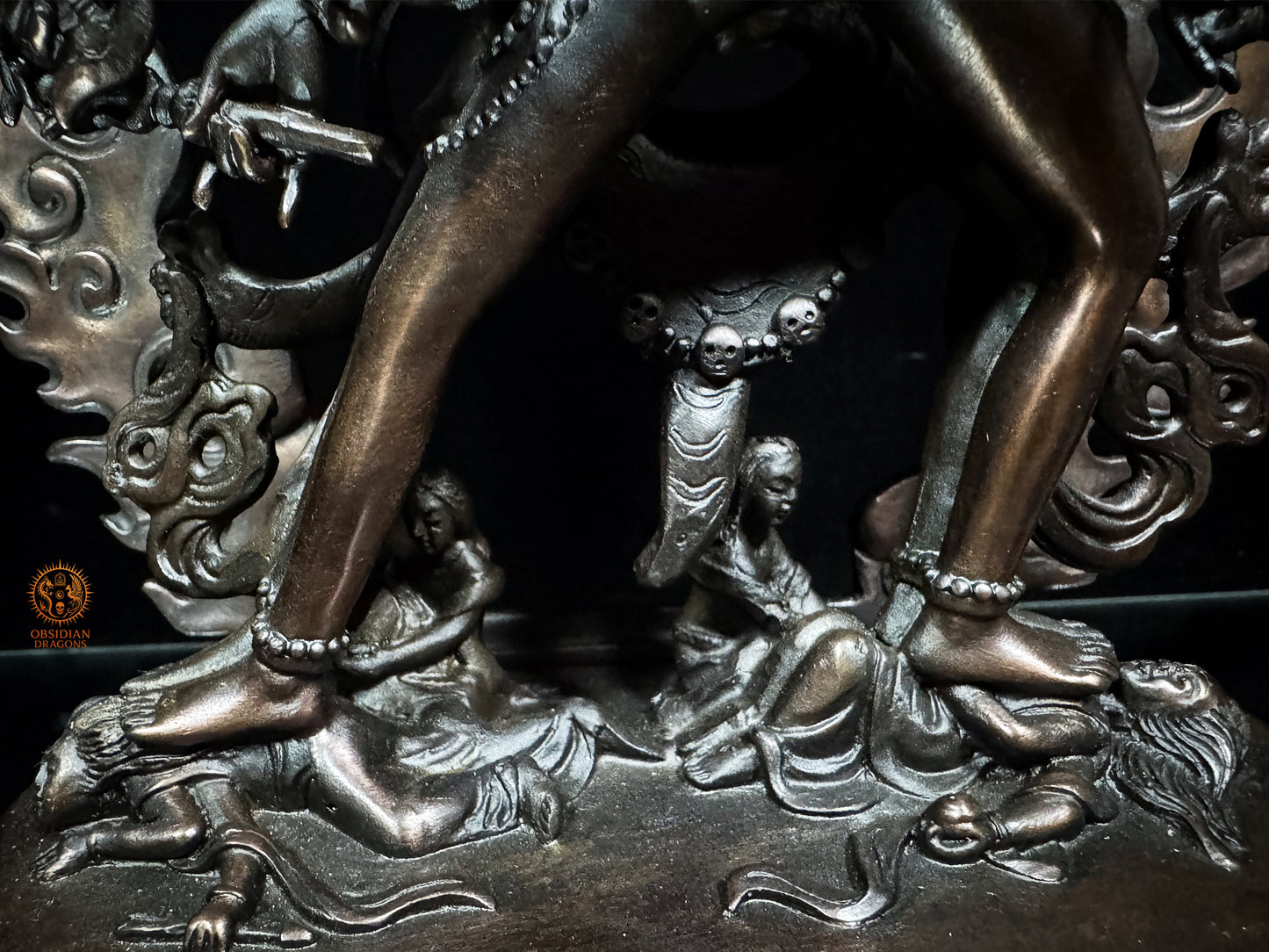
This material distinctly sets the piece apart from classic golden bronze. The strong presence of copper brings an incandescent warmth to the legs, faces, jewelry, and flamboyant halo. The surface seems to evolve with the viewing angle, revealing in turn a coppery brown patina, reddish glints, and subtle cooler metallic nuances.
The traditional bronze work is revealed in the extreme fineness of the limbs, crowns, ornaments, and Tibetan ritual objects. This artisanal bronze statuette combines modeling, casting, assembly, and manual finishing. The profusion of hand-carved details, openwork spaces, and very fine elements testify to the bronzesmiths' expertise. This artisanal Tibetan violet bronze statuette is thus much more than a decorative artisanal bronze statue: it is a Tibetan bronze made by master bronzesmiths, designed to retain great expressive power.
A Creation by the Master Bronzesmiths of Gyalthang
The statue was made by bronzesmiths from northern Yunnan, in the Tibetan region of Yunnan. Gyalthang or Gyaltran is located within a territory deeply marked by Tibetan Buddhism, its monasteries, and its Tibetan artistic tradition. The workshop from which this piece originates specializes in bronze for temples, Buddhist temple bronzes, and lamaserie bronzes.
This origin gives the work a character different from that of a simple decorative production. Yunnan craftsmanship and Tibetan bronze craftsmanship are put to the service of demanding Tantric Buddhist iconography. Tibetan bronze workshops working for religious spaces must reconcile symbolic fidelity, compositional stability, and the frontal power of the image. This artisanal Tibetan sculpture is thus an extension of Tibetan religious craftsmanship and Tibetan monastic craftsmanship, without being presented as an antiquity.
By its origin, material, and design, this Kalachakra statue from Gyalthang also constitutes a remarkable example of contemporary Himalayan art and Himalayan religious art. This Gyalthang bronze or Gyaltran bronze expresses the encounter between a living regional culture and the requirements of the sacred Tibetan image.
Who is Kalachakra, the "Wheel of Time"?
The Sanskrit name Kālacakra combines kāla, time, and cakra, wheel or cycle. Kalachakra thus means "Wheel of Time" or "cycles of time." However, it is neither a creator god nor a historical figure. In the Vajrayana tradition, Kalachakra is a meditation deity, a Tibetan yidam giving a visible form to a fully awakened state of consciousness.
The teaching of Kalachakra connects three dimensions:
🌌 The Outer Kalachakra concerns the cycles of the world and the cosmos: days, seasons, movements of celestial bodies, birth, and dissolution of universes.
🫁 The Inner Kalachakra concerns the cycles of the human being: breathing, subtle energies, birth, aging, death, and rebirth.
☸️ The Alternative Kalachakra designates the path that allows one to understand and transform these outer and inner cycles to progress toward liberation and Buddhist awakening.
The Kalachakra tantra thus constitutes one of the most extensive systems of Vajrayana Buddhism. It connects the macrocosm, the universe, and the microcosm, the human being. The tantric deity therefore does not only symbolize the passage of time: it represents the possibility of no longer being dominated by its cycles and of consciously directing the energy of existence toward spiritual transformation.
In tantric Buddhism, the form of the deity serves as a support for demanding inner practice. The cultural and artistic contemplation of this statue remains accessible to all, while the complete practice of the Kalachakra tantra traditionally requires initiation and the guidance of a qualified master.
Why is Kalachakra represented in Yab-Yum?
This bronze Kalachakra Yab-Yum statue shows Kalachakra intimately united with Vishvamata. The Tibetan expression Yab-Yum literally means "father-mother." The Yab-Yum representation does not describe an ordinary erotic scene: it gives form to the tantric union that lies at the heart of the path.
Kalachakra primarily represents method, awakened action, and active compassion. Vishvamata, the "Mother of All Diversity" and Kalachakra's consort, represents the wisdom that understands emptiness. Their embrace manifests the union of method and wisdom, but also the union of compassion and wisdom. Neither of these dimensions alone can lead to complete accomplishment.
This sacred union brings together several levels of meaning:
✨ Great bliss and emptiness;
☯️ Masculine and feminine principles, complementary and non-hierarchical;
🧘 Contemplative consciousness and active energy;
🌌 The outer world and the inner universe;
🔥 Power and compassion;
♾️ Apparent duality and non-duality.
Tibetan Yab-Yum therefore does not seek to artificially oppose then reconcile two forces. It reveals that at the ultimate level, they have never been separate. Kalachakra and Vishvamata form a representation of non-duality: a union of complementary forces in which wisdom gives direction to energy, while energy allows wisdom to become action.
The sexual dimension of the image is intentional, but it is transfigured by tantric language. Desire is no longer sought for its own sake: its energy is transformed into consciousness. Bliss, when freed from attachment and united with the understanding of emptiness, becomes the symbol of an extremely subtle mental state. This is why Kalachakra in Yab-Yum is one of the deepest images in tantric Buddhism.
👉 To learn more about Yab Yum
I invite you to consult my complete article on this topic by clicking directly on the following link: 📎 What is a Yab Yum? Union of Wisdom and Compassion
An Iconography of Extraordinary Density
This sculpture follows the traditional iconography of 24-armed Kalachakra in union with eight-armed Vishvamata. It can thus be described as a 24-armed tantric Buddhist statue, specifying that the eight additional visible arms belong to his consort. Their multiple faces and radiating limbs do not evoke ordinary anatomy: they express the awakened mind's ability to perceive and act simultaneously in all directions.
The multitude of hands holds Buddhist ritual attributes, emblems, and symbolic instruments. Each element represents a quality, method, or transformative force. This multi-armed Tibetan deity initially appears abundant, but its organization follows a very precise structure: all lines converge towards the central embrace of Kalachakra and Vishvamata.
The Mandorla of Flames
An imposing mandorla of flames rises around the couple. This flamboyant halo evokes the flames of wisdom that consume ignorance, illusions, and inner obstacles. Entirely openworked, it accentuates the circular movement of the work and recalls the Wheel of Time.
The Wrathful Posture
Kalachakra adopts a wrathful posture and an expression of great intensity. In Tibetan Buddhism, a wrathful deity personifies neither hatred nor evil. Its formidable appearance expresses an energetic compassion, capable of cutting through illusions and neutralizing forces that keep beings in suffering.
The figures subjugated under his feet symbolize the submission of ignorance, attachments, and spiritual obstacles. Kalachakra's power proceeds from wisdom, not ordinary anger.
The Lotus Base
The composition rests on a lotus-shaped base. This lotus pedestal, worked in superimposed registers, gives the statuette its stability and reinforces its monumental presence. In Buddhist iconography, the lotus evokes purity capable of emerging from a conditioned world without being defiled by it.
A Feat of Buddhist Bronze Sculpture
This bronze Kalachakra statue impresses with its extraordinary iconographic density: the artisans have created a true sense of space by superimposing faces, bodies, arms, jewelry, and attributes on multiple planes.
The entirely openwork sculpture allows the gaze to circulate between the limbs and the mandorla. Some fingers, objects, and ornaments seem almost suspended. The mastery required to design, cast, assemble, and finish these very fine elements makes this bronze Kalachakra statuette a striking demonstration of technique.
The work is not only designed to be viewed frontally. Three-quarter views reveal the depth of the different planes, while the reverse shows the extension of the faces, arms, crowns, clothing, and adornments. This is a true hand-sculpted piece conceived in three dimensions, not a simple decorative relief.
Why is this Bronze Kalachakra Statue Exceptional?
Its exceptional character arises from the convergence of several qualities rarely combined at this level of density:
🎭 A masterfully ordered composition: the profusion of arms, objects, and faces forms a visual vortex, yet the central embrace remains perfectly stable.
🔥 A living material: the high-copper bronze reveals a changing palette of browns, reds, golds, and cooler reflections.
🔍 Great technical finesse: the hands, crowns, jewelry, and symbols remain distinct despite their number and proximity.
🔄 Work on all sides: the volume is discovered from the front, profile, three-quarters, and reverse.
⚖️ Considerable physical presence: its weight of 3.180 kg and broad silhouette give it unusual monumentality for a height of 29 cm.
☸️ Spiritual depth: every part of the image contributes to the teaching of Kalachakra, from the Wheel of Time to the union of great bliss and emptiness.
This Tibetan bronze Kalachakra statuette therefore does not reveal itself in a single glance. From afar, it imposes a flamboyant silhouette and sovereign presence. As one approaches, it reveals a world of faces, gestures, attributes, and small figures. This ability to constantly renew observation makes it a true object of Buddhist art and a collectible work of Buddhist art.
What Emanates from this Representation of Kalachakra
This Tibetan tantric statue primarily exudes an extremely concentrated ritual power. It possesses an almost monumental presence. The multiplication of arms and flames produces a circular motion that evokes the cycles of time and expanding energy.
Its expression manifests a protective and indomitable force, directed against ignorance and inner obstacles. Yet, at the center of this intensity remains the embrace of Vishvamata. The work thus unites power and wisdom, tension and stability, cosmic movement and inner stillness.
The gaze continually moves from the multitude to the center, then from the center to the multitude. Everything seems abundant, but nothing is truly dispersed. This organization produces an impression of controlled chaos: the representation does not deny the complexity of the world; it gathers it and gives it an axis.
The warmth of the violet bronze reinforces this sensation. Beneath the deep shadows, the copper seems to retain an inner light. This violet bronze Kalachakra statue appears at once dark, warm, formidable, and magnetic.
A Work for Contemplation and Collection
This collectible Buddhist statue can find its place in a collection of Asian art, a collection of Himalayan art, a meditation space, or an interior dedicated to sacred art. Its richness makes it an exceptional support for contemplation: it invites observation of the relationship between movement and stability, multiplicity and unity, cyclical time and consciousness.
It can also be presented as a statuette for a Buddhist altar, as a meditation object or as a bronze Vajrayana statue for a Buddhist altar, in keeping with its tradition. Its iconography belongs to the world of Buddhist ritual objects; however, its presence on an altar does not mean that it has been ritually consecrated. For a specific tantric practice, it is advisable to refer to a qualified master of the Vajrayana tradition.
Both a Tibetan art object, a Buddhist collector's item and a spiritual Tibetan decoration, this work is aimed at sculpture lovers, practitioners, as well as anyone sensitive to Tibetan Buddhist art. It is also a gift for a collector of Buddhist art, provided that its visual power, symbolic density and weight are fully appreciated.
This collectible Tibetan sculpture stands out from more common representations due to its material, scale and degree of detail. This collectible Tibetan sculpture is distinguished by the richness of its iconography, the warmth of its coppery bronze and the remarkable mastery of its artisanal execution, stemming from contemporary Himalayan art.
A Kalachakra sculpture intended for discerning eyes
This bronze Yab-Yum statuette combines the power of traditional iconography, the warmth of metal and the precision of demanding craftsmanship. The general silhouette strikes immediately, while the finesse of its countless details extends the experience far beyond the first glance.
For a connoisseur of sacred Tibetan art, this sculpture of Kalachakra and Vishvamata constitutes a particularly complete representation of non-duality. For a collector of Tibetan Buddhist bronzes, it offers unusual material, a substantial mass and a richly detailed three-dimensional work. For a practitioner or contemplative, it reminds us that true mastery does not consist in stopping the cycles of time, but in deeply understanding their nature.
This bronze Kalachakra statue – Tibetan Yab-Yum embodies an esoteric, protective and magnetic power: a work in which the profusion of the world is ordered around the perfect union of wisdom and compassion.
🔍 Discover our collection of authentic Buddhist statuettes
Immerse yourself in our collection of bronze Buddhist statuettes, carefully selected for their authenticity, symbolism and fine craftsmanship. Each piece embodies the essence of Buddhist traditions, whether Tibetan, Chinese or Japanese, and offers you a strong spiritual presence for your sacred space or personal collection.
🔗Buddhist Statuettes – Authentic Buddhist Sculpture - Sacred Art