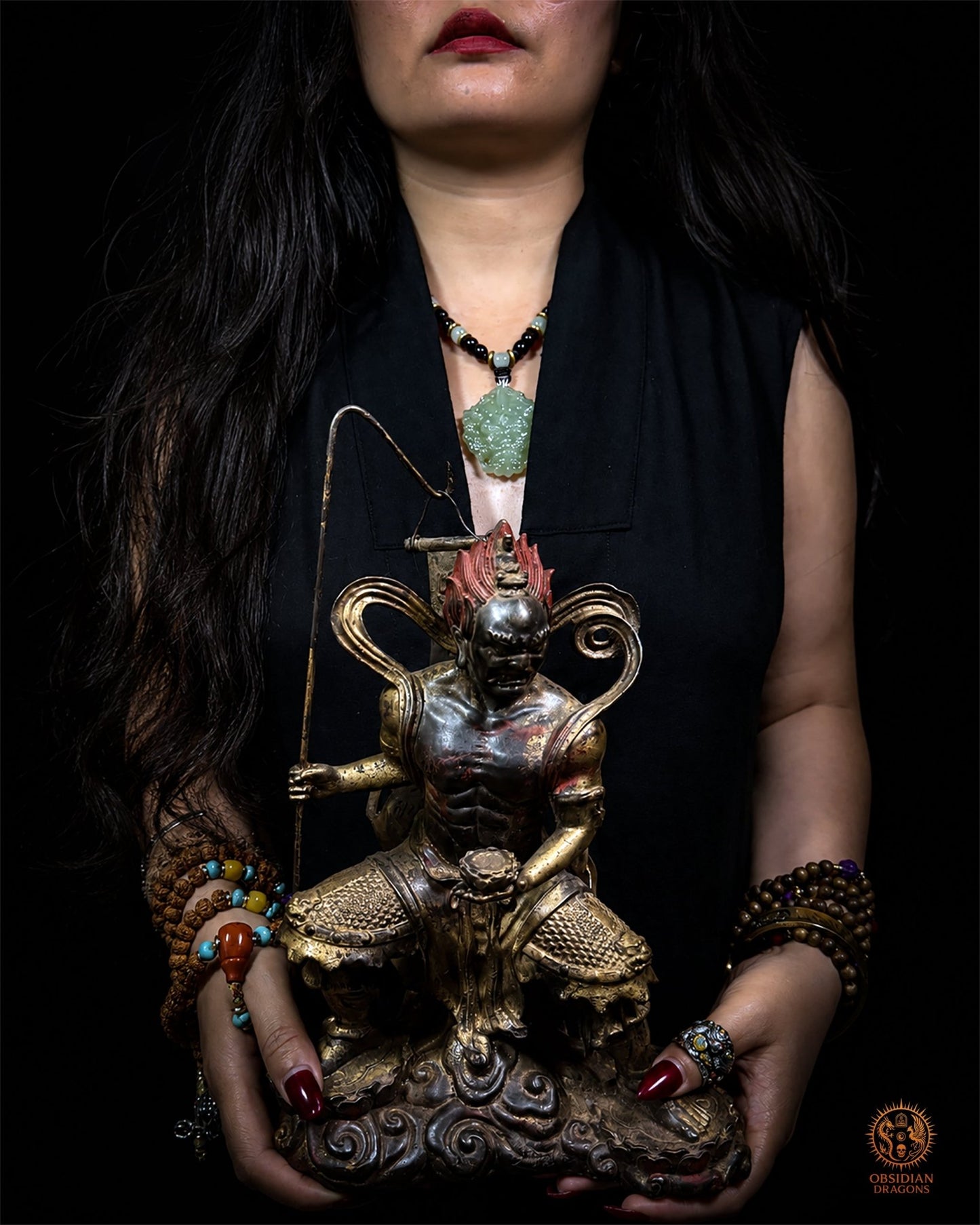
Esoteric Buddhist bronze statue of Mianran Dashi, savior of pretas, protector of hungry ghosts, Ghost King of Chinese Tangmi Tantric Buddhism, central figure of the Yànkǒu ritual and the Zhongyuan Jie Ghost Festival.
Photos and video are contractual, you will receive exactly this statue.
👉 To understand the history, symbolism, and ritual role of Mianran Dashi in Chinese esoteric Buddhism, we invite you to read our full article:
📎 Mianran Dashi, Ghost King of Chinese Esoteric Buddhism
Among the many representations of the Asian Buddhist pantheon, some figures are immediately recognizable. Guanyin, Amitābha, Kṣitigarbha, and the great deities of Tantric Buddhism hold an important place in the spiritual imagination of Asia.
Others, however, remain largely unknown, even to specialized collectors.
This esoteric Buddhist bronze statue of Mianran Dashi belongs precisely to this category of rare and singular pieces.
Known in China as 面燃大士 (Mianran Dashi), this mysterious figure of Chinese Tangmi Tantric Buddhism, an emanation of the bodhisattva Guan Yin, is associated with the realm of pretas, the famous hungry ghosts of Buddhist cosmology. Protector of suffering beings, guide of wandering souls, and central character of the Yànkǒu (焰口) ritual, Mianran Dashi occupies an essential place in ceremonies aimed at relieving forgotten dead and inhabitants of the hungry ghost realm.
Although his role is major in Chinese esoteric Buddhism, his iconography remains relatively little known in the West. Ancient representations of Mianran Dashi are quite rare on the market today. This discretion largely contributes to the interest shown in him by lovers of Chinese religious art, collectors of Buddhist bronze statues, and enthusiasts of Asian spiritual traditions.
The piece presented here is a remarkable esoteric Buddhist bronze statue, featuring a particularly attractive old patina. Its iconography respects the traditional attributes of Mianran Dashi: flaming face, powerful body, wrathful expression, ritual banner, and conquering posture, characteristic of the protector of hungry ghosts.
Beyond its aesthetic interest, this sculpture is a true collector's item, a testament to a mystical aspect of Chinese Buddhism where compassion, the spirit world, and deliverance rites come together around one of the most enigmatic figures of the Asian religious pantheon.
Characteristics of this Esoteric Buddhist bronze statue depicting Mianran Dashi
Material
🟤 Bronze with ancient patina
Dimensions
📏 Height with banner: 30 cm
📏 Height without banner: 25 cm
📏 Width: 20 cm
📏 Depth: 10 cm
Weight
⚖️ 2.358 kg
Origin
🏮 China, probably Henan province.
Condition
✨ Very good condition.
This esoteric Buddhist bronze statue depicting Mianran Dashi showcases remarkable casting quality and a particularly aesthetic ancient patina that highlights the sculpture's reliefs. The iconographic details, the ritual banner, the flames, the character's attributes, and the expressive face bear witness to careful craftsmanship and give this work a remarkable visual presence.
With its generous dimensions, significant weight, and exceptionally rare subject, this representation of Mianran Dashi, protector of hungry ghosts and central figure of the Yànkǒu ritual, is a choice piece for enthusiasts of Chinese esoteric Buddhism, Asian religious art, and collectible Buddhist statues.
Mianran Dashi: The Ghost King of Chinese Buddhism
Who is Mianran Dashi?
Among the many figures in Chinese Buddhism, few possess as unique an identity as Mianran Dashi.
Of Indian origin, he is Ulkāmukha Pretarāja, literally "King of the Pretas with a Flaming Face," a figure who came from India with the first Buddhist sutras and became, over the centuries, one of the most singular characters in Chinese Buddhism.
Through these different names, a single spiritual reality emerges: that of a being capable of penetrating the darkest realms of Samsara to bring aid and deliverance.
The Ghost with the Flaming Face
Tradition recounts that Mianran Dashi once appeared before the disciple Ānanda in the guise of a terrifying ghost whose face was consumed by flames.
This apparition warned Ānanda that he himself would be reborn among the pretas if he did not undertake a practice capable of rescuing the suffering beings in the realm of hungry ghosts.
Profoundly disturbed, Ānanda then sought advice from the Buddha.
Śākyamuni's response gave rise to a set of practices based on offerings, invocations, dhāraṇī, and the transfer of merit intended to alleviate the suffering of invisible beings.
However, this manifestation should not be understood as that of a demon or a malevolent spirit.
In Chinese Buddhism, Mianran Dashi's terrifying appearance primarily serves a pedagogical function: it recalls the consequences of greed, attachment, and selfishness, while illustrating the capacity of compassion to penetrate even into worlds of suffering.
His flaming face has become one of the most famous symbols of the relationship between wisdom, purification, and spiritual liberation.
His role in Chinese Esoteric Buddhism (Tangmi)
In the Tangmi tradition, the esoteric Buddhism developed during the Tang dynasty, which later disappeared in favor of Tibetan Buddhism in China, Mianran Dashi holds a particular function.
He acts as an intermediary between the visible and invisible worlds.
His presence is invoked during ceremonies for the dead, wandering souls, and beings deprived of ritual offerings.
As such, he belongs to those figures of Chinese Buddhism whose role extends far beyond the individual framework of spiritual practice to encompass the entire community of the living and the deceased.
Protector of hungry ghosts
One of the most important missions attributed to Mianran Dashi concerns the pretas (餓鬼).
In Buddhist cosmology, pretas occupy a particular realm of Samsara. They are described as beings trapped by insatiable desire, unable to satisfy their hunger or thirst despite their incessant efforts.
Mianran Dashi is considered their protector because he intervenes precisely where suffering is deepest.
This function makes him an exceptional figure in the Chinese religious pantheon.
While many deities are responsible for suppressing, exorcising, or punishing, Mianran Dashi is primarily associated with deliverance.
Compassion towards suffering beings
Beyond the sole realm of hungry ghosts, Mianran Dashi embodies a fundamental idea of Mahāyāna Buddhism: no form of suffering is unworthy of compassion.
Even the most forgotten, terrifying, or distant beings from the human world are still capable of receiving help and benevolence.
This vision explains why Mianran Dashi still holds an important place today in ceremonies for the deliverance of souls, in rites for the dead without descendants, and in practices related to the Ghost Festival.
Through his figure, Chinese Buddhism reminds us that true compassion knows no bounds and must extend even into the darkest regions of existence.
A traditional representation of Mianran Dashi
This esoteric Buddhist bronze statue features iconography particularly faithful to traditional representations of Mianran Dashi (面燃大士).
Every detail of the sculpture contributes to understanding his spiritual and ritual role.
The powerful body
Unlike classical representations of pretas, often emaciated and starved, this esoteric Buddhist bronze statue depicts Mianran Dashi with a powerful, muscular, and firmly rooted body.
This musculature reinforces his role as protector of hungry ghosts and Ghost King. He is not depicted here as a suffering preta, but as an authoritative figure capable of commanding invisible beings, protecting wandering souls, and maintaining order in the spirit world.
His vigorous torso, stable posture, and sovereign demeanor highlight Mianran Dashi's wrathful dimension: a spiritual force in the service of compassion, deliverance, and the Yànkǒu ritual.
The flames
The flames emanating from the deity's head and face are another essential element of his iconography.
They directly refer to his traditional names:
面燃大士
"The Great Being with the Flaming Face"
and
焰口鬼王
"The Ghost King with the Flaming Mouth"
These flames represent the purifying fire of wisdom capable of consuming ignorance, attachment, and illusions.
The representation of Guanyin on the forehead
A key detail of this esoteric Buddhist bronze statue is the small representation of Guanyin visible on Mianran Dashi's forehead.
This presence indicates the deity's true spiritual nature: behind the wrathful appearance of the Ghost King, the compassion of the bodhisattva Guanyin is manifested.
In the traditional iconography of Mianran Dashi, this image of Guanyin reminds us that the protector of hungry ghosts is not a demon, but a compassionate emanation come to rescue pretas and wandering beings of the invisible world.
This detail makes this piece particularly interesting, as it directly links Mianran Dashi's terrifying power to Guanyin's universal compassion.
👉 For more information on the bodhisattva Avalokiteshvara
Avalokiteshvara is a Mahasattva bodhisattva who represents the power of compassion. He is one of the three Western Saints along with Mahāsthāmaprāpta and Amitabha Buddha. To learn all about this trilogy, please click on the following link to access our detailed article: 📎 The "Three Saints of the West", Amitabha Buddha, Bodhisattvas Avalokiteshvara and Mahāsthāmaprāpta
The ritual banner
One of the most remarkable elements of this representation is the long banner Mianran Dashi holds in his right hand.
In traditional Chinese iconography, this banner symbolizes his authority over invisible beings and his role as guide of wandering souls. It also evokes the ceremonies of the Yànkǒu (焰口) ritual during which hungry ghosts are summoned, fed, and then guided towards a more favorable destiny.
The presence of this banner is one of Mianran Dashi's most characteristic attributes and allows him to be immediately identified among the many deities of the Chinese Buddhist pantheon.
The Om Mani Padme Hum mantra
The banner bears the traditional inscription of the famous mantra of compassion:
唵嘛呢叭咪吽
Om Mani Padme Hum
This mantra is intimately linked to the bodhisattva Avalokiteshvara, known in China as Guanyin (觀音).
Its presence reminds us that Mianran Dashi is not considered a demon or merely a king of ghosts, but as a manifestation of Guanyin's compassion, who voluntarily descended into the realm of pretas to rescue suffering beings.
👉 For more details on the compassion mantra "Om Mani Padme Hum"
I invite you to consult my dedicated blog article by clicking on the following link:
📎 OM MANI PADME HUM, THE MANTRA OF COMPASSION
The offering bowl
The left hand holds a vessel for offerings.
This attribute directly refers to the ceremonies of feeding hungry ghosts practiced during the Yànkǒu rituals and the Zhongyuan Jie Ghost Festival.
The bowl symbolizes generosity, compassion, and the ability to alleviate the suffering of invisible beings by offering them food, merits, and spiritual liberation.
The knee pads adorned with animal heads
A remarkable detail of this representation of Mianran Dashi lies in the imposing knee pads sculpted in the form of animal heads.
These ornaments reinforce the protective and majestic aspect of the deity. Their presence evokes certain ceremonial armors and iconographies of the Dharma protectors present in Chinese Tantric Buddhism.
Beyond their decorative function, these animal heads contribute to highlighting Mianran Dashi's spiritual authority over invisible worlds and wandering beings. They contribute to the visual balance of the sculpture by emphasizing the power of his posture and the sovereign dimension of the Ghost King.
Associated with the ritual banner, the flames, and the wrathful expression of the face, they give this esoteric Buddhist bronze statue a particularly impressive and unusual presence.
The floating ribbons
On each side of the body, Mianran Dashi is accompanied by long, flowing ribbons that give the sculpture an impression of movement and ritual energy.
These dynamic drapes contrast with the massive power of the body and accentuate the supernatural aura of the deity. They evoke invisible breaths, spiritual winds, and the circulation of ritual forces in the spirit world.
In this esoteric Buddhist bronze statue, the floating ribbons fully participate in portraying Mianran Dashi as the Ghost King of Chinese Buddhism: a figure who is at once conquering, protective, and imbued with an intense spiritual presence.
The conquering posture
Mianran Dashi is depicted standing in a powerful, frontal, and conquering posture.
His muscular torso, firmly anchored legs, and the banner held high in his right hand give him the appearance of a sovereign of the invisible world. He does not merely seem to watch over hungry ghosts: he appears to command them, guide them, and impose his spiritual authority over the invisible realms.
This attitude reinforces his dimension as a Ghost King in Chinese Buddhism. Mianran Dashi is not depicted here as a suffering being, but as a wrathful deity capable of entering the dark worlds to restore order, protect wandering souls, and lead pretas to deliverance.
The entire composition emanates an impression of active, almost martial power, but always in the service of compassion and the Yànkǒu ritual.
A rare iconography
The iconography of Mianran Dashi remains relatively little known outside of China today.
His representation differs greatly from that of Buddhist or Taoist deities more familiar to Western audiences.
Differences with Guanyin
Although he is considered a manifestation of Guanyin, Mianran Dashi presents a radically different appearance.
Where Guanyin typically appears with peaceful, luminous, and benevolent features, Mianran Dashi adopts the very appearance of the beings he seeks to save.
His flaming face and his aspect as a ghost king convey a compassion that voluntarily descends into the worlds of suffering.
Differences with Taoist protectors
His appearance may also recall certain wrathful deities of popular Taoism.
Although integrated into the Taoist pantheon through syncretism, Mianran Dashi remains fundamentally a figure of Chinese Buddhism.
Where many Taoist protectors exercise a function of control, judgment, or exorcism, Mianran Dashi acts primarily as a savior of suffering beings.
This profoundly compassionate orientation is one of the most original characteristics of his iconography and explains the unique place he occupies in the religious history of China.
A piece sought after by collectors
A deity rarely offered for sale
This esoteric Buddhist bronze statuette is distinguished above all by the unusual nature of its subject.
Representations of Mianran Dashi are much rarer on the market than those of the great classical figures of Asian Buddhism. Statues of Mianran Dashi appear much less frequently in private collections and catalogs of Chinese religious art.
This rarity is explained by the very nature of this deity. Mianran Dashi is not a decorative or popular figure in the ordinary sense of the term. He belongs to the more confidential world of Chinese Buddhism, funeral rites, the Yànkǒu ritual, the Zhongyuan Jie Ghost Festival, and traditions related to pretas.
For a collector, this type of subject therefore holds particular interest. It allows entry into a much less known dimension of Chinese religious art, at the crossroads of esoteric Buddhism, Tangmi, popular beliefs, and ritual practices intended for invisible worlds.
An unusual subject in Chinese religious art
This representation of Mianran Dashi possesses an iconographic power very different from more common Buddhist statues; his appearance as a Ghost King makes him an immediately recognizable piece for seasoned connoisseurs.
It is not only for collectors seeking a beautiful Buddhist bronze statuette. It will also interest enthusiasts of Chinese Buddhism, esoteric Buddhism, ritual iconography, wrathful deities, and traditions related to hungry ghosts.
Historical and spiritual interest
Beyond its aesthetic interest, this esoteric Buddhist bronze statuette possesses a true historical and spiritual depth.
It testifies to a fundamental but little-known aspect of Chinese Buddhism: the attention paid to invisible beings, forgotten dead, wandering souls, and unseen suffering.
Through Mianran Dashi, Chinese Buddhism reminds us that compassion is not limited to the living, nor to visible beings. It also extends to pretas, to the deceased without descendants, and to wandering spirits trapped in their own torments.
This dimension makes the piece particularly powerful for an admirer of Asian religious art.
Collector's item
By its weight, dimensions, ancient patina, rare subject, rich iconography, and its direct link to the rites of deliverance for hungry ghosts, this statuette constitutes a true collector's item.
It can find its place in a collection dedicated to Chinese Buddhism, wrathful deities, Asian ritual bronzes, or rare representations of the East Asian religious pantheon.
Object of contemplation
This representation of Mianran Dashi can also be considered an object of contemplation.
His wrathful appearance invites one to look beyond initial impressions.
Behind the Flaming Face of the Ghost King lies a profound spiritual lesson: to transform hunger into offering, wandering into a path, fear into understanding, and suffering into compassion.
It is precisely this tension between power, mystery, and benevolence that makes this esoteric Buddhist bronze statuette such a singular piece.
A central figure in the Yànkǒu ritual
The Flaming Mouth ritual
Among the many ceremonies in Chinese Buddhism, few are as impressive and symbolically rich as the Yànkǒu (焰口) ritual, literally "Flaming Mouth."
Still practiced today in many temples in China, Taiwan, and East Asia, this ritual aims to rescue hungry ghosts, wandering souls, and invisible beings deprived of offerings and spiritual support.
The Yànkǒu holds a special place in Chinese Buddhism, where it is one of the most important compassion ceremonies dedicated to the dead.
Feeding hungry ghosts
At the heart of the Yànkǒu ritual is the idea of feeding those who cannot feed themselves.
Offerings of food, water, incense, and spiritual merits are symbolically multiplied to reach the innumerable beings wandering in the invisible realms.
Mianran Dashi's role
It is precisely in this context that Mianran Dashi occupies a central place.
His presence symbolically guarantees that suffering beings can receive nourishment, spiritual assistance, and blessings.
Guide of invisible beings
Through his intervention, lost souls find a path to more favorable conditions of existence.
This function explains why his image is often associated with ceremonies for the dead without descendants, victims of disasters, or forgotten spirits.
Protector of wandering souls
In popular Chinese religion, many beliefs concern souls without burial, abandoned dead, or spirits who have received no offerings.
Mianran Dashi then appears as a protector capable of watching over these vulnerable beings.
This profoundly compassionate function is one of the reasons for his immense popularity in Chinese ritual traditions.
Mediator between worlds
His presence in Yànkǒu ceremonies symbolizes the possibility of spiritual dialogue between the different realms of existence.
Through him, Chinese Buddhism expresses a fundamental idea: compassion should not stop at the boundaries of the visible world, but should also extend to forgotten beings wandering in the invisible regions of Samsara.
The Zhongyuan Jie Ghost Festival
The Ghost Month
In the traditional Chinese calendar, the Zhongyuan Jie Ghost Festival is celebrated during the seventh lunar month, a period called the Ghost Month. According to popular Chinese beliefs, this time of year corresponds to a symbolic opening of the invisible worlds.
The boundaries between the world of the living and the dead then become more permeable. The spirits of the deceased, wandering souls, and hungry ghosts can temporarily return to the human world to receive prayers, offerings, and merits.
The symbolic opening of invisible worlds
During Zhongyuan Jie, families, temples, and communities honor the dead with offerings of food, incense, light, and votive paper.
These gestures aim to appease ancestors, but also spirits without families, forgotten dead, and beings deprived of ritual support.
In this context, Mianran Dashi holds a particularly important place.
His function as protector of hungry ghosts makes him a figure directly linked to this period of the Chinese calendar, where visible and invisible worlds symbolically interact.
Offerings to the dead
The offerings made during Zhongyuan Jie express a central idea of Chinese culture: the dead should not be abandoned.
Food, incense, flames, prayers, and votive objects form a symbolic language intended to maintain a connection between the living and the deceased.
For hungry ghosts, these offerings take on even greater importance. They represent a possibility of appeasement and transformation.
Mianran Dashi then appears as the one who ensures that these acts of compassion can reach the beings who need them most.
Ceremonies of deliverance
The Ghost Festival is not limited to honoring ancestors.
It also includes major ceremonies aimed at relieving wandering souls and suffering beings in the invisible worlds.
In Chinese Buddhism, these ceremonies express the idea that compassion must extend beyond family, beyond loved ones, and even beyond the human world.
It is precisely this dimension that gives Mianran Dashi his full symbolic power.
Through him, the Zhongyuan Jie Ghost Festival becomes a living manifestation of compassion towards all forgotten beings.
This esoteric Buddhist bronze statuette thus takes on its full meaning in this context, evoking an entire section of Chinese ritual traditions related to the memory of the dead, hungry ghosts, and the deliverance of wandering souls.
A unique piece
This esoteric Buddhist bronze statuette of Mianran Dashi has a true presence.
A rare, powerful, and profoundly unique figure, intended for those who recognize in Chinese religious art something more than an object: a memory, a force, a symbol, and a gateway to invisible worlds.
By its exceptional subject, ancient patina, weight, complete iconography, and direct link to the rites of deliverance for hungry ghosts, this piece appeals to demanding collectors, Chinese Buddhism enthusiasts, and connoisseurs of rare spiritual objects.
Only one piece is available.
You will receive exactly the statuette shown in the photos and video.
If Mianran Dashi calls to you, this encounter will likely not happen twice.
🔍 Discover our collection of authentic Buddhist statuettes
Immerse yourself in our collection of bronze Buddhist statuettes, carefully selected for their authenticity, symbolism, and fine craftsmanship. Each piece embodies the essence of Buddhist traditions, whether Tibetan, Chinese, or Japanese, and offers a strong spiritual presence for your sacred space or personal collection.
🔗Buddhist Statuettes – Authentic Buddhist Sculpture - Sacred Art