
🚚 Free delivery - returns within 14 days after delivery


Obsidian dragons
Laughing Buddha Figurine in Celestial Eye Obsidian – Budai
Laughing Buddha Figurine in Celestial Eye Obsidian – Budai
Couldn't load pickup availability
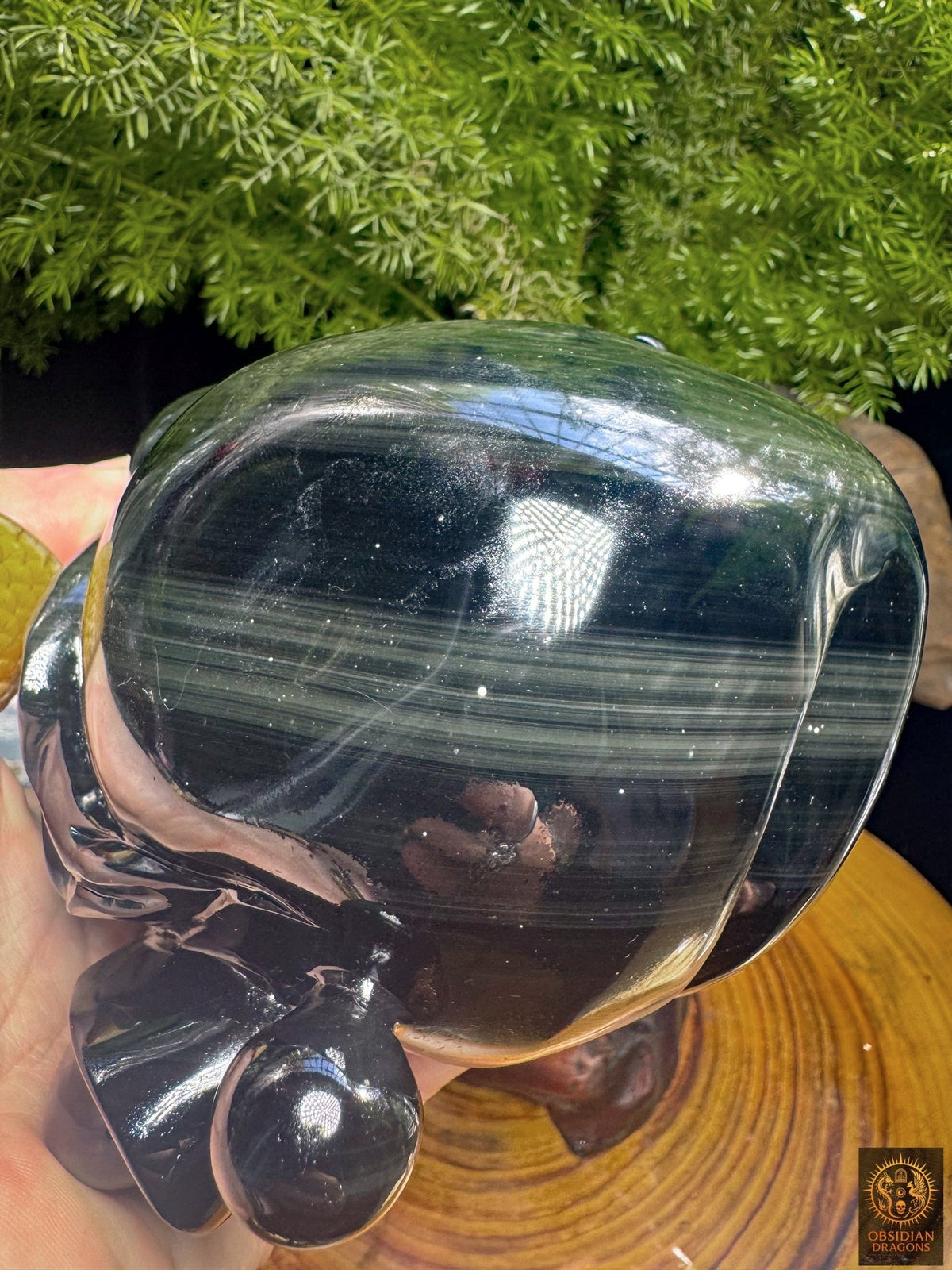
Laughing Buddha in Mexican celestial eye obsidian – Budai seated on his sack, a unique handcrafted sculpture with green and purple iridescence and silver reflections, on a cedar base, symbolizing prosperity.
Contractual photos and video, you will receive exactly this Laughing Buddha statuette in celestial eye obsidian
📋 Technical specifications of this Laughing Buddha statuette in celestial eye obsidian
🔬 As a gemmologist graduated from the National Institute of Gemmology (ING, Paris, France), I personally select and appraise the natural stones offered by Obsidian Dragons. Each material is studied according to its gemmological characteristics, its structure, its quality, and its aesthetic appeal. For this statuette, particular attention is paid to the iridescence of the obsidian, the arrangement of its concentric patterns, and their integration into the sculpted volumes.
🗿 Representation : Budai, the Chinese Laughing Buddha, depicted seated on his canvas sack.
💎 Material: natural celestial eye obsidian, natural volcanic glass
🌎 Origin of the raw material : Mexico.
✨ Material characteristics: green and purple iridescence, concentric ring patterns, and the presence of silver obsidian sections within the same piece.
🖐️ Craftsmanship: handcrafted sculpture, with a polished surface highlighting the character's contours and the optical effects of the obsidian.
🔹 Specimen: unique piece, characterized by the distribution of its natural patterns and its sculpted composition.
🌳 Support: gnarled cedar wood base, accompanying the bottom of the sculpture.
🧩 Assembly: removable statuette from its support. The sculpture and the base can be separated for observation, cleaning, and handling.
📏 Total height of the work with its base : 26 cm.
📐 Dimensions of the obsidian alone : height of 22 cm, width of 10.5 cm, and thickness of 9 cm.
⚖️ Weight of the obsidian alone: 3 kg, or 3,000 grams.
📐 Dimensions of the base alone : height of 12 cm and horizontal dimensions of 14 × 9 cm.
⚖️ Weight of the cedar base: 655 grams.
⚖️ Total weight of the work: 3.655 kg, or 3,655 grams.
🔦 Observation of colors: the intensity of the iridescence and silver reflections varies with the lighting and viewing angle. The piece may appear darker under diffused light and reveal more of its colors under directional lighting.
📷 Photographs : the views show the offered specimen, its support, and different angles of the sculpture.
Laughing Buddha in celestial eye obsidian: a unique piece with iridescent and silver reflections on a cedar base
A round belly crossed by iridescence, a canvas sack turned into a seat, a smile that seems to extend into the reflections of the stone. This Laughing Buddha in celestial eye obsidian represents Budai seated on his sack, in a composition where the sculpture and the natural characteristics of the material complement each other. The concentric patterns of the belly find an echo in those of the sack, while the cedar wood support accompanies the silhouette with its gnarled forms and warm tones.
This substantial statuette is a unique piece, handcrafted from natural Mexican obsidian. The sculpture is removable: Budai can be removed from its cedar base to be observed from different angles.
The material has an additional feature: its green and purple iridescence is adjacent to silver-reflecting areas. This coexistence enriches the reading of the polished surface and gives this Budai statuette in obsidian a presence whose photographs reveal several aspects.
A handcrafted sculpture in obsidian, guided by the material
The first appeal of this Laughing Buddha statue lies in the meeting between the volumes of the character and the patterns of the obsidian. This Laughing Buddha sculpture features a largely exposed belly whose domed surface accommodates the concentric rings. Further down, Budai's sack takes up this rounded organization and carries a second set of colored reflections. Between the two, the feet, hands, and folds of the garment give rhythm to the composition.
The face retains an open expression. The squinted eyes, full cheeks, and smiling mouth give the character this warm familiarity that characterizes many representations of the Chinese Laughing Buddha. The sculpted details animate the volumes without erasing the large surfaces on which the optical effects manifest.
This handcrafted sculpted obsidian presents a double interest: that of an identifiable religious and cultural figure, and that of a material whose internal organization contributes to the artistic result. Lapidary sculpture here requires composing with the bands present in the raw material, their orientation, and the way they meet the curves of the subject.
The quality of this collectible sculpture is seen in the breadth of the patterns, their placement on the main face, the nuances visible under appropriate lighting, and the balance of the presentation. These concrete characteristics define the appeal of the handcrafted work and allow it to be appreciated beyond a commercial quality designation.
Celestial eye obsidian: a volcanic history preserved in glass
Obsidian is a natural volcanic glass, generally originating from silica-rich lava. The composition of this lava, its high viscosity, and the conditions of its cooling can prevent widespread crystallization. The material then solidifies while retaining an essentially amorphous structure: at the atomic scale, it does not have the periodic organization of a crystal.
Cooling must be understood in relation to the speed at which crystals could form. Viscosity and the history of the lava play a role as much as its heat loss. Obsidian can also contain tiny crystals and other inclusions within its glassy mass.
During flow, bands form, deform, and stretch. Some inclusions and some areas of different composition can align with the movement of the lava. The solidified glass retains traces of this history. The dark depth of natural obsidian can thus contain a very fine organization that cutting, polishing, and light make perceptible.
In lapidary vocabulary, the term celestial eye obsidian evokes these iridescent obsidians whose patterns can take on the appearance of an eye. The term rainbow obsidian is also used for materials presenting colored bands. These names describe an appearance and optical effects within the obsidian.
Why do green and purple iridescence appear?
Studies of Mexican obsidians have revealed very small oriented crystals, notably of hedenbergite, a pyroxene containing calcium and iron, and, in other samples, plagioclase. The organization of these inclusions and internal interfaces can promote light interference.
When different fractions of reflected light overlap, some wavelengths are reinforced while others are attenuated. Colors then become visible depending on the structure encountered, the direction of the lighting, and the viewing angle. However, research shows that several mechanisms can occur depending on the iridescent obsidians: visual examination of a sculpture is not enough to precisely identify all its microscopic inclusions.
On this Laughing Buddha in celestial eye obsidian, the main face allows one to follow large green and purple patterns. The domed surfaces of the belly and the sack give these patterns a particularly expressive presentation. Their reading as rings depends on the meeting between the internal organization of the material, the geometry of the sculpture, and the observation conditions.
The lighting of the iridescence is therefore part of the presentation of the obsidian. Under diffused light or from certain angles, the sculpture appears darker. A directional light source and a slight change in position can reveal more of its colors. The photographs required difficult adjustments to make these effects visible while maintaining a good reading of the character. They show the offered piece from several angles and with its support; the intensity of the reflections observed by you will also depend on the chosen lighting.
Silver sections within the celestial eye obsidian
This work also features sections of silver obsidian, perceptible by their colder reflections. Their association with the colored bands constitutes a particularity of this specimen.
The term "silver" here qualifies an optical effect. In reflective obsidians, researchers have described different reflective structures, including oriented inclusions and flattened areas containing gas or glass of a different composition. The differences in optical properties between these structures and the surrounding glass can contribute to the observed reflections.
It is therefore appropriate to distinguish the multicolored iridescence from a silver reflection, even when they coexist in the same piece. Their common presence brings an additional variety to the material and to the gaze one casts on the sculpture. Each movement of the light can bring out another area, another fold, another transition between the black depth and the brilliance of the surface.
A Mexican celestial eye obsidian, among sources renowned for their iridescence
Mexico has a geological context particularly favorable to obsidians. Its vast volcanic belt includes many centers that produced silica-rich lavas, with rhyolitic domes and flows. The west of the country, notably Jalisco and Nayarit, brings together several important regions for the study and exploitation of these volcanic glasses.
The diversity of compositions and formation conditions contributes to that of the materials encountered. Jalisco is notably known for rainbow obsidians with large colored bands. Mexico's reputation lies in this variety and the remarkable appearance of certain specimens, whose lapidary work allows the patterns to be revealed.
Beauty is then appreciated piece by piece: intensity of colors, readability of the patterns, condition of the material, and quality of its shaping. For this Laughing Buddha statuette, the origin of the raw material is Mexico; no more precise deposit is attributed to this specimen.
To deepen the nature of this material, its history, its different origins, and the questions of identification,
consult our article dedicated to obsidian: formation, history, deposits, uses, counterfeits, and place in lithotherapy.
Who is Budai, the Laughing Buddha?
Budai 布袋 means "canvas sack". This name is linked to a Chinese monk called Qici 契此, whose memory was formed around the turn of the 10th century. The sack he carried became his most recognizable attribute, to the point of giving him his name in tradition.
In Chinese Buddhism, Budai has been recognized as a manifestation of Maitreya, the bodhisattva called to become the future Buddha of our world. This religious identity explains his place in temples and in the Chinese devotional imagination. The character represented here is therefore distinguished from Shakyamuni, the historical Buddha.
Over time, the smile, the exposed belly, and the familiar attitude of Budai have nourished interpretations around contentment, generosity, happiness, and welcome. His image has circulated between monasteries, homes, and spaces of daily life. In many Chinese temples of classic plan, he welcomes the visitor in the Pavilion of the Celestial Kings, at the entrance of the devotional path.
The meaning of the Laughing Buddha then takes on a particular depth. His smile invites us to loosen what makes us tense and to make room for an encounter. His contentment can become a reminder of an inner disposition: knowing how to receive, share, and look at what is already present.
This sculpture extends our study
« The Laughing Buddha is not the Buddha: who is Budai really? », which explores his history, his iconography, his relationship with Maitreya, and his transformations in the cultures of Asia.
Budai seated on his sack: the rest of the monk with the canvas sack
In this composition, the seated Laughing Buddha rests on the large sack that accompanies him. This representation belongs to the repertoire of Chinese sculpture. It keeps the character close to his identity as an itinerant religious figure, carrying his few possessions with him.
Budai's sack can receive different interpretations depending on the works and traditions. Here, its presence under the body allows us to read a scene of rest: the traveler sits on what he carries. The object of travel becomes the support of a halt.
We can see it as an invitation to contentment. The monk with the canvas sack has enough to stop and smile. This philosophical reading of the pose finds an echo in the sculpture: the belly and the sack compose two generous masses, united in a stable and welcoming silhouette.
The association of Budai with prosperity in Chinese popular beliefs has enriched his image with wishes of happiness and abundance. It accompanies the cultural meaning of this statue; each can recognize in it a wish for a more open life, sharing, and satisfaction.
A silhouette evoking a Chinese hulu gourd
Seen from the front, this Budai statuette presents a silhouette evoking a gourd: the belly and the sack draw two rounded volumes stacked, connected by the narrowing of the legs and the garment. The head finishes this vertical composition.
The rapprochement with the Chinese hulu gourd 葫芦 constitutes a formal reading of the work. It nevertheless opens an interesting correspondence with a symbol very present in Chinese arts.
The symbolism of the hulu associates several auspicious wishes. Its name is linked by sound play to fúlù 福禄, which evokes happiness and prosperity. Its numerous seeds and its prolific stems explain its link with offspring and family continuity. In Taoist iconography, the gourd carried by certain immortals can contain elixirs of long life; it thus participates in the themes of happiness and longevity. Popular uses also attribute to it a protective meaning for the home.
This kinship of form adds a possible resonance to the sculpture. Budai retains his Buddhist identity, while the form allows the eye to encounter another element of Chinese symbolic heritage.
Why choose a Laughing Buddha in celestial eye obsidian?
The meeting between Budai and obsidian first has a plastic strength. The large curves of the character welcome the reflections; the dark depth highlights the reliefs; the polish gives continuity to the belly, the cheeks, and the drapery. The natural stone sculpture acquires a presence that changes with the light.
In this work, a Mexican volcanic material meets iconography from Chinese Buddhism. This association allows one to appreciate both a geological history and a cultural history. The provenance of the raw material, the nature of its optical effects, and the identity of Budai give the eye several paths to approach the same piece.
A spiritual reading can extend this meeting. The iridescence sometimes requires one to stop, slightly move their point of view, and pay attention to what is revealed. Budai's smile accompanies this more available time. Contemplation becomes a way to inhabit the moment with less haste.
In an esoteric approach, the depth of the obsidian can also serve as a symbolic support for introspection, lucidity, and an intention of protection.
Choosing this Laughing Buddha in celestial eye obsidian means being able to make these approaches coexist: observe a natural material, recognize a cultural figure, and give a place to contemplation in one's daily environment.
The cedar base: another texture to extend the sculpture
The cedar wood support brings a visual warmth that responds to the dark tones of the obsidian. Its irregular shapes, its hollows, and its reliefs accompany the base of the sculpture. The contrast of textures allows one to distinguish the polish of the volcanic glass and the knotty character of the wood.
This obsidian statuette on a wooden base can be removed from its support. The assembly with a removable support allows one to examine the stone, its back, its profiles, and its lower part, while facilitating the separate maintenance of the two elements.
The height of the whole corresponds to its mounted presentation, the support welcoming a part of the base of the stone. The heights of the statuette and the base therefore do not simply add up.
Who is this collectible obsidian sculpture for?
This work is for the Chinese art enthusiast, the sculpture collector, and the person who wishes to deepen their relationship with the figures of Asian Buddhism. It can accompany a practice of contemplation or find its place in a collection appreciated for its cultural and artistic richness.
For a collection of obsidians, its interest lies in the meeting of concentric patterns, green and purple nuances, and silver reflections in a figurative sculpture. The material can be looked at for itself, then rediscovered through the volumes of Budai.
As a collectible object intended for interior decoration, it is also suitable for a library, a living room, or a cabinet of curiosities where wood, stones, antique objects, and spiritual representations meet. Its presence can agree with a dark and warm universe, in which a few chosen lights give the materials their full place.
Acquiring this statuette means choosing a precise specimen, whose drawings and presentation make its uniqueness. It can also be given as a gift to express a wish of welcome, generosity, and contentment, with the pleasure of transmitting the history of a character and that of its material.
Where to place a Laughing Buddha to appreciate this work?
The location of a Budai statue depends on the meaning one wishes to give it and the material conditions of its presentation. A console near the entrance can highlight the welcome. A piece of furniture in the living room or a library allows for regular observation. A space dedicated to contemplation can give it a more personal place.
As a living room sculpture, this piece benefits from having a little space around it and a relatively sober background. As an office statuette, it can introduce a calm point of attention near the workplace. Its weight imposes in both cases a stable piece of furniture, deep enough and adapted to the load.
To highlight this celestial eye obsidian Buddha statue, choose a directional light and adjust its direction by observing the front face. A limited movement of the source can improve the visibility of the colored bands. The presentation must allow the eye to discover the variations of the material without being dominated by the white reflections of the lighting.
In certain contemporary uses of Feng Shui, Budai accompanies an intention of welcome, happiness, or prosperity. These uses give a meaning to the choice of location; their recommendations vary according to the approaches and do not constitute a universal Buddhist rule of orientation of the statue.
An interior with relatively stable humidity, away from a radiator and prolonged direct sunlight, will favor the conservation of the wooden support and its finish. In a devotional approach, a clean location, chosen with care and allowing a respectful relationship with the statue, suits this Buddhist presence.
Maintenance of the obsidian and the cedar support
To clean an obsidian statuette, start by removing the dust with a very soft brush. Then, if necessary, pass a clean and soft cloth slightly moistened. A small amount of mild soap can help remove traces of handling; the residues must be removed with another damp cloth, then the surface carefully dried.
The maintenance of the obsidian must preserve the polish. Abrasive products and rubbing on hard dust risk marking the surface. Avoid shocks, sudden thermal variations, and steam or ultrasonic cleaning. The glassy nature of the material requires careful handling, particularly on the protruding elements.
For the maintenance of the wooden base, favor a soft brush and a dry cloth. The cleaning of the cedar must take into account its finish, on which depends the tolerance to water and other products. A systematic application of oil, wax, or furniture product could change the appearance of the surface; gentle dusting remains the common gesture to favor.
Since the stone and the support are separable, preferably move them individually. Support the obsidian from underneath with both hands, above a protected surface, and check its proper positioning when you replace it on the base.
The gaze of Obsidian Dragons: linking the material to its history
As a gemmologist graduated from ING Paris, I give an essential place to the description of materials, their optical phenomena, and the characteristics specific to each specimen. My path in China also nourishes the attention I pay to Buddhist and Taoist figures, their uses, and the meanings attributed to them.
For this Budai statuette, this approach consists of looking together at the nature of the obsidian, the presence of the bag, the expression of the character, and the possible readings of its silhouette. Gemmological rigor and the cultural approach then allow everyone to build a personal relationship with the object.
To discover other figures, other materials, and other expressions of Asian sacred art,
browse our collection of Buddhist statuettes and sacred art sculptures.
Between the depth of the volcanic glass, the lights of the obsidian, and the warmth of the cedar, this celestial eye obsidian Laughing Buddha offers a presence to look at over time. Budai's smile accompanies a material that reveals its nuances as one takes the time to observe it.
Scientific and cultural references
The gemmological explanations rely notably on the work of Chi Ma and his collaborators concerning the optical properties of iridescent and sheen Mexican obsidians, as well as the synthesis published by the GIA about the microstructures at the origin of the optical phenomena of gemstones. The notices of the Metropolitan Museum of Art dedicated to Budai and the resources of the Palace Museum of Beijing on the hulu gourd provide references for the historical and cultural reading of the sculpture.
Frequently asked questions about this Celestial Eye Obsidian Laughing Buddha Statuette
Will I receive exactly the statuette presented in the photographs and the video?
Yes. The photographs and the video present the specimen offered for sale, with its cedar base. This handcrafted sculpture is a unique piece: the arrangement of the concentric patterns, the iridescence, and the silver parts belongs to this particular obsidian.
Is this statuette carved from natural obsidian?
Yes. It is carved from natural celestial eye obsidian from a Mexican raw material. Obsidian is a natural volcanic glass: this expression describes its structure and its geological origin. It forms when lava solidifies under conditions that limit the crystallization of its mass.
Why does obsidian sometimes appear black, then green or purple?
The iridescence becomes visible when light meets the internal structures of the obsidian at a favorable angle. The appearance therefore varies with the lighting and the position of observation. A diffuse light can give a mainly dark perception, while a directional lighting reveals more of the green and purple rings. The photographs show several of these aspects.
What do the silver parts visible in the stone represent?
They correspond to areas presenting a silver reflection, which coexist here with the colored iridescence of the celestial eye obsidian. The word "silver" qualifies their optical appearance; it does not designate metallic silver. This association enriches the nuances visible on the sculpture when the light is varied.
Who does this Laughing Buddha represent?
This statuette represents Budai, the Chinese monk with a cloth bag, traditionally recognized as a manifestation of Maitreya, the future Buddha. His smile, his exposed belly, and his bag constitute characteristic elements of his iconography. He is distinguished from Shakyamuni, the historical Buddha at the origin of Buddhism.
Why is Budai represented sitting on his bag?
The bag accompanies Budai in his identity as a traveling religious figure carrying his few possessions. Representing him sitting on it evokes a stop during the journey. This pose can also be read as an invitation to contentment and simplicity: what the monk carries becomes the support of his rest.
Does the shape of this statuette recall a Chinese hulu gourd?
Seen from the front, the superposition of the belly and the bag draws two rounded volumes that can evoke a hulu gourd. This closeness is part of a reading of the silhouette. In Chinese arts, the hulu accompanies notably wishes of happiness, prosperity, longevity, and family continuity.
What spiritual meaning can be given to an obsidian Budai?
Budai can recall generosity, welcome, and the ability to feel contentment. In an esoteric reading, obsidian can be chosen as a symbolic support for introspection, lucidity, and protection. This work thus allows to associate the observation of a natural material with a personal approach of contemplation.
Is the cedar base provided with the sculpture?
Yes, the work is presented with its cedar wood base. The statuette is removable and can be removed from the support to examine its different faces or clean the two elements separately. The base welcoming a part of the base of the obsidian, their individual heights do not simply add up.
Where to place this celestial eye obsidian Laughing Buddha statuette?
An entrance console, a library, a living room piece of furniture, or a desk can be suitable, provided it offers a stable surface, deep enough and adapted to its weight. A directional light allows to appreciate the iridescence. To preserve the wooden support, favor an interior away from direct heat and persistent humidity.
Should a particular orientation be respected according to Feng Shui?
The recommendations vary according to the approaches of Feng Shui and popular uses. Budai can accompany an intention of welcome, happiness, or prosperity, but no single orientation constitutes a universal Buddhist rule. Choose a location coherent with your approach and allowing to appreciate the sculpture well.
Is this statuette suitable for a person who does not practice Buddhism?
Yes. It can be appreciated for its material, its craftsmanship, its expression, and its cultural history. It is addressed as well to an obsidian collector as to a Chinese art enthusiast or a person wishing to introduce a contemplative presence in their interior. The knowledge of Budai allows to gradually enrich its reading.
Partager



Return conditions for a Zen purchase
We offer you a money back guarantee within 14 days after delivery of your order.
If you are not completely satisfied with your purchase, please contact us to arrange a return of the product and a refund.
Except for returns, shipping is free on all orders.
-

100% secure payment
3 times interest-free option with Scalapay
-

Free delivery in France and internationally
14 days money back guarantee after delivery (see our conditions of sale)
-

Excellent customer service
Live chat
Whatsapp +33674049312


Let customers speak for us
from 956 reviewsMagnifique! Absolument ravie il est trés beau! Et en plus ma divinité favorite! Et ce parfum est un vrai bonheur envoûtant ! MERCI infiniment particulièrement à Zhou-li (j'espère bien l'orthographier), merci beaucoup

Tout est parfait, merci de votre envoi rapide et du règlement des frais de douane de votre côté.
Bonne continuation !

Quel bonheur de recevoir ce mala ! J'ai adoré découvrir une pièce à l'énergie totalement neutre, qui s'est animée et a pris toute sa force dès le premier tour. On ressent tout le soin et l'art de la création. Merci Jérémy.
Marie

Envoie rapide, le bracelet est incroyable et plus beau qu’en photo. Les réponses aux questions via whatsapp sont quasi instantanées. Je recommande vivement!!!

Je suis très satisfait de mon achat.
Je recommande fortement.

Crâne en Malachite Naturelle 3kg - Rare et exceptionnel

Merci pour tout, la communication, les facilités et la qualité des produits.

Comme a son habitude, Jeremy a des pièces exceptionnelles. Ce collier est une merveille absolue. Encore MERCI pour toutes ces merveilles.

Merci pour cet objet de magnifique qualité
Chaque détail, la qualité de sa réalisation
Les explications qui l'accompagnent..
En font un objet superbe comme support de méditation
En font un très bel objet de collection...
Merci

Magnifique grande sphere . Superbes couleurs et tres haute qualité. Promesses largement tenues. Envoie rapide. Confiance totale pour un prochain achat.

Le Mala a été livré très rapidement et je vous en remercie.
C’est notre fille qui l’a réceptionné, elle m’a confirmé que c’était une très belle pièce. Elle nous rejoint dans deux semaines, mon époux le découvrira alors et en fera le meilleur usage…
Merci pour le partage de votre passion ! 🙏🏽

bracelet puissant, je suis content de mon achat

Très beaux bracelet et très puissants

Magnifique crâne givré de l'Himalaya.

cette chevalière est tres bien réalisé, avec beaucoup de détails, je suis heureux de l'avoir
