-
Buddha pendant. Samantabhadra Bodhisattva. Ghau, Tibetan protection amulet. Genuine handcrafted tangka
Regular price €790,00 EURRegular price -
Buddha pendant. Mahasthamaprapta Bodhisattva. Ghau, Tibetan protection amulet. Genuine handcrafted tangka
Regular price €790,00 EURRegular price -
Acala Buddha pendant. Ghau, Tibetan protection amulet. Genuine handcrafted tangka
Regular price €790,00 EURRegular price -
Buddha pendant. Akashagarbha bodhisattva. Ghau, Tibetan protection amulet. Genuine handcrafted tangka
Regular price €790,00 EURRegular price -
Amitabha Buddha pendant. Ghau, Tibetan protection amulet. Genuine handcrafted tangka
Regular price €790,00 EURRegular price -
Buddha pendant. Jambhala. Ghau, Tibetan protection amulet. Genuine handcrafted tangka
Regular price €790,00 EURRegular price -
Buddha pendant. Guan Yin/ Chenrezig bodhisattva. Ghau, Tibetan protection amulet. Genuine handcrafted tangka
Regular price €790,00 EURRegular price -
Buddha pendant. Manjushri bodhisattva. Ghau, Tibetan protection amulet. Genuine handcrafted tangka
Regular price €790,00 EURRegular price -
Buddha pendant. Green Tara. Ghau, Tibetan protection amulet. Genuine handcrafted tangka
Regular price €790,00 EURRegular price -
Vairocana Buddha pendant. Ghau, Tibetan protection amulet. Genuine handcrafted tangka
Regular price €790,00 EURRegular price -
buddha pendant. protection of Akashagarbha bodhisattva. Authentic ghau with tangka painted on gold. Vajrayana Buddhist Amulet
Regular price €555,00 EURRegular price -
buddha pendant. protection of Amitabha. Authentic ghau with tangka painted on gold. Vajrayana Buddhist Amulet
Regular price €555,00 EURRegular price -
buddha pendant. protection of Cherenzig/ Guan Yin bodhisattva, in his thousand arms form. Authentic ghau with tangka painted on gold. Vajrayana Buddhist Amulet
Regular price €555,00 EURRegular price -
buddha pendant. protection of Manjushri bodhisattva. Authentic ghau with tangka painted on gold. Vajrayana Buddhist Amulet
Regular price €555,00 EURRegular price -
buddha pendant. protection of Samantabhadra bodhisattva. Authentic ghau with tangka painted on gold. Vajrayana Buddhist Amulet
Regular price €555,00 EURRegular price -
buddha pendant. protection of Vairocana. Authentic ghau with tangka painted on gold. Vajrayana Buddhist Amulet
Regular price €555,00 EURRegular price







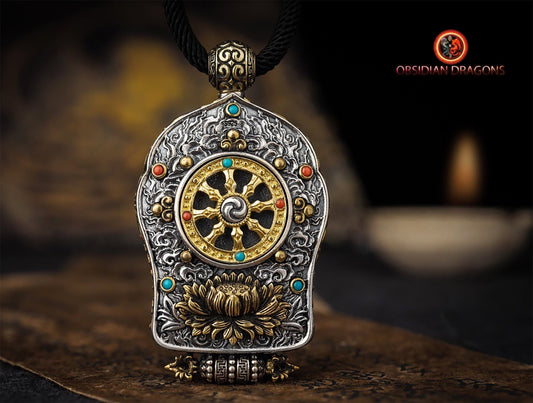

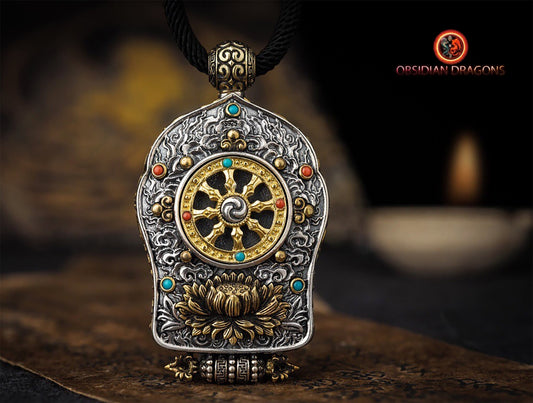


Collection: Authentic Buddhist Amulets – Tibetan Talismans
Buddhist Amulets – Tibetan Protection Talismans
🪷 Authentic Handcrafted Buddhist Amulets
Discover our collection of Buddhist amulets, Tibetan talismans, and sacred pendants selected for their rich iconography, quality materials, and precise craftsmanship. Ghau and portable reliquaries, DZI beads, pendants depicting Buddhas or bodhisattvas, objects adorned with Vajrayana mantras and symbols: each creation carries a unique history, rooted in the spiritual and artistic traditions of Asia.
A Buddhist amulet, depending on its tradition, shape, and contents, serves as a reminder of the Buddha's teachings, a devotional support, or a symbol of protection.
Some pieces are worn close to the heart; others take the form of small reliquaries intended to house an image, a mantra, a prayer, or a consecrated object. Their meaning always depends on their origin, iconography, and intended use.
At Obsidian Dragons, we pay particular attention to this diversity. Natural materials are examined with a gemologist's eye, while metalwork, sculpture, painting, and setting are evaluated according to precise artisanal criteria. We prioritize unique pieces, creations made in small series, and collaborations that respect the cultural identity of the symbols represented.
Each product description specifies the amulet's composition, dimensions, known provenance, and specific features. When a consecration, age, or origin cannot be documented, it should not be asserted. This requirement for transparency allows one to choose a Buddhist talisman for what it truly is: an object imbued with meaning, shaped by material, craftsmanship, and tradition.
🕉️ What is a Buddhist amulet?
In Buddhist cultures of Asia, the term "amulet" covers a wide variety of objects. It can refer to a small pendant depicting a Buddha, a bodhisattva, or a protective deity, but also a reliquary box, a ritual diagram, a DZI bead, a sacred formula, or an object that has been placed in a temple. Not all have the same function or religious status.
A Buddhist protection amulet is generally worn or kept as a reminder of spiritual qualities: compassion, wisdom, courage, discernment, or perseverance. The protection mentioned in texts and traditions is not always understood as an external barrier. It can also refer to the ability to recognize the causes of suffering, to pacify fear, and to guide one's actions with greater clarity.
The term "Buddhist talisman" is often used interchangeably with "amulet" in commercial contexts. In practice, the function attributed to an object depends on its context. A Buddha pendant can serve as a reminder of a teaching or support a daily intention. A Tibetan Ghau can contain an image and become a small portable shrine. A Sungkhor is linked to a protective diagram and ritual formulas. A DZI bead is worn in various Himalayan cultures as a precious object with specific associated meanings.
The value of an amulet, therefore, does not rest on an automatic promise. It arises from the encounter between the object, the tradition from which it comes, the understanding of its symbol, and the intention of the person wearing it. A carefully chosen piece can thus become a personal landmark, a support for contemplation, or a discreet companion in daily practice.
🏔️ Tibetan Amulets, Ghau, and Buddhist Reliquaries
Tibetan amulets hold an important place in Himalayan cultures. They can combine copper, bronze, silver, wood, stone, and miniature painting. Some are designed to be worn around the neck, while others can be placed on an altar or used as small travel shrines.
🛕 The Ghau, Tibetan Portable Shrine
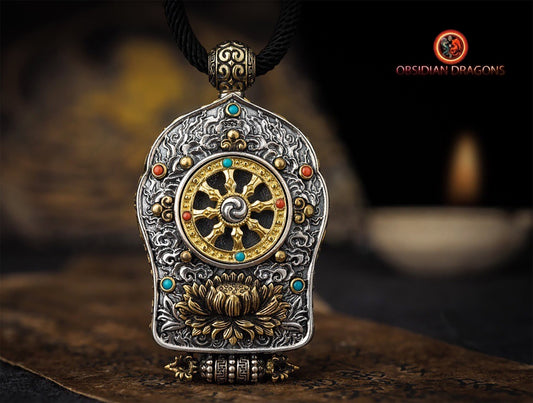
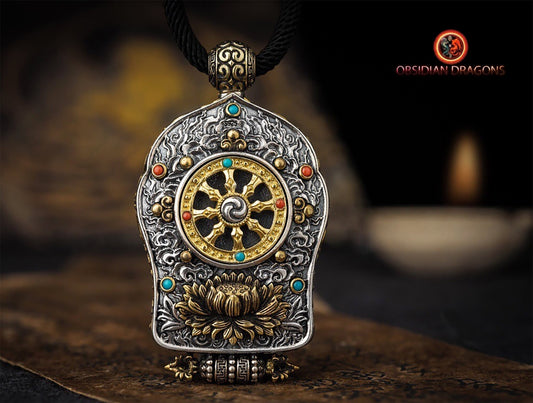
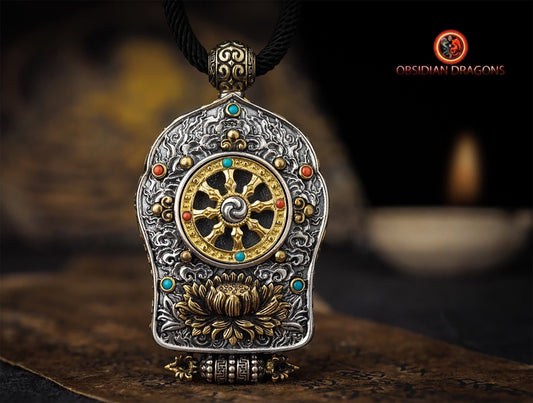
The Ghau, also spelled Gau, Ga’u, or Gawu depending on the transliteration, is an amulet box and portable reliquary used particularly in Tibetan Buddhism. Its front may feature a window revealing an image of a deity, a small sculpture, a painting, or a ritual element. Its interior can house mantras, dharanis, images of masters, small clay tsa-tsa, ritual substances, or fragments linked to a sacred place.
The richness of a Ghau lies as much in its contents as in its casing. Ancient or contemporary models can be made of repoussé copper, brass, silver, or gilded alloys. They are sometimes adorned with turquoise, coral, natural stones, or the eight auspicious symbols of Buddhism. The smallest are worn as Tibetan pendants; larger ones can be hung on the chest or placed in a practice space.
An empty Ghau is not necessarily incomplete: it may be intended to receive carefully chosen contents. Conversely, the presence of paper, powder, or a small object inside is not sufficient to demonstrate consecration. When the contents and their origin are documented, this information is specified on the item's description.
🧿 The Sungkhor, Traditional Protection Diagram
The Tibetan word Sungkhor refers to a protective support that can bring together diagrams, sacred syllables, mantras, and symbolic representations. It is often folded, wrapped in threads, or placed in a case to be carried on one's person. Its geometry and inscriptions belong to a precise tradition and can be associated with a particular practice or transmission.
Contemporary Sungkhor are sometimes integrated into pendants or reliquaries. Their external appearance varies considerably depending on the region, artisan, and desired function. To respect the nature of these objects, it is important to distinguish a decorative reproduction from a ritual support prepared in an identified religious context.
📜 Relics, Mantras, and Sacred Images
Not all Buddhist reliquaries contain relics in the strict sense. A small pendant can house a printed image, a thangka painting, a sacred formula, or a rolled prayer. Other Ghaus contain tsa-tsa, small clay molded representations depicting a deity, a stupa, or an auspicious symbol.
The presence of ancient, consecrated, or master-attributed contents must always be accompanied by provenance documentation. In the absence of documentation, we prefer to precisely describe what can be observed rather than attribute to the object a history that cannot be verified.
👁️ DZI Beads, Heaven's Beads and Himalayan Talismans
DZI beads are agate beads adorned with clear and dark patterns, long worn in various regions of the Himalayas. Their name is frequently translated as "bright," "luminous," or "splendor." Circles called eyes, lines, waves, lotuses, turtles, or geometric patterns compose a visual vocabulary to which popular traditions associate different meanings.
A DZI with one eye, three eyes, nine eyes, or twenty-one eyes does not have the same symbolic interpretation. According to interpretations, the eyes can evoke vigilance, wisdom, prosperity, protection, or the ability to overcome obstacles. These associations belong to cultural and spiritual traditions; they do not constitute guaranteed measurable effects.
Ancient DZI beads are rare, and their identification requires great caution. The surface appearance, the nature of the agate, the depth of the decoration, traces of use, and treatment processes must be examined together. A contemporary bead can be very beautiful and perfectly legitimate when presented as such. Authenticity does not consist of transforming every DZI into an antiquity but of honestly describing its material, manufacture, and probable age.

In our collection, DZI beads can be mounted alone, combined with a pendant, or integrated into a more elaborate Tibetan talisman. Some accompany a phurba, a dorje, a dragon sculpture, or a reliquary. Their selection takes into account the quality of the agate, the clarity of the pattern, the balance of the mounting, and the symbolic coherence of the creation.
👉 To delve deeper into their history, patterns, and different interpretations,
discover our guide dedicated to DZI, mysterious Tibetan heaven beads, by clicking directly on the following link: 📎 Dzis: Mysteries and Powers of Tibetan Beads
⚡ Phurba, Dorje and Symbols of Tantric Buddhism
Some Buddhist pendants replicate the form of larger ritual objects. The phurba, or kila, is a three-sided ritual dagger associated with Vajrayana Buddhism. It symbolizes, in particular, the ability to immobilize obstacles and to transform the three poisons traditionally identified as ignorance, attachment, and aversion. Worn as a pendant, it retains this iconography without replacing the consecrated object used in rituals.
To go further,
consult our article on the Phurba by clicking on the following link: 📎 Phurba - Dagger of Tantric Buddhism

The dorje, the Tibetan name for vajra, represents the indestructibility and stability of the awakened mind. Its symmetrical shape evokes the union of method and wisdom. It appears alone, crossed as a double dorje, or associated with a bell, a Ghau, a phurba, and various auspicious symbols.
👉 To learn more about the dorje
Also consult our blog article dedicated to it by clicking on the following link: 📎 Vajra - Dorje - Striking Ignorance
These forms possess great visual strength, but their interest is not limited to their aesthetics. Understanding their meaning allows one to choose a Tibetan pendant in accordance with the tradition it represents. However, specialized tantric practices may require instructions from a qualified teacher; wearing a symbol and performing a ritual are not equivalent approaches.
To go further, consult our collection of Buddhist ritual objects.
🌺 Buddhas, Bodhisattvas, and Deities Represented on Amulets
The choice of an amulet can begin with an encounter with a Buddhist figure. Each representation is recognizable by its posture, attributes, color, and hand gestures. These iconographic details make it possible to distinguish a Buddha, a bodhisattva, a protector, or a deity linked to a particular practice.
🟢 Green Tara, Active Presence of Compassion
Green Tara is depicted seated, one leg slightly extended, ready to rise to respond to the suffering of beings. She is traditionally associated with active compassion, courage, and liberation from fears. A Green Tara amulet can be chosen as a reminder of benevolent vigilance and availability towards others.
👉 To go further
I invite you to consult my blog article dedicated to Tara and all her manifestations by clicking on the following link: 📎 Tara - Mother of all Buddhas
⚪ Chenrezig, Bodhisattva of Compassion
Chenrezig, or Avalokiteshvara in Sanskrit, embodies compassion in Mahayana and Vajrayana Buddhism. His four-armed form is particularly widespread in Tibet. His hands, the lotus, and the jewel he holds refer to different aspects of the altruistic path. His mantra, Om Mani Padme Hum, is one of the most recited in the Tibetan world.
🗡️ Manjushri, Wisdom that Cuts Through Ignorance
Manjushri is the bodhisattva of wisdom. He typically carries a flaming sword symbolizing knowledge that cuts through ignorance and a lotus supporting the Prajnaparamita text, the teaching of the perfection of wisdom. A Manjushri pendant is traditionally linked to study, discernment, and profound understanding.
👉 To go further
I invite you to consult my blog article dedicated to the bodhisattva Manjushri by clicking on the following link: 📎 Bodhisattva Manjushri
💛 Jambhala, Generosity and Prosperity
Jambhala appears in several forms and colors in Tibetan Buddhism. Often depicted with a mongoose spitting jewels, he is associated with prosperity and the liberation from material obstacles that hinder practice. His symbolism, however, is not limited to the accumulation of wealth: it also recalls the importance of generosity and the just use of resources.
👉 To go further
I invite you to consult my dedicated blog article by clicking on the following link: 📎 Jambhala, Tibetan Deity of Wealth
🔵 Medicine Buddha, Aspiration for Healing
The Medicine Buddha, Bhaisajyaguru, is often depicted in blue, holding a bowl and a medicinal plant. He is associated with prayers and practices dedicated to healing, the alleviation of suffering, and clarity. An amulet representing him remains a spiritual support and naturally does not replace any medical diagnosis or treatment.
🔴 Guru Rinpoche, Transmission of Vajrayana
Guru Rinpoche, or Padmasambhava, holds a fundamental place in the history of Tibetan Buddhism, particularly within the Nyingma school. His iconography brings together the lotus, the vajra, the skull cup, and the ritual khatvanga staff. Amulets representing him are traditionally associated with the transmission of tantric teachings and the overcoming of obstacles.
☸️ The Protective Buddha and Figures Associated with Birth
In several East Asian traditions, Buddhas and bodhisattvas are associated with zodiac years. This correspondence is not a universal rule of Buddhism, but it can help some people discover a particular protective figure.
👉Consult our guide
Accessible by clicking on the following link: 📎 Find your protective Buddha according to your year of birth
💎 Natural Stones, Precious Metals, and Traditional Materials
The material determines the presence, durability, and character of each Buddhist amulet. A miniature sculpted in ebony does not produce the same sensation or contrast as an embossed copper reliquary, a DZI agate bead, or a rock crystal pendant.
Natural stones can be chosen for their color, transparency, inclusions, and consistency with the iconography. Turquoise, coral, jade, lapis lazuli, rock crystal, obsidian, and various agate varieties regularly appear in Himalayan arts. Their value depends on their exact nature, quality, and any treatments applied, rather than just a commercial designation.
Ebony and other dense woods allow for particularly precise sculpting. Their deep hue highlights the gold, turquoise, and pigments used to emphasize the faces, clothing, and attributes of the deities. Over time, the wood surface can acquire a patina from contact with hands, developing a more satiny appearance.
Copper, brass, bronze, and silver are used to fashion pendants, Ghau casings, and reliquaries. Techniques may include casting, chiseling, engraving, repoussé, gilding, and setting. Slight irregularities, when they do not affect solidity, sometimes indicate manual craftsmanship rather than uniform industrial production.
🔬 The Gemmologist's Perspective
Jeremy Guelle, a gemmologist graduated from the National Institute of Gemmology in Paris, examines the stones and gem materials used in Obsidian Dragons creations. This expertise allows for distinguishing a mineralogical description from a symbolic interpretation and presenting materials with greater precision.
A natural turquoise, a stabilized turquoise, a reconstitution, and an imitation do not possess the same nature. The same applies to coral, jade, agate, and rock crystal. When analyses or observations allow for identifying a treatment or a particularity, this information is transparently indicated.
🎨 Thangka Painting and Regong Arts from the Longwu Region
Some of our amulets are made in collaboration with traditional thangka painters from the Rebkong region, around Longwu, in the current Chinese province of Qinghai. These artists work on an extremely reduced scale to integrate the face, gestures, attributes, and environment of a deity into a pendant or miniature reliquary.
Thangka painting is not a matter of decorative improvisation. The proportions, colors, postures, and objects held by the deities follow iconographic rules passed down within the workshops. Preparing the support, tracing, successively applying pigments, and adding final details require patience, precision, and knowledge of the subject depicted.
The Regong arts, which include thangka paintings, frescoes, sculpture, and certain forms of appliqué, are inscribed on UNESCO's Representative List of the Intangible Cultural Heritage of Humanity. This recognition concerns a living artistic tradition carried on by Tibetan and Tu monks and popular artists.
By integrating these miniature paintings into wood, metal, stone, or gem material settings, artisans create Buddhist amulets that stand at the intersection of sacred art and contemporary jewelry.
🐉 Obsidian Dragons Selection: Provenance, Authenticity, and Unique Pieces
An authentic amulet is not necessarily old, and an old amulet is not automatically consecrated. These three notions — authenticity of the material, period of manufacture, and ritual status — must be distinguished. A contemporary creation made by an identified artisan can possess great artistic and spiritual value without being presented as an antiquity.
Our selection is based on the examination of the material, manufacture, iconography, and available provenance information. We observe the consistency of the sculptures, the quality of the paintings, the stability of the settings, the readability of the symbols, and the general balance of the object. For natural stones and gem materials, gemmological expertise complements this analysis.
Variations in shade, veining, inclusion, or patina are part of the identity of natural materials. A hand painting may also show subtle differences from one piece to another. These characteristics make each amulet unique and allow for recognizing the presence of artisanal craftsmanship.
We avoid arbitrarily attributing an age, a temple, a blessing, or a prestigious provenance to a piece. When information is provided by the artisan or accompanied by a verifiable element, it is presented as such. When it remains uncertain, the description is deliberately limited to what the object allows to establish.
🤲 How to Choose Your Buddhist Amulet?
Choosing an amulet often begins with an affinity for a figure, a symbol, or a material. Some people turn to Tara for her active compassion, to Manjushri for wisdom, to Chenrezig for altruism, or to Guru Rinpoche for his connection with Vajrayana. Others primarily seek a Ghau, a DZI bead, a phurba, or a Buddha pendant whose aesthetics complement their practice.
🪷 Symbolism guides the choice. Take the time to identify the deity, mantra, mudra, or motif represented. Two visually similar amulets can carry different meanings depending on their attributes.
🏔️ Tradition helps to place the object in its context. A Tibetan amulet, a Japanese omamori, a Thai Buddhist medal, and a Chinese pendant do not serve the same purposes. The Obsidian Dragons collection primarily features creations related to Tibetan, Himalayan, and East Asian cultures, specifying their origin when known.
💎 Material influences the weight, feel, and how the amulet will evolve. A polished stone offers a dense and cool presence; wood is lighter and develops a patina; copper and silver gradually reveal traces of time. Gilding, paintings, and inlays require more care.
📏 Format determines comfort. A small Buddhist pendant can be worn daily, while a more imposing Ghau has a more pronounced ritual and visual presence. The dimensions, weight, and suspension system are indicated on each product page to facilitate your choice.
🔍 Provenance deserves to be considered with the same attention as appearance. A precise description, correctly identified materials, and a consistent history offer more value than an accumulation of unverifiable qualifiers.
The most fitting amulet is one whose symbol, material, size, and history naturally find their place in your daily life or practice.
🧘 How to Wear and Respect a Buddhist Talisman?
An amulet can be worn around the neck, kept in a pouch, placed on an altar, or stored in a personal space. The use depends on its size, fragility, and the tradition from which it comes. A Ghau containing an image or a mantra is not handled exactly like a decorative stone pendant.
From the perspective of Buddhists, representations of the Buddha, sacred texts, and consecrated objects are treated with respect. It is generally avoided to place them directly on the ground, in an impure place, or to handle them carelessly. If an amulet is linked to a specific lineage or practice, the guidance of a qualified teacher takes precedence over general advice.
Wearing an amulet does not create mechanical protection independent of our actions. However, it can serve as a reminder: to return to compassion before responding, to acknowledge fear without obeying it, to observe attachment, or to remember a spiritual commitment. It is in this conscious relationship that the object takes on a personal dimension.
✨ Maintaining an Amulet, Ghau, or Tibetan Pendant
Maintenance must be adapted to the materials. Perfumes, cosmetic products, chemical cleaners, prolonged immersion, and significant variations in humidity can alter threads, gilding, paints, wood, and certain porous stones.
A soft, dry cloth is usually sufficient to remove superficial marks. Miniature paintings, thangkas, papers, mantras, and reliquary contents should not be exposed to water. An old or delicate Ghau should not be opened repeatedly, especially when its contents are documented or sealed.
Silver can naturally tarnish when exposed to air. Its cleaning should remain localized to avoid affecting paint, intentional patina, fragile stones, or gilding. Copper and bronze also develop a patina that can be part of the piece's identity.
After use, store your amulet in an individual pouch, away from impacts and friction with other jewelry. These simple actions preserve the integrity of the object while respecting its symbolic dimension.
🧵 Creation of a Personalized Buddhist Amulet
Are you looking for an amulet designed around a specific deity, material, or aesthetic intention? Obsidian Dragons can explore the creation of a personalized Buddhist pendant, a setting around a DZI bead, a painted miniature, or a symbolic element selected with you.
Each project begins with a discussion dedicated to the figure represented, desired materials, format, weight, and use of the piece. Possibilities depend on the availability of artisans, stones, and necessary elements. A custom creation takes time: it must maintain a balance between iconographic precision, mounting solidity, and aesthetic coherence.
💬 Do not hesitate to contact us to present your personalized Buddhist amulet or Tibetan talisman project.
📖 Deepening Buddhist Culture and Symbols
An amulet becomes more intelligible when one knows the history of the figure, mantra, or object it represents. Our blog dedicated to Buddhist culture gathers detailed articles on the deities, symbols, practices, and ritual objects of the Himalayan world.
If your search is oriented towards ritual daggers, dorjes, bells, and Vajrayana accessories, explore our collection of Buddhist ritual objects. For talismans related to Taoist and Feng Shui traditions, separately consult our Feng Shui amulets. This distinction allows for respecting the origin of each symbol and choosing an object with a better understanding of the cultural world from which it originates.