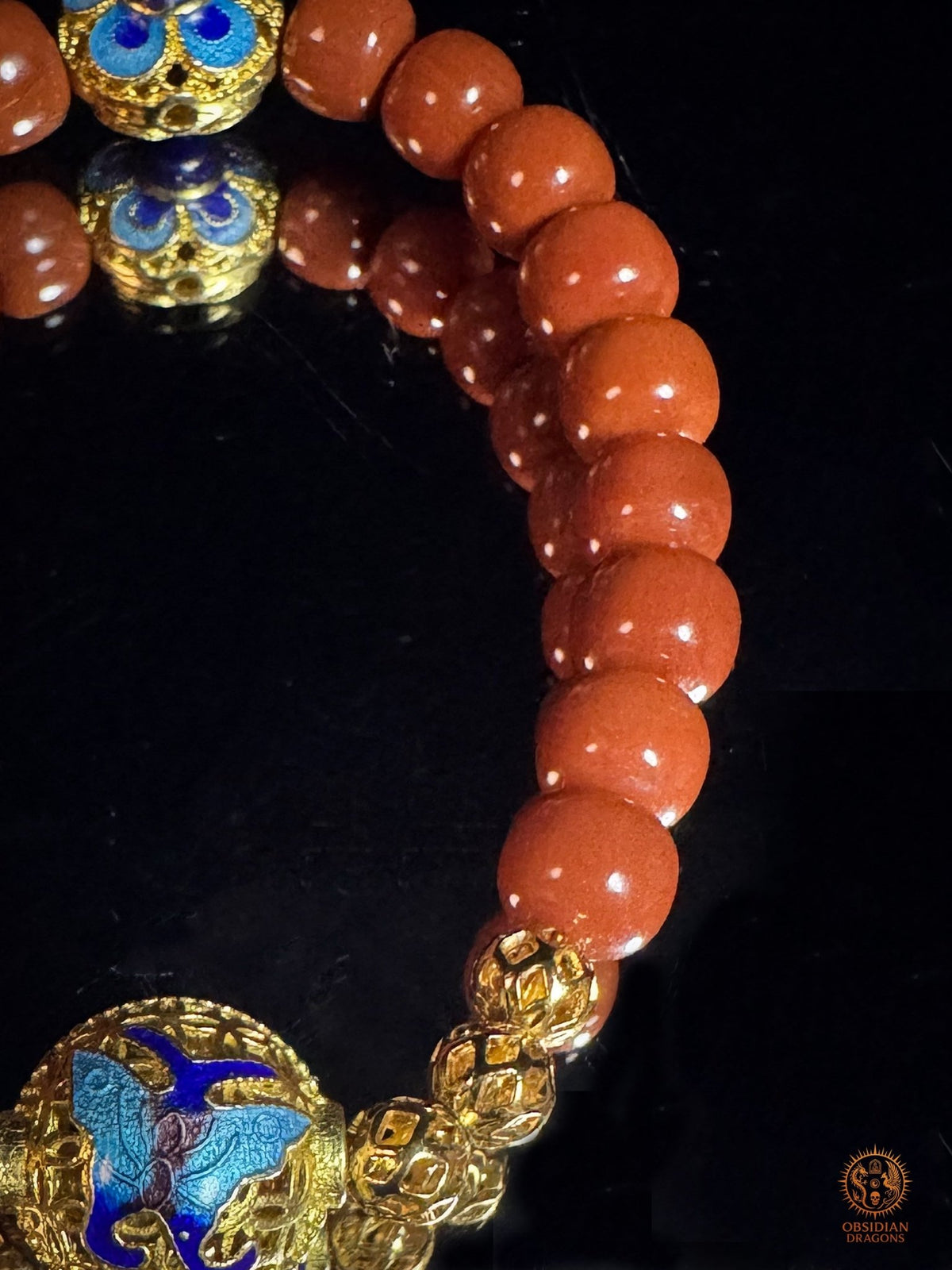
Shibazi 18-Bead Buddhist Mala Bracelet in Baoshan Nan Hong Agate: Meditation, 18 Dhatus, Sar-e-Sang Lapis Lazuli and Cloisonné Enamel on Gold-Plated Silver
The photos and video are contractually binding; you will receive exactly the Nan Hong agate mala bracelet shown here.
📿 Technical Specifications of This Nan Hong Agate Mala Bracelet
As a gemologist graduated from the National Institute of Gemology (ING – Paris, France), I personally selected and examined the Baoshan Nan Hong agate beads as well as the natural Sar-e-Sang lapis lazuli. I paid particular attention to the nature of the materials, the quality of the polish, the chromatic nuances, and the precision of the cloisonné enamels.
📿 Type of jewelry: a Chinese Shibazi mala bracelet composed of 18 beads, intended for both meditative practice and everyday wear.
🔢 Number of main beads: 18 natural Nan Hong agate beads.
🔴 Main material : Nan Hong agate, a variety of red chalcedony prized for its warm hues and chromatic depth.
🗺️ Origin of the agate : Baoshan, in Yunnan Province, southwestern China.
📏 Dimensions of each Nan Hong agate bead: 7 mm long by 8 mm in diameter.
🪷 Central element: gold-plated silver adorned with polychrome cloisonné enamel.
📐 Dimensions of the central element: 14 mm high × 14 mm wide × 11 mm thick.
🙏 Guru Bead : gold-plated silver enriched with a traditional cloisonné enamel design.
📐 Dimensions of the Guru bead : 20 mm high × 15 mm wide × 12 mm thick.
🏵️ Finishing bead : gold-plated silver decorated with polychrome cloisonné enamel.
📐 Dimensions of the finishing bead: 12 mm high × 20 mm wide × 8 mm thick.
💙 End beads : small natural lapis lazuli beads, positioned at the ends of the cord.
🏔️ Origin of the lapis lazuli: historic mines of Sar-e-Sang, Afghanistan.
🧵 Assembly: handcrafted assembly on a durable cord that maintains the flexibility required for mala practice.
🔗 Adjustment system: sliding knot placed under the finishing bead, allowing the bracelet to be easily tightened or loosened.
🖐️ Recommended wrist size: 18 to 21 cm.
⚖️ Total weight: 29.5 grams.
🎨 Color palette: deep red of Nan Hong agate, intense blue of lapis lazuli, golden shine of the metal, and polychrome colors of the cloisonné enamels.
🧘 Use: meditation bracelet, support for mantra recitation, tool for counting breaths, or spiritual jewelry worn on the wrist.
🔄 Traditional equivalence: six complete cycles of 18 beads allow you to reach the symbolic number of 108 recitations.
👐 Fabrication : handcrafted creation designed and assembled by hand in my workshop in Wudang Shan.
☯️ Style: a meeting of the Buddhist mala bracelet, the Chinese Shibazi tradition, the imperial aesthetic of cloisonné, and a contemporary red, blue, and gold composition.
Shibazi 18-Bead Mala Bracelet in Baoshan Nan Hong Agate, Sar-e-Sang Lapis Lazuli and Chinese Cloisonné
This 18-bead Nan Hong agate Shibazi mala bracelet was designed at the intersection of several worlds: that of the Buddhist mala used for recitation, that of the Chinese Shíbāzǐ 十八子, Qing dynasty court jewelry, and the artisanal creation unique to Obsidian Dragons.
I entirely conceived and assembled this model. Its architecture, the choice of its materials, the contrast between red, gold, and blue, and the balance between the central element, the Guru bead, and the pendants are unique to this creation.
Each component serves a precise function in the overall construction.
The eighteen red beads form the circle of experience. The central element creates a first axis. The Guru bead marks the turning point. The finishing bead leads to the sliding knot and the small lapis lazuli beads.
This mala bracelet is simultaneously a wrist mala, a handcrafted Buddhist piece of jewelry, a meditation bracelet, and a collectible with a strong visual presence. Red, gold, turquoise, and deep blue create a language.
🔬 What is the origin of Baoshan Nan Hong agate?
The name Nan Hong is written 南红玛瑙 in Chinese, Nánhóng mǎnǎo, and literally means "red agate from the South". It refers to a cultural and commercial variety of red agate that is particularly appreciated in China.
Agate belongs to the family of microcrystalline quartz. Its composition consists mainly of silica, SiO₂, organized into crystals so fine that they are not discernible to the naked eye. Mineralogical studies of Nan Hong agates have notably identified alpha quartz, sometimes associated with moganite and various mineral inclusions.
The red to reddish-orange color of Nan Hong is mainly due to very fine concentrations of hematite, an iron oxide with the formula Fe₂O₃. More orange or yellowish tones can also be influenced by the presence of goethite. The hue therefore depends on the nature, size, and especially the distribution of coloring minerals in the silica.
Baoshan is located in western Yunnan, a region of southwestern China that has long been associated with Nan Hong agates. Baoshan material is particularly sought after for its warm reds, dense appearance, and texture that can appear almost velvety after polishing.
The eighteen beads of this creation possess a beautiful chromatic continuity without becoming artificially identical. The nuances, slight differences in saturation, and internal manifestations of the material belong to the identity of a natural stone.
With a hardness generally ranging from 6.5 to 7 on the Mohs scale, agate is perfectly suited for a handcrafted natural stone bracelet. However, it remains a material to be respected: good hardness protects against ordinary scratches, but never makes a stone unbreakable.
🔵 Sar-e-Sang lapis lazuli: a blue from Badakhshan
Natural lapis lazuli is a rock composed of several mineral species, mainly lazurite, accompanied by varying proportions of calcite and pyrite. Lazurite is responsible for the deep blue that made this material famous.
The small beads used for the pendants come from Sar-e-Sang, in the mountainous province of Badakhshan, in northeastern Afghanistan. This Hindu Kush deposit is the most famous historic source of lapis lazuli.
Objects fashioned from this blue rock were already circulating between Afghanistan, the Indus Valley, Mesopotamia, and Egypt thousands of years before our time. Long before the expression "Silk Road" was used, lapis lazuli was already traveling through vast exchange networks connecting the mountains of Central Asia to the first great urban civilizations.
The meeting of Nan Hong agate and lapis lazuli makes this mala bracelet a truly Asian object, as it brings together materials whose history has always been linked to circulation, exchange, and cultural transformations.
✨ Gold-plated silver and cloisonné enamel: the heritage of Chinese decorative arts
Cloisonné is an enameling technique in which fine metal dividers delineate different cells, called cloisons. These spaces receive colored enamels that are then worked to form a stable, luminous, and slightly vitrified design.
Introduced and developed in China through contact with several technical traditions, cloisonné became one of the great decorative arts of the Ming and then Qing dynasties. Its bold colors, golden outlines, floral motifs, and ability to combine metal and light perfectly matched the taste of the imperial workshops.
Gold-plated silver provides a precious base here. The enamel brings color, relief, and decorative precision. The gilded metal ensures continuity between the Nan Hong, the cloisonné motifs, and the yellow cord.
This dialogue between gemstone material, metal, and color allows the creation to achieve a very particular form of luxury: an artisanal luxury based on complexity, the origin of the materials, the craftsmanship of the details, and the coherence of the whole.
🏯 What is a Shíbāzǐ 十八子 bracelet?
Shíbāzǐ 十八子 literally means "the eighteen grains" or "the eighteen elements". In the context of Chinese Buddhist jewelry, this name refers to a bracelet or small rosary composed of eighteen main beads.
The historic Shíbāzǐ 十八子 should not be confused with the contemporary expression 十八籽, also pronounced shíbāzǐ, whose last character 籽 means "seed". This second expression is now often used for modern bracelets combining different seeds or lucky materials.
Shíbāzǐ belongs to an older history.
It derives from Buddhist rosaries used to count recitations. In China, this compact form gradually became both an object of practice, a bracelet worn on the wrist, an object handled in the hand, and an ornament that could be suspended from clothing.
From the 18th century onward, the Shibazi occupied a special place in the material culture of the Qing court. It could be used for counting, accompany devotion, be given as a blessing gift, or become a personal piece of jewelry composed of sought-after materials such as jade, tourmaline, amber, coral, agate, and lapis lazuli.
The Palace Museum in Beijing notably preserves a Qing dynasty Shibazi composed of eighteen red agate beads and three lapis lazuli elements. The museum describes the combination of red and blue as brilliant without losing its gravity, dignified, and sumptuous.
The proximity to this creation is remarkable.
I did not seek to reproduce this historic object. The shapes, assembly, dimensions, and cloisonné elements belong to a contemporary creation. But the combination of eighteen red beads, lapis lazuli, gilded metal, and suspended elements has a true lineage with Chinese court bracelets.
This 18-bead Nan Hong agate Shibazi mala bracelet is therefore the heir to a 19th-century imperial architecture
To learn more about the origin of the mala, the function of the Guru bead, the symbolism of counting, and the different ways of practicing,
I invite you to consult my study on the mala, its origin, its meaning, and its use as a Buddhist rosary.
☸️ What do the 18 Buddhist beads represent?
It would be unwise to claim that all eighteen-bead malas, in all schools and at all times, have a single universal meaning.
Buddhist traditions are too vast to be reduced to a single formula.
One of the deepest readings, however, brings together the eighteen grains with the eighteen constituents or eighteen domains of experience, called aṣṭādaśa dhātu in Sanskrit and 十八界, shíbā jiè, in Chinese.
These eighteen constituents bring together the six sensory faculties, the six objects they apply to, and the six consciousnesses that result from their meeting.
👁️ The eye meets forms, and visual consciousness appears.
👂 The ear meets sounds, and auditory consciousness appears.
👃 The nose meets smells, and olfactory consciousness appears.
👅 The tongue meets flavors, and gustatory consciousness appears.
✋ The body meets tangible objects, and tactile consciousness appears.
🧠 The mind meets mental phenomena, and mental consciousness appears.
☸️ Six faculties, six objects, and six consciousnesses thus form eighteen domains.
In this reading, the eighteen beads represent the very field of our experience: that through which the world is perceived, interpreted, desired, rejected, or understood.
Other Chinese interpretations sometimes bring together the eighteen grains with the eighteen Arhats, or eighteen Luohan, figures of enlightened disciples who became particularly important in the Buddhist art and culture of China.
These readings do not necessarily exclude one another, but they should not be confused.
The symbolism of the Shibazi remains open, layered, and linked to the context in which the object is used.
In this Chinese mala with 18 red agate beads, the construction can be read as a journey between two poles. Nine beads lead from the central element to the Guru. Nine others allow you to return.
Central element → nine grains → Guru → nine grains → return.
The world appears. Consciousness traverses it. Then it returns to its starting point.
🧘 How to use an 18-bead mala to count 108 mantras?
It is indeed possible to practice with this bracelet.
This natural red agate prayer bracelet can accompany a mantra recitation, a prayer, a breathing practice, silent meditation, or a concentration sequence.
For a recitation, the practitioner traditionally begins with one of the beads located near the Guru. One repetition of the mantra is performed for each Nan Hong grain. When the eighteen beads have been traversed, one cycle is complete.
The Guru bead is not counted as an ordinary grain.
When it is reached, one generally avoids passing it. The bracelet is turned around, and then the recitation resumes in the opposite direction. This way of proceeding reminds us that the Guru does not represent an additional step to conquer, but the limit and the turning point of the cycle.
Six cycles of eighteen grains mathematically give 108 recitations.
This bracelet is an 18-bead mala for counting 108 mantras, much more compact than a full 108-bead rosary. It can easily be carried, worn on the wrist, and used during daily practice.
The sliding knot located beneath the finishing bead serves a practical purpose here. It allows the bracelet to be loosened so that the beads can move more freely between the fingers, and then tightened before wearing it.
Due to the cloisonné work, pendants, and gold plating, I recommend a gentle approach: seated recitation, breath meditation, or mindful walking. This is not the most suitable mala for vigorous prostrations or rough handling.
Each school has its own practices. When a master or lineage transmits a particular method, this transmission naturally takes precedence over any general guidance.
The bracelet can also be worn without formal practice. No consecration is required to appreciate its construction, history, and beauty. A blessing can strengthen the practitioner's personal connection to the object, but it can never replace mindfulness, discipline, and intention.
🔴 A symbolic reading of Nan Hong red
Red holds a fundamental place in Chinese culture. It evokes life, joy, intensity, celebration, and the capacity to act. In the case of Nan Hong,
Red can represent embodied energy: it is blood, fire, it is the impulse that drives us to enter the world rather than withdraw from it.
This bracelet of natural red agate possesses a solar, active, and deeply grounded visual energy. It evokes engaged awareness rather than still contemplation.
🔵 Blue as depth, wisdom, and a return to silence
Against the eighteen Nan Hong beads, the blue of the lapis lazuli and enamels acts as a counterbalance.
Red belongs to the movement of life; blue recalls the depth of the mind that observes this movement without necessarily becoming lost in it.
In many cultures, deep blue has been associated with the sky, the night, sovereignty, knowledge, and the sacred. In this creation, it can be read as the clarity necessary to prevent power from becoming agitation.
The strength of the bracelet comes from the balance between warm energy and cool energy.
☀️ Gold as a principle of organization
The gold of the plating and cloisonné does not merely serve to give the bracelet a precious appearance.
The golden lines contain the enamels, separate the colors, and organize the shapes. They prevent the blue and turquoise from dissolving into one another. They create a boundary that makes each color distinct.
This gold can symbolize clarity, the light of awareness, or the ability to give energy direction.
The yellow cord extends this light beyond the finishing bead, down to the lapis lazuli terminals. It acts as a thread of continuity between the main circle of the mala and what descends toward the hand.
☯️ Energies of the Nan Hong agate mala bracelet: vitality, wisdom, and mindful protection
This handcrafted spiritual bracelet exudes an impression of solar power, presence, courage, and mastery. Its symbolic energy is more yang than passive, but the lapis and blue enamels prevent this strength from becoming aggressive.
I would associate it with five concepts:
vitality — sovereignty — clarity — transformation — mindful protection.
Wearing this symbolic protection bracelet can serve as a reminder of a decision, a discipline, an intention, or a way of facing the world.
This is why this bracelet should be viewed as a Chinese esoteric jewel, a Chinese lucky bracelet, or a bracelet of vitality and wisdom.
If I had to condense its entire energetic reading into one sentence, it would be this:
The red strength of the world passes through the gold of awareness, deepens in the blue of wisdom, and returns transformed to the practitioner.
🪷 The paradox of a precious mala
Buddhism teaches detachment, but detachment does not necessarily mean the rejection of all beauty. Buddhist history is filled with sculptures, paintings, textiles, mandalas, reliquaries, and ritual objects made from precious materials.
The Qing court Shibazi were already at this boundary. They were objects of devotion, counting tools, gifts, ornaments, and signs of social distinction. Their richness did not necessarily erase their spiritual dimension, but rather placed it in constant tension with prestige and the desire for possession.
This bracelet can be acquired as a collector's jewel, a spiritual fashion accessory, or a precious gift. It can also become an instrument handled regularly until its brilliance is no longer merely observed but enters the rhythm of practice.
👤 Who is this Shibazi mala bracelet for?
This mala bracelet for women can also be worn as a mala bracelet for men. Its construction was designed as a unisex spiritual bracelet, even if its visual character remains particularly bold.
It is intended for the practitioner seeking a compact Buddhist practice bracelet, a meditation bracelet, a recitation mala, or a Buddhist wrist rosary for counting mantras.
It may also appeal to a collector interested in Chinese Buddhist jewelry, Qing dynasty decorative arts, cloisonné enamel, Central Asian stones, or the history of the Shíbāzǐ 十八子.
A gemology enthusiast may appreciate the meeting of Baoshan agate and Badakhshan lapis lazuli. A person drawn to symbolic jewelry may see a bracelet of transformation, courage, and clarity.
It can become a gift for a Buddhist practitioner, a meditation gift, a spiritual gift, or a blessing gift offered at a time of transition, commitment, or new beginning.
This is not a bracelet intended for someone seeking an almost invisible jewel.
From afar, one first notices the red and gold. As you approach, you discover the blue of the enamels and lapis. Only when handling it do you understand the organization of the eighteen beads, the presence of the Guru, the sliding knot, and the entire architecture of the mala.
This progression allows it to function simultaneously as a Nan Hong Yunnan handcrafted bracelet, a collectible Shibazi bracelet, a handcrafted Buddhist jewel, and a support for daily spiritual practice.
🧿 Protection bracelet or object of intention?
This creation can legitimately be perceived as a spiritual protection bracelet.
But the most interesting protection may not be the one passively expected from a talisman. It may be vigilance. The ability to recognize what unbalances us. The capacity to return to an intention when the mind becomes scattered.
In this perspective, the eighteen beads become eighteen opportunities to return to the present. The Guru marks the boundary. The reversal reminds us that there is no entirely linear progression. Practice continually brings us back to what we thought we had already understood.
🪢 A bracelet designed for the body and for practice
The sliding knot allows the object to adapt to the body.
Loosened, it facilitates the hand's passage and the manipulation of the beads. Tightened, it holds the bracelet on the wrist.
This adaptation itself has a philosophical reading.
A static practice quickly becomes an empty constraint. A living practice maintains a structure but knows how to adapt to the one who follows it.
This adjustable bracelet is particularly suitable for medium to wide wrists. Its weight of 29.5 grams gives it a tangible presence without reaching the heaviness of some monumental bracelets.
🖤 How to care for this Nan Hong agate and cloisonné bracelet?
Agate is quite resistant to wear, but the enamel, gold plating, and lapis lazuli require greater care.
I recommend removing the bracelet before showering, swimming, exercising, or any activity that may cause repeated impacts. It is advisable to avoid perfume, chemicals, chlorine, detergents, as well as steam or ultrasonic cleaning.
A soft, dry cloth is generally sufficient to remove traces left by the skin. When the bracelet is not being worn, it is preferable to keep it separate from jewelry that may strike or scratch the enamels.
The sliding knot should be manipulated by the cord rather than by pulling abruptly on the lapis lazuli pendants.
These precautions will help preserve the plating, the colors of the cloisonné, and the overall quality of the assembly.
✨ A creation between Yunnan, Badakhshan, and Qing China
This bracelet brings together several histories without confusing them. Nan Hong tells the geology of Yunnan. Lapis lazuli tells of the mountains of Badakhshan and the ancient routes connecting Central Asia to the first civilizations. Cloisonné evokes the great Chinese decorative arts.
The eighteen beads refer to the Buddhist mala, the sensory experience, and the tradition of the Shibazi.
From my workshop in Wudang Shan, I wanted to create a bracelet in which visual richness would not destroy spiritual depth. A jewel luxurious enough to evoke court ornaments, but coherent enough to remain a true wrist mala.
To discover other pieces designed around meditation, natural stones, and Buddhist traditions,
you can browse my collection of handcrafted Buddhist malas and rosaries.