Mahakala Deer Antler Mala Bracelet: 9 Hand-Carved Beads, Guru Ganesha Kangiten, Vajrayana Meditation Talisman for 108 Mantras.
The essence of this Mahakala mala bracelet
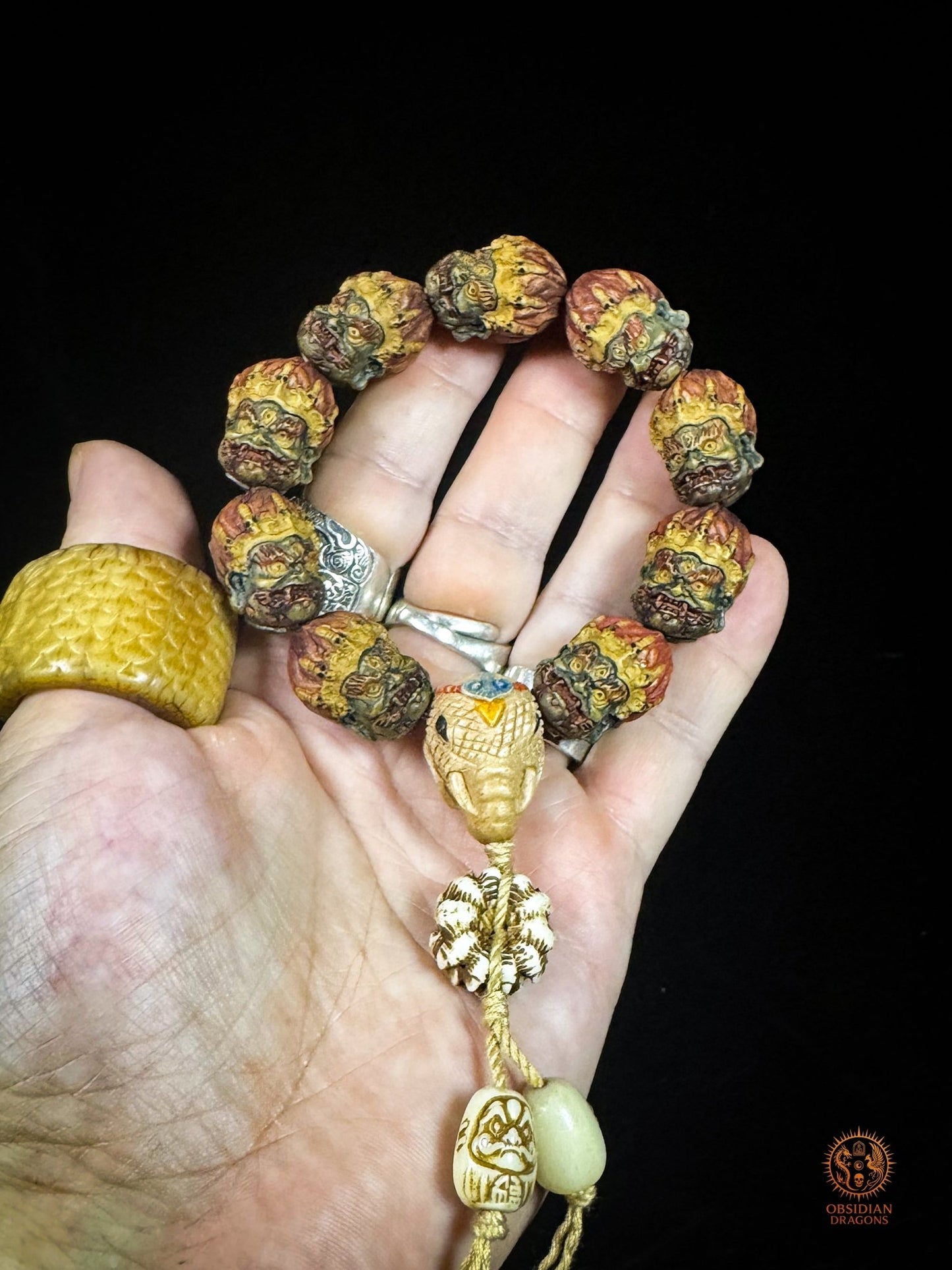
This Mahakala mala bracelet in deer antler is an artisanal creation, designed as a wrist mala, a meditation support, and a portable mandala.
🦌 Material: natural deer antler from natural shedding, hand-carved and colored with vegetable dyes.
🖤 Composition: nine Mahakala heads measuring 24 × 16 mm, carved and polychrome.
🐘 Guru Bead: Ganesha in his Japanese tantric Buddhist form Kangiten, depicted with his two intact tusks.
☸️ Symbolism: protection of the Dharma, mastery and transformation of obstacles, perseverance and awakening of consciousness.
📿 Usage: three rounds for 27 recitations, six for 54, and twelve to complete a full cycle of 108 mantras.
🐉 Finishings: dragon claws and two Daruma/Bodhidharma beads carved from deer antler.
🧵 Assembly: high-strength stretch silicone cord.
⚖️ Weight and size: 60 grams, for a wrist circumference of 18 to 22 cm.
|
This Mahakala deer antler mala bracelet is an entirely handcrafted creation by Obsidian Dragons, conceived as an object of contemplation, a counting instrument, and a portable mandala. It brings together nine carved Mahakala heads, a Guru bead representing Ganesha in his Japanese tantric Buddhist form Kangiten, a transition element adorned with dragon claws, and two terminal beads depicting Bodhidharma in the popular form of Daruma.
This composition illustrates an essential principle of Vajrayana Buddhism: obstacles are not simply rejected. They are recognized, mastered, and transformed to become a step on the path. The nine wrathful faces surround Ganesha, who is both the master of obstacles and the power capable of creating them. The circle of the bracelet thus becomes the image of an inner process: encountering what obstructs, understanding its nature, and then converting this energy into vigilance, perseverance, and awareness.
Technical characteristics of the bracelet
As a certified gemologist from the National Institute of Gemmology in Paris, I apply the same rigor of observation, selection, and control to carved deer antler and vegetable dyes as I do to any precious material.
Each component has been individually examined for the quality of its deer antler, its integrity, its natural grain, the regularity of its proportions, the precision of its artisanal carving, and the finesse of its polychromy made from ground plants.
🦌 Composition: bracelet entirely made of deer antler.
🌿 Main material:: natural deer antler from natural shedding
🖤 Main beads: nine carved and polychrome Mahakala heads.
📏 Dimensions of each head: approximately 24 mm in height × 16 mm in diameter.
🐘 Guru Bead: Ganesha in his Japanese tantric Buddhist form Kangiten.
📐 Dimensions of Ganesha: approximately 26 mm in height × 17 mm in width × 18 mm in thickness.
🐉 Lower element: carved "bi" representing dragon claws.
🧘 Finishings: two beads representing Daruma/Bodhidharma.
🌿 Colors: dye made from ground plants.
🧵 Assembly: high-strength stretch silicone cord.
⚖️ Weight: bracelet weighing 60 grams.
⭕ Recommended size: wrist circumference from 18 to 22 cm.
🛠️ Manufacturing: artisanally carved deer antler, manual assembly and finishing.
Why did I create this mala bracelet?
As a Malakara, I didn't want to simply juxtapose sacred figures for their visual power alone. I wanted to transpose the iconographic relationship between Mahakala and Ganesha into a circular object. In traditional representations, Mahakala dominates Vinayaka to subdue obstacles. On this bracelet, this vertical composition becomes a path: the nine Mahakalas lead to Ganesha, then the Guru bead forces one to pause and turn the mala.
The Mahakala deer antler mala bracelet therefore does not recount the destruction of Ganesha, but the integration of his power. The obstacle ceases to be an external enemy: it becomes a threshold of knowledge. It is this encounter between protection, lucidity, and transformation that guided every choice, from the number of beads to the dragon claws and the two terminal Daruma figures.
An entirely handcrafted creation made from deer antler
Each element of this carved deer antler bracelet has been fashioned from the same organic material. The volumes, expressions, details of the crowns, hair, skulls, and faces have been meticulously hand-worked. This entirely handmade sculpture retains the natural nuances, grain, and irregularities of the deer antler: these peculiarities are the material signature of a unique artisanal creation.
The polychromy is obtained from natural vegetable dyes. Plants are ground to produce the vegetable pigments that give the beads their red, yellow, green, brown, and dark tones. The color highlights the reliefs and differentiates the iconographic attributes. The result remains intentionally lively, with slight variations that testify to the artisanal work and the direct intervention of the hand.
Deer antler also carries a particular resonance. Through the shedding and periodic renewal of antlers, it can evoke cycles of stripping away and regeneration. In a Buddhist context, the deer also recalls the Deer Park in Sarnath, the place of the Buddha's first teaching and the turning of the Wheel of Dharma. This is a symbolic reading of the material, not an assertion of a supernatural property.
The nine Mahakala heads: compassion in its wrathful form
Mahakala, whose Sanskrit name can be translated as "Great Black One" or "Great Time," is one of the great protectors of the Dharma. In Tibetan Buddhism, he belongs to the category of Dharmapala, the guardians of teachings and practice. His terrifying appearance expresses an awakened energy capable of cutting through ignorance and dispelling what diverts beings from the path.
In several traditions, Mahakala is understood as a wrathful emanation of Avalokiteshvara, the Bodhisattva of Compassion. His iconographic fury thus becomes wrathful compassion: a compassion that takes the necessary form to confront illusions, fears, pride, and obstructing forces.
👉 To delve deeper into his history, forms, and function as a protector of the Dharma,
consult our study: 📎 Mahakala, the Great Black King and Protector of the Dharma.
The bracelet features nine Mahakala heads. Their expressions are not rigorously identical: the manual nature of the carving gives them an individual presence, like nine successive guardians arranged around the wrist.
Six-armed Mahakala and the subjugation of Vinayaka
The composition is notably inspired by a famous iconography of tantric Buddhism: that of six-armed Mahakala, or Shadbhuja Mahakala, depicted standing on an elephantine figure. The image of Mahakala trampling Ganesha should not be understood as the destruction of the Hindu god. In the tantric context, Vinayaka or Ganapati can embody the obstacle to be subdued, while Ganesha is also honored as a power of wisdom, success, and remover of obstacles.
The ritual trampling thus represents the mastery of inner and outer obstacles: ignorance, pride, attachment, confusion, adverse influences, or resistance of the mind. The Mahakala mala adopts this relationship without literally copying it. Ganesha is not crushed under Mahakala's feet; he is placed at the edge of the circle, as a Guru bead, and becomes the threshold before which the practitioner must stop, become aware, and change direction.
Buddhist Ganesha Kangiten: the obstacle becomes a door
The large Guru Ganesha bead represents the Buddhist Ganesha Kangiten, also called Shōten in Japan. Integrated into Japanese esoteric Buddhism, particularly within the Shingon school, Kangiten possesses a complex nature: he can be an obstacle maker, a power to be appeased, a guardian, or a dispenser of success.
The sculpture deliberately distinguishes itself from the popular image of Ekadanta, "the one who has only one tusk": this carved Ganesha head possesses its two intact tusks. This visual integrity here expresses an undiminished strength and a duality maintained in balance. Ganesha is not reduced to the conquered obstacle; he retains all his power, now located at the precise point where one cycle ends and another can begin.
This position gives the Guru a particularly rich paradoxical meaning. Ganesha represents what blocks the way, but also the intelligence that allows one to recognize the blockage. He is the trial and its resolution, the guardian and the door.
👉 To better understand the integration of the divine elephant in Buddhist traditions,
consult our article: 📎 Ganesha, the Divine Elephant in Buddhism and its Spiritual Integration.
Why nine beads and a Guru bead?
This 9-bead mala is a condensed form of a Buddhist rosary. The nine Mahakalas are the counting beads; Ganesha is the head bead, present in the composition but excluded from the count. The Guru bead traditionally represents the teacher, the inner guide, or the principle of orientation. It marks the beginning and completion of mantra recitation.
The number nine can first be read as three multiplied by three. In the symbolic reading proposed by Obsidian Dragons, it relates the body, speech, and mind to three levels of work: outer, inner, and secret. The nine beads become nine passages of purification, nine reminders of vigilance, or nine ways to observe what obstructs.
The number can also evoke the nine vehicles presented in the Nyingma tradition; this correspondence is a possible resonance and not a universal meaning imposed on all malas.
The whole forms a protective mandala: the nine manifestations surround a tenth element that is not counted. Nine belongs to the movement of the cycle; Ganesha occupies the turning point. This architecture gives the bracelet an esoteric reading of the one and the multiple: nine manifested forces around an axis that remains outside the count.
A mala for 108 recitations
The choice of nine beads also has a precise function. Twelve full rounds of the nine beads yield 108 recitations:
9 beads × 12 rounds = 108 mantras.
This mala for 108 recitations thus transposes the traditional grand mala into a wrist format. Three rounds allow for 27 recitations, six rounds for 54 recitations, and twelve rounds for a cycle of 108 mantras. In Buddhist traditions, 108 can notably evoke the passions or obscurations that the practitioner seeks to recognize and overcome.
👉 To discover the origin, composition, and uses of the mala,
consult our complete guide: Mala: origin, meaning, and use of the Buddhist rosary.
The "bi" with dragon claws: grasping and channeling power
Below Ganesha is a transition element, or "bi", also carved from deer antler. It represents deer antler dragon claws clasping the cord. In the symbolic reading of the piece, the claws grasp the force that has just been recognized and mastered: they contain the energy, direct it, and prevent it from dispersing.
The dragon thus becomes the mediator between the confrontation with the obstacle and the perseverance necessary to continue the path. It also introduces the unique identity of Obsidian Dragons into a composition where Himalayan, Indian, Chinese, and Japanese traditions resonate with each other.
Daruma and Bodhidharma: fall, rise, start again
The bracelet concludes with two Daruma beads, also made from deer antler. They represent Japanese Bodhidharma in his popular form: the Daruma, a figure of determination, discipline, and perseverance.
After the strength of Mahakala, the ambivalence of Ganesha, and the grasp of the dragon, Daruma formulates the conclusion of the object: falling does not end the path. One must get up, resume practice, and continue. The terminal beads thus give a concrete dimension to the transformation of obstacles.
How to use this Buddhist mala bracelet?
This Buddhist mala bracelet can be used as a wrist mala, a contemplation aid, or a daily reminder. At the crossroads of the Tibetan Buddhist mala and the Japanese juzu, it does not claim to replace the specific prescriptions of each lineage. It offers a coherent contemporary structure for concentration, counting, and symbolic study.
- Place the bracelet in your hand and start with the first Mahakala head next to Ganesha.
- Recite a mantra, a prayer, or formulate an intention on each head.
- Advance the hand-carved Mahakala beads one by one with your thumb.
- When you return to Ganesha, do not count and do not cross the Guru bead.
- Turn the mala around and continue in the opposite direction.
- Perform three, six, or twelve rounds depending on whether you wish to count 27, 54, or 108 recitations.
Specific mantras, visualizations, and rites of Mahakala or Kangiten traditionally belong to qualified transmissions. Without initiation, this meditation bracelet can accompany a breathing practice, personal prayer, philosophical contemplation, or a public mantra adapted to the practitioner's tradition.
Meditation, breathing, and observation of obstacles
A slow breath can be associated with each bead. When facing Ganesh, the practitioner pauses and observes what within them resists or seeks to avoid passing. Each cycle then becomes a method of attention: nine breaths, nine observations, then a conscious turning point.
The mala can also be used to name nine personal obstacles—fear, dispersion, attachment, anger, pride, doubt, inertia, confusion, or discouragement—and then associate them with nine opposing qualities. This method is a contemporary contemplative proposition, not a canonical ritual.
Worn object, symbolic talisman, or altar support
Worn on the wrist, this Tibetan Buddhist bracelet acts as a tactile reminder of vigilance and perseverance. Its weight and the significant relief of the carvings promote an immediate physical presence. It can also be kept on a personal altar, used as an iconographic study support, or presented as an artisanal Buddhist jewel.
It can be considered a Buddhist talisman of spiritual protection, provided these terms are understood in their traditional and symbolic sense: the object guarantees no magical, medical, or material effects. Its function is to support an intention, recall a teaching, and accompany inner discipline.
A Mahakala bracelet designed as a circular teaching
This Mahakala antler wood mala bracelet intentionally unites several spiritual territories: Mahakala's protective function in Vajrayana, Ganesh's ambivalence in Buddhist tantrism, Kangiten's Japanese form, Daruma's perseverance, and the dragon's transformative power. Each of these elements retains its identity, but all participate in the same movement.
Its interpretation can be summarized as follows: Mahakala reveals and subdues the obstacle; Ganesh guards its threshold; the dragon seizes its energy; Daruma teaches to get back on track. The nine beads always lead back to the Guru bead, and the Guru bead necessitates the turning point. The practitioner therefore does not flee the obstacle and does not cross it unconsciously: they stop before it, recognize it, change direction, and continue their work.
Both an antler wood bracelet, a miniature art object, and a mantra recitation tool, this bracelet asserts a demanding conception of spirituality: true protection does not consist of denying difficulties, but of developing the lucidity and strength necessary to transform them.
Do not flee the obstacle, but seize it, transform it, and make it the threshold of the path.
When the object becomes the path
A creation of this nature can never be reproduced identically. The grain of the antler wood, the sculptor's gesture, the nuances of vegetable polychromy, and the unique expression of each of the nine Mahakala give this mala an absolutely singular presence.
If its symbolism resonates with your own path, do not consider it merely a bracelet. Welcome it as a practice companion, a guardian of your intentions, and the silent witness of the obstacles you choose to transform.
Bring this Mahakala mala into your story.
🔗 Discover our collection of authentic malas
Each Buddhist mala I create is a unique piece. This Mahakala antler wood mala bracelet represents only one facet of my spiritual, artisanal, and gemmological expertise.
🧵 All my malas are handcrafted with carefully selected stones, natural materials, and ritual elements, respecting spiritual traditions and artisanal ethics.
👉 Discover our collection of authentic malas and find the sacred companion that will resonate with your personal path.
🔗 Discover our bracelet collection
Dive into the world of Obsidian Dragons and explore our collection of natural stone bracelets. Each piece is carefully selected, handcrafted, and certified for its quality and authenticity.
➡️ See all our bracelets on obsidian-dragons.com and find the energetic bracelet or protective jewel that will accompany you with meaning and elegance.