Traditional Lug Mig Tibetan Eye Amulet Necklace in Ocular Agate – Three-Eyed Dzi, Tara Dzi, Lord Dzi, Amulet of Protection, Wisdom and Discernment
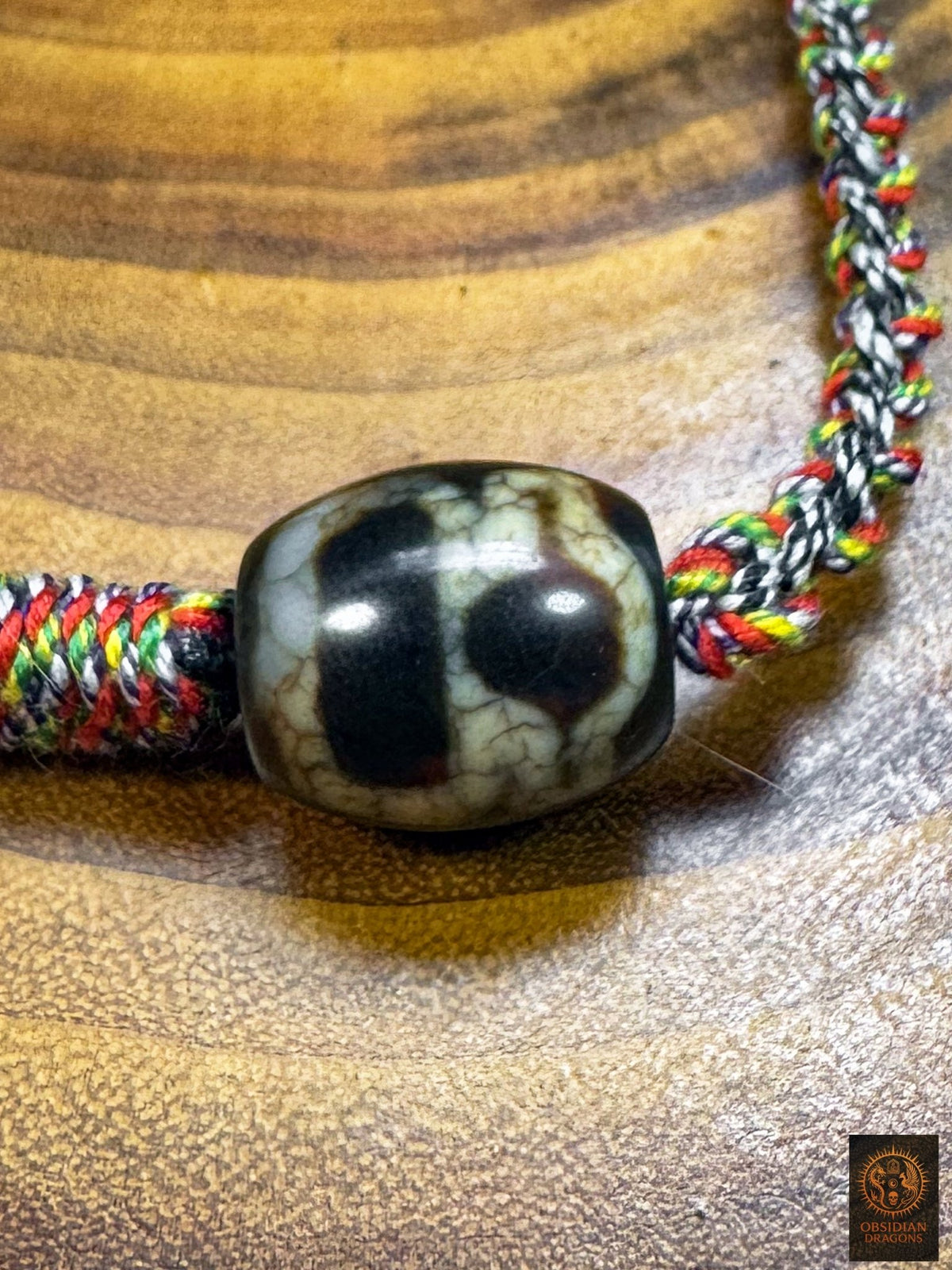
The photos and video are contractually binding; you will receive exactly the traditional Tibetan Lug Mig eye amulet necklace presented here.
Technical Features of This Tibetan Eye Amulet Necklace
🧿 Type of Jewelry: an adjustable handcrafted Tibetan necklace, fully braided and mounted by us around a traditional Lug Mig pendant.
🪨 Main Pendant : Traditional Lug Mig or Luk Mik in natural carved agate, also referred to as a "Tibetan eye amulet," "Tibetan ocular agate," "Tibetan eye stone," or "carved Celestial Eye stone."
📍 Origin of the Lug Mig: Gyalthang region of Tibet, present-day Shangri-La, Diqing Tibetan Autonomous Prefecture, northwest Yunnan, China
📏 Dimensions of the Lug Mig Pendant: approximately 67 mm long × 14 mm high × 19 mm thick.
👁️ Agate Characteristics: several natural eye structures, with a particularly prominent central eye surrounded by secondary formations.
🪙 Back of the Pendant: engraved patterns representing coins.
👁️ Three-Eyed Dzi: two three-eyed Dzi beads placed symmetrically on either side of the pendant.
📐 Dimensions of the Three-Eyed Dzi Beads: approximately 10 mm in diameter each.
🟢 Tara Dzi: a Tara Dzi bead, associated in contemporary Dzi traditions and interpretations with protection, courage, overcoming fear, compassion, and the ability to overcome obstacles.
🧭 Lord Dzi: a Lord Dzi bead, associated with discernment, inner authority, support, favorable relationships, and the ability to recognize circumstances or people likely to help one progress.
📐 Dimensions of the Tara Dzi and Lord Dzi: approximately 15 mm long × 13 mm in diameter each.
🧵 Assembly : handcrafted multicolored (cotton) braiding, specifically designed around the Lug Mig pendant and its four Dzi beads.
🎨 Braiding Colors: a combination of black, white, red, and green threads with metallic shades, reminiscent of certain Himalayan cords and assemblies.
⭕ Adjustment System: a sliding mount allowing the necklace length to be freely adjusted.
📿 Wearing: this unisex Tibetan necklace can be worn long as a Tibetan amulet or closer to the neck, depending on personal preference.
⚖️ Total Weight: approximately 46 grams.
🧘 General Symbolism : vigilance, intuition, symbolic clairvoyance, wisdom, discernment, protection, courage, inner stability, personal authority, opportunities, symbolic prosperity, and decision-making ability.
🏔️ Cultural Universe: Tibetan Buddhism, Himalayan traditions, Yunnan Tibetan culture, Lug Mig symbolism, Dzi beads, Tara, protective beliefs, and the material culture of the Tibetan Plateau.
From Gyalthang to the Workshop: The Birth of a Tibetan Eye Amulet Necklace
I found this pendant in the mountainous regions of northwest Yunnan with a strong Tibetan culture, in the Gyalthang region, present-day Shangri-La, within the Diqing Tibetan Autonomous Prefecture.
In this dark agate, several light-colored concentric structures appear, giving the impression that eyes are literally emerging from the material.
In the center, one of them dominates the entire composition, making it almost impossible not to look at it.
And the more you observe it, the more you realize that the entire Tibetan eye amulet necklace seems organized around a single idea: learning to see before acting.
On either side of the Lug Mig pendant, we placed a three-eyed Dzi bead. Above one is a Tara Dzi; above the other, a Lord Dzi.
The result is a Tibetan necklace entirely handcrafted and braided by us around a stone that cannot be precisely reproduced.
👁️ Lug Mig: Tibet's "Magic Eye"
The Tibetan term Lug Mig — ལུག་མིག — literally means "sheep's eye."
The transcription Luk Mik is also found in some Western publications and commercial listings.
Under these names are grouped agates whose natural structures form circles, rings, concentric bands, or formations that immediately evoke eyes.
In the West, terms such as Tibetan magic eye, Tibetan eye stone, Tibetan eye agate, Tibetan ocular agate, Tibetan eye amulet, or natural ocular stone are therefore used.
In China, these stones are notably associated with the term 天眼石 — Tiānyǎn shí — literally "Celestial Eye Stone."
When they are subsequently carved, the expression 雕刻天眼石 can be understood as "carved Celestial Eye stone."
On this Tibetan Lug Mig pendant, the appeal lies precisely in the meeting of natural structure and human intervention.
The carver did not create the eye from scratch; he built his work around what the agate already offered.
This is what profoundly distinguishes a genuine natural agate Lug Mig pendant from a simply painted or artificially added design.
On this traditional Lug Mig Tibetan eye amulet necklace, the large central eye acts as the focal point of the entire composition.
🪨 Agate: A Natural Architecture of Silica
Gemmologically, agate belongs to the chalcedony group, microcrystalline forms of quartz composed mainly of silicon dioxide, SiO₂.
Natural agate generally forms when silica-rich solutions circulate through cavities or fissures in the rock.
Over time, the silica gradually deposits.
These successive deposits produce bands, colored zones, clouds, lines, concentric layers, and sometimes orbicular structures.
When the stone is subsequently cut in a favorable orientation, some of these structures take on the appearance of an almost perfect circle.
On an eye-patterned agate, the effect can be extremely striking, as our brains naturally tend to recognize familiar shapes in random structures.
But behind this almost supernatural impression lies a mineralogical reality: the gradual growth of chalcedony, variations in composition, successive bands, and the natural architecture of silica.
It is precisely this boundary between science and symbolism that makes ocular agate so interesting.
Since each structure originates from the stone's own history, every carved Celestial Eye stone remains unique.
This is why this Tibetan agate necklace cannot be exactly reproduced.
Lug Mig and Dzi: Two Related, but Not Identical Universes
Lug Mig is frequently compared to the famous Tibetan Dzi beads.
This comparison is understandable because in both cases, agate holds a central place, the eye constitutes one of the most important motifs, and the stone is imbued with a protective, symbolic, or spiritual function.
But one distinction remains essential.
In a traditional Lug Mig, the eye is sought above all in the natural structure of the agate.
On many Dzi beads, by contrast, the visible patterns have been intentionally produced, transformed, or enhanced by various processes applied to the stone.
This does not prevent these two universes from eventually coming together in popular traditions, the trade of Himalayan objects, and modern classifications.
Dzi beads then organize this gaze around several intentions: wisdom, protection, discernment, and symbolic prosperity.
To learn more about the history of Dzi beads, their manufacture, their motifs, and the beliefs associated with them,
you can read our article on Dzi Beads: Mysteries and Powers of Tibetan Beads.
🧿 Why Is the Tibetan Magic Eye Considered a Protection?
The eye is probably one of humanity's oldest protective symbols. It sees what approaches, observes, distinguishes, and may recognize danger before it is too late.
In many cultures, this ability has symbolically transformed the eye into an apotropaic motif, meaning one intended to avert or repel what is considered harmful.
In Himalayan traditions, wearing a Tibetan eye amulet therefore symbolically means keeping an open eye on what surrounds us.
This idea is where much of Lug Mig's reputation as a Tibetan talisman, Tibetan protection amulet, Tibetan spiritual stone, or protective eye originates.
🔮 The "Tibetan Magic Eye": Seeing Beyond Appearances
The expression "Tibetan magic eye" may seem highly esoteric, yet its philosophical significance far exceeds the idea of magic.
In Himalayan popular and esoteric traditions, ocular stones have been associated with intuition, subtle perception, symbolic clairvoyance, and spiritual vigilance.
It reminds us that most important decisions begin with the quality of our gaze on what is already before us.
A Stone from Gyalthang, in Northern Yunnan
This Lug Mig pendant comes from Gyalthang, the traditional Tibetan name for present-day Shangri-La, in the Diqing Tibetan Autonomous Prefecture in northwest Yunnan.
The Tibetan region of Yunnan has long constituted a transition zone between the Tibetan Plateau, the Chinese worlds, and the Southwest Asian routes.
For centuries, population movements, trade routes, pilgrimages, and religious exchanges have brought stones, ritual objects, amulets, artisanal techniques, and beliefs through the region.
It is precisely this context that makes objects from Gyalthang particularly interesting.
The same object can simultaneously belong to Himalayan craftsmanship, Tibetan culture, popular Buddhism, local protective beliefs, and family practices.
This Lug Mig necklace from Shangri-La can be appreciated as a Tibetan piece of jewelry, Himalayan amulet, protection talisman, collector's stone, meditation object, or simply as a remarkable example of carved ocular agate.
The Back of the Lug Mig: Engraved Monetary Motifs
The back of the pendant features several engraved patterns representing coins.
Their presence is all the more interesting because the entire necklace also develops a symbolic field related to prosperity.
In many cultures, money is much more than a mere instrument of exchange. It evokes circulation, the movement of resources, security, and transmission.
🟢 The Tara Dzi: Protection, Courage, and the Ability to Move Forward
Above one of the two three-eyed Dzi beads is a Tara Dzi.
Tara holds an immense place in Mahāyāna and Vajrayāna Buddhism, particularly in Tibet.
Her name is commonly interpreted as "she who makes cross over," "she who saves," or "the Liberator."
Green Tara is often depicted in a posture where one of her legs appears ready to leave the meditative seat.
Tibetan traditions also associate Tara with the Eight Great Fears, which can be understood as external dangers but also as internal states that can imprison us.
In the contemporary symbolism of Dzi beads, the Tara Dzi is thus associated with protection against fears, spiritual courage, compassion, and the ability to overcome obstacles.
To learn more about its history, forms, iconography, and role in Tibetan Buddhism,
you can read our article on Tara.
👁️👁️👁️ The Two Three-Eyed Dzi Beads: Intuition, Wisdom, and Symbolic Prosperity
Two three-eyed Dzi beads have been placed on either side of the pendant
Their symmetrical presence is essential to the construction of this Tibetan necklace with three-eyed Dzi beads.
A single three-eyed Dzi would have constituted a secondary symbol.
Two identical beads, on the contrary, create a true axis.
In traditional interpretations of Dzi beads, the three-eyed motif is associated with several concepts.
The first is intuition: the three eyes evoke the ability to look at a situation from several angles, to move beyond the first appearance, and to develop a finer perception.
This is why the three-eyed Dzi is sometimes associated with symbolic clairvoyance and discernment.
The second is wisdom: seeing more is useless if one does not know how to interpret what one sees.
The Dzi of wisdom then becomes the symbol of a passage between perception and understanding.
The third is protection: the three eyes are considered as many protective gazes accompanying the wearer.
The fourth dimension is related to prosperity: the three-eyed Dzi is very frequently presented in contemporary literature dedicated to Dzi beads as a prosperity Dzi, an abundance Dzi, or a good fortune Dzi.
Some commercial texts associate it with the Chinese "three stars" of good fortune and values such as wealth, social success, and longevity.
It is also associated with Jambhala, deity of wealth in Buddhist traditions.
🧭 The Lord Dzi: Discernment, Support, and Inner Authority
Above the second three-eyed Dzi bead is a Lord Dzi.
In the symbolism of Dzi beads, the Lord Dzi is associated with support, authority, dignity, discernment, and the ability to encounter favorable circumstances or people.
The Lord Dzi can be understood as a Dzi of support or a Dzi of discernment.
It is also associated with success, influence, opportunities, and relationships with people capable of helping you progress.
The Dzi Monseigneur symbolically helps you know which direction to move in and with whom.
From perception to discernment
When the Lug Mig, two three-eyed Dzi, a Tara Dzi, a Dzi Monseigneur, and the monetary motifs engraved on the back of the pendant are brought together, an extremely coherent language emerges.
The Lug Mig brings vigilance, the three-eyed Dzi deepen intuition, wisdom, and the ability to discern, Tara introduces courage and protection against fear, the Dzi Monseigneur evokes support, inner authority, and the ability to recognize the right circumstances, and finally, the monetary motifs recall the concrete world: exchange, work, acquisition, personal or professional success, and symbolic prosperity.
The symbolic energy of this Tibetan magic eye necklace can therefore be summarized as follows:
see, understand, discern, choose, act, and build.
This is why the expressions Tibetan wisdom and protection necklace, Tibetan intuition and clairvoyance necklace, or Tibetan prosperity and wisdom necklace fairly accurately describe its identity.
Who is this necklace for?
This unisex Tibetan necklace may naturally interest a collector of Lug Mig, Dzi, eye agates, or objects related to Himalayan cultures.
I also see it particularly well suited for someone who has to make decisions.
Someone who simply wishes to maintain greater clarity when going through a period of change.
In this sense, it can be understood as a Tibetan decision-making necklace or a Tibetan discernment amulet.
At 46 grams, the necklace also maintains a real presence without becoming excessively heavy.
Why wear a Lug Mig, a Tibetan magic eye?
Wearing a Tibetan Lug Mig can meet several sensibilities.
The first is cultural: the Lug Mig belongs to this vast family of Himalayan objects where natural stone, craftsmanship, popular beliefs, protection, and spirituality meet.
The second is gemmological: a Tibetan Lug Mig eye agate is a fascinating object in itself. The structure of the stone tells a geological story that the carving reveals rather than conceals.
The third is aesthetic: a natural Tibetan magic eye pendant has something immediately hypnotic about it. The gaze is drawn to the stone because it seems to be looking back.
The fourth is protective: those who adhere to popular traditions can wear a Lug Mig as a Tibetan protective eye amulet, Tibetan protection stone, or Tibetan talisman.
The fifth is philosophical: learning to see is one of the most difficult exercises there is. To see what is really in front of us, to see danger without exaggerating it, an opportunity without idealizing it, one's own fears, another person's motivations, to see clearly enough to then be able to decide how to act.
On this traditional Lug Mig Tibetan magic eye necklace, this dimension is amplified by the two three-eyed Dzi, Tara, and the Dzi Monseigneur.
Buddhism, Bön, and Tibetan popular traditions
It would be too simplistic to present all Tibetan or Himalayan objects as belonging strictly to philosophical Buddhism.
The material culture of Tibet and the Himalayas results from multiple layers: Tibetan Buddhism, Bön traditions, local beliefs, domestic rituals, protective practices, family transmission, trade, and regional influences.
Eye stones, Dzi, and amulets often belong more to this meeting place than to a single doctrinal corpus.
Some interpretations come from ancient beliefs. Others have been reformulated over time.
Some meanings that are now very widespread in the Dzi trade are relatively contemporary.
Frequently asked questions about this Tibetan magic eye necklace
👁️ What is a Tibetan Lug Mig?
The term Lug Mig refers to agates whose natural structures resemble an eye.
You may also encounter the spelling Luk Mik as well as the terms Tibetan magic eye, Tibetan eye agate, Tibetan eye stone, or Celestial Eye stone.
On this pendant, the large central eye belongs to the agate's natural architecture and was subsequently enhanced by lapidary work.
🧿 What is the difference between a Lug Mig and a Dzi bead?
The Lug Mig and the Dzi belong to two close but different worlds.
In a Lug Mig, the eye effect is based primarily on the agate's natural structures.
On many Dzi beads, the patterns were deliberately produced or enhanced by various processes applied to the stone.
This necklace deliberately brings together these two traditions: a natural Lug Mig pendant surrounded by four Dzi beads.
👁️👁️👁️ What is the meaning of the three-eyed Dzi?
The three-eyed Dzi are primarily associated with intuition, wisdom, discernment, protection, and symbolic prosperity.
They can also be presented as Dzi of clairvoyance, Dzi of wisdom, or Dzi of prosperity.
Some modern sources associate them with Jambhala or symbols of good fortune.
🟢 What is the meaning of the Tara Dzi?
The Tara Dzi symbolically incorporates certain qualities associated with Tara: protection, compassion, courage, and the ability to overcome obstacles.
In this necklace, Tara represents above all the ability to act despite fear.
🧭 What is the meaning of the Dzi Monseigneur?
The Dzi Monseigneur is associated with support, discernment, inner authority, dignity, and favorable relationships.
It can be understood as the symbol of the ability to recognize the people, circumstances, or decisions that can help us move forward.
🔮 Does this necklace really have protective powers?
The protection attributed to the Lug Mig, Dzi, and Himalayan amulets stems from beliefs, symbolic traditions, and spirituality.
We therefore use the terms protection necklace, Tibetan amulet, or Tibetan talisman in their cultural and symbolic sense.
🧵 Is the necklace really handmade?
Yes. The Lug Mig is the starting point of the creation, but the assembly and braiding were done by us.
Each Dzi was positioned according to the overall composition to achieve true coherence between the central stone, the two three-eyed Dzi, Tara, and the Dzi Monseigneur.
It is therefore not an industrial necklace to which a pendant was simply added.
👤 Is this necklace intended for men or women?
The necklace is completely unisex. Its adjustable construction allows it to be worn closer to or further from the neck depending on the desired style.
It has a real presence while remaining suitable for regular wear.
💧 Can this necklace be worn in the shower or in water?
We advise against it. Agate itself generally withstands occasional contact with water, but the necklace features handmade braiding and several assembled elements.
Repeated immersion can loosen the fibers, promote the buildup of dirt in the braiding, and reduce the lifespan of the assembly.
It is best to remove the necklace before showering, bathing, or swimming.
🧴 Should perfumes and cosmetic products be avoided?
Yes. Perfumes, oils, creams, hair products, detergents, and chemicals should not be applied directly to the necklace.
Ideally, apply cosmetic products before putting on the jewelry and wait a few moments before wearing it.
🧼 How to clean a Lug Mig necklace and its Dzi?
Cleaning should remain gentle.
Use a clean, soft, and slightly damp cloth to remove traces from the agate and beads.
Dry immediately afterward with a clean cloth.
Avoid solvents, detergents, ultrasonic cleaners, and steam cleaners.
☀️ Can the necklace be left in the sun for a long time?
Occasional exposure does not pose any particular problem for agate.
As a precaution, however, we advise against prolonged exposure to intense heat or sunlight through glass.
The braiding and certain surface treatments of the beads may be more sensitive than the stone itself.
📦 How to store the necklace when it is not being worn?
Store it flat or slightly coiled, in a dry environment away from strong temperature fluctuations.
Avoid placing heavy or metallic jewelry directly on top of it.
Agate is resistant, but it is not indestructible.
🪨 Is agate fragile?
Agate has good hardness and is perfectly suited for jewelry.
However, it can chip if it strikes a hard surface with great force.
As the Lug Mig pendant is carved and features several raised areas, it should be handled with greater care than a simple round bead.
🔥 Can the Lug Mig be "purified" or "recharged"?
If you wish to perform a personal ritual with your necklace, choose methods that pose no risk to the stone: meditation, chanting a mantra, or simply a moment of silence.
We advise against salt, salt water, burial, or any method that could physically damage the jewelry.
It is not necessary to damage a stone to give it meaning.
📸 Will the necklace received be exactly the one shown in the photographs?
Yes.
It is a unique piece.
The photographs and video are contractual: you will receive exactly the traditional Lug Mig Tibetan magic eye necklace shown on this page.
Explore the world of Buddhist spiritual protections on obsidian-dragons.com
Each Obsidian Dragons creation is conceived as the meeting of several dimensions: natural stone, gemmology, history, culture, craftsmanship, and symbolism.
You can discover other spiritual jewelry, Tibetan talismans, meditation objects, and protective amulets
in our dedicated collection: 👉 Buddhist Amulets – Protection and Wisdom Talismans