Buddhist Mala in Amazonite, Nan Hong Agate and Cinnabar – 108 Amazonite Beads from Russia, Nan Hong Agate from Yunnan, Vairocana, Om Mani Padme Hum, Bāguà, Yin-Yang, Dorje and 999 Silver – Handcrafted Creation - Natural Materials
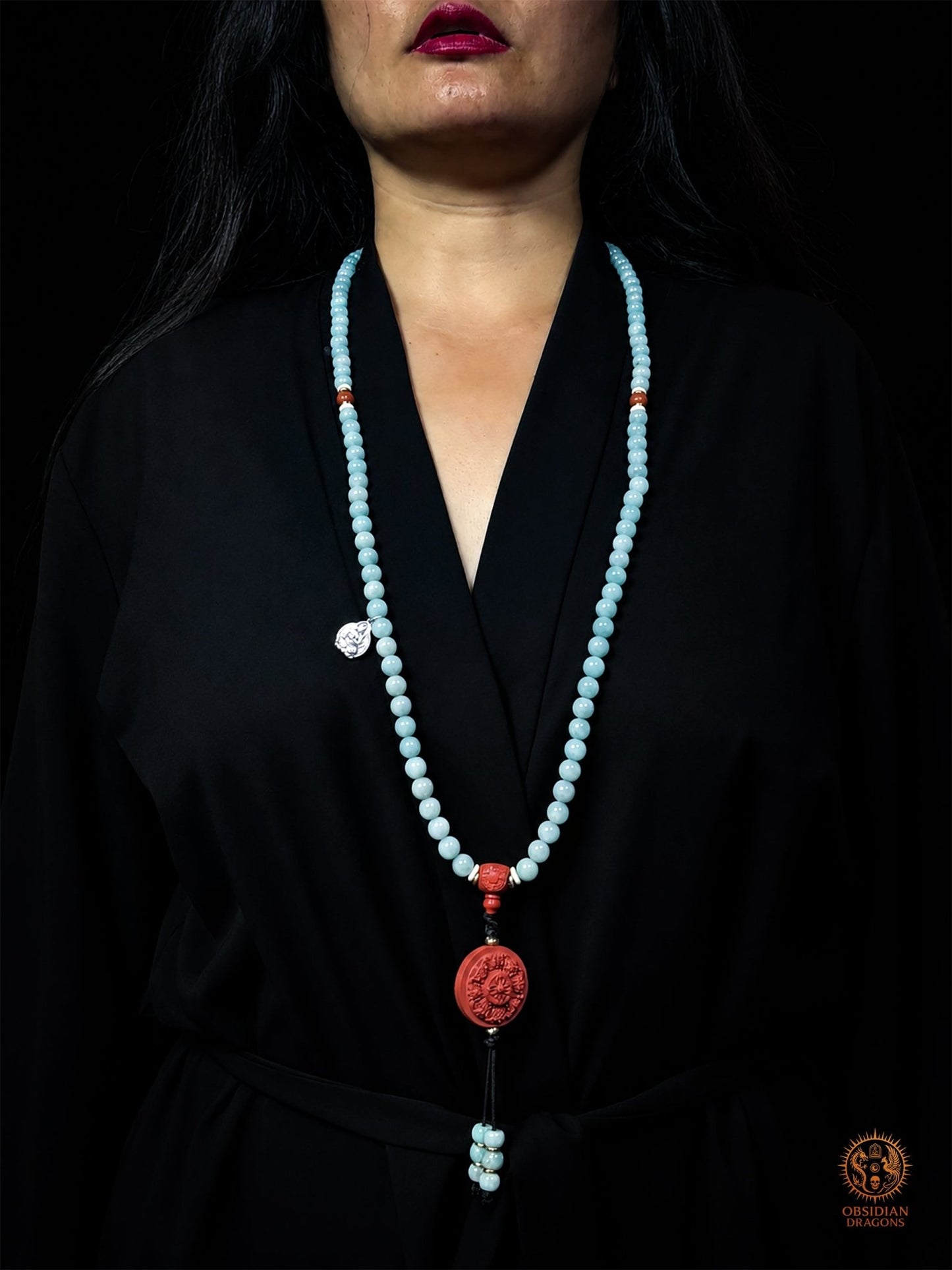
Photos and video are contractual, you will receive exactly this amazonite mala
Technical specifications of this amazonite mala
As a certified gemologist from the National Gemology Institute (ING – Paris, France), I personally select the natural materials used in my creations. Each element has been personally examined to verify its natural character and to ensure the absence of imitation, counterfeiting, or treatment.
👐 Handcrafted manufacturing: as a malākāra, this mala was entirely designed, composed, and assembled by my hands.
💎 Main body of the mala: 108 natural amazonite beads from Russia.
📏 Dimensions of the amazonite beads: 8 mm in diameter.
🔴 Counter beads: three counter beads in natural Nan Hong agate from Yunnan, China.
📐 Dimensions of the Nan Hong counter beads: 6 mm in length and 8 mm in diameter.
⚪ Spacers: white buffalo bone spacers combined with copper spacers.
☸️ Side votive medallion: 999 silver medallion, meaning 999 ‰ pure silver. Its front depicts the Vairocana Buddha and its back bears the compassion mantra Om Mani Padme Hum.
📏 Dimensions of the Vairocana medallion: 16 mm in length and 14 mm in width.
☯️ Guru bead: natural cinnabar Guru bead representing the bāguà luópán on the front and the taijitu, symbol of the dynamic union of yin and yang, on the back.
📐 Dimensions of the cinnabar Guru bead: 17 mm in length, 12 mm in width, and 12 mm in thickness.
⚡ Main pendant: circular natural cinnabar pendant depicting, on both sides, a dorje or vajra surrounded by the eight auspicious symbols of Buddhism, the Ashtamangala.
⭕ Dimensions of the cinnabar pendant: 29 mm in diameter.
🧿 Mala termination: two terminal cords, each carrying three small amazonite beads and two copper spacers.
📏 Dimensions of the terminal beads: 6 mm thick and 8 mm in diameter.
📿 Total length of the mala: 57 cm.
⚖️ Total weight: 116 grams.
Buddhist mala in amazonite and cinnabar: calm permeated by an inner fire
This Buddhist amazonite mala is a handcrafted creation entirely made by my hands. This traditional mala unites the softness of a blue-green stone with the symbolic power of red in Buddhist cultures.
I designed this mala as a complete spiritual architecture, in which each material, color, and symbol occupies a precise function. Amazonite forms a calm and continuous space. Nan Hong agate punctuates the journey with red touches that awaken attention. Cinnabar concentrates around the Guru bead and the final pendant, like an inner fire gradually revealed.
This 108-bead amazonite mala exudes, I think, a particular sensation: that of a serenity that is neither passive nor fragile, but perfectly aware of its own strength. Its symbolic energy could be summarized in a few words: clarity, compassion, orientation, transformation, and protection.
A creation entirely made by me
As a malākāra, I personally imagined, composed, balanced, and assembled this handcrafted Buddhist mala. The choice of proportions, the distribution of counter beads, the association of colors, the arrangement of spacers, and the construction of the termination were designed to form a coherent whole, both aesthetically and symbolically.
This handcrafted mala is not the result of industrial production. It necessarily bears the trace of a gesture, a gaze, and an intention. The design of a mala requires patience, but also an understanding of the rhythm created by the beads as they pass between the fingers. A difference of one millimeter, a too abrupt change of color, or a poorly proportioned central element can break the entire balance of the composition.
This mala was therefore built slowly, bead by bead. It is a true designer mala, in which my work as a creator joins my profession as a gemologist.
To delve deeper into the history of these objects, their structure, symbolism, and use,
I invite you to consult my study on theorigin, meaning, and use of the Buddhist rosary.
🔬 Examined natural stones
The dual approach of gemologist and creator of artisanal Buddhist malas is essential to my work. The malākāra builds the object and gives it its balance. The gemologist identifies the materials, observes their characteristics, and controls their authenticity. This Buddhist rosary thus combines an artisanal practice and a scientific rigor that make it possible to go beyond the vague descriptions too often encountered in the trade of spiritual jewelry.
The stones have been selected to ensure their natural character and the absence of counterfeiting, dyeing, reconstitution, or treatment. It is a mala of expert natural stones, composed of untreated natural stones. It is both a mala without dyed stones, a mala without reconstituted stones, and a mala without treatment.
The authenticity of natural stones should never rely on a simple commercial declaration. The differences in shade, the slight variations in translucency, and the visible inclusions in the beads are precisely the witnesses of their mineral origin. They do not constitute defects, but the unique identity of each stone.
It is therefore a piece for which I personally assume the design, expertise, and description.
The 108 beads: a path that fingers learn to travel
In Buddhism, a traditional 108-bead mala accompanies the recitation of mantras, prayers, and refuge formulas. Each bead corresponds to a repetition. The rosary thus frees the mind from the need to count mentally and allows it to return to the sound of the mantra, the breath, and the intention that supports the practice.
The number 108 receives several interpretations according to traditions. It is notably associated with passions, obscurations, and forms of attachment that keep the being in a confused perception of reality. Performing a recitation of 108 mantras symbolically amounts to completing a full cycle of purification and attention.
The three counter beads naturally divide the circle into four sequences. When encountered during mantra practice, they act as thresholds: they briefly interrupt the automatism of the gesture and invite the practitioner to return to a more conscious presence.
In a symbolic reading, their number can also evoke the Three Jewels of Buddhism, namely the Buddha, the Dharma, and the Sangha. It can also recall the body, speech, and mind, the three dimensions through which inner transformation becomes concrete.
This 108-bead meditation mala is both a prayer rosary, a counting tool, a meditation support, and a physical reminder of spiritual intention.
Natural amazonite from Russia: a soft and luminous mineral presence
Amazonite is a blue-green variety of microcline, a natural potassium feldspar whose chemical formula is KAlSi₃O₈.
Their color is between a celadon blue, a very soft aquamarine, and some milkier shades. This subtle diversity adds depth to the mala without breaking its unity.
Each bead has its own internal movements. Slight lines, clearer areas, and small inclusions may appear on its surface. These characteristics are natural. They constitute the visual memory of the feldspar's growth and allow a genuine stone to be distinguished from a perfectly uniform imitation.
Aesthetically, amazonite creates a vast field of calm. It evokes water, sky, and the silent space where thoughts can appear without necessarily carrying us away. In contemporary esoteric tradition, natural amazonite is associated with appeasement, sincere communication, righteous speech, and the harmonization of emotions.
In this Buddhist amazonite rosary, their repetition creates a soothing continuity. It envelops, tempers, and prepares the necessary space for introspection.
Nan Hong agate from Yunnan: the three red awakenings of the mala
Three Nan Hong agate counter beads interrupt the blue of the amazonite. The term Nan Hong, 南红, literally means "Southern Red". This variety of natural red chalcedony holds a special place in Chinese lapidary culture.
Yunnan's Nan Hong agate is appreciated for the depth of its red, often warm, dense, and slightly orange. Its coloration is linked to the presence of finely dispersed iron compounds in its microcrystalline structure.
It is a material belonging to the vast group of microcrystalline quartzes.
In this amazonite and Nan Hong agate mala, the three counter beads appear at regular intervals like small awakening signals. Where amazonite establishes continuity, Nan Hong introduces rhythm. Where blue calms, red reminds the mind to remain present.
The Nan Hong agate counter beads can thus be understood as three passages. Each marks a step taken, but also the need to renew one's attention. Their color gradually prepares the gaze to meet the cinnabar of the Guru bead and the central pendant.
Copper and buffalo bone: two transitional materials
Their role is primarily structural and aesthetic: they prevent too abrupt a chromatic contact between the blue of the amazonite and the red of the central stones.
Copper brings a warm light. It responds to the visual fire of Nan Hong agate and cinnabar while creating small flashes between the materials. In an esoteric reading, it can symbolize circulation, transmission, and the passage from one force to another.
Buffalo bone introduces a white, matte, and sober color. In Buddhist cultures, bone materials recall the impermanence of the body and the need to look at the human condition without turning away. Used in small touches, bone becomes a discreet memento mori, a reminder of the fragility of existence placed at the heart of an object dedicated to attention.
The white of the bone, the luminous copper, the mineral red, and the blue of the amazonite thus compose a succession of thresholds. Each material prepares the next.
Vairocana Buddha: the consciousness that illuminates
The small silver Buddhist medallion suspended on the side of the mala represents the Vairocana Buddha. This slightly off-center position gives it the appearance of a discreet presence, a witness accompanying each round of recitation.
Vairocana means "the Resplendent," "the Great Light," or "the Great Sun." In several Mahayana and Vajrayana traditions, he occupies the center of the Five Wisdom Buddhas. He can represent the Dharmakaya, the absolute body of the Buddha, that is, the awakened reality that is not limited to an individual appearance.
The light of Vairocana symbolizes the consciousness that illuminates phenomena without grasping them, the wisdom that recognizes their interdependence and their absence of separate existence.
To learn more about its history, forms, and place in Asian Buddhism,
you can consult my article on Vairocana Buddha, the primordial Buddha.
This mala dedicated to the Vairocana Buddha thus associates the light of knowledge with the repetition of the 108 beads. The Vairocana medallion reminds us that recitation is not about escaping the world, but about learning to look at it with more clarity.
Om Mani Padme Hum: compassion placed on the reverse of wisdom
The reverse of the medallion bears the mantra Om Mani Padme Hum, the six-syllable formula associated with Avalokiteshvara, called Chenrezig in the Tibetan world.
This arrangement has great symbolic coherence. On the front is Vairocana, the luminous and universal consciousness. On the reverse appears Avalokiteshvara's mantra, an expression of Buddhist compassion. Wisdom and compassion thus become the two sides of the same coin.
True knowledge must transform the way we view other beings. Conversely, compassion needs discernment so as not to become blind or possessive.
This Om Mani Padme Hum mala can therefore accompany the recitation of the Chenrezig mantra. It becomes a mala for compassion mantras, intended to support bodhicitta, that aspiration for awakening oriented towards the good of all beings.
To discover the meaning of this formula and the symbolism of each of its syllables,
I invite you to read my article Om Mani Padme Hum, the mantra of compassion.
☯️ A Cinnabar Guru Bead featuring the Bāguà Luópán and Taijitu
The Buddhist Guru bead marks the beginning and completion of a cycle. It is not counted among the 108 beads.
I chose to place a bāguà luópán on the front and a taijitu on the back specifically at this point. This choice transforms the Guru bead into a true spiritual compass.
The bāguà, 八卦, is formed of eight trigrams composed of yin and yang lines. Derived from the thought of the Yi Jing, these signs represent states, relationships, and transformations. They describe a world in which nothing exists in isolation and where every situation evolves according to the forces with which it interacts.
The luópán, or Chinese Luo Pan, is the traditional compass used in various Feng Shui schools. It is used to observe directions, cycles, and correspondences between human beings, earth, and sky. In this creation, the bagua luopan becomes the image of a spirit seeking its orientation.
On the reverse, the taijitu represents the balance of yin and yang. It describes a permanent movement in which each polarity already carries the seed of the other. The dark contains the light, the light contains the dark, and neither can exist alone.
This bagua Guru bead gives a particular meaning to the turning of the mala. Upon reaching the end of the 108 recitations, the practitioner encounters the yin yang symbol, changes direction, and resumes their path. The ritual gesture then becomes an image of transformation: returning is never exactly repeating the same thing, because the one who returns has already completed a cycle.
To delve deeper into Qi, taijitu, and the eight trigrams,
you can consult my article on bāguà, yin, and yang in Chinese cosmology.
Cinnabar in Chinese Culture: Material, Talisman, and Transformation
Natural cinnabar is a mercury sulfide with the formula HgS. Its color can vary from scarlet red to brick red. Its high density and low hardness give it a particular presence, but also necessitate careful handling.
In China, cinnabar is called 朱砂, zhūshā, and also 丹砂, dānshā. Its use is very ancient. Its color, close to blood and fire, placed it at the intersection of vitality, the funerary world, transformation, and the quest for immortality.
Cinnabar in Chinese culture is a threshold material. It connects life and death, the visible and the invisible, material form and its transformation.
The relationship between cinnabar and Taoism is particularly important. In external Taoist alchemy, cinnabar was used in ancient research devoted to elixirs and longevity. These historical practices have given cinnabar a lasting philosophical value: that of a material capable of changing state and symbolizing rebirth.
In this context, cinnabar becomes a symbol of transformation, while its color also makes it a symbol of vitality.
Zhūshā was also used to draw Taoist talismans, ritual characters, and seals. The red color conferred a particular visual authority on the sign. This is why Chinese cinnabar talismans still occupy an important place in religious and popular imagination today.
The choice of a zhūshā cinnabar to bear the bāguà and the taijitu is therefore not insignificant. The diagrams of Chinese cosmology are inscribed in the very material traditionally used to give form to talismanic signs.
A Buddhist Cinnabar Pendant Consecrated to the Vajra
Below the Guru bead is a 29 mm diameter Buddhist cinnabar pendant. On both sides appears a dorje surrounded by the eight auspicious symbols.
The Buddhist dorje, called vajra in Sanskrit, has a double meaning. It evokes the irresistible power of lightning and the indestructibility of diamond. In Vajrayāna, it particularly represents the imperishable nature of the awakened mind.
The indestructible force of the vajra refers to that which can no longer be destroyed by ignorance, illusion, or disordered mental movements. The vajra symbol affirms that beyond the changes of existence remains the possibility of clear and stable consciousness.
This dorje pendant gives the mala a protective dimension. The vajra recalls the inner strength needed to overcome these difficulties without losing one's center.
To delve deeper into its history and meanings,
consult my article Vajra-Dorjé: Striking Down Ignorance.
The Eight Auspicious Symbols around the Dorje
Around the vajra appear the eight auspicious symbols of Buddhism, also called Ashtamangala. This set includes the parasol, the two golden fish, the treasure vase, the lotus, the white conch, the endless knot, the victory banner, and the Dharma wheel.
Each of these sacred Buddhist symbols develops a particular quality. The parasol evokes protection from suffering. The fish represent the freedom to move in the ocean of samsara. The vase expresses the abundance of spiritual qualities. The lotus reminds us that purity can rise above the mud. The conch carries the word of Dharma in all directions. The endless knot unites wisdom, compassion, and interdependence. The banner announces victory over inner obstacles. The Dharma wheel represents teaching and its activation.
Gathered around the vajra, these eight auspicious symbols form an auspicious enclosure; they give visible form to the qualities that practice seeks to develop.
The dorje occupies the center as an indestructible axis, while the Ashtamangala deploy around it the different dimensions of the path. This pendant is an authentic Buddhist talisman in which protection, teaching, wisdom, and transformation resonate with each other.
To discover the meaning of each of these emblems separately,
you can consult my article Ashtamangala: The Eight Auspicious Symbols of Buddhism.
A Dialogue Between Buddhism and Chinese Cosmology
Vairocana, the Om Mani Padme Hum mantra, the Buddhist vajra, and the eight auspicious symbols belong to the vast universe of Mahāyāna and Vajrayāna. The bagua, the Chinese Luo Pan, the taijitu, and Chinese cinnabar refer to cosmological thought, Feng Shui, Taoism, and the talismanic practices of China.
This Buddhist mala should be understood as an object of encounter, juxtaposing two ways of questioning humanity's place in the world.
Buddhism asks how to free oneself from ignorance, attachment, and suffering. Chinese thought observes transformations, relationships, and the search for right orientation within reality. In this Chinese Buddhist mala, these two perspectives converge around the same requirement: to see more clearly in order to act with greater accuracy.
It is this dialogue that makes the creation a true Sino-Buddhist talisman, but also a singular piece among traditional malas.
A Chromatic Reading: From Water to Fire, Then From Fire to Calm
The arrangement of colors also tells a story.
Amazonite largely dominates. Its 108 beads form a continuous blue-green circle that evokes calm water, the sky, and inner space. The three Nan Hong beads appear as red awakenings distributed throughout this expanse.
As the gaze descends towards the Guru bead, red becomes more present. It first concentrates in the compact form of the cinnabar bāguà, then blossoms into the large pendant bearing the dorje and the Ashtamangala.
Finally, the two terminations return to amazonite. After the concentration of red and the power of the vajra, the mala regains the mineral softness of its starting point.
The visual movement can be read as a cycle: calm, awakening, concentration, transformation, protection, then return to calm.
This is what makes this amazonite and cinnabar mala particularly balanced. The amazonite does not extinguish the fire of the cinnabar. The cinnabar does not destroy the serenity of the amazonite. Each allows the other to fully reveal its nature.
In a symbolic and esoteric reading, this mala primarily conveys an impression of vigilant serenity.
Amazonite envelops the practitioner in a gentle and regular atmosphere. Nan Hong keeps attention awake. Cinnabar introduces vitality, ritual authority, and transformation. Vairocana illuminates consciousness. Avalokiteshvara opens this consciousness to compassion. The taijitu recalls the balance of polarities. The vajra fixes the whole in a force that refuses to yield to confusion.
Its spiritual Buddhist protection lies in the ability to find one's center, observe the movements of the mind, and not let fear alone dictate our choices.
This is a mala of spiritual balance because it reminds us that true harmony is built amidst transformations.
For Which Practices Should This Mala Be Used?
This mala for mantra recitation can accompany a regular japa practice, silent meditation, or recitation performed in a low voice.
The mantra of compassion, Om Mani Padme Hum, naturally constitutes one of the most coherent practices with this mala. However, it can also accompany any formula adapted to the tradition and commitment of the practitioner.
This mala for meditation can be used to return to the breath, set an intention, or support contemplation on bodhicitta. The Vairocana medal lends itself to meditation on the light of consciousness, while the Guru bead can accompany a reflection on the balance of yin and yang.
This mala for recitation can also be placed on an altar when not in use. It then becomes a reminder of the practice, rather than an object abandoned between sessions.
For advanced tantric practices, the methods of holding the mala, mantras, and visualizations must naturally respect the teachings of the relevant master and lineage.
Who Is This Mala For?
This spiritual mala is primarily for people seeking a practice object with true symbolic coherence. It can accompany both an experienced practitioner and someone discovering meditation with a mala.
It will suit people sensitive to Buddha Vairocana, Avalokiteshvara, or the Chenrezig mantra. It may also appeal to those interested in yin and yang, the bāguà, Feng Shui, Chinese cosmology, and the symbolism of cinnabar.
Collectors of natural stones will appreciate the association between Russian amazonite, natural Nan Hong agate from Yunnan, cinnabar, pure 999 silver, copper, and buffalo bone. Craftsmanship enthusiasts will seek an artisanal Buddhist necklace whose creator, origin, and manufacturing choices are clearly identified.
This handmade mala for men and women has a unisex aesthetic. Its luminous blue may seem soft, but the red of the cinnabar, the weight of 116 grams, and the 29 mm pendant give it a strong presence.
It is also for the person going through a period of change, decision, or reconstruction. The luópán then becomes the image of a direction to rediscover, the taijitu that of a movement to accept, and the vajra that of a center that must not be abandoned.
It may not necessarily suit someone looking for a very light or almost invisible piece of jewelry. Its discretion comes from its elegance, not from the effacement of its presence.
A Mala to Wear, Practice, and Transmit
With its total length of 57 cm, this amazonite mala necklace can be worn with dark clothing, where the blue of the stones and the red of the cinnabar become particularly visible. It can also be carefully wrapped, held in the hand during recitation, or kept in a pouch dedicated to practice.
Worn as a spiritual Buddhist jewel, it recalls an intention throughout the day. Used as a Buddhist rosary, it becomes a rhythm that the fingers learn to know. Placed on an altar, it retains the memory of accomplished recitations.
It is both a Buddhist prayer mala, a meditation rosary, an object of contemplation, a support for spiritual practice, and a collectible mineral creation.
Special Precautions Related to Natural Cinnabar
Cinnabar is a natural mercury sulfide. Although it is incorporated here in solid and polished form, its mineralogical nature requires special precautions.
The mala must never be heated, sanded, sawn, drilled, abraded, or ground into powder. Cinnabar elements should not be placed in the mouth. This mala should under no circumstances be used to prepare gem water, a mineral elixir, or any liquid intended for ingestion.
It must be kept out of reach of young children and protected against shocks that could damage the carved parts.
These precautions do not diminish its value. They are simply the consequence of an honest gemmological description and a responsible approach to natural cinnabar.
Maintenance Tips
To preserve this natural stone mala, it should be handled with clean, dry hands. After use, it can be gently wiped with a soft, lint-free cloth.
Water, perfumes, cosmetics, chemical products, solvents, and abrasive cleaners should be avoided. Ultrasonic and steam cleaning are also prohibited.
Copper and 999 silver can naturally develop a patina over time. This evolution does not alter their authenticity. If cleaning becomes necessary, it should remain light and localized, without allowing products intended for metals to come into contact with the amazonite, bone, cord, or cinnabar.
When not worn, the mala should be stored flat or slightly rolled in a pouch, away from humidity, heat, and prolonged sun exposure. It should not be grasped solely by its pendant or subjected to sudden pulling.
A Unique Piece Between Gemmological Requirements and Inner Path
This amazonite and cinnabar Buddhist mala is the result of a meeting between material and symbol.
Gemmology identifies amazonite as a natural potassium feldspar, Nan Hong as red chalcedony, and cinnabar as mercury sulfide. History places these materials within their cultures. Philosophy questions the ideas they make visible. Spirituality gives them a place in personal practice.
108 steps to journey, three thresholds to awaken, a light to see, a mantra to open the heart, a compass to orient oneself, and a vajra to not lose one's center.
This is what makes this natural amazonite Buddhist mala a particularly complete practice companion.
Amazonite brings calm. Nan Hong maintains the fire of attention. Cinnabar makes transformation visible. Vairocana illuminates. Avalokiteshvara reminds us of compassion. The bāguà orders changes. The taijitu sets them in motion. The dorje affirms the stability of the awakened mind. The eight auspicious symbols open an auspicious space around it.
This Obsidian Dragons handmade mala could finally be defined as:
A mala of clarity and compassion in which calmness is not a weakness, but a perfectly controlled strength.
You can also discover my other handmade Buddhist malas and rosaries, all selected or made with the same attention to materials, symbols, and their authenticity.