
🚚 Free delivery - returns within 14 days after delivery


Obsidian dragons
Bronze Acala statue – Fudō Myōō seated in the lotus position
Bronze Acala statue – Fudō Myōō seated in the lotus position
Couldn't load pickup availability
Bronze statue of Acala – Buddhist statuette of Fudō Myōō seated in the lotus position, a Vidyārāja protector of the Dharma with a sword of wisdom, a lasso, and a flaming mandorla, symbolizing inner strength and spiritual protection
Contractual photos and video; you will receive the statuette shown in this description
⚙️ Technical specifications of this bronze statue of Acala
🏷️ Designation : bronze statue representing Acala, also known as Fudō Myōō in Japan and Bùdòng Míngwáng (不动明王) in China.
☸️ Nature of the representation : Buddhist sculpture depicting Acala, the Immovable One, the principal of the Vidyārāja or Kings of Wisdom in esoteric Buddhism.
🟤 Material: bronze (copper and tin alloy)
📏 Total height : 25 cm, including the flaming mandorla.
↔️ Maximum width: 14 cm.
↕️ Maximum depth : 11 cm.
⚖️ Weight: 2.263 kg, excluding packaging.
🔥 Manufacturing technique: hollow casting made around a refractory inner core, using a process likely related to lost-wax casting or a derived traditional technique. In the absence of documentation from the workshop, the exact process cannot, however, be stated with absolute certainty.
🌏 Origin: Henan, China
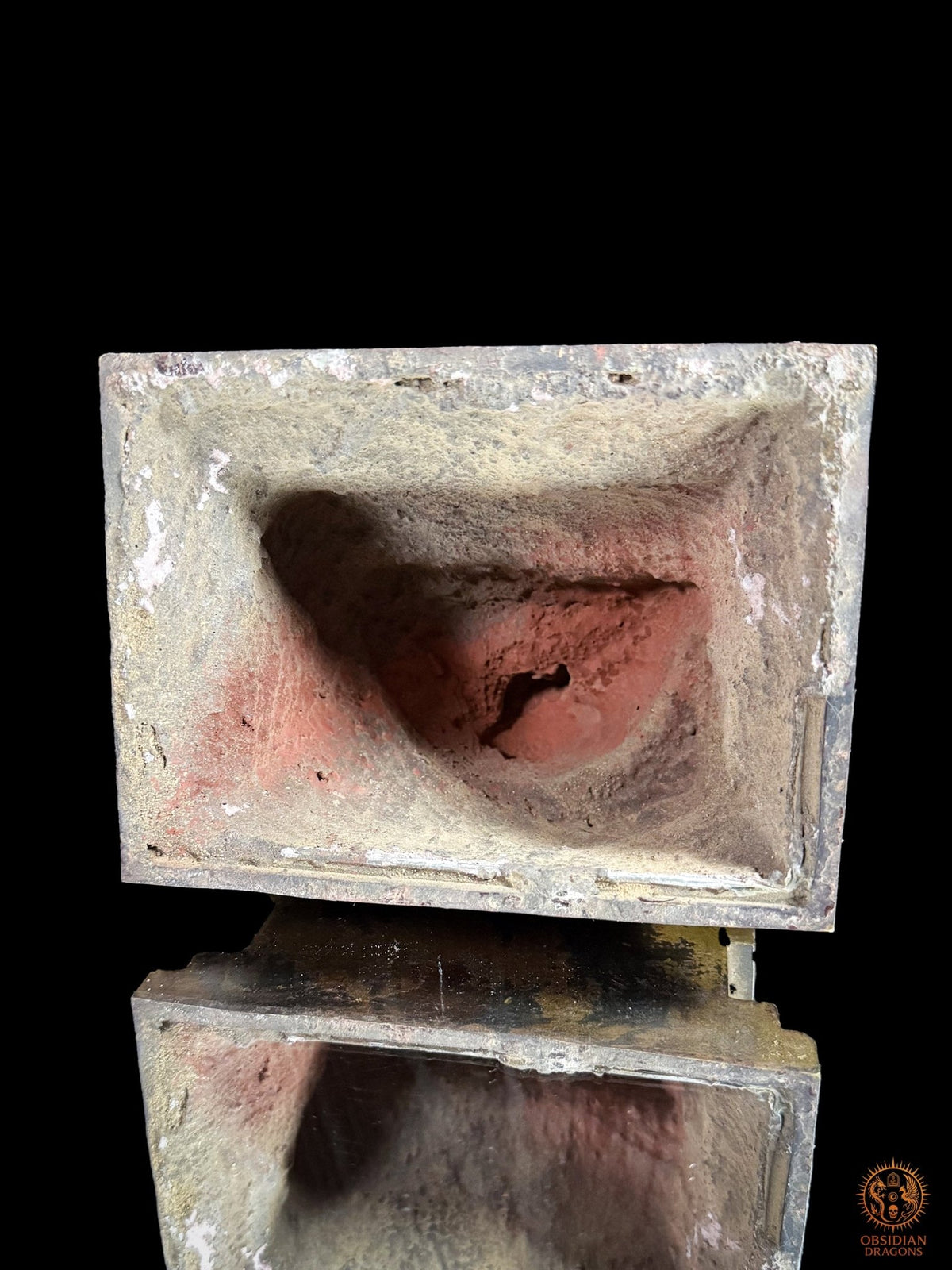
🔴 Internal traces: reddish and earthy residues are visible at the bottom of the cavity. They most likely correspond to fragments of the refractory core composed of clay, earth, or a mineral mixture used during casting. These traces are consistent with hollow casting.
🎨 Surface appearance : dark patina with brown and almost black nuances, enriched with golden and reddish highlights that emphasize the face, ornaments, folds of the garment, the base, and the movements of the mandorla.
🧘 Posture: Acala is depicted seated in the lotus posture, or padmāsana, expressing meditative stability, grounding, and unwavering inner mastery.
⚔️ Right-hand attribute: sword of wisdom with a handle inspired by the vajra or kongō, symbolizing indestructible truth and the ability to cut through ignorance, illusions, and attachments.
🪢 Left-hand attribute: rope or ritual lasso, called pāśa, symbolically used to capture harmful forces and bring lost beings back to the path of the Dharma.
🔥 Mandorla: large openwork halo composed of stylized flames, evoking the fire of knowledge that consumes passions, purifies obstacles, and transforms destructive energies.
☸️ Base symbol: eight-spoked Dharma wheel, or Dharmachakra, associated with the Buddha's teaching and the Noble Eightfold Path.
🏛️ Base : multi-level architectural base, adorned with geometric and lotus motifs. Its massive construction visually reinforces the stability of the posture and the protective power of the deity.
👁️ Facial iconography: wrathful expression, wide-open eyes, clenched mouth, and the presence of fangs characteristic of traditional Acala iconography. This anger does not express hatred, but the awakened energy mobilized against ignorance and obstacles.
🖐️ Sculptural execution: three-dimensional work allowing the statue to be observed from several angles, with attention paid to the face, ritual attributes, the back of the mandorla, and the construction of the base.
🧽 Care instructions: gently dust with a soft brush or dry cloth. Avoid water, chemicals, abrasives, and products designed to polish metals, which could alter the patina and surface highlights. The internal residues related to the casting must be preserved and should not be subject to aggressive cleaning.
🔥 Bronze statue of Acala: the unwavering strength at the heart of the flames
This bronze statue of Acala represents neither rest nor the contemplative gentleness of a peaceful Buddha. It gives visible form to a more demanding power: that which remains upright when everything wavers, which cuts through illusion when it obscures the mind, and which opposes fear with a determination that has become unwavering.
Seated in the lotus posture, Acala holds his sword of wisdom in his right hand and the rope intended to seize what is lost in his left hand. Behind his massive body rises an imposing openwork flaming mandorla. Beneath him, a tiered architectural base carries an eight-spoked Dharma wheel in its center.
This sculpture has an astonishing density. Its presence is compact, vertical, and immediately perceptible. The dark nuances of the bronze, the golden highlights, and the red traces running across its surface bring to life a figure in which immobility and fire no longer oppose each other: they become two expressions of the same mastery.
Acala does not represent the absence of a storm, but the strength that remains motionless in the midst of the flames.
🜃 A true bronze Buddhist statuette
Traditional bronzes generally combine copper with tin, sometimes with other elements in varying proportions. Determining the exact elemental composition and the percentages of the alloy would require instrumental analysis, such as X-ray fluorescence. It would therefore be contrary to all scientific rigor to invent a precise composition that has not been measured.
The surface of this bronze statue of Acala features a dark patina deliberately contrasted with golden and red highlights. These variations emphasize the face, clothing, jewelry, flames, and different levels of the base. They give depth to the sculpture.
Its interest does not lie in an imaginary dating, but in the power of its composition, the quality of its patinated bronze, and the coherence of its iconographic language.
Hollow casting and the red traces of the casting core
The visible opening beneath the sculpture reveals hollow casting. This process is perfectly consistent with a bronze sculpture of this size. It allows for the control of the amount of metal, weight, cooling, and stresses likely to appear during solidification.
The fact that this hollow bronze nevertheless weighs 2.263 kg testifies to the actual mass of the whole, the importance of the base, and the material presence of the piece.
The red deposits observable at the bottom of the cavity are very likely remains of the casting core or traces of refractory material used during manufacturing. Depending on the workshops and processes, this core may consist of mixtures based on clay, earth, silica, or other materials capable of withstanding the temperature of the molten metal.
These traces are compatible with a hollow molding method and the lost-wax casting technique.
It is preferable not to try to aggressively remove these red residues. They belong to the material history of the casting, and mechanical cleaning could damage the interior or weaken certain areas.
🔥 Who is Acala, the Immovable One?
The Sanskrit name Acala means "immobile," "unchanging," or "unwavering." The deity is also known in the forms of Acala, Achala, and Acalanātha, the latter name being able to be translated as "Unchanging Lord."
In China, Acala bears the name Bùdòng Míngwáng, or Budong Mingwang, written 不动明王 in simplified characters and 不動明王 in traditional characters. In Japan, the same deity is called Fudō Myōō, a transcription also found in the forms Fudo Myoo or Fudo Myo-o.
These different names refer to the cultural expressions of the same figure that has crossed India, China, Tibet, and Japan over the course of the development of Vajrayāna Buddhism and East Asian esoteric Buddhism.
The expression "Acala Buddha" is sometimes encountered. It facilitates the identification of the figure, but remains doctrinally imprecise. Acala is not a historical Buddha comparable to Śākyamuni. He belongs to the category of the Vidyārāja, the Kings of Wisdom or Kings of Science, called Myōō in Japan. He is also considered a dharmapāla, a protector of the Dharma tasked with defending the teachings and fighting the forces that hinder awakening.
Acala is understood as a wrathful manifestation of the Vairocana Buddha, or Mahāvairocana, the cosmic Buddha whose light symbolizes universal reality. His anger is therefore not ordinary anger. It does not arise from the ego, frustration, or the desire for dominance. It represents a wisdom that has become powerful enough to no longer negotiate with ignorance.
Acala is a wrathful Buddhist deity, but his wrath is a form of active compassion. When gentleness is no longer enough to awaken the mind, compassion takes the form of fire.
A major figure in esoteric Buddhism
The earliest forms of Acala appear in Indian tantric traditions before developing considerably in China, and then in Japan. In Chinese esoteric Buddhism, particularly in the historical Tangmi tradition, Acala becomes Bùdòng Míngwáng, the Immovable King of Wisdom.
In Japan, he occupies an essential place in Mikkyō, a term designating esoteric teaching, particularly within the Shingon school and certain branches of the Tendai school. Under the name Fudō Myōō, he becomes one of the most recognizable protective deities in Japanese Buddhist art. He is also venerated in certain practices of Shugendō, an ascetic tradition closely linked to mountains, ritual fire, and inner transformation.
To delve deeper into this history and discover the different traditions associated with Acala
I invite you to consult my article dedicated to Acala, Chief of the Vidyārāja and the Five Kings of Knowledge.
Acala at the center of the five great Kings of Wisdom
In Japanese esoteric Buddhism, Fudō Myōō is considered the principal and most powerful of the Godai Myōō, the five great Kings of Wisdom, also called the five Kings of Science or the five guardian deities.
These five figures are placed according to the four cardinal directions, to which the center is added. This organization transforms the ritual space into a mandala: each direction has a function, while Acala constitutes its immovable axis.
In the center remains Fudō, the Immovable One. To the east stands Gōzanze, or Trailokyavijaya, the conqueror of the three worlds. To the south appears Gundari, or Kundali, associated with amrita and the elixir of immortality. To the west is Daiitoku, the Japanese form of Yamāntaka, the conqueror of death. To the north watches Kongōyasha, or Vajrayaksa, the King of Wisdom linked to purification and protection.
Acala occupies the center because he represents that which does not move when all forces unfold around him. He is the fixed point of the mandala, the axis around which the directions can exist without falling into disorder.
This notion is essential to understanding the symbolism of Acala: immobility is the inner stability that allows one to act without being carried away by what one faces.
🪷 A lotus posture from ancient iconography
A text translated into Chinese at the beginning of the 8th century, around 707-709, already described Acala holding a rope in his left hand, a sword in his right hand, and seated in half-lotus. Japanese sculptures from the beginning of the 13th century, notably during the Kamakura period, also show Fudō Myōō seated in a meditative posture related to the lotus.
The statue of Acala seated in the lotus posture therefore belongs to an ancient and perfectly legitimate tradition. The posture of the legs must also be distinguished from the nature of the support. Some representations place Acala on a rock, a symbol of his firmness, while others show him on a lotus-shaped or architectural base.
In this sculpture, Acala sits in the lotus posture on an imposing tiered architectural base. Lotus motifs, geometric friezes, and the Dharma wheel structure his base. The base gives the deity the verticality of an altar and the stability of a monument.
This posture profoundly transforms the reading of the whole. The face is wrathful, the sword is raised, the rope is ready to close, and the flames seem to stir. Yet, the body remains perfectly centered. The crossed legs close the composition and prevent visual violence from becoming chaos.
True strength does not agitate.
The wrathful face: looking at illusion without turning away
Traditional iconography emphasizes Acala's wrathful face. His deeply contracted eyebrows, bulging eyes, and clenched mouth give the impression of concentration pushed to its extreme point.
Classic representations of Fudō Myōō show two protruding fangs, one pointing up and the other down. They symbolically establish a link between heaven and earth, mind and matter, elevation and incarnation. The bitten or compressed lip reinforces the idea of contained rather than dispersed energy.
On this statue, the gaze faces forward. This expression may seem threatening when separated from its context, but Acala does not direct his anger at beings: he directs it against ignorance, destructive passions, illusions, and the forces that keep the mind in bondage.
His face expresses a resolution that no longer retreats.
⚔️ The sword of wisdom: cutting through ignorance
In his right hand, Acala brandishes a sword of wisdom whose handle evokes the vajra. The Sanskrit term vajra, called kongō in Japan, symbolically combines two realities: the diamond, indestructible, and the lightning, irresistible.
The function of the sword with the vajra handle is to cut what obscures perception. It cuts through ignorance, illusions, attachments, and deceptive reasoning to which human beings sometimes end up identifying.
The sword reminds us that some confusions do not simply disappear with time. They must be recognized, confronted, and then precisely separated from consciousness.
In a philosophical reading, it is the faculty of discernment. In a spiritual reading, it is the indestructible truth. In a more intimate reading, it is the decision one makes when one finally stops lying to oneself.
Acala's rope: seizing what is lost
In his left hand, Acala holds a rope, described as a ritual lasso or pāśa. Its role complements that of the sword.
The sword cuts through illusion; the rope gathers what has been scattered. It seizes harmful forces, masters what escapes control, and brings beings back to the path from which they have strayed.
Acala's rope represents the unbreakable bond of compassion. Acala does not destroy the one who is lost: he captures what enslaves them in order to restore their ability to find their way.
This complementarity between the sword and the rope is one of the deepest dimensions of Fudō Myōō. Wisdom cuts, but compassion restrains. One frees from error; the other prevents immediately falling back into confusion.
The flame mandorla: purify rather than destroy
Acala's body is surrounded by a vast flame mandorla whose points seem to emerge from his back. This openwork mandorla gives the sculpture an unusual depth and allows it to retain a spectacular presence, even when viewed from the side.
In Buddhist art, this halo of fire represents a fire of knowledge capable of consuming passions, mental defilements, and obstacles to awakening. These are flames of purification and transformation.
Acala's fire burns what prevents him from becoming free.
This distinction allows us to understand the transformation of anger at the heart of this iconography. Ordinary anger destroys indiscriminately. Acala's fire, on the contrary, concentrates all its power on ignorance, greed, fear, and attachment. It transforms a potentially chaotic energy into a clear-sighted will.
The mandorla thus combines movement and stillness. The flames rise, divide, and seem agitated by an invisible wind, while Acala remains seated in the center. This opposition probably constitutes the most beautiful reading of the statue: the world can burn around the mind without the mind being forced to burn with it.
☸️ The eight-spoked Dharma wheel
At the center of the base appears an eight-spoked Dharma wheel, or dharmachakra. Its position, exactly on the axis of the statue, indicates that all of Acala's power rests on the Dharma.
The eight spokes are traditionally associated with the Noble Eightfold Path: right understanding, right intention, right speech, right action, right livelihood, right effort, right mindfulness, and right concentration.
The Dharma wheel therefore gives meaning to everything happening above it. The sword serves right understanding. The rope brings back to the path. The flames purify obstacles. The wrathful face manifests a resolution placed at the service of awakening.
The wheel reminds us that Acala's strength is never separated from Buddhist teaching. Without it, his appearance could be interpreted as that of a warrior deity. With it, the reading becomes clear: this anger is wisdom in action.
The entire base participates in this meaning. Its successive levels, its geometric friezes, and its lotus motifs build a visual progression from earth to fire. The base anchors, the wheel guides, the lotus stabilizes, the sword cuts, and the flames transform.
🛡️ Energies of this bronze Acala statue: anchoring, spiritual protection, and inner strength
Acala's symbolic energy is above all an energy of anchoring. The weight of the bronze, the width of the base, and the closed lotus posture give the feeling of a force that descends, settles, and can no longer be moved.
To this anchoring are added determination, courage, discipline, and firmness of mind. Acala invites us to look at it with enough clarity to understand what must be cut, mastered, or transformed.
This statue also evokes spiritual protection, the purification of passions, and the transformation of anger. It can symbolically accompany periods during which one must set a limit, break free from control, abandon a destructive habit, or remain faithful to a decision despite fear.
Its energy is that of a meditative stability under tension, a concentration at its peak. It reminds us that we can remain standing internally, even when nothing is yet resolved.
This Buddhist spiritual sculpture thus carries a simple and demanding idea: fear can be present without becoming the master, anger can be felt without becoming blind, and the movement of the world does not force the mind to lose its center.
Acala, protection against black magic and occult influences
Acala is also considered a protective Buddhist deity capable of warding off hostile influences, malevolent forces, curses, and what is commonly referred to as black magic.
Acala's reputation as protection against black magic stems from his function as a dharmapāla, a destroyer of obstacles, and a tamer of demonic forces.
Fudō Myōō is associated with spiritual protection, protection against sorcery, protection against occult influences, and, in more contemporary vocabulary, protection against negative energies. He can be considered a guardian against invisible obstacles and a symbolic figure for warding off malevolent forces.
It also has a deep psychological dimension. "Black magic" can also refer to fear, suggestion, manipulation, control, obsessive thoughts, or the feeling of being overwhelmed by an external influence.
In this second reading, Acala reminds us that the first protection consists in finding one's axis, clarity, and capacity for discernment. He who no longer allows himself to be governed by fear becomes less accessible to that which seeks to disorient him.
Why place a bronze Acala statue in your space?
This Buddhist protection statue can find its place on an altar, in a meditation space, a study, a workshop, or a place where important decisions are made.
As a statue for a Buddhist altar, it can become the central point of contemplation dedicated to determination, overcoming obstacles, and mastery of the mind. Used as a meditation aid, it invites us to observe inner movements without abandoning control to them.
The lotus posture allows us to return to the center. The sword asks what must be cut. The rope questions what must be gathered or mastered. The Dharma wheel reminds us of the direction. The flames teach that transformation sometimes requires crossing a zone of discomfort.
This sculpture can also be installed as a guardian of the meditation space. Its face turned forward and its flame mandorla create a particularly strong symbolic boundary. It does not close the space: it affirms its intention.
For a collector, it constitutes a true Buddhist collectible and a remarkable Asian collectible. It combines a bronze sculpture, complete iconography, a trans-Asian history, and an aesthetic presence strong enough to exist even outside of a religious context.
It can also constitute a Buddhist gift intended for a person going through a period of transformation, developing a meditative practice, or needing a symbol of inner strength. It is not about promising them that the statue will do the work for them. It is about offering them an image capable of reminding them that this work can be accomplished.
This Buddhist meditation sculpture therefore appeals as much to the practitioner as to the sacred art collector, the lover of symbolism, the Asian culture enthusiast, or the person who feels a deep affinity with the meaning of Fudō Myōō.
☸️ Bronze Acala statue: Fudō Myōō iconography, Dharma wheel, flame mandorla, and patina with golden highlights
Its iconography is particularly complete, each element dialogues with the others and participates in the overall meaning.
The presence of the dharmachakra at the center of the base is essential. It prevents reducing the figure to a simple warrior deity and reminds us that all its power remains founded on the Dharma.
The patina also constitutes one of the piece's charms. The bronze alternates brown-black areas, metallic reflections, golden highlights, and red traces. This irregular surface catches the light differently depending on the viewing angle and accentuates the tension between Acala's dark flesh and the fire that envelops him.
Finally, this statue combines two apparently irreconcilable movements. The mandorla rises, dances, and divides. The body, on the contrary, descends into the lotus and anchors in the base. The entire sculpture rests on this opposition: the fire is in motion, but its center does not move.
That is perhaps where its true uniqueness lies.
Bronze conservation
To preserve the patina, it is recommended to dust this sculpture with a soft brush or a dry, non-abrasive cloth. or a feather duster. Acidic products, metal cleaners, and polishing pastes should be avoided, as they could erase the dark nuances, the colored highlights, and the superficial traces that give the piece its character.
The red residues visible in the lower cavity should not be scraped. They likely belong to the casting process and harm neither the stability nor the reading of the sculpture.
Discover also our collection of bronze Buddhist statuettes, spiritual sculptures, and sacred art objects.
❓ Frequently asked questions about this bronze Acala statue
Who is Acala in Buddhism?
Acala is a wrathful deity of esoteric Buddhism belonging to the category of the Vidyārāja, the Kings of Wisdom or Kings of Science. His Sanskrit name means "the Immobile", "the Immutable", or "the Unwavering".
Protector of the Dharma, he embodies a wisdom powerful enough to cut through ignorance, master destructive passions, and defend Buddhist teachings. Acala is therefore not a historical Buddha, but a protective figure sometimes understood as a wrathful manifestation of Vairocana.
What difference is there between Acala, Bùdòng Míngwáng, and Fudō Myōō?
These three names refer to the same deity in different cultural contexts. Acala is his Sanskrit name, Bùdòng Míngwáng or Budong Mingwang is his Chinese name, written 不动明王, while Fudō Myōō is his Japanese name.
This bronze Acala statue is primarily based on a Chinese interpretation, while also adopting iconography that has also become emblematic of Japanese Buddhist art.
Is this bronze Acala statue ancient?
It is a sculpture whose exact date of manufacture is not documented, selected in Nanyang, in the Henan province, China. No archaeological or historical antiquity is attributed to it.
Its manufacture does not, however, mean that its iconography is recent. Representations of Acala seated in a meditative or lotus posture have been attested in texts and Buddhist art for several centuries. This contemporary sculpture therefore reinterprets an ancient iconographic model.
Is this representation of Acala seated in lotus traditional?
Yes. Acala is not exclusively represented standing or seated on a rock. Ancient sources already describe him sitting in half-lotus, with a sword in his right hand and a rope in his left hand. Japanese works dating notably from the Kamakura period also show Fudō Myōō in a meditative posture related to the lotus.
The posture adopted by this statue expresses inner stability: the flames rise and seem to dance around him, but the body remains perfectly centered.
Why is this bronze statue hollow?
Hollow casting is a technique commonly used to make bronze sculptures. It allows for better control of the quantity of metal, the cooling of the alloy, and the tensions likely to appear during its solidification.
This statue nevertheless has a significant weight. This density is explained by the thickness of the bronze, the mass of the architectural base, and the overall complexity of the composition.
What do the red traces visible inside the statue mean?
The reddish and earthy deposits observable in the lower cavity very probably correspond to residues of the refractory core used during casting. This core can be composed of clay, earth, silica, or a mineral mixture capable of resisting the temperature of liquid bronze.
These traces are compatible with hollow casting and a process related to lost wax. However, they do not constitute, on their own, either proof of antiquity or certain evidence of ritual consecration. It is preferable not to try to scrape them.
Where to place a Fudō Myōō statue?
A Fudō Myōō statue can be placed on a Buddhist altar, in a meditation space, a study, a library, a workshop, or a place dedicated to reflection and important decisions.
It must rest on a stable, dry, and sufficiently solid surface to support its weight. It is also advisable to maintain space around its mandorla so that the movement of the flames and the overall silhouette can be fully appreciated.
Should this statue be consecrated before being used?
No ritual consecration is claimed for this statue. Consecration is not necessary to appreciate it as a work of Buddhist art, a philosophical symbol, or a personal meditation aid.
A practitioner wishing to integrate it into a formal religious practice can, if they wish, consult a teacher or a qualified representative of their tradition to determine the appropriate ritual.
Do you have to be Buddhist to own an Acala statue?
It is not necessary to be Buddhist to feel an affinity with Acala. This sculpture can interest a practitioner, an Asian art collector, a lover of symbolism, or a person seeking a representation of inner strength and determination.
However, it should be considered with respect and understood that it belongs to a specific religious, philosophical, and artistic tradition.
Will the statue received be exactly the one presented in the photographs?
Yes. The photographs and video are contractual: you will receive precisely the bronze Acala statue presented on this page, with its patina, its colored highlights, and its surface particularities.
Partager



Return conditions for a Zen purchase
We offer you a money back guarantee within 14 days after delivery of your order.
If you are not completely satisfied with your purchase, please contact us to arrange a return of the product and a refund.
Except for returns, shipping is free on all orders.
-

100% secure payment
3 times interest-free option with Scalapay
-

Free delivery in France and internationally
14 days money back guarantee after delivery (see our conditions of sale)
-

Excellent customer service
Live chat
Whatsapp +33674049312


Let customers speak for us
from 956 reviewsMagnifique! Absolument ravie il est trés beau! Et en plus ma divinité favorite! Et ce parfum est un vrai bonheur envoûtant ! MERCI infiniment particulièrement à Zhou-li (j'espère bien l'orthographier), merci beaucoup

Tout est parfait, merci de votre envoi rapide et du règlement des frais de douane de votre côté.
Bonne continuation !

Quel bonheur de recevoir ce mala ! J'ai adoré découvrir une pièce à l'énergie totalement neutre, qui s'est animée et a pris toute sa force dès le premier tour. On ressent tout le soin et l'art de la création. Merci Jérémy.
Marie

Envoie rapide, le bracelet est incroyable et plus beau qu’en photo. Les réponses aux questions via whatsapp sont quasi instantanées. Je recommande vivement!!!

Je suis très satisfait de mon achat.
Je recommande fortement.

Crâne en Malachite Naturelle 3kg - Rare et exceptionnel

Merci pour tout, la communication, les facilités et la qualité des produits.

Comme a son habitude, Jeremy a des pièces exceptionnelles. Ce collier est une merveille absolue. Encore MERCI pour toutes ces merveilles.

Merci pour cet objet de magnifique qualité
Chaque détail, la qualité de sa réalisation
Les explications qui l'accompagnent..
En font un objet superbe comme support de méditation
En font un très bel objet de collection...
Merci

Magnifique grande sphere . Superbes couleurs et tres haute qualité. Promesses largement tenues. Envoie rapide. Confiance totale pour un prochain achat.

Le Mala a été livré très rapidement et je vous en remercie.
C’est notre fille qui l’a réceptionné, elle m’a confirmé que c’était une très belle pièce. Elle nous rejoint dans deux semaines, mon époux le découvrira alors et en fera le meilleur usage…
Merci pour le partage de votre passion ! 🙏🏽

bracelet puissant, je suis content de mon achat

Très beaux bracelet et très puissants

Magnifique crâne givré de l'Himalaya.

cette chevalière est tres bien réalisé, avec beaucoup de détails, je suis heureux de l'avoir
